
#12: Casanova (You’re Playing Days Are Over) by Ruby Andrews
City: Pointe Claire, PQ
Radio Station: CFOX
Peak Month: October 1967
Peak Position in Pointe Claire ~ #4
Peak position in Vancouver ~ did not chart
Peak Position on Billboard Hot 100 ~ #51
YouTube: “Casanova (Your Playing Days Are Over)”
Lyrics: “Casanova (Your Playing Days Are Over)”
Ruby Stackhouse was born in 1947 in rural western Mississippi. She moved with her family to Chicago in 1953. Near the end of high school, Ruby started singing with a vocal group called the Vondells. She made her debut on the Kelmac label, recording with the Vondells although the record was released as by Ruby Stackhouse. She was signed to the Zodiac label and released “Let’s Get A Groove Going On”, credited to Ruby Andrews. This was followed by “I Just Can’t Get Enough”. Her third release for the Zodiac label was her biggest seller, “Casonova [sic] (Your Playing Days Are Over)”.

The Canadian label, Trans World Record Co. Inc., had the song title simply as “Casanova”. On the Canadian label’s disc the songwriter and the recording artist are both listed as “Ruby Anderson.” This is likely a reflection of a hurried arrangement to get Ruby Andrews recording into the Canadian record market. Her actual name, and the name of the person who wrote the song – who was neither Ruby Andrews or Ruby Anderson – likely mattered little. However, the name of the songwriter of “Casanova” is actually “Joshie” Jo Armstead. She was born Josephine Armstead in 1944, in Yazoo City, Mississippi.
Armstead started singing in the church in which her mother was a minister. After her grandfather introduced her to blues music, she also began singing in juke joints and at dances, and first sang in a club as part of Bobby “Blue” Bland’s band. She joined a local band, Little Melvin & The Downbeats, as a teenager.
In 1960, Armstead along with Eloise Hester and Delores Johnson became The Ikettes as part of the Ike & Tina Turner Revue. She had been recommended to Ike Turner by her sister Velma Dishman who was his ex-wife. As an Ikette, Armstead recorded the single “”I’m Blue (The Gong-Gong Song)” which peaked at #19 on the Billboard Hot 100 and #3 on the Hot R&B Singles chart. As well, Armstead in her capacity as an Ikette backed Ike & Tina Turner on “I Idolize You”, “It’s Gonna Work Out Fine” and “Poor Fool”. The former and latter made the Top 5 on the R&B charts. However, “It’s Gonna Work Out Fine” not only reached #2 on the Hot R&B Singles chart, but also #14 on the Billboard Hot 100.
In 1962, Jo Armstead settled in New York City and recorded under the name Deena Johnson, by her own account a pseudonym to avoid being tracked down by Turner. However, she recalled her time as an Ikette fondly: “It was the greatest but you had to be young to travel the Chitlin’ Circuit as they called it. We weren’t flying and we didn’t stay in 5-star hotels. It was really rough. You really had to be young but it was fun and we joked and laughed a lot.” She added, “I have the utmost respect for Ike Turner as an artist and what he created.”
After her tenure as an Ikette, Jo Armstead recorded advertising jingles, and sang back-up for such musicians as James Brown, Walter Jackson and B.B. King. Than she had a chance meeting with Nick Ashford and Valerie Simpson. They began writing songs together, one of the first results being “Let’s Go Get Stoned”, which became a number-one hit on the R&B charts for Ray Charles in 1966. Its follow-up “I Don’t Need No Doctor” was also a hit for Ray Charles and later Humble Pie. The trio of writers also had success with songs for Chuck Jackson, Maxine Brown, The Shirelles, The Nashville Teens, and the Guess Who? hit “Hey Ho, What You Do to Me” (1965). Armstead separately wrote songs for Aretha Franklin, Garland Green, Syl Johnson. Gladys Knight & the Pips, Dorothy Moore, and Carl Carleton.
In 1968, Jo “Joshie” Armstead had a Top 30 R&B hit with “A Stone Good Lover”. This was followed by a minor hit with “I’ve Been Turned On”. In 1972, Jo Armstead was in the Broadway musical Don’t Play Us Cheap. In 1973 the musical earned two Tony Award nominations. And in 1973, Seesaw generated seven Tony Award nominations and won two. Armstead was also part of this Broadway production. As well, Armstead has been a backing vocalist for Esther Phillips, Quincy Jones, Roberta Flack (including on “Feel Like Makin’ Love”), The Kiki Dee Band on “I’ve Got The Music In Me”, Frankie Valli on “My Eyes Adored You” and “Swearin’ to God”, B.B. King, Burt Bacharach, Taj Mahal, Nina Simone, Luther Vandross and others. Between 1962 and 1989, Jo Armstead released ten of her own singles. In the 1980s, after returning to Chicago, Armstead had a stint managing boxer, Alfonso Ratliff (who won the World Boxing Council title in 1985). She recorded for her own Prairie Rose Records in the 1990s.
“Casanova (Your Playing Days Are Over)” is a song concerning a “boy” (young man) who needs someone to clip his wings. Andrews sings “Hey boy, they say you’re contrary ’cause you think your love is extraordinary. But I’m gonna show you what I’m worth. I’m bringing good to earth.” She tells him his ‘playing days are over.’ The season of playing the field and romancing as many women as possible is done. At least, if he’s serious about this woman. She makes a demand: “yes or no boy?” He has to decide if she’s the woman for him, he needs to change his ways. She’s going to pop his balloon, “shoot him down” off his pedestal. In other words, “it’s all over casanova.”
In the song the guy who is playing around is called a ‘Casanova.’ Giacomo Girolamo Casanova was born in Venice, Republic of Venice, in 1775. He studied law at the University of Padua (established in 1222). However, he abandoned law and became an itinerant gambler, violinist, confidence trickster, and man of letters. Throughout his life, Casanova obtained money and other advantages from various aristocratic patrons by pretending to possess alchemical, cabbalistic, and magical secret knowledge. Among other exploits, Casanova escaped from the Piombi prison (in the Doge’s Palace in Venice), to which he had been confined by order of the Venetian Council of Ten for offenses against religion and morals. Casanova later helped convince the authorities of the Kingdom of France to establish a state lottery as a source of revenue.
Casanova, who often misrepresented himself as an aristocrat, used a variety of pseudonyms, including Baron or Count of Farussi (his mother’s maiden name) and the invented title Chevalier de Seingalt (French pronunciation: [sɛ̃ɡɑl]).[7] After he began writing in French, following his second exile from Venice, he often signed his works as “Jacques Casanova de Seingalt”.[a] In his autobiography, Casanova reports encounters with popes, cardinals, and monarchs, as well as with major intellectual and artistic figures such as Voltaire, Goethe, and Mozart.
The most notorious aspect of Casanova’s career are his many complicated sexual affairs with women, stretching from his early adolescence to his old age, which he described in detail in his autobiography: Histoire de ma vie (“The Story of My Life”). As a consequence of this, Casanova’s name has become a byword for a male seducer, a libertine and a “Lothario” (the latter based on the 1703 Nicholas Rowe’s tragedy The Fair Penitent – an adaptation of the 1632 stage play The Fatal Dowry by Philip Massinger and Nathan Field. In the play the character Lothario was a rake (a womanizer). As a result of the play “a Lothario” became synonymous with being known among society as a libertine, a rake. With the publication of Casanova’s autobiography, a male seducer also was given the term ‘Casanova.’ And so, in the song by Ruby Andrews, her romantic boyfriend has to give up the thrill of seducing women for something more permanent.
“Casanova (Your Playing Days Are Over)” climbed to #1 in Atlanta, #4 in Pointe Claire (PQ), Harrisburg (PA), and Vineland (NJ), #8 in Birmingham (AL), and Weirton (WV), and #12 in Wilmington (DL).
Some later reissues of the track used the (historically correct) spelling “Casanova”. Follow-up was “Hey Boy Take A Chance On Love” which stalled at #92 on the Hot 100. Next up, “The Love I Need” failed to crack the pop charts, but was a minor hit on the Hot Rhythm & Blues Singles chart, peaking at #48. While “You Can Run (But You Can’t Hide)”, “You Made a Believer (Out of Me)” (#18 on the Billboard Hot Rhythm & Blues Singles chart, and #96 on the Billboard Hot 100 in 1969), “Everybody Saw You” (#34 Hot Rhythm & Blues in 1970) and “You Ole Boo You”. In 1970, she released her debut studio album titled Everybody Saw You. which featured a track titled “Casanova ’70’.” These were followed by Black Ruby (1972) and Genuine Ruby (1977). In the 1990s she released her fourth, fifth and sixth studio albums: Kiss This (1991), Ruby (1993), and Hip Shakin Mama (1998).
In 2007, Andrews cut ten tracks for a record titled Swamp Dogg Presents: The Boss Ladies of Soul. Ruby Andrews is the CEO of Genuine Ruby Records LLC.
December 12, 2025
Ray McGinnis
References:
Michael Limnios, “Ruby Andrews: The Gemstone of Soul,” Blues.gr, February 4, 2015.
“Jo Armstead: From The Cotton Fields of Mississippi, To The Cotton Club in New York City,” Sound Motion, May 13, 2008.
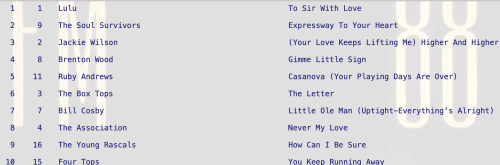
CFOX 1470-AM Pointe Claire (PQ) Top Ten | October 13, 1967
Leave a Reply