
#6: If You Don’t Want My Love by Jack London & The Sparrows
City: Saint John, NB
Radio Station: CHSJ
Peak Month: January 1965
Peak Position in Saint John ~ #2
Peak Position in Vancouver ~ did not chart
Peak Position on Billboard Hot 100 ~ did not chart
YouTube: “If You Don’t Want My Love”
Lyrics: N/A
The original Jack London and the Sparrows line-up was formed in Oshawa, Ontario, in early 1964. It was founded by British émigré Dave Marden, who took the stage name Jack London. He was born in 1944, in London, England. Another bandmate was guitarist Dennis Edmonton, who was born Dennis McCrohan, in 1943, in Oshawa. A third original member was keyboard player Dave Hare, who later played with Everyday People. Jack London and the Sparrows began as a beat group and played heavily on Dave Marden’s English background. Their early repertoire reflected the influence of the “British invasion” and London even went as far as coaxing the others to “fake” English accents, in order to convince the audience that they had just arrived from England. Early on, Dennis’ brother Jerry Edmonton, born Jerry McCrohan, in 1946, in Oshawa, joined the band on drums. The group began to build up a local following, playing at various venues, such as the local Jubilee Auditorium (which was owned by the Edmonton brothers’ father).
After moving to Toronto later that year, C.J. Feeny (born in 1943) joined on organ. Conrad Feeny had been the frontman for his band C.J. Feeny and the Spellbinders. They had a minor hit in Hamilton (ON) and a few other radio markets in southern Ontario in 1963 titled “Candy Apple Black”.
A short while later, Bruce Palmer was added on bass guitar. Palmer had been with Robbie Lane and the Disciples. There were a few additional changes in the membership along the way. This line-up: Jack London, Dennis and Jerry Edmonton, C.J. Feeney and Bruce Palmer, signed to Capitol Records. They released their debut single “If You Don’t Want My Love”.
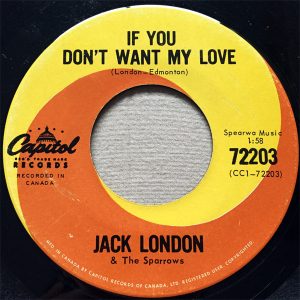
“If You Don’t Want My Love” peaked at #2 in Saint John (NB), #7 in Hamilton (ON), #13 in Toronto, and into the Top 40 in Halifax (NS) and Montreal. The B-side, “It’s Been One Of Those Days” peaked at #15 in Oshawa. (Due to limited Top 4o chart archives from Oshawa, it is likely that “If You Don’t Want My Love” also charted into the Top Ten in Oshawa.
However, soon tired of affecting an English accent, Bruce Palmer (born 1946) was traded for the Mynah Byrds’ member Nick St. Nicholas in January 1965. Around the same time, Toronto-born (1942) local jazz keyboardist Art Ayre replaced C.J. Feeney.
While in the Mynah Byrds, Bruce Palmer got to know fellow bandmate Neil Young. The pair headed to Los Angeles and ended up forming a band called the Buffalo Springfield (along with Stephen Stills, Ritchie Furey, and Dewey Martin). The band enjoyed “For What It’s Worth” and other influential hits in the late 60s.
The new line-up was responsible for the band’s lone album and the subsequent singles. The single “I’ll Be The Boy” reached #29 on the Canadian RPM Top 100 Singles chart in March 1965. Next, “Our Love Has Passed” climbed to #7 on the RPM chart in May 1965.
By mid-1965, the group was beginning to progress beyond its early British influences and was starting to incorporate more of a North American blues-rock sound. At the same time, resentment was growing over London’s role in the band; he had signed the recording deal so that he would collect most of the group’s royalties. As a result, the band separated from London (who went solo) and recorded a final single as the Sparrows, “Hard Times With The Law”, which hit #13 on the RPM chart in August, ’65.
After his solo career dried up, London moved into production and then became president of the Canadian Association of Real Estate Investors.
Guitar and harmonica player John Kay joined the band. Art Ayre left The Sparrows to pursue a career in jazz with the Art Ayre Trio (and later Moe Koffman). He was replaced by Goldy McJohn, formerly keyboard player for the Diplomats and for the Mynah Birds. The Sparrows opened for Garry Lewis & The Playboys at a concert in October 1965 at Massey Hall in Toronto.
Sparrow (as they were now called) moved to Los Angeles, and into 1967 played as an opener for The Doors, and the Steve Miller Band among others. During June 1967, Dennis Edmonton announced his decision to go solo and the band recruited American guitarist Michael Monarch in early July. Edmonton subsequently changed his name to Mars Bonfire. In the late 60s, Bonfire released two solo albums.
In late 1967, Sparrow changed their name again, this time to Steppenwolf. The band’s name was inspired by the tenth novel by Hermann Hesse. The novel, Steppenwolf, is a discourse on a man, Harry Haller, who believes himself to be of two natures: one high, the spiritual nature of a human “man”; The other is low and animalistic, a “wolf of the steppes.” Harry Haller is entangled in an irresolvable struggle, never content with either nature because he cannot see beyond this self-made concept. And so Sparrow’s choice to name themselves Steppenwolf appealed to an intellectual element in the youth counter-culture of the late ’60’s.
The members of Steppenwolf were John Kay (guitar), Jerry Edmonton (drums), Goldy McJohn (keyboards), Michael Monarch (guitar) and Rushton Moreve (bass guitar). In the summer of 1968, Steppenwolf had a huge hit titled “Born To Be Wild”, written by Dennis Edmonton. This was followed by another international Top Ten hit “Magic Carpet Ride”.
In 1993, Jerry Edmonton died when his vehicle crashed into a tree near his California home, when he was unable to manoeuvre a turn. He was 47 years of age.
Bruce Palmer died in 2004 of complications related to substance abuse. He was 58 years old.
In 2006, former Sparrows and Steppenwolf bandmate, John Kay, sold his music business assets and devoted his life to saving endangered elephants that were born to be wild.
On 22 June 2015, Mars Bonfire was awarded the Cultural Impact Award by SOCAN at the 2015 SOCAN Awards in Toronto for “Born to be Wild”.
C.J. Feeny died at the age of 72 in Toronto in January 2016.
Whatever happened to Jack London (aka Dave Marden) seems to be lost to time (at least on the Internet).
March 18, 2026
Ray McGinnis
References:
Stan Endersby, Carny Corbett and Nick Warburton, “Jack London and the Sparrows,” Canadian Bands.com, April 11, 2022.
John Kay, “It’s Been A Hell of a Ride,” Steppenwolf.com, October 24, 2018.
Dave Simpson, “How We Made Steppenwolf’s ‘Born To Be Wild’“, Guardian, July 31, 2018.
“Conrad Feeny Obituary,” Toronto Star, February 13, 2016.
Adam Sweeting, “Bruce Palmer Obituary,” Guardian, October 16, 2004.
Paul Sexton, “Steppenwolf’s Jerry Edmonton: The Man With The ‘Born To Be Wild’ Beat,” UDiscoverMusic.com, October 24, 2025.
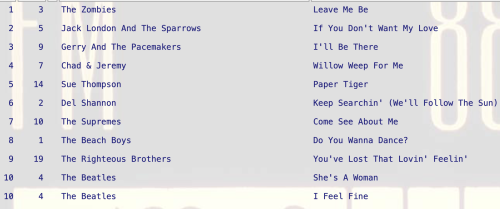
SJ Smart Chart | CKOC 1150-AM Saint John (NB) | January 23, 1965
Leave a Reply