
#55: Everyday I Have To Cry Some by Steve Alaimo
City: Saskatoon, SK
Radio Station: CKOM
Peak Month: March 1963
Peak Position in Saskatoon ~ #8
Peak Position in Vancouver ~ #32
Peak Position on Billboard Hot 100 ~ #46
YouTube: “Everyday I Have To Cry”
Lyrics: “Everyday I Have To Cry”
Stephen “Steve” Alaimo was born in 1939 in Omaha, Nebraska. He entered the music business during his time as a pre-med student at the University of Miami. He joined his cousin’s instrumental rock band the Redcoats. Alaimo became the guitarist, and shortly took the role of lead singer. The Redcoats played at a sock hop held by local disc jockey Bob Green and record label owner Henry Stone. Subsequently, the Redcoats were signed to a record contract with Stone’s Marlin Records. In 1959, “I Want You To Love Me” became a regional hit for the band. That year Dick Clark’s Caravan of Stars came to Miami. They needed a band to back up headliners, so the Redcoats got the nod. As well, Steve Alaimo and the Redcoats climbed to number-one on WINZ in Miami with “She’s My Baby” in August 1959. In the winter of 1959-60, the band released “You Can Fall In Love”, credited to Steve Alaimo and the Redcoats on Dade Records. It charted in Miami. In September 1960, Steve Alaimo and the Redcoats charted the rockabilly tune “Blue Fire” into the Top 20 in Bakersfield (CA), and the Top 30 in Portland (OR).
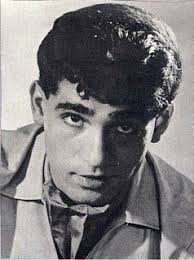
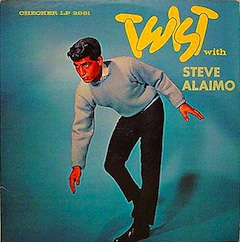
After the band dissolved in 1960, Alaimo became a blue-eyed soul singer. In the winter of 1960-61, Alaimo’s cover of “Unchained Melody” on Imperial Records charted in Orlando, and in Rochester (NY). He got a record deal with Checker Records in 1961. His soulful release of “I’m Thankful” reached #6 in Washington DC in September 1961. That year he released his first studio album, Twist with Steve Alaimo.
In early 1962, Steve Alaimo finally cracked the Billboard Hot 100 with “Mashed Potatoes” (distinct from Dee Dee Sharp’s “Mashed Potato Time”). It stalled at #81 on the national chart. His second studio album, Mashed Potatoes, was released to capitalize on the hoped-for hit single.
Finally, Steve Alaimo had a minor hit on his sixth single release with Checker Records. The single was titled “Every Day I Have To Cry”.
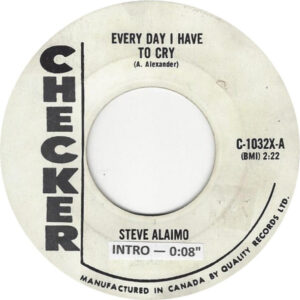
Arthur Alexander wrote “Every Day I Have To Cry”. He was born in Sheffield, Alabama, in 1940.
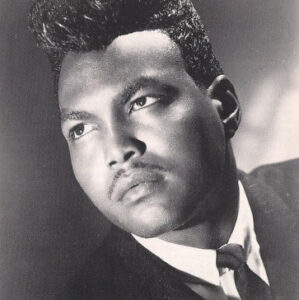
Arthur Alexander (1962)
He released his first single, “Sally Sue Brown” in 1960. The song was later covered by Bob Dylan on his 1988 album Down in the Groove. In early 1962, Alexander’s song “You Better Move On” peaked on the Billboard Hot 100 at #24. The song was covered by the Rolling Stones, Billy “Crash” Craddock, the Hollies, Dean Martin, Tommy Roe, Mink DeVille, Johnny Paycheck and George Jones, and others. In 1962, he recorded a Barry Mann-Cynthia Weil song titled “Where Have You Been (All My Life)”. It reached the Top Ten in Baltimore, Bethesda (MD), Huntsville (AL), and New Orleans. The song was later covered by The Beatles early in their career. Another song the Beatles covered was Arthur Alexander’s “Anna (Go With Him)”. Alexander’s original release reached #2 in Birmingham (AL), and Washington DC. It also reached the Top Five in Little Rock (AR), Baltimore, Wheaton (MD), and Lincoln (NE). The Beatles also recorded a cover of the B-side by Arthur Alexander titled “Soldier Of Love”. A minor hit for Arthur Alexander in the winter of 1962-63 was “Go Home Girl”. It was covered by the Rolling Stones, Gary U.S. Bonds, Ry Cooder and others. Later in 1963, Alexander covered the 1959 Eugene Church hit “Pretty Girls Everywhere”.
In London, England, The Independent wrote an obituary for Arthur Alexander after he died in 1993 at the age of 53. Writer Geoff Brown commented, “in the Sixties he had been beaten by Florida police, thrown in jail and briefly committed to a mental hospital – Arthur Alexander retreated from the music business and moved north to Cleveland, drove a community centre bus, had some ill-health.” At the time of his death, he had concerts booked for the summer, and a new album about to be released. Lonely Just Like Me would be his third and final studio album, and his first in twenty-one years.
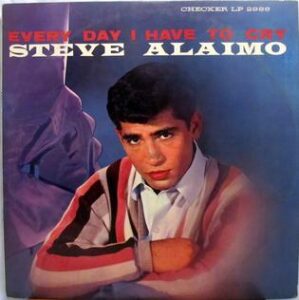
Steve Alaimo’s third studio album was Everyday I Have To Cry
“Everyday I Have To Cry” is a song about love and money. The opening verse describes how a guy planned to marry his sweetheart. However, she turns him down. The singer explains, “She said she couldn’t love me ’cause I didn’t have no money.” He concludes:
Had me a girl, I guess I really loved her,
every night when I was thinking of her.
But you can’t mix love with money.
‘Cause if you do it’s gonna hurt somebody.
In an article titled “Money and Marriage: 7 Tips for a Healthy Relationship,” Rachel Cruze recommends the following:
1) Keep a joint bank account. See your marriage as a partnership. Don’t keep separate accounts. Look at the whole and share what you have.
2) Discuss your lifestyle choices together. Your lifestyle needs to line up with what your actual income, not what you wish it was.
3) Recognize your difference in personality. While personality differences cause some marital problems, it isn’t the real root of your money and marriage issues. The source of the problem is whenever one of you neglects to hear the other’s input, or when one of you bows out from handling the finances altogether.
4) Don’t let salary differences come between you.
5) Keep purchases out in the open. Be open about your savings, but also your debts. It’s crucial to be open and honest about any side checking or savings accounts or secret credit cards you have. It’s time to own up to the truth and clear the air. Then, work toward establishing financial trust again.
6) Set expectations together so you are on the same page regarding your financial goals and dreams.
7) Don’t let the children run the show. Decide together how to budget for the things your children need.
However, during a dating relationship it may become clear, just as it was to the “girl” the guy asked to marry in “Everyday I Have To Cry”, that the financial circumstances just aren’t compatible for building a life together.
“Everyday I Have To Cry” reached #3 in San Bernardino (CA), and Little Rock, #4 in Odessa (TX), and Fresno (CA), #8 in Saskatoon (SK), #9 in El Dorado (AR), San Diego, and Trenton (NJ). It climbed to #18 in Toronto.
Dusty Springfield covered “Everyday I Have To Cry” in 1964 on her EP I Only Want To Be With You. Songwriter Arthur Alexander had a chart run with “Everyday I Have To Cry” in 1975. His release charted to #2 in Louisville (KY) and Nashville. “Everyday I Have To Cry” was also recorded by Bobby Vee, Claude François for his French version “Chaque jour c’est la même chose“, the Bee Gees, The Gentrys, The McCoys, Ike and Tina Turner, Johnny Rivers, Bob Luman, Jerry Lee Lewis, Debbie Boone, Rick Nelson and others.
In the summer of 1963, Alaimo covered the 1946 R&B hit “Don’t Let The Sun Catch You Crying” written by Joe Greene which charted to #3 for Louis Jordan and His Tympany Five. Steve Alaimo’s “Don’t Let The Sun Catch You Crying” peaked at number-one in Sanford (FL), and reached the Top Ten in Tyler (TX). The song is different from the identically named hit by Gerry & the Pacemakers from 1964. In the fall of 1963, Alaimo’s cover of the Highwaymen’s number-one 1961 hit, “Michael”, charted in Calgary, Halifax and Montreal. And in the winter of ’63, Alaimo was heard singing “Gotta Lotta Love” in Hamilton (ON), Montreal, Moose Jaw (SK) and Winnipeg (MB).
Steve Alaimo switched to Imperial Records in 1964. His soulful, funky release of “I Don’t Know” reached #2 in Miami and #6 in Washington DC. In the winter of 1964-65 Alaimo’s cover to “Real Live Girl” from the Broadway musical Little Me was a Top Ten hit in Arveda (CA), and spent two weeks at #11 in Miami. In the spring of ’65, Alaimo reached #2 in Miami with “Cast Your Fate To The Wind”. The single also made the Top Five in Jacksonville (Florida), Grand Rapids (MI), Meadville (PA), and Kingston (NY).
In 1965, Dick Clark hired Alaimo as host and music director of Where the Action Is.
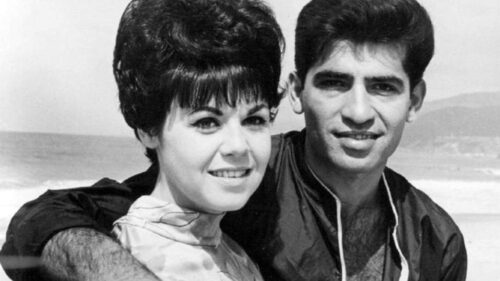
Steve Alaimo co-hosted Where the Action Is with fellow pop music star Linda Scott
Alaimo took the opportunity to promote his own records on-air; however, he rarely had time to record new songs. Alaimo would also become co-producer of the program, which lasted from 1965 to 1967.
In the spring of 1966, Alaimo’s treatment of the Gerry Goffin-Carole King song, “So Much Love”, reached the Top Ten in both Orlando and Tampa, and #11 in Roanoke (VA). Originally recorded by Ben E. King early in 1966, the song was later covered by Dusty Springfield on her 1968 album Dusty in Memphis. Between 1961 and 1966, Steve Alaimo released seven studio albums.
In 1967, Alaimo teamed up with Paul Revere & the Raiders vocalists Mark Lindsay and Keith Allison to form The Unknowns. They released a single titled “Melody For An Unknown Girl”. It was a Top 20 hit in Windsor, Ontario.
In 1968, the pop tune “Denver” reached number-one in Denver, and was a Top Ten hit in a few other radio markets. In 1971, another Goffin-King tune titled “When My Little Girl Is Smiling” was a Top Ten hit in Pittsburgh and a few other radio markets. It stalled at #72 on the Billboard Hot 100.
Alaimo engineered a pre-Allman Brothers demo recording for Duane and Gregg Allman that included early versions of “Nobody Knows You When You’re Down and Out” and “Melissa” at TK’s studio in Hialeah in 1968.
Among the recording artists he produced are Mercy and their #2 hit in 1969 “Love Can Make You Happy”; Betty Wright’s #2 R&B hit in 1972 titled “Clean Up Woman”; a number-one R&B hit for two weeks in early 1973 titled “Why Can’t We Live Together” by Timmy Thomas; a number-one R&B hit in 1975 titled “Rockin’ Chair” for Gwen McRae; the hits for Latimore “”Let’s Straighten It Out” (1974 – #1 R&B) and “Keep The Home Fire Burnin'” (1975 – #5 R&B); As well as producing recordings for the Last Words, Stephen Stills, KC & the Sunshine Band and others.
Steve Alaimo had nine singles chart in the Billboard Hot 100 without once reaching the Top 40 in his career, the most by any artist. Between 1959 and 1986 Alaimo released three dozen singles. Steve Alaimo died six days before what would have been his 85th birthday. He died in late November 2024.
After Steve Alaimo died, Joyce Moore, wife and manager of Sam Moore (one-half of the R&B duo Sam & Dan) said, “Steve actually discovered Sam and Dave in 1961 at the King of Hearts” Club in Liberty City in greater Miami.
May 18, 2026
Ray McGinnis
References:
“This singer and producer helped make the Miami sound — and was a force behind big hits,” Miami Herald, December 4, 2024.
Steve Alaimo, “Don’t Let The Sun Catch You Crying“, Checker Records, 1963.
Steve Alaimo, “I Don’t Know“, Imperial Records, 1964.
Steve Alaimo, “Cast Your Fate To The Wind“, Imperial Records, 1965.
Steve Alaimo, “So Much Love“, ABC/Paramount Records, 1966.
Dusty Springfield, “Everyday I Have To Cry“, 1964.
Ike and Tina Turner “Everyday I Have To Cry“, 1966.
Geoff Brown, “Obituary: Arthur Alexander,” The Independent, June 19, 1993.
Arthur Alexander, “Anna (Go to Him)“, Dot Records, 1962.
Arthur Alexander, “Where Have You Been (All My Life)” Dot Records, 1962.
Mercy, “Love Can Make You Happy“, Sundi Records, 1969. (Produced by Steve Alaimo)
Timmy Thomas, “Why Can’t We Live Together“, Glades Records, 1972. (Produced by Steve Alaimo)
Betty Wright, “Clean Up Woman“, 1971. (Produced by Steve Alaimo).
Gwen McRae, “Rockin’ Chair“, 1975. (Produced by Steve Alaimo).
Rachel Cruze, “Money and Marriage: 7 Tips for a Healthy Relationship,” Ramsey Solutions, September 16, 2025.
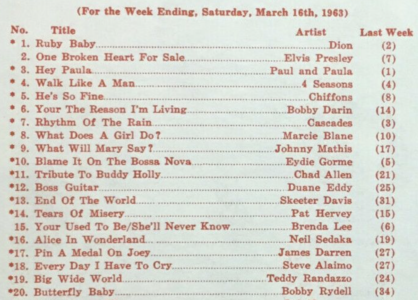
CKOM 1250-AM Fabulous Fifty Saskatoon (SK) | March 16, 1963
Didn’t know that Steve Alaimo discovered Sam & Dave and didn’t realize the connection with Arthur Alexander, a brilliant singer/songwriter.