
#9: Give Peace A Chance by Plastic Ono Band
City: St. Thomas, ON
Radio Station: CHLO
Peak Month: August 1969
Peak Position in St. Thomas ~ #1
Peak Position in Vancouver ~ #4
Peak Position on Billboard Hot 100 ~ #14
YouTube: “Give Peace A Chance”
Lyrics: “Give Peace A Chance”
The Plastic Ono Band was formed in 1968 by John Lennon and Yoko Ono. They met in 1966 while Lennon was a member of the Beatles, and Ono was an avant-garde artist and performer. By 1968, the two established a romantic relationship and they began collaborating on a number of musical projects. The Plastic Ono Band name, and the idea of an open-ended plastic band, was conceived of by Yoko Ono in 1967 as an idea for an art exhibition in Berlin. The Plastic Ono Band was realized in 1968 as a multi-media machine maquette by John Lennon, also called The Plastic Ono Band. Ono and Lennon collaborated on several art exhibitions, concerts, happenings and experimental noise music recording projects, before recording and releasing somewhat more standard rock-based albums that were still connected to the Plastic Ono Band concept.
On March 20, 1969, Lennon and Ono married, and subsequently hosted their first “Bed-in for Peace” event in at the Amsterdam Hilton (Amsterdam, the Netherlands). During their second bed-in in late May into June 1969 at the Queen Elizabeth Hotel in Montreal. On June 1, they invited a number of guests to be part of the Plastic Ono Band to record “Give Peace A Chance” in their hotel room.
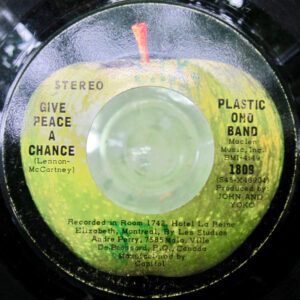
The guest list included Petula Clark and Timothy Leary (backing vocals), Tommy Smothers (on guitar), André Perry (percussion, production), and on handclaps: US black civil rights advocate Dick Gregory, Quebec separatist Jacques Larue-Langlois, Toronto Rabbi Abraham Feinberg, New York DJ Murray the K, British journalist Derek Taylor, and poet Allen Ginsburg. John Lennon and Yoko Ono provided lead vocals, as he played guitar and she played the tambourine.
Petula Clark was born November 15, 1932, with “a voice as sweet as chapel bells.” Petula first broke into the limelight during World War II when as a child she entertained the troops, both on radio and in concert. She is said to have performed in over 200 shows for the forces all over England before the age of nine and by war’s end, Petula Clark–the British “Shirley Temple” who had come to represent childhood itself–was so popular in England she was asked to sing at a national victory celebration at Trafalgar Square. Since 1944, Petula has appeared in over 30 British and American films. Her first hit on the British Singles chart was “The Little Shoemaker” in 1954, which topped the pop chart in Australia. By the early sixties, Petula found herself reinvented as a French chanteuse, even rivaling the legendary Edith Piaf during Piaf’s own lifetime. Between 1958 and 1977 Clark charted 17 songs into the Top 10 on the French singles chart, including four #1 singles on the France’s pop singles chart. She had five German-language Top Ten hits in West Germany, including two reaching number-one, between 1962 and 1965. While in Italy she had four number-one hits and two more Top Five hits. In Canada and the USA, both “Downtown” and “My Love” reached number-one, while “I Know A Place”, “This Is My Song” and “Don’t Sleep In The Subway ” reached the Top 5.
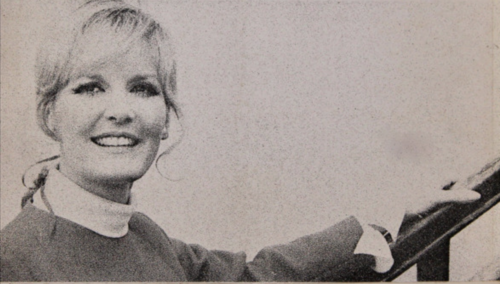
Petula Clark (1968)
Petula Clark was in Montreal at the time performing a bilingual (English/French) show at Place des Arts. Amid tense Quebec separatist politics in 1969, her set drew heckling from both English- and French-speaking audience members—anglophones when she sang in French, and vice versa. She found the experience upsetting and “heartbreaking.”
Timothy Leary was born in 1920 in Springfield (MA) in an Irish Catholic household. He studied at West Point Military Academy, and was later drafted into the United States Army in 1943. Given his studies in psychology, Leary was assigned to the psychology subsection of the Army Specialized Training Program. While a professor at Harvard, in 1960 Leary went to Mexico and experimented with psilocybin “magic” mushrooms. Leary was inspired by Allen Ginsberg’s enthusiasm over Leary’s research into psychedelics. The two shared an optimism that psychedelics could help people discover a higher level of consciousness. They began introducing psychedelics to intellectuals and artists including novelist Jack Kerouac, poet Charles Olson, and jazz musicians Maynard Ferguson and Charles Mingus. Leary was fired in 1963 for introduction LSD in his experiments to undergraduate students. In September 1966, Leary said in a Playboy magazine interview that LSD could cure homosexuality. According to him, a lesbian became heterosexual after using the drug. But in 1982, Leary wrote that the there was something “genetically natural” about homosexuality.
Timothy Leary testified before a Senate subcommittee in 1966. Senator Ted Kennedy asked Leary whether LSD usage was “extremely dangerous”, Leary replied, “Sir, the motorcar is dangerous if used improperly…Human stupidity and ignorance is the only danger human beings face in this world.” To conclude his testimony, Leary suggested that legislation be enacted that would require LSD users to be competently trained and licensed adults, so that LSD could be used “for serious purposes, such as spiritual growth, pursuit of knowledge, or their own personal development. However, months later LSD became a banned substance in America. In September 1966, in a speech before the press in New York City, Timothy Leary advanced it was time for the new generation to “Turn on, tune in, drop out.” He urged people to embrace cultural changes through the use of psychedelics by detaching from the existing conventions and hierarchies in society. Leary explained it was important to Turn On – find a sacrament which returns you to the ‘temple of God – your own body.’ As well to Tune In – to be reborn. And to Drop Out – of the social ersatz, dehydrated social dramas of the day, and the distractions of TV. Leary also told people to “think for yourself and question authority.”
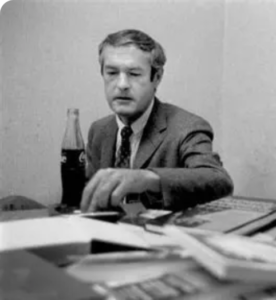
Timothy Leary having a Coke
In 1969, Leary declared he was going to run for Governor of California in a bid to unseat Republican Ronald Reagan. John Lennon wrote a song recorded by The Beatles titled “Come Together” after Leary asked him to write a campaign song for his long-shot campaign. Leary’s campaign slogan was “Come Together, Join the Party.” But, on January 21, 1970, Timothy Leary was sentenced to twenty years in prison for a variety of possession of marijuana offenses. He died of cancer in 1996 at the age of 75. Over the decades, Timothy Leary wrote 38 books, published in academic journals, and in over a dozen spoken word recordings.
Tommy Smothers was born in New York City in 1937. His father died in a Japanese prisoner of war camp in 1945. He played guitar and piano by ear. Smothers competed on the gymnastics team, where he tied for first place on the parallel bars at the 1958 State College Gymnastics Championships. Inspired by the Kingston Trio, with his brother Dick, the Smothers Brothers performed folk music in San Jose nightclubs before college students. They appeared on The Steve Allen Show in 1961. By 1965, CBS aired The Smothers Brothers Show, which was a sitcom. In February 1967, it morphed into The Smothers Brothers Comedy Hour.
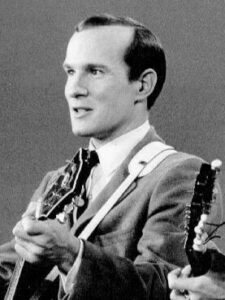
Tommy Smothers
The show was noted for its daring political satire and emerging anti-war stance. Tommy publicly criticized Democratic president Lyndon B. Johnson and foreign policy to expand the Vietnam War. Pete Seeger, Joan Baez, and others contributed to an image that CBS executives were uncomfortable with and the show was abruptly cancelled on April 4, 1969. Tommy Smothers died at the age of 86 in 2023.
André Perry is a jazz musician, and producer and owner of a recording studio in Montreal, called Les Studios André Perry. He provided sound equipment for the recording of “Give Peace A Chance”. He was about 27-years-old when he got a phone call from EMI Records asking him to bring sound equipment to the Queen Elizabeth Hotel in Montreal.
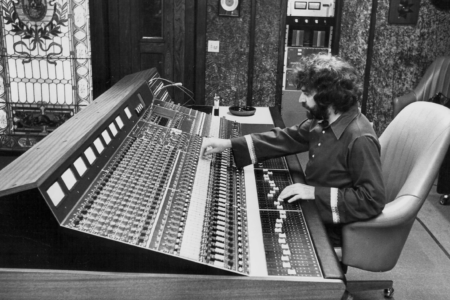
André Perry (1970)
Perry told Beatology Magazine in 2001, “…basically it was quite primitive really. And so it was recorded with earphones even though I had a small pair of speakers for reference but I could not use them because I was in the room with them. I was about twelve feet from the bed…. the ceiling was extremely low so there was a tremendous amount of distortion…. When we finished Give Peace A Chance, I think as I recall, people hung out for a little bit, and then everybody left, and it was just the three of us. We did that possibly around two o’clock in the morning ’til about four in the morning, or even more than that, actually probably from a little earlier than that, one to three or four in the morning.”
Derek Taylor was born in Brandon, Suffolk, England, in 1932. Taylor started his career as a local journalist on the Wirral, now part of Merseyside, aged 17 working for the Hoylake and West Kirby Advertiser, followed by the Liverpool Daily Post and Echo. On May 30, 1963, the Beatles gave a concert in Liverpool. He was expected by his newspaper to pan the concert as an inconsequential teen fad. However, Derek Taylor was enchanted by the group and instead sang their praises. Shortly afterwards, he was invited to meet the Beatles and soon became a trusted journalist in their circle. In early 1964, Beatles manager Brian Epstein hired Taylor away from his newspaper job, putting him in charge of Beatles press releases, and acting as media liaison for himself and the group. He subsequently became Epstein’s personal assistant for a short period. He worked as a publicist for the Beach Boys, the Byrds, Paul Revere and the Raiders, and the Mamas and the Papas. He subsequently organized the Monterey Pop Festival, and was the events publicist and spokesman. He returned to England in April 1968, after the death of Brian Epstein (August 1967), to take the position of press officer for Apple Records.
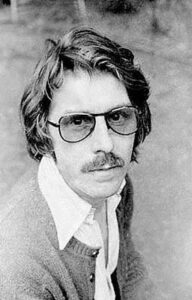
Derek Taylor
It was Derek Taylor who confirmed in April 1970 the break-up of the Beatles. He wrote obliquely to hide his sadness. “Spring is here and Leeds play Chelsea tomorrow and Ringo and John and George and Paul are alive and well and full of hope. The world is still spinning and so are we and so are you. When the spinning stops – that’ll be the time to worry. Not before …”
In 1980, Taylor wrote the foreword and edited George Harrison’s memoir I, Me, Mine. He later authored It Was Twenty Years Ago Today (about the twentieth anniversary of the release of the Beatles’ album Sgt. Pepper’s Lonely Hearts Club Band). He was on the set for Raiders of the Lost Ark, and authored The Making of Raiders of The Lost Ark. He published several memoirs, including Fifty Years Adrift in 1983. A later memoir, Getting sober…and loving it!, was published in 1992 with a foreword by Ringo Starr. Derek Taylor was working on the Beatles Anthology book in 1997 when he died at the age of 65 from throat cancer.
Dick Gregory was born in St. Louis, Missouri, in 1932. He won the Missouri State cross-country championship in 1950. He was drafted into the United States Army in 1954, and got his start as a comedian while in the army. In 1961, at the black-owned Roberts Show Bar in Chicago, Gregory said “Good evening, ladies and gentlemen. I understand there are a good many Southerners in the room tonight. I know the South very well. I spent twenty years there one night. Last time I was down South I walked into this restaurant and this white waitress came up to me and said, “We don’t serve colored people here.” I said, “That’s all right. I don’t eat colored people. Bring me a whole fried chicken.” Then these three white boys came up to me and said, “Boy, we’re giving you fair warning. Anything you do to that chicken, we’re gonna do to you.” So I put down my knife and fork, I picked up that chicken and I kissed it. Then I said, “Line up, boys!” Hugh Heffner spotted Dick Gregory at the club and hired him to work at his Chicago Playboy Club. He appeared on The Jack Paar Show, and made it into Time Magazine. In 1964, he published his autobiography, nigger. His dedication at the front of the book read “Dear Momma — Wherever you are, if ever you hear the word “nigger” again, remember they are advertising my book.” Gregory wass known for comedic performances that not only made people laugh, but mocked the establishment.
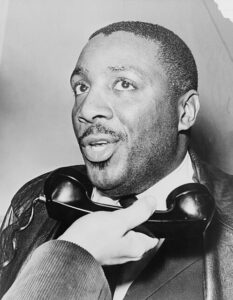
Dick Gregory
In 1964, Dick Gregory made his public opposition to the Vietnam War known. He was active in the search for the bodies of three murdered young civil rights workers in Philadelphia, Mississippi, on June 21, 1964. His campaign with Hugh Heffner to offer a $25,000 reward for information leading to the discovery of the bodies shamed the FBI into finally conducting a proper investigation, and 44 days after the murder the agency discovered the corpses.
He was a vocal critic of the Warren Commission report that contended Lee Harvey Oswald assassinated President John F. Kennedy, and had no accomplices. He also lobbied the government to re-open the investigation into the murder of the Reg. Dr. Martin Luther King Jr. He co-authored Murder in Memphis: The FBI and the Assassination of Martin Luther King. Over the decades, Gregory wrote (or co-wrote) seventeen books. He also appeared in eight films, and recorded sixteen spoken word albums.
Dick Gregory ran unsuccessfully for mayor of Chicago against Mayor Richard Daley, garnering over 19,000 votes to Daley’s 792,000 votes. In 1968, Gregory announced he was running for President of the United States as candidate for the Peace and Freedom Party. On November 5, 1968, Gregory received over 47,000 votes as a write-in candidate. He died of heart failure, aged 84, in 2017. In 2021, he was the subject of a documentary titled The One and Only Dick Gregory.
Allen Ginsburg was born in 1926 in Newark, New Jersey. In his 1956 poem, “Howl”, Ginsburg denounced militarism, economic materialism and sexual repression. His description of homosexual sex, at a time when the sodomy laws across all states made sex between males a crime, landed him in an obscenity trial the following year. However, a judge dismissed the charges finding the poem had “redeeming social importance.” Ginsburg was one of the ‘beat generation’ who has an interest in developing a new literary ideology that rejected the cultural conformity of America post World War II. His colleagues included William S. Boroughs, Jack Kerouac, John Clellon Holmes, and Neal Cassady. He formed a bridge between the beat writers and the hippies, and befriended Timothy Leary, Bob Dylan, Lenny Bruce, and others. Ginsberg was a signer of the anti-war manifesto “A Call to Resist Illegitimate Authority”, circulated among draft resistors in 1967 by members of the radical intellectual collective RESIST. Other signers included Noam Chomsky, the Rev. William Sloane Coffin, Denise Levertov, and Norman Mailer.
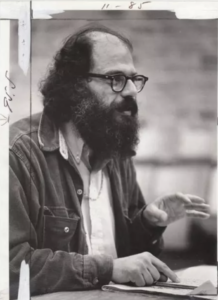
Allen Ginsburg (1969)
Controversially, Ginsburg was a member of NAMBLA (North American Man-Boy Love Association). Ginsburg famously said “I’m a member of NAMBLA because I love boys too—everybody does, who has a little humanity.” He alleged the CIA was involved in drug trafficking, personally confronting CIA Director, Richard Helmes, about the matter. Over the decades, he published over twenty books of poetry. He also released nineteen spoken word albums of his poetry. Allen Ginsburg died in 1997 of liver cancer brought on by hepatitis. Posthumously, I Greet You at the Beginning of a Great Career: The Selected Correspondence of Lawrence Ferlinghetti and Allen Ginsberg, 1955–1997, was published, as was The Selected Letters of Allen Ginsburg and Gary Snyder.
Murray the K (Murray Kaufman) was born in 1922 in New York City. He was a child actor and appeared as an extra in a number of films in the 1930s. In 1958, he co-wrote “Splish Splash” which was a Top 5 hit for Bobby Darin. Kaufman’s big break came in 1958 after he moved to WINS 1010-AM in New York City to do the all-night show, which he titled The Swingin’ Soiree. His show became the top rated radio show in Manhattan. When the Beatles came to New York on February 7, 1964, Murray was the first DJ they welcomed into their circle. When the band arrived in New York, Murray was invited by Brian Epstein to spend time with the group, and Murray persuaded his radio station (WINS) to let him broadcast his prime time show from the Beatles’ Plaza Hotel suite. He subsequently accompanied the band to Washington, D.C. for their first American concert, was backstage at their The Ed Sullivan Show premiere, and roomed with Beatles guitarist George Harrison in Miami, broadcasting his nightly radio shows from his hotel room there. He was temporarily nicknamed ‘the fifth Beatle.’ (Others who have been given this moniker include former Beatles Stuart Sutcliffe and Pete Best, and temporary bandmates Chas Newby (1960) and Jimmie Nicol (who replaced an ill Ringo Starr on drums for the first nine concerts between June 4 – Copenhagen – and June 13 – two concerts in Adelaide on The Beatles 1964 World Tour), Beatles’ manager Brian Epstein, Beatles’ producer George Martin, road manager and personal assistant Neil Aspinall, Daily Express journalist Derek Taylor who later became press agent for Apple Corps., Tony Sheridan (who sang lead vocals with the Beatles on backing vocals on the 1961 recording of “My Bonnie”, and Billy Preston (for his collaboration on “Get Back”).
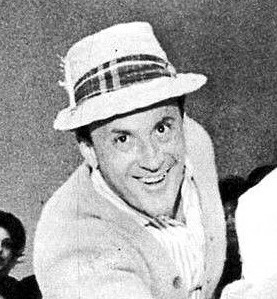
Murray the K
On June 28, 1965, Murray the K hosted a TV special on CBS titled Murray the K – It’s What’s Happening, Baby. It featured performances by Martha & the Vandellas, Dionne Warwick, Herman’s Hermits, Marvin Gaye, Cannibal & the Headhunters, Patti LaBelle & the Bluebelles, Little Anthony & the Imperials, the Ronettes, Chuck Jackson, Mary Wells, Johnny Rivers, the Temptations, Gary Lewis & the Playboys, the Drifters, the Supremes, the Righteous Brothers, the Four Tops, the Miracles, and Ray Charles. He was the author of a 1966 book, Murray the K Tells It Like It Is, Baby. In 1966, Murray collaborated with media art collective USCO to design and produce the psychedelic multimedia event The World, which took place in the Roosevelt Field abandoned airplane hangar in Long Island and was dubbed the first discotheque. Between 1967 and 1972 he moved to CHUM in Toronto and WHFS in Bethesda, Maryland. Murray the K died of cancer in 1982 at the age of 60.
Rabbi Abraham Feinberg was born in 1899 in Ohio. His parents were from Lithuania, Russian Empire. After high school, Feinberg worked in a steel mill in his hometown of Bellaire (OH). He was ordained as a rabbi in 1924, and later headed the Temple Israel a prestigious Reform congregation for wealthy Jews in Manhattan. He hosted a popular music show on WMCA and then WOR in New York City, and in 1932 was paid $1,500 per week (over $36,450 per week in 2026 US dollars). He sang on the show and his baritone voice was classically trained. However, by 1935, he was sufficiently troubled by Nazi Germany to end his career as a singer/radio show host and returned to working as a rabbi. In 1943, he accepted a position as rabbi at Toronto’s Holy Blossom Temple. He also wrote about social issues in publications such as the Globe and Mail, Saturday Night, Maclean’s, and the Toronto Star. He was critical of the Canadian government’s internment of Japanese-Canadians during WWII. A strong proponent of Zionism, Feinberg trusted the establishment of the state of Israel would usher in an age of peace and stability for Jews. He spoke in favor of interracial marriage, viewed human sexual diversity as normal, and the RCMP spied on him and viewed him as “subversive.”
Rabbi Feinberg retired from Holy Blossom Temple in 1961. He condemned the Vietnam War and in January 1967 Feinberg travelled to Hanoi to meet Ho Chi Minh as part of a peace mission to protest the Vietnam war. By 1967, Feinberg had emerged as the chairman of Vietnam Coordinating Committee in Toronto that organized protests against the war and pressed the Canadian government to grant asylum to American draft-dodgers who had fled to Canada.
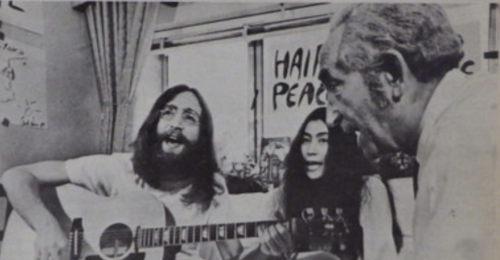
John Lennon, Yoko Ono and Rabbi Abraham Feinberg
At the time of the recording of “Give Peace A Chance”, Rabbi Feinberg told The Montreal Gazette that he had gone to join the “Bed-In” out of admiration for Lennon, saying “he is one of the most powerful influences in the modern world, and I feel he is doing a phenomenal thing for peace.” Feinberg was described having bonded with Lennon, forming an instant friendship. About the charge that it was undignified for a rabbi to associate with Lennon and Ono, Feinberg told The Montreal Gazette: “I’m not interested in what people say about dignity. I don’t worship respectability. I feel you can sing for truth, justice and peace.” In his final years, Feinberg argued that women could be rabbis. He died in 1986 at the age of 87 of cancer.
Jacques Larue-Langlois was born in 1934 in Montreal. In 1966, he led the Nuclear Movement for Disarmament and Peace. That year he also founded an Aid Committee for two separatists who had been arrested in New York City for participating in a demonstration for Quebec independence. Though he never advocated violence, he was assimilated into the Front de Liberation du Quebec (FLQ), and fired in 1968 by his employer, Radio-Canada. He was arrested in October 1970 during the FLQ Crisis and imprisoned for four months, and charged with “seditious conspiracy.” He published a book of poetry recollecting his experiences during the unrest. Larue-Langois then taught journalism at the Université du Québec, where a press room on the 4th floor of the Judith-Jasmin Pavilion bears his name. Later, he collaborated with Le Devoir as a theatre critic. He died in 2001 at the age of 66.
Lyrics
Initially, “Give Peace A Chance” was credited to Lennon-McCartney. John Lennon expressed his regrets about being “guilty enough to give McCartney credit as co-writer on my first independent single instead of giving it to Yoko, who had actually written it with me.” According to author Ian MacDonald, the credit was Lennon’s way of thanking McCartney for helping him record “The Ballad of John and Yoko” at short notice.
In the lyrics, Lennon sings “everybody’s talking ’bout bagism…” Bagism is a form of performance art and conceptual protest created by John Lennon and Yoko Ono in 1969 as part of their peace campaign. It involves one or more people enclosing themselves completely inside a bag (often a large fabric sack covering the entire body). The goal was to satirize and eliminate social prejudice and stereotyping based on physical appearance.
In the opening verse, the song mocks how people endlessly debate and latch onto various ideologies, trends, and social labels (“this-ism, that-ism”) instead of focusing on something simple like peace. Shagism, dragism, madism, ragism and tagism are made-up words illustrating the nonsensical rabbit holes people go down to embrace complicated ideologies instead of something simple like peace.
Other verses illustrate the distractions people get caught up in. But the chorus urges a return to something everyone can unite around: “All we are saying is give peace a chance.”
In the final verse John Lennon sings
Ev’rybody’s talking about
John and Yoko, Timmy Leary, Rosemary,
Tommy Smothers, Bobby Dylan, Tommy Cooper,
Derek Taylor, Norman Mailer,
Alan Ginsberg, Hare Krishna,
Hare, Hare Krishna.
Timothy Leary was married in 1969 to Rosemary Woodruff, his fourth of five wives. Rosemary Woodruff was born in St. Louis, Missouri, in 1935. Raised in a conservative Baptist environment, she left home at age 17. She became a model and a flight attendant on El Al Airlines (State airline of Israel). She was twice divorced when she met Timothy Leary at an art exhibition in 1965. The couple engaged in experimental drug use, leading to several arrests.
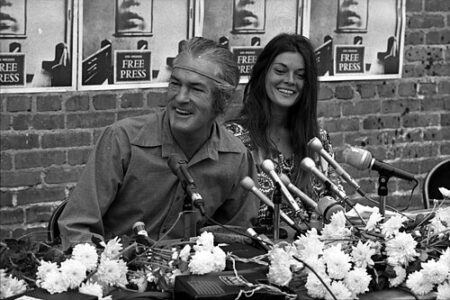
Timothy Leary and Rosemary Woodruff Leary
In 1970, Woodruff was sentenced to six months in prison on charges of drug possession, while Leary was sentenced to 28 years. Following her release, Woodruff helped Leary escape from prison, with the aid of the Weather Underground, and the couple took refuge in Algeria. Woodruff remained abroad for 23 years in multiple countries after separating from Leary in 1971.
Rosemary Woodruff surrendered to authorities in the United States in 1994. A judge declined to pursue further penalties against her, considering the time elapsed. She reconnected with Leary, who was again incarcerated in the United States. He appointed her the executor of his estate before he died in 1996. In her later years, Woodruff taught classes about the 1960s at the University of California at Santa Cruz. She also worked on two memoirs. The Magician’s Daughter, was never published, while another, Psychedelic Refugee, was published posthumously in 2021. She died of congestive heart failure in 2002 at the age of 66.
The final verse of the song also includes a nod to Welsh prop comedian Tommy Cooper, novelist and essayist Norman Mailer, folk-rock singer Bob Dylan, and others mentioned above. As well, the Hare Krishna – and the mantra Hare Krishna – are repeated at the end of the final verse. The International Society for Krishna Consciousness was founded in New York City on July 1966, and promotes bhakti yoga as the central spiritual practice of its members.
“Give Peace A Chance” peaked at #1 in St. Thomas (ON), Rochester (NY), Gaithersburg (MD), and St. Louis, #2 in Saint Charles (MO), #3 in Victoria (BC), Detroit, Tucson (AZ), San Bernardino (CA), Cleveland, Santa Rosa (CA), and Atlanta, #4 in Vancouver (BC), Rockville (IL), Boston, Louisville (KY), and Kalamazoo (MI), #5 in Hamilton (ON), Allentown (PA), and Cincinnati (OH), #6 in Windsor (ON), Calgary, Edmonton (AB), Columbus (OH), Columbia (MO), Hartford (CT), Bloomington (IN), Albany (NY), Quincy (IL), Harrisburg (PA), and Pointe Claire (PQ), #7 in Honolulu, Charleston (WV), Palm Springs (CA), Troy (NY), and San Diego, #8 in New York City, Buffalo, Worcester (MA), and Savannah (GA), #9 in Minneapolis/St. Paul, Miami, Battle Creek (MI), Schenectady (NY), and Washington DC, and #10 in Ottawa and Seattle.
Internationally, “Give Peace A Chance” reached number-one in the Netherlands, #2 in both Austria and the UK, #3 in Belgium, #4 in Switzerland and West Germany, #8 in Canada, #11 in Norway, and #14 on the Billboard Hot 100 in the USA.
“Give Peace A Chance” was sung by half a million demonstrators in Washington DC on Vietnam Moratorium Day, November 15, 1969. They were led by Pete Seeger, who interspersed phrases like, “Are you listening, Nixon?” and “Are you listening, Agnew?”, between the choruses of protesters singing, “All we are saying … is give peace a chance”
The Plastic Ono Band had at its core John Lennon and Yoko Ono. Other musicians who were with the band include Eric Clapton, Klaus Voorman, Alan White, Ringo Starr, George Harrison, Billy Preston, Jim Gordon, Nicky Hopkins, Bobby Keys, Keith Moon, Delaney Bramlett, Bonnie Bramlett, Phil Spector, Frank Zappa, and many others.
On September 13, 1969, the Plastic Ono Band held a Live Peace Concert at the Toronto Rock and Roll Revival at Varsity Stadium. During the day the audience was treated to performances by Junior Walker and the All Stars, Chicago Transit Authority, Bo Diddley, Chuck Berry, Tony Joe White, Alice Cooper backing Gene Vincent, Cat Mother and the All Night News Boys, Jerry Lee Lewis, Little Richard, and The Doors.
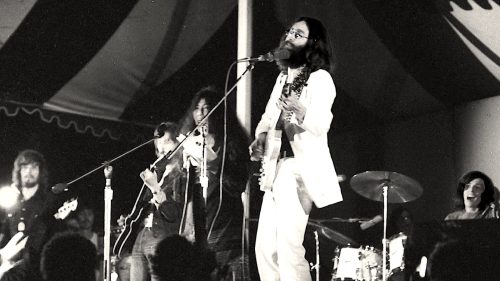
Plastic Ono Band: Live Peace Concert in Toronto
During their performance at the Varsity Stadium, the set by the Plastic Ono Band (fronted by John Lennon and Yoko Ono) included “Dizzy Miss Lizzy”, “Money (That’s What I Want)”, “Blue Suede Shoes”, “Give Peace A Chance” and “Cold Turkey”. The latter was written by John Lennon and became the Plastic Ono Band’s second single release.
In June 1972 the Plastic Ono Band released a part-live/part-studio album titled Some Time in New York City.
In January 1970, the Plastic Ono Band released a single titled “Instant Karma”. The song invited listeners to “get yourself together,” a phrase used at the time among hippies. Lennon also asked about the purpose of life: “Why in the world are we here? / Surely not to live in pain and fear.” Karma, Lennon wrote, was “going to knock you right in the head.” It was time to “recognize your brothers, every one you meet.” Lennon offered a common understanding of our humanity: “We all shine on, like the moon and the stars and the sun.” The song reached the Top Ten in Canada, Italy, Ireland, the USA, Austria, Belgium, New Zealand, Sweden, Australia, the UK, West Germany, Norway and Switzerland.
In December 1970, the Plastic Ono Band released “Mother”. The lyrics of “Mother” address both of Lennon’s parents, each of whom abandoned him in his childhood. Lennon subsequently stated that the song was intended as a general message about parents and their responsibility to their children. The single reached the Top Ten in Switzerland, Austria and the Netherlands, and sold well in Canada, Japan and West Germany.
In March 1971, the Plastic Ono Band released “Power To the People”. It was a song about the need for people to “get on your feet… and into the street” if they “want a revolution.” The lyrics spoke of people working for insufficient wages: “A million people working for nothing/you better give them what they really own…” As well, he addresses his “comrades, brothers,” and invites them to ask themselves “How do you treat your own woman back home?” The chorus invites people everywhere to sing “Power to the people.” The single was another international hit.
In December 1971, the Plastic Ono Band released “Happy Xmas (War is Over)”. The song endorsed social unity and peaceful change. It advanced that ordinary people have more power than they may realize, and that they can put a stop to wars (like that in Vietnam at the time) if they want it (demand it) from politicians, generals. The single was a Top Ten hit in the UK, the Netherlands, Norway, Australia, Austria, West Germany and Switzerland. It reached the Top 30 in Canada and Japan.
In 1972, the John Lennon with the Plastic Ono band released “Woman Is the Nigger of the World”. The phrase “woman is the nigger of the world” was coined by Yoko Ono in an interview on December 12, 1968, then released on Nova magazine in 1969 and quoted on the magazine’s cover, with Ono making the claim that women were the most oppressed group in the world. The National Organization for Women (NOW) awarded Lennon and Ono a “Positive Image of Women” citation for the song’s “strong pro-feminist statement” in August 1972. “Woman is the Nigger of the World” was another international Top Ten hit.
Separately, John Lennon had solo hits that include “Imagine”, “Whatever Gets You Through the Night”, “#9 Dream”, and “Mind Games”. After an absence from the recording studio, Lennon and Ono had released the album Double Fantasy in November 1980.
On December 8, 1980, John Lennon autographed a copy of Double Fantasyfor Mark David Chapman before leaving The Dakota apartment building at 1 West 72nd Street, with Ono for a recording session. After the session, Lennon and Ono returned to the Dakota in a limousine at around 10:50 p.m. (EST). They left the vehicle and walked through the archway of the building, just steps from Central Park in Manhattan. Chapman then shot Lennon twice in the back and twice in the shoulder at close range. John Lennon died by the time he arrived at the Roosevelt Hospital at 11:15 p.m. that night.
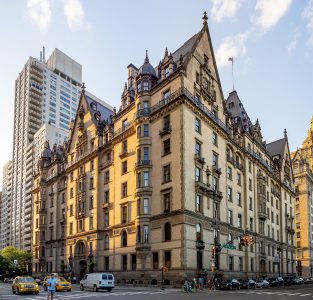
The Dakota, 1 West 72nd Street, New York City
The FBI admitted it had 281 pages of files on Lennon, but refused to release most of them on the grounds that they contained national security information. Unclassified memos, from the FBI’s Hoover to White House chief of staff H.R. Haldeman, showed improper political interference in an immigration proceeding while Lennon was seeking to obtain a green card. The story is told in the documentary The US vs. John Lennon.
After the Plastic Ono Band split, Yoko gave birth to Sean Lennon in 1975. At that point, John Lennon became a stay-at-home dad. In 1980, she worked with Lennon on the album Double Fantasy. From the album came the Top Ten hit singles “Woman”, “(Just Like) Starting Over” (nominated for a Grammy Record of the Year) and “Watching the Wheels Go Round”. In February 1982, the album won the Grammy Award for Album of the Year in 1981.
In 1981, Yoko Ono released the album Season of Glass, which featured the striking cover photo of Lennon’s bloody spectacles next to a half-filled glass of water, with a window overlooking Central Park in the background. This photograph sold at an auction in London in April 2002 for about $13,000. The album received highly favorable reviews and reflected the public’s mood after Lennon’s assassination. In 1985, Yoko Ono received a Grammy Award nomination for Heart Play (Unfinished Dialogue) in the Best Spoken Word or Non-Musical Recording category.
Ono funded the construction and maintenance of the Strawberry Fields memorial in Manhattan’s Central Park, directly across from the Dakota apartments, which was the scene of John Lennon’s murder, and remains Ono’s residence to this day. It was officially dedicated on October 9, 1985, which would have been Lennon’s 45th birthday.
On February 1, 1991, Ono recorded a new version of “Give Peace A Chance”, along with a music video, in response to the imminent Gulf War. The Peace Choir version of the song climbed to #6 in New Zealand, #7 in Switzerland, #12 in Belgium, #14 in the Netherlands, but only #54 in the USA.
On July 10 2008, Christie’s auction house in London sold John Lennon’s hand-penned lyrics to “Give Peace a Chance” for £421,250 ($834,000). Lennon had written the lyrics during the eight-day Bed-in and gave the sheet to 16-year-old Gail Renard who had sneaked into the Queen Elizabeth Hotel with a friend. The teenagers became friendly with Lennon and Yoko and the Beatle gave her several mementoes, including the lyrics, telling her: “One day they will be worth something.”
On March 4, 2022 at 08:45 (Central European Time), 150 European public radio stations broadcast “Give Peace A Chance” for peace and against the 2022 Russian invasion of Ukraine. On March 8th at 12:00 (CET), 200 European private radio stations did the same. The Rockin’ 1000 performed this song for the opening of the final of the Eurovision Song Contest 2022, also in reaction to the invasion.
August 24, 2026
Ray McGinnis
References:
“John Lennon Died 35 Years Ago Today: Read Original Associated Press Story,” Billboard, December 8, 2015.
Johnathan Cott, “John Lennon: The Last Interview: Three Days Before he Died, John Lennon Talked with ‘Rolling Stone’ for Nine Hours. For the First Time, we Present this Extraordinary Interview,” Rolling Stone, December 23, 2010.
Barbara Graustark, “The Lost 1981 Yoko Ono Interview,” Rolling Stone, October 1, 1981.
“Interview: John Lennon and Ringo Starr in Los Angeles,” Los Angeles Times, August 23, 1964.
Jim Emerson, “You say you want a revolution,” Rogerebert.com, September 28, 2006.
Jann S. Wenner, “Lennon Remembers, Part One,” Rolling Stone, January 21, 1971.
Julianne Escobedo Shepherd, “Walking on Thin Ice: A Career-Spanning Conversation with Yoko Ono,” November 6, 2013.
“Rosemary Woodruff, 66, Wife and Fellow Fugitive of Leary,” New York Times, February 16, 2002.
Erin Maxwell, “British Pop Legend Petula Clark Reveals How She Accidentally Ended Up on John Lennon’s Protest Song,” Remind, October 23, 2025.
Mayeer Nissim, “The story of how Petula Clark ended up singing on John Lennon’s ‘Give Peace a Chance’ by mistake,” Gold Radio, March 23, 2026.
Andrew Croft, “John and Yoko “Bed-in” at the Queen Elizabeth Hotel in Montreal: The Recording of Give Peace A Chance,” Beatology Magazine, May/June 2001. (Interview with André Perry)
Lisa Respers France, “Tom Smothers, one half of famed comedy duo, dies at 86,” CNN, December 27, 2023.
Chris Welch, “Obituary: Derek Taylor,” Independent, September 10, 1997.
Erinn Callahan, “On This Day in 1982, We Said Goodbye to the Self-Proclaimed “Fifth Beatle” Who Formally Introduced Americans to the Fab Four,” American Songwriter.com, February 21, 2026.
“Obituary: Richard “Dick” Gregory died on August 19th: The American comedian, dietician and civil-rights campaigner was 84,” The Economist, September 7, 2017.
“Rabbi Abraham L. Feinberg,” New York Times, October 8, 1986.
Wilborn Hampton, “Allen Ginsburg, Master Poet of Beat Generation, Dies at 70,” New York Times, April 6, 1997.
David S. Willis, “Allen Ginsburg and NAMBLA,” Beatdom.com, June 15, 2023.
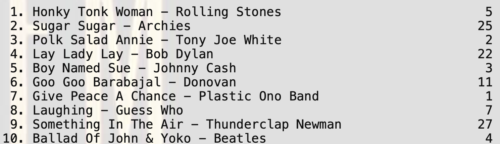
CHLO 1570-AM ‘Good Guy Survey’ St. Thomas (ON) | August 13, 1969
Leave a Reply