
#1: Nice ‘N Easy by Frank Sinatra
City: Sudbury, ON
Radio Station: CKSO
Peak Month: September 1960
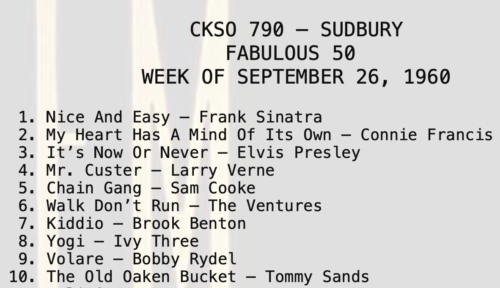
Peak Position in Sudbury ~ #1
Peak Position in Vancouver ~ #38
Peak Position on Billboard Hot 100 ~ #60
YouTube: “Nice ‘N Easy”
Lyrics: “Nice ‘N Easy”
Francis Albert Sinatra was born in 1915 in Hoboken, NJ. Sinatra spent much time at his parents’ tavern in Hoboken, working on his homework and occasionally singing for spare change. After leaving school before graduating, Sinatra began performing in local Hoboken social clubs and sang for free on radio stations such as WAAT in Jersey City. In New York, Sinatra found jobs singing for his supper or for cigarettes. He got his first break in 1935 when his mother persuaded a local singing group called the 3 Flashes to let him join. Baritone Fred Tamburro stated that “Frank hung around us like we were gods or something”, admitting that they only took him on board because he owned a car and could chauffeur the group around. Sinatra soon learned they were auditioning for the Major Bowes Amateur Hour show, and “begged” the group to let him in on the act. With Sinatra, the group became known as the Hoboken Four, and passed an audition from Edward Bowes to appear on the show. They each earned $12.50, and ended up attracting 40,000 votes to win first prize—a six-month contract to perform on stage and radio across the U.S. Sinatra quickly became the group’s lead singer, and, much to the jealousy of his fellow group members, garnered most of the attention from girls.
In 1938, Sinatra found employment as a singing waiter at a roadhouse called “The Rustic Cabin” in Englewood Cliffs, on the New Jersey side of the Hudson River, facing Manhattan. The roadhouse was connected to WNEW in New York City, and the Dance Parade show was broadcast live on the station from The Rustic Cabin. In 1939, Frank Sinatra had a #21 hit on the US pop charts titled “It’s Funny To Everyone But Me”, backed by the Harry James Orchestra. In 1940, Sinatra recorded his first Top Ten record titled “All or Nothing at All”, which reached #2 in 1943. In 1944, “I’ll Be Seeing You” peaked at #4 on the Billboard pop charts.
During WWII, Frank Sinatra was a regular in the Top Ten. His hits include from 1940: “I’ll Never Smile Again” (#1) with the Tommy Dorsey Orchestra; “We Three (My Echo, My Shadow and Me)” (#3), and “Our Love Affair” (#5); From 1941: “Dolores” (#1), “Do I Worry?” (#4) and “This Love Of Mine” (#3); From 1942: “In The Blue Of the Evening” (#1), “There Are Such Things” (#1), and “Take Me” (#5); From 1943: “It’s Always You” (#3), “You’ll Never Know” (#2), and “People Will Say We’re In Love”; From 1944: “I Couldn’t Sleep a Wink Last Night” (#4) and “Saturday Night (Is the Loneliest Night in the Week)” (#2); And from 1945: “I Dream of You (More Than You Dream I Do)” (#7), “Dream” (#5) and “Nancy (with the Laughing Face)” (#10).
In 1943, Frank Sinatra was nominated for an Academy Award for Best Original Song for “I Couldn’t Sleep a Wink Last Night” from Higher and Higher, but lost to “Swinging On A Star”. The following year, Sinatra was nominated again in the Best Original Song category for “I Fall in Love Too Easily” from the film Anchors Aweigh.
In the last half of the 1940s, Frank Sinatra continued to be popular on the pop charts. This includes from 1946: “Oh! What it Seemed to Be” (#1), “Day by Day” (#5), “They Say It’s Wonderful” (#2), “The Coffee Song” (#6), and “Five Minutes More” (#1); From 1947: “Mam’selle” (#1); From 1948: “Nature Boy” (#8); And from 1949: “Some Enchanted Evening” (#6) and “Don’t Cry Joe” (#9). In 1946, Sinatra was awarded an Honorary Award at the Academy Awards for “The House I Live In”, the theme song for The House I Live In.
In 1950, Sinatra had another three Top Ten hits, with his version of “Goodnight Irene” climbing to #5. Into the 1950s, Frank Sinatra’s recordings on Columbia Records became less successful. However, from 1950 to 1952, he hosted The Frank Sinatra Show on CBS. The singer switched labels in early 1953 and he was signed to Capitol Records. His first release was “I’m Walking Behind You” which peaked at #7. In 1954, he won an Academy Award and a Golden Globe Award for Best Supporting Actor for From Here to Eternity. In 1954, Sinatra’s “Young At Heart” reached #2, and “Three Coins In The Fountain” made it to #4 in the USA and #1 in the UK. In the case of the latter, his recording was featured in the film Three Coins in the Fountain won him an Academy Award for Best Original Song.
While in 1955, “Learnin’ The Blues” topped the pop charts, and “Love and Marriage” and “(Love is) The Tender Trap” (from the film of the same name) both cracked the Top Ten. That year Sinatra appeared in The Man with the Golden Arm, which earned him another Academy Award nomination for Best Actor. But he lost out to Ernest Borgnine who won for his role in Marty. Sinatra was also recognized for his role in the film with a Best Actor nomination at the BAFTA (British Academy Film Awards) in 1957. He was also nominated in the Best Actor category for his role in Not as a Stranger in 1956. Sinatra also appeared in the 1955 Academy Award nominated film Guys and Dolls.
Despite the headwinds of rock ‘n roll, Sinatra managed a few more Top Ten hits through the mid-50s including “Hey! Jealous Lover” (#3) in 1956. He also appeared in the Academy Award nominated films High Society and Around the World in 80 Days.
In 1957, All The Way” peaked at #2, a tune from the film The Joker is Wild. The song earned him his second Best Original Song Academy Award. In 2003, he was posthumously awarded a Grammy Award in the Best Pop Collaboration with Vocals in a duet of “All The Way” with Celine Dion. In late 1957, Sinatra released “Witchcraft”.
As well, Frank Sinatra Sings for Only the Lonely received a Grammy nomination for Album of the Year. The album won him a Grammy Award in the Best Recording Package category. In 1957, Sinatra won a Golden Globe Award for his role in Pal Joey. As well, Sinatra was on ABC hosting The Frank Sinatra Show from October ’57 to June ’58. In 1958, Frank Sinatra appeared in the Academy Award nominated film Some Came Running. That year he released the single “Mr. Success”. In 1959, the singer also released the single “French Foreign Legion”.
In late 1959, at the 2nd Grammy Awards, Sinatra won Grammy Awards for Album of the Year and in the Vocal – Male categories for Come Dance with Me! In 1960, Frank Sinatra won his third Best Original Song Academy Award for “High Hopes” from the film A Hole in the Head. The song received a Grammy Award nomination for Record of the Year. It peaked at #6 on the UK Pop Singles chart.
In late 1959, Sinatra also released a single titled “Talk To Me”. In 1960, Sinatra appeared in the Academy Award nominated film Can-Can. In the summer he released the single “Nice ‘N Easy”.
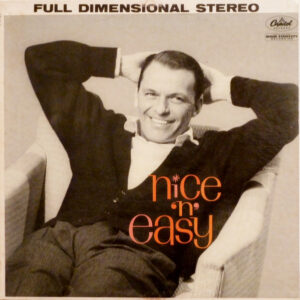
“Nice ‘N Easy” is the title song from Frank Sinatra’s eighteenth studio album, released in July 1960. It was a last-minute substitute for the originally planned “The Nearness Of You,” which did not appear on the original LP. It was co-written by Alan Bergman, Marilyn Bergman and Lew Spence.
Alan Bergman was born in Brooklyn in 1925. Marilyn Bergman was born in Brooklyn in 1929, and is the daughter of Edith and Alan Katz. Both were raised in Jewish families. In his early twenties, Alan Bergman worked as a television director and songwriter at WCAU-TV in Philadelphia. He was persuaded by Johnny Mercer to move to Los Angeles to advance his career as a songwriter. Marilyn Katz moved to Los Angeles, and after an injury that hampered her piano playing, she switched to songwriting. Alan and Marilyn met while collaborating with a fellow songwriter in LA. They married in 1958.
Alan and Marilyn Bergman wrote the title track for Dean Martin’s 1958 album Sleep Warm. And in 1960, Frank Sinatra recorded their song “Nice ‘n’ Easy”. The following year they wrote music for the film The Right Approach. They also wrote lyrics for the Haitian song, “Yellow Bird”, unrelated to a 19th-Century Haitian poem titled “Choucoune”. The Bergman’s “Yellow Bird” was recorded by Arthur Lyman in 1961 and reached #4 on the Billboard Hot 100. And in 1964 composed music for the Broadway musical Something More! In 1967 the songwriting couple wrote the title track for the movie In the Heat of the Night, starring Sidney Portier and Rod Steiger. In 1968, they wrote the song “The Windmills Of Your Mind” for the film The Thomas Crown Affair. Over the decades the Bergmans have written songs for 23 films. Most notably “The Way We Were” in 1973, for The Way We Were starring Barbra Streisand and Robert Redford. “The Way We Were” won Best Song at the 46th Academy Awards in April 1974. And in 1977 the Bergman’s co-wrote with Neil Diamond “You Don’t Send Me Flowers”. They also wrote “It Might Be You” for the film Tootsie. Other songs of note include “Pretty World” for Sergio Mendes win 1969. Alan Bergman died at the age of 99 in July 2025. Marilyn Bergman died in 2022 at the age of 93.
Lew Spence was born in Cedarhurst, New York, in 1920. Spence received little formal musical training, and led a dance band in his hometown as a teenager. He played piano and sang in his twenties, but did not publish any songs until he was almost 30 years old. For much of his career, he wrote melodies, but toward the end of the 1950s he devoted himself primarily to writing lyrics. His only charting hits were recorded by Frank Sinatra. In addition to “Nice ‘N Easy”, he wrote “So Long, My Love” with Sammy Cahn (peaked at ¢74 in 1957), and “‘Ol McDonald” (with Alan and Marilyn Bergman in 1960 and reached #11 in the UK).
“Nice ‘N Easy” is a song advising a couple newly dating to “hold your horses,” to not “hurry, relax and don’t you worry.” The narrator exudes confidence insisting “we’re gonna fall in love.” He frames the journey as being “on the road to romance.” But on that “road,” “let’s make all the stops along the way.” After all, “to rush would be a crime. ‘Cause, nice and easy does it every time.”
“Nice ‘N Easy” peaked at #1 in Sudbury (ON), Schenectady (NY) and Albany (NY), #5 in Rochester (NY), #8 in Rockville (IL), and Potsdam (NY), #10 in Wheaton (MD), and Washington DC. Internationally, the song peaked at #15 in the UK.
In 1961, Sinatra received four Grammy Award nominations for the single, “Nice ‘n’ Easy”, and one for Album of the Year for Nice ‘n’ Easy. It was won by Bob Newhart. Others include Best Male Performance for a Single Record or Track, Best Male Performance for an album, and Best Performance by a Pop Single Artist. In each of these categories in 1961, Ray Charles won all three.
In 1962, Sinatra received another Grammy Award for “The Second Time Around” for Record of the Year. That year he appeared in the Academy Award nominated film The Manchurian Candidate. In 1963, Frank Sinatra received a Best Actor nomination at the Golden Globe Awards for his role in the comedy film Come Blow Your Horn. At the April 8, 1963, 35th Academy Awards, Frank Sinatra was the host of the event.
In 1966, Sinatra won a Grammy Award for Best Vocal Performance, Male for “It Was A Very Good Year”. The song topped the Adult Contemporary chart in the USA. As well, he won a Grammy Award for Album of the Year for September of My Years. In 1966, Frank Sinatra had a comeback with “Strangers In The Night” which reached #1 on the Billboard Hot 100. In 1967, he won a Grammy Award for the song in both categories Best Vocal Performance, Male, and Record of the Year. He also won an Album of the year Grammy Award for A Man And His Music.
He followed up with three more Top 30 hits: “Summer Wind” (#25) which was a #1 Adult Contemporary chart hit, “That’s Life” (#4) which was another #1 Adult Contemporary chart hit, and “Something Stupid” in a number-one duet on the Hot 100 with his daughter Nancy Sinatra. The latter recording earned Frank and Nancy Sinatra a Grammy nomination for Record of the Year. In 1967, Frank Sinatra had his sixth consecutive number-one hit on the Billboard Adult Contemporary chart with “The World We Knew (Over And Over)”.
In 1968, Sinatra received two Grammy Award nominations for Francis Albert Sinatra & Antônio Carlos Jobim in both categories Best Vocal Performance – Male, and Album of the Year.
In 1970, Frank Sinatra earned a Grammy nomination for Best Contemporary Vocal Performance – Male for “My Way”. And in 1997, he received a second Grammy nomination for “My Way” in the Best Pop Collaboration with Vocals in a duet with Luciano Pavarotti.
His final Top 40 hit was in 1980 with “Theme From New York, New York” which peaked at #32 in the USA and #4 in the UK. For the recording, he received two Grammy Award nominations for Record of the Year, and in the Best Pop Vocal Performance – Male category.
In addition, Frank Sinatra had charted three holiday singles into the Top 20: “Jingle Bells”, “White Christmas” and “Have Yourself A Merry Little Christmas”.
Over the decades, Sinatra appeared in over sixty films. In 1970 he received the Jean Hersholt Humanitarian Award at the Academy Awards for his “outstanding contributions to humanitarian causes.” And in 1971, Sinatra was honoured at the Golden Globe Awards with a Cecile B. DeMile Award for Lifetime Achievement. In 1975, Frank Sinatra co-hosted the 47th Academy Awards on April 8, at the Dorothy Chandler Pavilion in Los Angeles.
In 1995, Frank Sinatra won a Grammy Legend Award. That year he received a Grammy Award nomination in the Best Traditional Pop Vocal Performance category for the album Duets. Then in 1997 he won a Grammy Award in the same category for the album Duets II.
As well, Frank Sinatra has received three stars on the Hollywood Walk of Fame. One in the Motion Pictures category (1600 Vine Street), a second in the Recording category (1637 Vine Street), and a third in Television (6538 Hollywood Blvd). Over the decades, Frank Sinatra appeared in concert in Canada on occasions. This includes appearances in Calgary, Gander (NL), Hamilton, Montreal, Ottawa, Stephenville (NL), Toronto and Vancouver.
Over the decades, Sinatra appeared in over sixty films. In 1998, Frank Sinatra died at the age of 82.
August 31, 2026
Ray McGinnis
References:
“Frank Sinatra Obituary,” BBC, May 16, 1998.
Tony Oppedisano, Sinatra and Me: In the Wee Small Hours, (Scribner, 2021).
Kitty Kelley, His Way: The Unauthorized Biography of Frank Sinatra, (Bantam, 2010).
Robert Sullivan, Remembering Sinatra: A Life in Pictures, (Time Life Education, 1998).
Charles L. Granata with Nancy Sinatra, Sessions with Sinatra: Frank Sinatra and the Art of Recording, (Chicago Review Press, 2003).
“Frank Sinatra – Concert dates – Canada,” setlist.fm.
Michael Pitts and Frank Hoffman, The Rise of the Crooners, (Scarecrow, 2002).
“Heart Attack Kills Publisher Sanicola,” Billboard, October 19, 1974.
Bruce Haring, “Marilyn Bergman Dies: Multiple Oscar-Emmy- & Grammy-Winning Lyricist Was 93,” Deadline, January 8, 2022.
Greg Evans, “Alan Bergman Dies: Co-Lyricist With Wife Marilyn Of “The Way Were Were”, Many Film & TV Themes Was 99,” Deadline, July 18, 2025.
Leave a Reply