
#183: Baby Come Back by the Equals
City: Windsor, ON
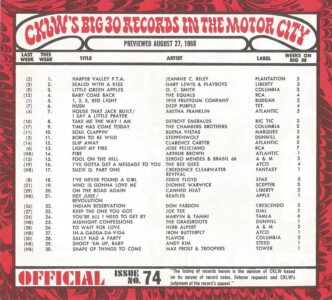
Radio Station: CKLW
Peak Month: August 1968
Peak Position in Windsor ~ #4
Peak Position in Vancouver ~ #7
Peak Position on Billboard Hot 100 ~ #32
Peak Position on Belgian Singles chart ~ #1
Peak Position on Rhodesian Singles chart ~ #1
Peak Position on South African Singles chart ~ #1
Peak Position on UK Singles chart ~ #1
Peak Position on French Singles chart ~ #2
Peak Position on Irish Singles chart ~ #2
Peak Position on Norwegian Singles chart ~ #4
Peak Position on Dutch Singles chart ~ #6
YouTube: “Baby Come Back”
Lyrics: “Baby Come Back”
Eddy Grant, Pat Lloyd and John Hall were school friends at Acland Burghley. Eddy Grant was born in 1948 in Guyana. John Hall was born in 1946 in London. While Pat Lloyd was born in London in 1949. In late 1964, John Hall suggested that they form a band. Hall played drums, Grant was on lead guitar, and Pat Lloyd on rhythm guitar. They added Derv Gordon on vocals, and Lincoln Gordon on rhythm guitar. Derv Gordon was born in Jamaica in 1946, and Lincoln Gordon was born in Jamaica in 1948. The bi-racial band named themselves the Equals. Edmond “Eddy” Montague Grant’s father, Patrick, was a trumpeter who played in a band called Nello and the Luckies. Grant’s parents moved to England to work. They would send money back to Guyana for Eddy Grant’s education. In 1960, he and his brother joined their parents in the Kentish Town area of London.
At first the Equals performed in London, and gained a following “with their apparently limitless energy and a distinct style fusing pop, blues, and R&B plus elements of ska and bluebeat.” They often opened the bill at shows by visiting American R&B and soul artists such as Bo Diddley, Solomon Burke and Wilson Pickett. A neighbour of Grant’s, singer Gene Latter, put them in touch with President Records, whose boss Edward Kassner heard them and agreed to sign them.
In 1966, the Equals released “I Won’t Be There” as their debut single. It failed to chart. Their next effort, “Give Love a Try”, reached #52 on the UK pop singles chart. A third single failed to chart, but “I Get So Excited” cracked the Top 50 in the UK climbing to #44. On their second album, “Police on my Back” was later covered by The Clash. However, it was their fifth single release that put The Equals on the radar of pop music listeners around the world. The song was titled “Baby, Come Back”.
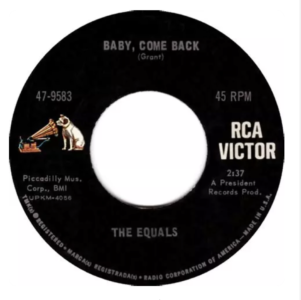
Eddy Grant wrote “Baby Come Back”. The song is about a guy who admits to his girlfriend “I shoulda not been out flirting.” He wants her to give him “a second chance.” His admission comes when he discovers “for the first time” that his sweetheart “has run away.” He pleads, “I’m asking you for the first time, love me enough now to stay.” The upset she has because he was flirting has her crying. He counters, “there ain’t no use in you crying, ’cause I’m more hurt than you.” He contends “now my love is true.” And so the chorus goes:
“Come back, baby come back…”
“Baby Come Back” climbed to #1 in Erie (PA), and Florence (SC), #3 in Fresno (CA), Indianapolis (IN), Columbus (OH), and San Diego, #4 in Detroit, Geneva (NY), Windsor (ON) and Akron (OH), #5 in Lansing (MI), Scranton (PA), and Saint Charles (MO), #6 in Toronto, Reading (PA), Endicott (NY), Bakersfield (CA), Los Angeles, and Cleveland, #7 in Vancouver (BC), Waterville (ME), Pittsburgh, Buffalo, Orlando, and Cincinnati (OH), #8 in Logan (UT), Grand Rapids (MI), and Syracuse (NY), #9 in Boston, Salt Lake City, and San Bernardino (CA), and #10 in Battle Creek (MI) Memphis, and Lincoln (NE).
Internationally, “Baby Come Back” reached number-one in Belgium, Rhodesia, South Africa and the UK. Elsewhere it climbed to #2 in France and Ireland, #4 in New Zealand and Norway, #6 in the Netherlands, #9 in Canada, #11 in Australia and West Germany, and #32 on the Billboard Hot 100 in the USA.
In 1994, British reggae singer Pato Banton covered “Baby Come Back”. His version reached number-one in New Zealand, Scotland and the UK. Elsewhere it reached the Top Ten in Belgium, Ireland, the Netherlands, and across Europe.
Later in the fall of 196, The Equals “Softly Softly” climbed to #8 in South Africa and also charted in Toronto. A Top 30 hit in the UK in 1969, “Michael and The Slipper Tree”, reached #9 in Ottawa. While “Viva Bobby Joe” became a #3 hit in Ireland, #6 in the UK, #9 in South Africa, and a Top Ten hit in Fredericton, New Brunswick.
A final charting single in the UK was “Black Skin Blue Eyed Boys”. It was released in December 1970, and peaked at #9 in the UK in early 1971.
In September 1969, all five group members were injured in a motorway car accident in Germany. Grant was the most severely injured and as a result left the touring version of the Equals while initially continuing to write songs for them. In January 1971, Grant suffered a collapsed lung and heart attack, following which he returned to Guyana. He soon started to pursue a solo career.
John Hall left the band in 1974. The Equals disbanded in 1979.
The Equals were reformed in 1984 with Pat Lloyd, Derv Gordon, and Lincoln Gordon three original bandmates, along with two newer members (Ronnie Telemacque on drums, and Rob Hendry on lead guitar).
Eddy Grant released his debut self-titled album in 1975. In 1979, his single “Walkin’ On Sunshine” was not a hit. But it was covered in 1982 by Rockers’ Revenge reached #4 on the UK pop singles chart. In the winter of 1980-81, Eddy Grant’s single “Do You Feel My Love” reached number-one in Argentina. It made the Top 5 in France, New Zealand, Sweden and Switzerland. As well, it was a strong seller in Belgium, Finland, Ireland, Israel, the Netherlands, South Africa, Spain, the UK, West Germany and Zimbabwe. In 1982, “I Don’t Want To Dance” topped the pop charts in Belgium, Ireland, New Zealand, South Africa, Switzerland and the UK. Elsewhere, the single peaked at #2 in Austria and the Netherlands, and #7 in West Germany.
However, it was Eddy Grant’s release of “Electric Avenue” in 1983 that made him an international sensation. The record topped the pop charts in Fredericton (NB), Hamilton (ON), Kitchener (ON), Oshawa (ON), Ottawa, Regina, Toronto and Winnipeg. It reached #2 in Halifax (NS), Saskatoon (SK), Sherbrooke (PQ), and Vancouver, and #3 in Montreal and Windsor (ON). The song topped the pop charts in Canada and the USA, and was a Top Ten hit in Australia, Austria, Belgium, Ireland, the Netherlands, South Africa, Sweden, Switzerland, the UK, and West Germany. It was nominated for Best R&B Song in 1983, at the Grammy Awards. But it lost to Michael Jackson’s “Billie Jean”.
In 1984, Eddy Grant recorded the theme song for the film Romancing The Stone. It peaked at #7 on the Canadian RPM Top 100 Singles chart and was featured on his album Going For Broke. In 1988, Grant released the anti-apartheid single “Gimme Hope Jo’anna”. It topped the pop charts in Belgium, Italy, the Netherlands, Spain and Zimbabwe. It also made the Top 5 across Europe, as well as Austria, Finland, New Zealand, Spain, Switzerland, and West Germany. In 2008, Eddy Grant performed at Nelson Mandala’s 90th birthday celebration. In 2017, Eddy Grant released his 16th studio album titled Plaisance. In 2024, Grant was awarded the Honorary Order of Freedom in Barbados.
September 14, 2026
Ray McGinnis
References:
Aidan Vaziri, “The Equals’ Derv Gordon returns with classic soul,” San Francisco Chronicle, July 26, 2017.
Jason Heller, “Black Skin Blue Eyed Boys: The Story of Pioneering Interracial Rock Band the Equals,” Pitchfork, July 18, 2016.
Eddy Grant, “Do You Feel My Love“, Ensign Records, 1980.
Adam Harris, “Eddy Grant – the Ringbang man and a national icon is a ‘Special Person’,” Kaieteur News, Guyana, March 3, 2013.
CHUM 1050-AM Toronto (ON) | September 21, 1968
Leave a Reply