
#123: The Politics Of Dancing by the Re-Flex
City: Montreal, PQ
Radio Station: CKOI
Peak Month: March 1984
Peak Position in Montreal ~ #2
Peak position in Vancouver ~ #17
Peak Position on Billboard Hot 100 ~ #24
YouTube: “The Politics Of Dancing”
Lyrics: “The Politics Of Dancing”
Re-Flex were formed in 1981 by musicians John Baxter on vocals and lead guitar and Paul Fishman on keyboards and backing vocals. Paul Fishman’s father, Jack Fishman, was a songwriter who had a number of hits to his credit. These included “Arrevederci Darling” by Anne Shelton (Top 20 in 1955); “Why Don’t They Understand” for George Hamilton IV (#10 in the USA in 1957); “My Friend The Sea” for Petula Clark (#7 in the UK in 1961); “If I Only Had Time” for John Rowles (#3 in 1968 in UK); “Help Yourself” for Tom Jones (#5 in the UK in 1968); “Something’s Happening” for Herman’s Hermits (#6 in 1968 in the UK); And “If Paradise Is Half As Nice” for the Amen Corner (a number-one hit in the UK in 1969). Given his father’s success, Paul Fishman saw a future in the music business, and at age 16 decided to pursue music as a career.
In a 2012 interview on the Kickin’ It Old School blog, Paul Fishman recalled “My earliest influences came from the music I heard my father play Ray Charles, Ella (Fitzgerald) but the radio and particularly Radio Luxembourg became pretty essential listening as it was to so many young kids and potential musicians during this time. I suppose one of the first things to rock my world was when I heard The Beatles’ early releases. I remember going to a fair and hearing “From Me to You” and “Please Please Me” loud and being totally impressed with how good it sounded. It is significant that the first records I ever bought was “From Me to You” and also “Just One Look” by the Hollies.”
Fishman relates how Re-Flex began. “I was producing some records for MCA and they introduced me to Robin Scott, from M (who had the number-one hit) “Pop Muzik”. They were interested in us collaborating and consequently I was introduced to some of the musicians who Robin was working with and that included John Baxter.” Fishman told Rediscover the 80s.com, “Re-Flex came from Re-Fuse. The band’s name was inspired by a graffiti artist in London who tagged his work with RE-FUSE.”
There were a few lineup changes and finally Roland Vaughn Kerridge took over on drums. Musician Thomas Dolby introduced the band to bass player Nigel Ross-Scott, as he had previously worked with him in the post-punk band Bruce Woolley & The Camera Club. Re-Flex’s classic line-up consisted of Baxter, Fishman, Kerridge and Ross-Scott. In late 1982, the band recorded their debut album, The Politics of Dancing, which was released in November 1983 by EMI Records. The album reached the Top 30 on the pop charts in Canada, the Top 40 album chart in New Zealand, and was a modest seller in Australia, West Germany, and the USA.
The title track from the album, “The Politics of Dancing”, was released as a single.
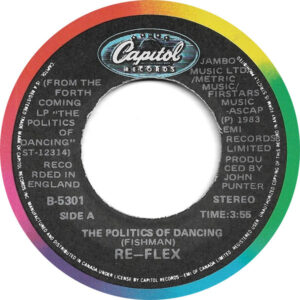
Bandmate Paul Fishman wrote “The Politics of Dancing”. On the lyrics, Fishman said, “The sentiment of the song is really about the power of when people come together and express themselves through dancing and letting go. During the ’80s, it was in its very early days but in the latter part of the decade the rave scene was pretty much the message in a nut shell. No, I don’t think people generally understand messages but some get it so that’s alright.”
The opening verse announces:
We got the message,
I heard it on the airwaves.
The politicians are now DJs.
The broadcast was spreading,
station to station,
like an infection across the nation.
The song celebrates dancing as a political statement. The energetic of dancing at a club eclipses the hum-drum of being lied to by the media or politicians and being focused on that trajectory. As Re-Flex recommended:
The politics of dancing.
The politics of, ooh, feeling good.
The politics of moving, aha.
Is this message understood?
In the first video for “The Politics of Dancing”, Fishman recalls, “It opened with a screen reading, “Meanwhile… The airwaves are humming with the sound of Re-Flex Radio who are transmitting from a secret hideout in the heart of metropolis. From far and wide the forces of evil are gathering. Their mission to seek out and destroy. The story continues…” A second video was made after the band wasn’t satisfied with the first. Fishman notes, “all that stuff in the video was a bit silly and on reflection Bax will never forgive Vaughn for making him wear the moustache. A lot of the video is about my interest in Pirate radio and the idea of the existence of an underground culture somewhere outside of the control of the authorities.” As an aside, Fishman mentioned “Although there has been much said about the association of music and drugs, little reference is made to the vast quantity of tea that is consumed… particularly common among English musicians. Loads of (UK) musicians are out the closet tea drinkers and would recommend it as a good alternative to smack or alcohol, particularly if they are keen on survival.”
In the lyrics of “The Politics of Dancing” lines happen to include “station to station,” and “under pressure.” Were these shout outs to the David Bowie’s 1976 album, Station to Station, the 1979 Bowie hit “D.J.” and the Bowie-Queen 1982 hit “Under Pressure”? John Baxter told John Lamoreaux on The Hustle podcast that it’s very probable that those references crept into the lyrics as the bandmates were fans of Bowie.
“The Politics of Dancing” climbed to #2 in Montreal, #4 in Ottawa, and Sherbrooke (PQ), #6 in Buffalo, and Boston, #8 in Seattle, #9 in Toronto, and Pittsburgh, and #10 in Minneapolis/St. Paul and Cleveland. Internationally, the single reached #12 in Australia and New Zealand, #13 in Canada, #19 in South Africa, while it cracked the Top 30 in Ireland, Switzerland, the UK, USA, and West Germany.
At the time, there were a number of songs about dancing on the pop charts. These include “Dancing in the Sheets” by Shalamar (1984), “No Parking (On the Dance Floor)” by Midnight Star (1984), “Come Dancing” by The Kinks (1982), “Private Dancer” by Tina Turner (1984), “Flashdance (What A Feeling)” by Irene Cara (1983), “Neutron Dance” by The Pointer Sisters (1984), “Dance Hall Days” by Wang Chung (1984), “Dancing With Myself” by Billy Idol (1981), “Dancing In the Dark” by Bruce Springsteen (1984), “Let’s Dance” by David Bowie (1983), and “The Safety Dance” by Men Without Hats (1983), “Dancing On the Ceiling” by Lionel Ritchie (recorded in 1985), “All She Wants to do is Dance” by Don Henley (recorded in 1984), and “Dancing In the Street” by David Bowie and Mick Jagger (1985). In the mid-80s it was hard not to get up on the dance floor and dance to a song with lyrics about dancing.
Re-Flex enjoyed a season of fame due to MTV. Paul Fishman states, “Image became the only goal for record companies because this is what they believed sells. Sexy, young, virile, are considered to be good brands, with musical talent being optional. MTV quickly became a success and a vital tool for the American music industry. The power of television cannot be denied and the impact MTV had upon music in America and later around the rest of the world was immense.” Re-Flex opened for The Police on a leg of that band’s last tour in 1983-84. The Police performed 105 concerts in three continents. Re-Flex opened for The Police at concerts in February 1984, in Syracuse (NY), Providence (RI), Atlantic City (NJ), Charleston (WV), Memphis (TN), Williamsburg (VA), Buffalo (NY), Carbondale (IL), Cincinnati (OH), Rosemont (IL), and Greensboro (NC).
A followup release from the album was “Hitline”, which was a commercial flop. “Hurt” was a minor charting single, stalling at #82 on the Billboard Hot 100. While “Praying to the Beat” made the Top 50 in New Zealand, though it barely cracked the Top 100 Singles chart in the UK. The fifth track released as a single from the debut album, “Couldn’t Stand a Day”, stalled at #97 on the UK chart. A sixth track from the album, “Sensitive”, failed to chart.
Recorded in late 1984 and planned for a release in February 1985, Humanication was to be Re-Flex’s follow-up album. The only single released from the album, “How Much Longer”, was a minor hit in Germany. The song discussed the topic of environmentalism, and featured Sting on backing vocals. Despite positive response, the record was pulled by EMI and deemed too political by the US company. Soon after, Re-Flex left EMI.
Paul Fishman reflects on why Re-Flex only had one Top 30 pop hit. He explains, “There are loads of reasons and little to do with the music we were making. I consider some of our best material was recorded after. Maybe the politics of dancing (not the song) got in the way. We were considered to be somewhat dangerous compared to most artists and that was not easy for an industry that is based on conformity. I should say by dangerous I mean not necessarily confrontational but more in a questioning way. We also shared different values and interests to most artists and that like with others set us apart.”
In spite of the turmoil, Re-Flex continued to record together, working on a new project entitled Jamming the Broadcast. During this period, the band also recorded two tracks, “Life’s Too Dangerous” and “Revolution Now,” for the soundtrack to the 1987 film Superman IV. After recording was completed, the group ceased actively working together, but never officially disbanded.
According to a September 2012 interview with Paul Fishman, drummer Roland Vaughn Kerridge died in February of that year after undergoing three rounds of surgery for a brain tumor. Kerridge was able to record one final song in a brief reformation of the classic Re-Flex lineup (minus bassist Nigel Ross-Scott) prior to his death. Fishman states that the band intends to release this final track, “Vibrate Generate” as a single and the title track of a new compilation album.
On May 23, 2022, Paul Fishman announced through Re-Flex’s various social media platforms that the band’s long-anticipated final track with Kerridge, “Vibrate Generate”, would be released in June, both as a digital single and as part of a double-CD album of the same title. The single became available for download through all major online digital music platforms on 17 June 2022. The double-CD became available through the Cherry Red Records website on June 24, 2022. It is a compilation of re-mixes of previously released tracks and new material.
July 24, 2026
Ray McGinnis
References:
John Lamoreaux, “Baxter of Re-Flex,” The Hustle, Denver, Colorado, 2015.
“Re-Flex,” Jazzrocksoul.com.
“Interview with Paul Fishman from Re-Flex,” Kickin’ It Old School Blog, September 12, 2012.
“Re-Fuse: The Stage of History, The Only One Worth Playing,” Re-flex.com.
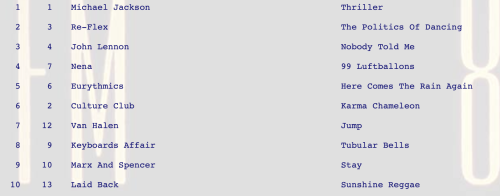
CKOI 96.9-FM Montreal Top Ten | March 9, 1984
Leave a Reply