
#60: Manhattan by G’race
City: Montreal, PQ
Radio Station: CKOI
Peak Month: June 1984
Peak Position in Montreal ~ #1
Peak position in Vancouver ~ did not chart
Peak Position on Billboard Hot 100 ~ did not chart
YouTube: “Manhattan”
Lyrics: “Manhattan”
The music group Grace was founded in 1968 by guitarist Henk van der Burgh and his two brothers Frans (singer and guitarist) and John (singer and keyboardist). Other band members at the time were Ronald Dobber on drums, and Guido Collard on bass guitar. In the early years the group often performed on North Holland stages as a cover band. In 1970, brothers John and Frans van der Burgh left the group. Their places were taken by singer and keyboard player Ed Kemperman and ex-Funfair member singer, saxophonist and guitar player Peter de Wijn. Grace made its debut on vinyl in 1975 with the single “I Hear Music”. But it was not a hit. A year later the second single, “Jamaica”, was released.
In 1977, Henk van der Burgh returned, who had previously left the band and been replaced by ex-Funfair singer and guitar player Jan van Droffelaar. In 1979, lead singer Gerda van den Outenaar, who was previously active under the stage name Jennifer, joined the band. On the other hand, bass guitarist Collard left, so Henk van der Burgh now took over his position. De Wijn was now a composer for various artists and founded his own record label, YaYa Records. A year later, Kemperman also decided to resign and was succeeded by John Hoogland on vocals, guitar and keyboards, who came from the group Amphora.
The single “Manmade In Japan”, was released in 1981 on Ya Ya Records. It drew the first serious attention for the band. In 1983, the band name Grace was changed to G’race and a contract was signed with record company WEA. The first single released on this label, was “Manhattan”.
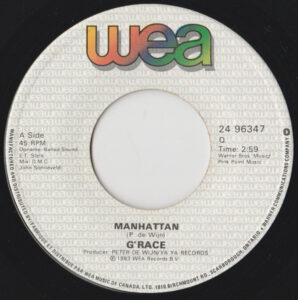
Written by Peter de Wijn, “Manhattan” notes people want “all the highs without the lows.” However, “that’s not the way life goes.” The lyrics continue:
they’re all part of the hunting set.
“Applejack(s)” here is not the cereal or the apple brandy. It refers to a hat style: historically (in mid-20th-century US Black slang) a large-brimmed or oversized hat, and more commonly in fashion contexts an 8-panel newsboy/cabbie/Gatsby-style cap (sometimes called an “applejack” or “Big Apple” hat). These were (and still are) associated with a distinctive, somewhat flashy or vintage-urban look.

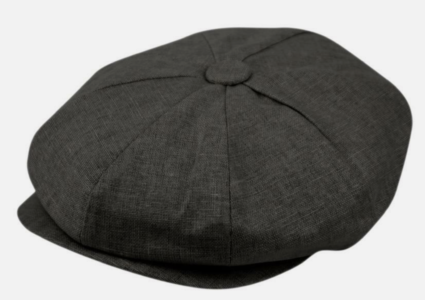

Several styles of “applejack” hats or dusters.
The song also carries advice from a mother “Mama said ‘don’t turn your head. Keep it cool girl, don’t look back. Treat them right and they will bite. Boys don’t loose their appetite.” This is clearly not advice from a mother who is pious or a prude. This “mama” wants her daughter to get out on the town and make her moves in the dating scene.
“Manhattan” reached #1 in Montreal and #3 in the Netherlands.
A new album was also released, Junglebeat. Later singles “Dr. Rhythm” and “Jay-O-Dee” both charted, but did not become big hits. “Nothing in This World” and “Ayobuwan” both stalled in the Dutch Top 20. There was no output from the group for the next three years. Meanwhile, De Wijn did very well individually as a composer and producer of Koos Alberts and Gerard Joling. With Joling, De Wijn had a 1985 number-one hit on the Dutch pop chart titled “Ticket to the Tropics”, and a #4 hit titled “Shangri-La” which was also the Dutch entry for the 1988 Eurovision contest.
After three years of silence, G’race released a new album, Color Locale. “Never Felt this Way Before” climbed to #9, “Southern Rain” reached #5, and “Calypso Round the Clock” peaked at #8 on the Dutch pop charts. Gerda Van den Outenaar and Peter De Wijn had also started a relationship.
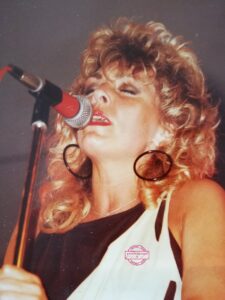
Gerda Van den Outenaar

Peter De Wijn
In 1991, “Don’t Keep Me Waiting” was a minor Dutch pop hit. And in 1995, the single “Rhythm of Your Heart” became the groups 21st and final release. The CD Beach Club, G’race’s sixth studio album was also released. Five years later, Gerda Van den Outenaar released the single “Music from Venus” under the name Shaken and Stirred.
Most commentaries online about G’race, and members of the group, are written in Dutch.
September 5, 2026
Ray McGinnis
References:
“Applejack,” Greens Dictionary of Slang.
Gerard Joling, “Ticket to the Tropics“, WEA, 1985.
Gerard Joling, “Shangri-la“, WEA, 1988.
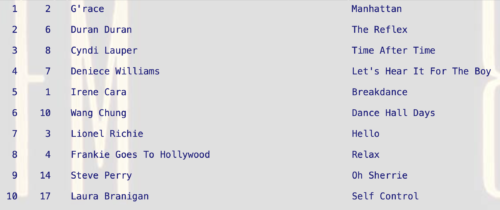
CKOI 96.9-FM Montreal (PQ) | June 15, 1984
Leave a Reply