
#6: Silhouettes by Steve Gibson and the Red Caps
City: Smiths Falls, ON
Radio Station: CJET
Peak Month: November 1957
Peak Position in Smiths Falls ~ #2
Peak Position in Vancouver ~ did not chart
Peak Position on Billboard Hot 100 ~ #63
YouTube: “Silhouettes”
Lyrics: “Silhouettes”
On his website, Marv Goldberg writes “In the music world of the late 30s and early 40s, there were many pioneer black vocal groups, all of whom owed a common debt to the Mills Brothers and Ink Spots. However, other influences were also apparent in their styles. Swing and big band jazz had a tremendous impact in the 30s, and myriad small combo jazz and jive groups resulted, often with members drawn from the larger orchestras. In parallel with this trend were the vocal groups that evolved from these combos in the 30s. In them, all members played (and vocally imitated) instruments besides singing – a combination that all but disappeared from R&B by the middle 50s. It was in this atmosphere that the group later known as the 5 Red Caps was born. While there were vocal groups in all cities with large black populations, in the 1930s many of them flocked to the Los Angeles area because, in addition to niteclubs, theaters, and radio, there were also opportunities to work in films and cartoon soundtracks. Three of these groups had a hand in the formation of the Red Caps: the original Basin Street Boys, the 4 Blackbirds, and the 5 Jones Boys. In 1938, they would coalesce into the 4 Toppers, the predecessor to the Red Caps.”
Steve Gibson, George Thompson, Perry Anderson, and Sam Hutcherson began as the 4 Dots in the early 1930s in Lynchburg, Virginia. Steve Gibson was born in 1915. Though they’d never been to New Orleans, they were renamed the Basin Street Rhythm Boys in 1935. The following year they travelled to Los Angeles in search of fame. In August 1936, they were one of 1500 acts who entered a talent contest on a radio program called California’s Hour. The contest was aired over ten days. The Basin Street Boys were one of the six winning acts and got to perform on the August 10, 1936 airing of the show. They were advertised as “the Basin Street Boys, Negro quartet from Virginia”. They subsequently appeared in the Fred Astaire and Ginger Rodgers movie Shall We Dance, and in Swing Monkey Swing. In 1938, they appeared in The Isle Of Pingo Pongo which was a Warner Bros. cartoon where they sang “Sweet Georgia Brown”.
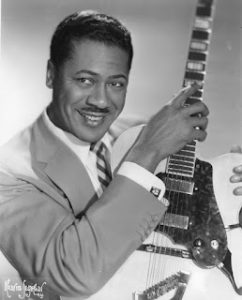
Steve Gibson
In 1938, with the Basin Street Boys, the 4 Blackbirds, and the 5 Jones Boys each disbanding, a new group was formed called the 4 Toppers. Jimmy Springs on tenor and drums was from the 5 Jones Boys, David Patillo (second tenor and sometimes guitarist and bassist – from the 4 Blackbirds), Richard Davis (baritone and bassist – from the 4 Blackbirds), Steve Gibson (bass and guitarist – from the Basin Street Boys). As such they appeared in four movies between 1939 and 1940. In 1940, the Four Toppers appeared in an all-black horror film Son of Inagi.
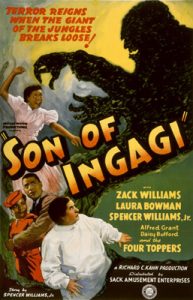
The Four Toppers perform a couple of songs for a bride and groom: “So Long Old Pal” and “You Drove the Groom Away”, starting at eight minutes into the film.
In 1942, the Four Toppers appeared in the USO show Harlem On Parade.
They began to record in 1943 as the 5 Red Caps. (In a November 14, 1953 Valley Times in North Hollywood wrote, “Steve Gibson, head of the Red Caps, currently starring at the Tiffany Club, adopted their name from the porters’ caps and suitcases they used in their now famous introduction number.” The group word red caps as part of their act).
In 1944, billed as the 5 Red Caps, the Vocal group charted “Boogie Woogie Ball”, “Just for You” and “No One Else Will Do” each to #10 on the Billboard R&B chart. They had a fourth Top Ten R&B hit that year titled “I Learned A Lesson I’ll Never Forget”. It peaked at #14 on the Billboard pop charts, #2 on the Country charts, and #3 on the R&B chart. They revised “Mary Had A Little Lamb” in 1945 as “Mary Had A Little Jam” who consequently “knocked herself right out” from playing with the band.
In mid-1945, the Five Red Caps returned to the studio, recording another batch of songs including “You Thrill Me” and “My Everlasting Love for You.” Few of these records generated airplay, but the group nevertheless toured the national theater circuit, headlining supper clubs across the U.S., and at the El Mocombo in Montreal. They appeared on stage for concerts and radio shows variously with Peggy Lee, Skitch Henderson, Louis Armstrong, Roy Milton, Sophie Tucker, Jack Carter, Tony Bennett, Jane From an, Jackie Gleason, Joey Grey, Nat “King” Cole, Sid Cesar, Edith Piaf, the DeCastro Sisters, Georgie Jessel, the Treniers, Tony Martin, Al Martino, Mickey Rooney, Connie Boswell, Georgia Gibbs, Sammy Kaye, Jane Morgan, Russ Morgan, Art Lund, and many others.
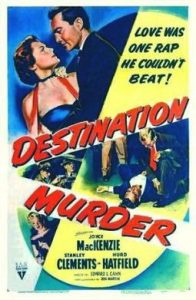
In late 1949, the group made a TV film called Excess Baggage, a Rudy Vallee production that featured them as red caps baggage handlers. They recorded “Blueberry Hill” and it climbed into the Top Ten on the pop charts in Pittsburgh and Trenton (NJ). While “I Love You” reached #3 on WCPO-AM on the pop chart in Cincinnati (OH). In the spring of 1950, “Sentimental Me” reached #2 on the pop chart on Philadelphia’s WHAT-AM. The Red Caps appeared in the RKO film Destination Murder, released in June 1950, singing “Let’s Go To A Party” and “Palace Of Stone” billed as Steve Gibson’s Redcaps.
In 1950, Steve Gibson’s Original Red Caps recorded an amusing version of “The Thing” which was topping the pop charts for Phil Harris. In March 1951, Damita Jo became a featured singer with Steve Gibson and his Red Caps. In 1951, “Sidewalk Shuffle” reached #7 on the pop chart in Richmond, Virginia. In 1952, “Two Little Kisses” reached #9 on the pop chart in Rochester (NY). As well, “I May Hate Myself In The Morning” was a Top Ten pop hit in Chicago, Philadelphia, and Tucson (AZ). In 1952, the group recorded “I Went To Your Wedding” which peaked at #20 nationally, and number-one on the pop chart in Philadelphia. “I Went To Your Wedding” was first a #3 country hit for Hank Snow, and then a chart-topping pop hit for Patti Page. Steve Gibson made a new recording of the song in 1960 which charted in Philadelphia and Trenton (NJ).
In 1953, Steve Gibson and Damita Jo were married.
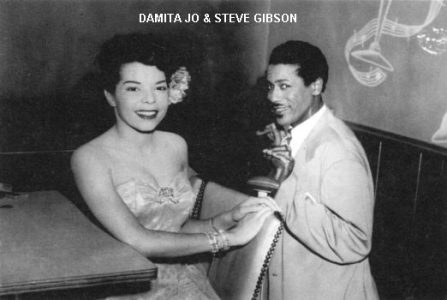
Steve Gibson’s Red Caps had television exposure in the 50s, on the Jackie Gleason Show, Arthur Godfrey And Friends, and Ed Sullivan’s The Toast Of The Town.
Over the years the lineup for Steve Gibson and The Red Caps changed constantly.
Here is a photo of the (ever-revolving) group in the summer of 1955: Steve Gibson, Bobby Gregg, Jimmy Johnson, David Patillo, Jimmy Springs, Jay Price, Henry Tucker Green, Gene Redd Sr., and Walkin’ Willie Smith.
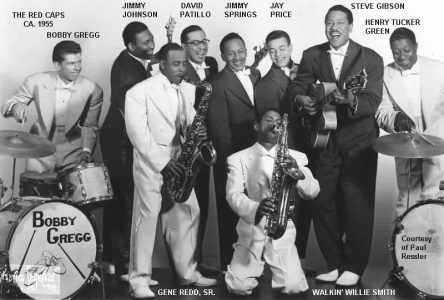
Henry Tucker Green was a member of Lester Young and His Band between 1946 and 1952. He was simultaneously with Helen Humes and Her All-Stars that recorded a half dozen singles between 1946 and 1950. In addition, he was also with Gene Gilbeaux’s Orchestra in the late ’40s. Green played drums on recordings by Jimmy Witherspoon. He also wrote songs recorded by King Pleasure, and was a sideman with The Treniers. As well, Henry Tucker Green was with former 5 Red Caps member Romaine Brown’s band Romaine Brown and His Romaines.
Marv Goldberg writes, it was “In late 1952 (that) white baritone, comedian, and dancer James “Jay” Price (recalls), “I had been working around Philly for a few years: the 2-4 Club, the Celebrity Room, and any other saloon that would hire me. A friend of mine that owned a record store and also acted as my manager, named Nick Pertrillo, said ‘Why don’t you go and see Steve Gibson. He’s always looking for something new.’ I sang, did comedy, and impressions. I went to Lee Guber’s joint on Walnut Street in Philadelphia and auditioned. That was on a Saturday night in October 1952. That Monday, I opened with the group at Harry Altman’s Town Casino in Buffalo, New York and stayed with the group until 1958.” Interestingly, Jay says, “In the early years, Steve may have had a black following, but when I joined the group in 52, I can only think of one black club that we worked with the group, and that was the Flame Show Bar in Detroit around 56 or 57. The rest of the time we worked Vegas, Miami, New Jersey.”
Here is a photo of the Red Caps who showed up to perform with Sammy Davis Jr. in the fall of 1955.
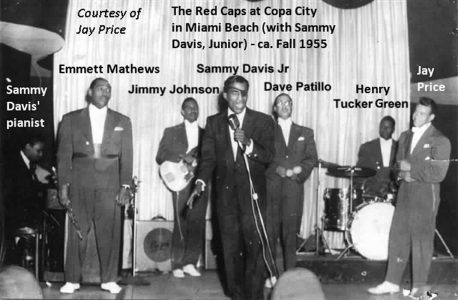
Emmett Matthews led his own band in the 1930s and recorded as a sideman with Fats Waller in the mid-30s.
Jimmy Johnson was formerly with Chris Powell & the Blue Flames, as well as concurrently with the Treniers, and the Romaine Brown and His Romaines.
A March 21, 1956 review of a show at the Gatineau Club in Ottawa, the Ottawa Journal printed this review: “Old fuddy-duddies like myself who prefer the waltz or fox trot to rock and roll may block the ears when Steve Gibson and his lads let loose, but the younger crowd scream with delight. Quite honestly, the Red Caps are a torrid lot, and put on a bang-up show. They have mellow numbers like Great Pretender and Blueberry Hill, but the highspots remain Dig You Later Alligator [sic], Ain’t That A Shame, and Four Or Five Times. A drum interlude by Bobby Greggs [sic] socks you right between the teens and twenties. Damita Jo, RCA Victor recording artist, is cute and dark-haired. Her best number is the too-good-for-the-hit-parade Cry Me A River. In dazzling white bouffant gown she makes a pretty picture on stage. Music for dancing is supplied by the Red Caps too. In more restrained fashion, they supply delightfully danceable rhythms.”
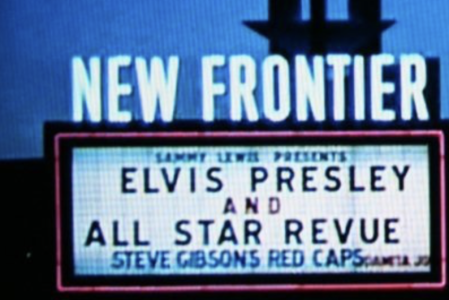
In April 1956, Steve Gibson’s Red Caps were an opening act for Elvis Presley at the New Frontier club in Las Vegas.
In 1956, the group recorded “Love Me Tenderly” which in the summer charted into the Top Ten in Camden (NJ).
By the summer of 1956, the group consisted of Steve Gibson, Damita Jo, David Patillo, Emmett Mathews, Bobby Gregg, Jay Price, Earl Plummer, and baritone and bassist Kenny Mitchell. (Jay Price thinks that a ninth member at the time was Andre D’Orsay.)
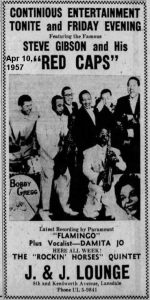
Steve Gibson and His Red Caps also played in Canada:
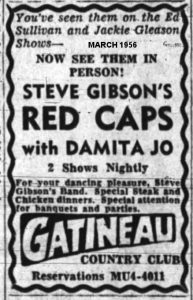
In September 1957, the group recorded a cover of The Rays’ “Silhouettes”.
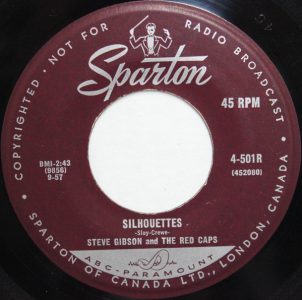
“Silhouettes” was co-written by Bob Crewe and Frank Slay. Robert Stanley Crewe was born in 1930 in Newark, New Jersey. He had a musical aptitude from a young age and in 1953 met pianist Frank Slay Jr. They started writing songs recorded by R&B singer Faye Adams and others. In 1957 Bob Crewe and Slay cowrote the Rays B-side to “Silhouettes” titled “Daddy Cool”. It was covered by the Diamonds and peaked at #10 on the Billboard pop chart. In 1958 the pair wrote “La Dee Dah”, a Top Ten hit for Billy and Lillie, and another one for the duo titled “Lucky Ladybug” which peaked at #14.
Then in 1959, Crewe and Slay wrote “Talahassee Lassie” for Freddy Cannon. In the early 60s Crewe wrote songs for rockabilly singer Dale Hawkins, Ben E. King, Dee Dee Sharp, Tracey Dey, Barbara Lewis’ “Puppy Love“, Eddie Rambeau, the Orlons and others. The pair also produced “Way Down Yonder In New Orleans”, “Jump Over” and a few others for Freddie Cannon. The duo also wrote for Sal Mineo, Danny & The Juniors, Chubby Checker and Marcy Jo.
In 1962 it was Bob Crewe who suggested to Vee-Jay Records that the Four Seasons record “Sherry”. In the mid-60s Bob Crewe co-wrote “Navy Blue” for Diane Renay, “Big Girls Don’t Cry”, “Silence Is Golden”, “Rag Doll”, “Ronnie”, “Save It For Me”, “Let’s Hang On” and “Bye Bye Baby (Baby Goodbye)” all for the Four Seasons. “Silence Is Golden” was also a hit for the Tremeloes in 1967. Bob Crewe also co-wrote “The Sun Ain’t Gonna Shine Anymore” – a hit for the Walker Brothers, and “Jenny Take A Ride” by Mitch Ryder & The Detroit Wheels – the latter with Little Richard.
Crewe produced “Dawn (Go Away)”, and “Opus 17 (Don’t You Worry ‘Bout Me)” both for the Four Seasons; “Devil With A Blue Dress” for Mitch Ryder & The Detroit Wheels, “Music To Watch Girls By” for The Bob Crewe Generation, and “Jean” for Oliver. Crewe also co-wrote several songs for Frankie Valli in solo efforts: “Can’t Take My Eyes Off You”, “Swearin’ To God” and “My Eyes Adored You”. Other songs Bob Crewe wrote that were hits in the 1970s include “Lady Marmalade” for Labelle and “Get Dancing'” for Disco Tex and the Sex-O-Lettes. Crewe died at the age of 83 in Maine.
“Silhouettes” concerns a guy who is walking past his girlfriend’s house late in the evening. He notices a couple in the living room kissing and making out. He wonders why he isn’t the guy she’s kissing. He gets mad and rushes up to the front door and rings the doorbell. The lyrics tell the rest:
Lost control and rang your bell.
I was sore.
Let me in or else I’ll beat
down your door.
When two strangers who had been
two silhouettes on the shade,
said, to my shock,
“You’re on the wrong block.”
The penny drops, as the boyfriend realizes his girlfriend is no doubt in her home a block away, and not making out with someone else. Perhaps the girlfriend lived in a neighborhood later described in folksinger Pete Seeger’s song “Little Boxes”:
Little boxes on the hillside.
Little boxes made of ticky-tacky.
Little boxes, little boxes,
little boxes all the same.
There’s a green one and a pink one,
and a blue one and a yellow one.
And they’re all made out of ticky-tacky,
And they all look just the same.
Some suburban neighborhoods had a lot of homes that looked quite alike. And radio listeners would know that, so the boyfriend mixing up one house for a similar house on the next block was plausible.
In the final verse in “Silhouettes” the boyfriend runs down the street to the next block to his girlfriends’ house. His relief, and desire for her is palpable:
Rushed down to your house with wings on my feet.
Loved you like I never loved you my sweet.
Vowed that you and I would be
two silhouettes on the shade,
all of our days,
two silhouettes on the shade.
“Silhouettes” was a #3 hit for The Rays, spending nine weeks in the Top Ten, four weeks at #3, and two weeks at #11 between October ’57 and January ’58. The Diamonds charted the song to #10 on the Billboard pop chart.
The lead on the Steve Gibson and his Red Caps recording was Nate Nelson, the current lead of the Flamingos, whom Steve Gibson brought in specifically for the session. This was done, according to Jay Price, to have a “teenage sound”, which no one else in the group at the time was capable of. (The Flamingos had been appearing with the Red Caps at the Martinique that summer, so Gibson had a chance to assess Nate Nelson’s voice.)
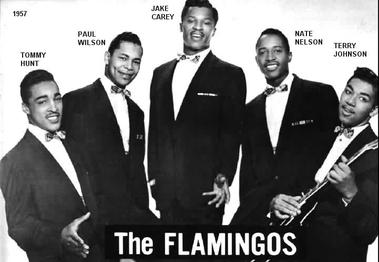
The Flamingos are best known for their cover of the pop standard “I Only Have Eyes For You“. Nate Nelson was the lead singer on the hit single. Born in 1932, Nate Nelson was drafted in the United States Army during the Korean War. He was discharged in the fall of 1954. He joined The Flamingos in December 1954. He was a cousin of Sonny Till who was the lead singer of The Orioles. Nate Nelson left the Flamingos in 1961 to form a rival group called the Modern Flamingos. From 1964 to 1982, Nate Nelson became a member of the Platters singing “Only You”, “The Great Pretender”, “Twilight Time”, “Smoke Gets In Your Eyes”, and more of their greatest hits. Nate Nelson died from heart failure in 1984, at the age of 52.
“Silhouettes” by Steve Gibson and the Red Caps climbed to #1 in Pittsburgh, Alexandria (LA), and Boston, #2 in Smiths Falls (ON), San Francisco, Woonsocket (RI), and Albany (NY), #3 in Rochester (MN), Springfield (VT), Montreal, and Baltimore, #4 in Worcester (MA), #5 in Colorado Springs (CO), and #6 in London (ON), Kansas City (MO), and Plattsburgh (NY). Internationally, Steve Gibson and The Red Caps’ “Silhouettes” charted to #7 in Sydney, Australia.
In 1965, Herman’s Hermits had a #3 hit in the UK with “Silhouettes”, which climbed to #5 in the USA. And in 1990, Cliff Richard took the song to #10 on the UK pop chart. “Silhouettes” inspired another doo-wop group to call themselves The Silhouettes who had a number-one hit in February-March 1958 with “Get A Job”.
In 1957, Barbara Randolph joined Steve Gibson’s Red Caps. In 1958, Steve Gibson and Damita Jo got a divorce. In 1959, Steve Gibson and His Red Caps released “Bless You (For Being An Angel)”. The single was in the teen idol pop style of the late 50s. It charted to #2 in Indio (CA), and got airplay in several radio markets across Pennsylvania. An upbeat recording of “San Antone Rose” reached #9 in Los Angeles and Troy (NY) in the winter of 1959-60.
Damita Jo left the Red Caps in 1960, the latter enjoying some solo success with the answer record “I’ll Save the Last Dance for You” (to The Drifters’ “Save The Last Dance For Me”). A series of male and female vocalists rotated through the lineup in the months to follow. In 1961 founding member David Patillo broke ranks to form his own rival group, the Modern Red Caps. From the classic lineup, only Steve Gibson and Emmett Matthews remained by the time of the Red Caps’ final single in 1962 “No More.” The group remained a fixture of the supper-club circuit, and for a time in the mid-’60s, they featured up-and-coming vocalist Tammy Montgomery, later known as the tragic Motown diva Tammi Terrell. Gibson finally dissolved the Red Caps around 1968.
Red Caps member Bobby Gregg was the only white member of the group. Bobby’s musical career started as a member of “Paul Whiteman’s TV Teen Club Show,” and he toured with Mr. Whiteman for six years. After his association with the Red Caps, in 1962, he fronted Bobby Gregg and His Friends. He recorded an instrumental titled “The Jam – Part 1”. It reached #14 on the Billboard R&B chart and #29 on the Hot 100. Gregg was also a house studio drummer for Cameo-Parkway Records based in Philadelphia. In the late 1950s and early 1960s. While he was there, he played for artists such as Bobby Rydell (“We Got Love”, “Kissin’ Time”, “Wild One”, “Swingin’ School”, “Volare”, “Sway”, “Good Time Baby”, “The Cha-cha-cha”, “Forget Him”, “I’ll Never Dance Again”, “Wildwood Days” and others, Chubby Checker (“The Twist”, “Let’s Twist Again”, “Pony Time”, “The Hucklebuck”, “Slow Twistin'”, “The Fly”, “Limbo Rock” and others), The Dovells (“Bristol Stomp”), Dee Dee Sharp “Mashed Potato Time”, “Ride” and others), The Orlons (“South Street”, “Don’t Hang Up” and “The Wah-Wahtusi”), Georgia Gibbs, and many others. Bobby Gregg continued to do this until the hits dried up for the label during the British Invasion. That is when he moved from Philadelphia to New York officially in 1964.
In 1965, Bobby Gregg was in the studio playing drums for “Like A Rolling Stone”, “Tombstone Blues”, “Ballad Of A Thin Man”, “Queen Jane Approximately”, “Highway 61 Revisited”, “Just Like Tom Thumb’s Blues”, “It Takes A Lot To Laugh, It Takes A Train To Cry” and “From A Buick 6” on Bob Dylan’s album Highway 61 Revisited. He was also the drummer for the single “Positively 4th Street”. Gregg subsequently played drums on Dylan’s album Blonde on Blonde including “Just Like A Woman”, “Rainy Day Women #12 & 35”, and “I Want You”. In November 1965, Bobby Gregg joined The Hawks who were Bob Dylan’s backing band. Gregg later was the drummer on “Sounds Of Silence” for Simon & Garfunkel. He also was in the studio for recordings by Jim & Jean, Janis Ian, Astrud Gilberto, Melanie (on “Brand New Key” and “Ring The Living Bell”), “Desiree” for the Left Banke, “Ha Ha Said The Clown” for the Yardbirds, The Isley Brothers, Esther Phillips, and for Peter, Paul and Mary.
David Patillo (born around 1911, married in 1935/divorced and 2nd marriage in 1938) died in 1970.
Nate Nelson of The Flamingos (born in 1932) died in 1984 at the age of 52.
Steve Gibson (born in Lynchburg, Virginia, in 1914) died in 1996 at the age of 81.
Damita Jo DeBlanc (born in 1930) died in 1998 at the age of 68.
Emmett Matthews (born in 1907) died in 1999 at the age of 91.
Jimmy Springs (born in 1911) died in 1999 at the age of 88.
Robert J. “Bobby” Gregg (born in 1936) died in 2014 at the age of 78.
The Five Red Caps were inducted into the Vocal Hall of Fame in 2007.
March 28, 2026
Ray McGinnis
References:
“Steve Gibson born 17 October 1914,” Fromthevaults.com, October 17, 2021.
Marv Goldberg, “The Red Caps,” uncamarvy.com.
“Bob Crewe Biography,” Bob Crewe.com.
Michael Jack Kirby, “Damita Jo: If You Go Away,” WayBackAttack.com.
“Jimmy Springs,” WBSS Media.
“Emmett Morris ‘Snake’ Matthews,” Findagrave.com.
“Robert Gregg,” Legacy.com.
“The Five Red Caps,” Vocal Group Hall of Fame, 2007.
“Nate Nelson,” WBSS.
“Ex-Platters star Nate Nelson died Friday, one day after…,” UPI, June 1, 1984.
“Steve Gibson and The Original Red Caps,” Bear Family Records.
5 Red Caps, “Mary Had A Little Jam“, Joe Davis Record Co., 1945.
Steve Gibson and The Original Red Caps, “Three Dollars and Ninety-Eight Cents“, RCA Victor Records, 1951.
5 Red Caps, “I Learned A Lesson I’ll Never Forget“, Beacon Records, 1944.
5 Red Caps, “Boogie Woogie Ball“, Beacon Records, 1944.
5 Red Caps, “Just For You“, Beacon Records, 1944.
Steve Gibson and His Red Caps, “Flamingo“, ABC-Paramount, 1957.
Steve Gibson and His Red Caps, “The Thing“, RCA Victor, 1950.
Steve Gibson and His Red Caps, “Would I Mind“, RCA Victor, 1951.
Steve Gibson and The Red Caps, “Two Little Kisses“, RCA Victor, 1952.
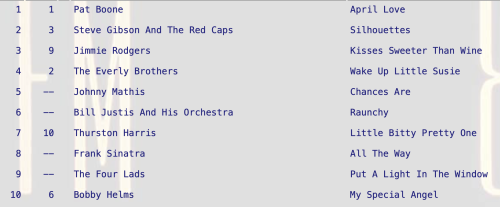
CJET 630-AM Smiths Falls (ON) | November 30, 1957
Leave a Reply