
#22: Seattle by Perry Como
City: Edmonton, AB
Radio Station: CHED
Peak Month: June 1969
Peak Position in Edmonton ~ #2
Peak Position in Vancouver ~ did not chart
Peak Position on Billboard Hot 100 ~ #38
YouTube: “Seattle”
Lyrics: “Seattle”
Pierino Ronald “Perry” Como was born in Canonsburg, PA, in 1912. He was one of 13 children of parents who emigrated from Italy. He learned to play the organ from a young age. Como took on other jobs to pay for music lessons, and learned to play many different instruments, but never had a voice lesson. He showed more musical talent in his teenaged years as a trombone player in the town’s brass band, playing guitar, singing at weddings, and as an organist at church. Como was a member of the Canonsburg Italian Band along with bandleader Stan Vinton, father of singer Bobby Vinton and often a customer at Como’s barber shop. Como started helping his family at age 10, working before and after school in Steve Fragapane’s barber shop for 50¢ a week. By age 13, he had graduated to having his own chair in the Fragapane barber shop, although he stood on a box to tend to his customers. As Pierno Como had a good singing voice, he was asked to sing at weddings, especially in the local Greek community. In time he became known as the “wedding barber” even in the Pittsburgh area and across Ohio.
To supplement his work at the barbershop, Como was invited to sing with Frank Carlone and His Orchestra at the Silver Slipper Ballroom. This lasted from 1933 to 1936. Next, Como accepted an invitation to be a featured vocalist Ted Weems Orchestra. Ted Weems band were regulars on radio programs The Jack Benny Show and Fibber McGee and Molly. This gave Perry Como national exposure. Como’s first recording with the Weems band was a novelty tune called “You Can’t Pull the Wool Over My Eyes”, recorded for the Decca Records in May 1936.
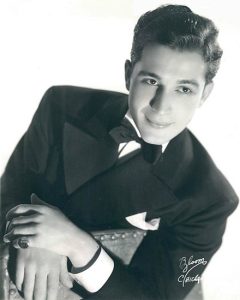
Perry Como photo (1939) while in Ted Weems Orchestra.
From 1940 to 1941, Ted Weems Orchestra, with Perry Como, were on a regular musical quiz show on NBC called Beat the Band. Como’s first charting hit single was “Goodbye, Sue” in 1943. The following year he had four Top 20 hit songs, with “Long Ago (And Far Away)” written by Jerome Kern and Ira Gershwin, peaking at #8. In 1945, Perry Como had ten singles that made the Top 15 on the Billboard pop charts. Of these, six made the Top Ten, including “I’m Gonna Love That Gal” (#4), “If I Loved You” and “Dig You Later (A Hubba-Hubba-Hubba)” each climbing to #3, and his first number-one hit, “Till The End of Time”. The song was inspired by a nocturne written by Frederick Chopin. The next year, Como exceeded his commercial success in record sales with nine singles reaching the Top Ten. Of these, “Winter Wonderland” became a seasonal favorite. He also racked up three more number-one hits: “Prisoner Of Love”, “Surrender”, and “Chi-Baba, Chi-Baba”.
In December 1944, Como began hosting a 15-minute radio show on NBC titled The Chesterfield Supper Club. The show continued on the radio until 1950. The show was also broadcast on NBC TV from December 1948 to 1950. Perry and his sponsor, Chesterfield cigarettes, moved to CBS in 1950. The show was re-titled The Perry Como Chesterfield Show and the schedule returned to one similar to the “Supper Club” radio shows: a 15-minute program three times a week.
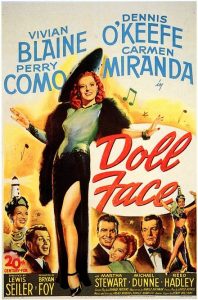
In 1945, Como appeared in the feature length film Doll Face.
The late ’40s saw Perry Como add to his durability with several #2 hits “When You Were Sweet Sixteen”, “I Wonder Who’s Kissing Her Now” and “Forever and Forever”. Other Top 5 hits included “Because”, “Bali Hai”, and “Far Away Places”. Como added to his number-one hits with “Some Enchanted Evening” and “A-You’re Adorable” (with the Fontane Sisters).
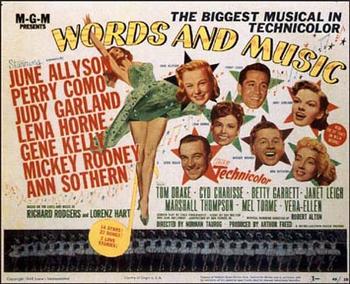
In 1948, Perry Como starred along with June Allyson, Lena Horner Judy Garland, Mel Tormé, Cyd Charisse, Gene Kelly, and Mickey Rooney, in Words and Music. In the film, Como sang “With A Song in My Heart”. The musical was based on the story of the creative partnership of songwriting team Richard Rodgers and Lorenz Hart.
In 1950, Chesterfields cigarettes featured Perry Como in the 26-minute Tobaccoland on Parade film short advertisement. Como sang “Because” as a narrator later told viewers, “If you take good care of tobacco, tobacco will take good care of you.” After all, “Chesterfields smells milder, smokes milder.” The tobacco company invited citizens to “Be your own cigarette expert.” After all, the taxes paid by tobacco companies to the U.S. government were “helping strengthen America’s defenses.” A letter from Bing Crosby underlined his partnership with the tobacco industry, and was followed by a refrain from “Swinging On A Star”.
Before the advent of rock ‘n roll, in the early to mid-50s Perry Como was a regular chart-topper with “Hoop-De-Do”, “If”, “Don’t Let The Stars Get in Your Eyes”, “Wanted” and “No Other Love”. In 1954, Como had another Top Ten Christmas hit titled “(There’s No Place Like) Home For the Holidays” at #8. (It climbed to #13 in January 2024).
NBC offered Como a long-term contract to host a weekly hour-long television show that would beginning in the fall of 1955. Como signed a 12-year contract with the network in April 1955. The Perry Como Show made its debut September 17, 1955. Clad in his well-known cardigan sweaters, Como welcomed guest stars to his musical-comedy variety program. The “Sing to me, Mr. C.” segment of the show was where Como responded to letters of viewer song requests. Como was seated on a stool as he sang some of the music of the weekly requests. The setting for this segment had its beginnings in the first television broadcasts of the Chesterfield Supper Club. Como and his guests did the radio show sitting on stools behind music stands; this is what was seen by the cameras when they initially came into the radio studio. The opening theme song for Como’s shows from 1955 to 1963 was “Dream Along with Me (I’m On My Way to a Star)”. The Perry Como Show was also the only NBC television show in the Nielsen top ten for the 1956–1957 season.
Between 1955 and 1962, Perry Como was nominated seven times for an Emmy Award, winning on five occasions. He was also inducted into the Emmy Hall of Fame in 1989.
In 1955, Como’s “Ko Ko Mo” jostled for position in the Top Five along with “Earth Angel” (Penguins/Crew Cuts), “Hearts of Stone” (Fontane Sisters/Charms), “Tweedlee Dee” (Georgia Gibbs/LaVern Baker), and “Dance With me Henry” (Georgia Gibbs/Etta James). His number-one effort in 1956, “Hot Diggity” jostled with Elvis Presley’s “Heartbreak Hotel”, Carl Perkins’ “Blue Suede Shoes”, Frankie Lemon and the Teenagers’ “Why Do Fools Fall in Love”, and Morris Stoloff’s “Moonglow and Picnic”. Perry Como cracked the Top Ten later in ’56 with “Juke Box Baby”, “More” and “Glendora”.
In 1957, Perry Como managed another number-one hit with “Round and Round”, which topped the Billboard Best Sellers in Stores chart on April 6/57. As traditional pop singers struggled to break into the Top Ten, Como and others were more often elbowed down the charts. The upstarts, Buddy Knox, the Del Vikings, the Coasters, the Diamonds, Chuck Berry, Paul Anka, Elvis and others were in the ascendant. One of the few tunes to crack the Top 20 later in 1957 was “The Girl With The Golden Braids”.
In 1958, Perry Como had a final chart-topper in the USA titled “Catch A Falling Star”. It topped the Most Played By Jockeys’ Billboard chart on March 24/57. In the UK, “Magic Moments” climbed to number-one, while “Kewpie Doll” was his last Top Ten hit for a dozen years.
In 1959, Perry Como received a Grammy Award for Best Vocal Performance – Male for “Catch A Falling Star”. On television, Perry Como’s Kraft Music Hall ran from 1959–1967. When Como signed the $25 million deal with Kraft in 1959, he told a reporter, “Frankly, I don’t know a thing about the deal. But I’ve met the president of Kraft [J. C. Loftis], and he seemed a helluva nice guy. Also, I’m quite a cheeseman myself.” Time wrote “The other cheesemen picked Perry precisely because he sees the world as filled with nice guys, and makes audiences feel the same way. The clean-cut Como appeal runs from toddlers to dodderers. It is no surprise that convent TV sets glow for Como, that he was rated America’s ideal husband in a poll of 20-year-old girls…” The magazine went on to detail how by 1959, “after selling 50 million records (eleven have topped the 1,000,000 mark), Perry the pro is mainly a solid family man. He lives unostentatiously at Sands Point, L.I., has few cronies and owns but two cars, a Cadillac and a Thunderbird. His wife Roselle, whom he married 25 years ago in Canonsburg, does the cooking; he sometimes dries the dishes. His interests are golf (high 70s) and his three children. Chief entertainment: watching TV while sprawled on a couch in his den, and writing congratulatory telegrams to TV comedians.”
In 1969, Perry Como had a Top 40 hit with “Seattle”.
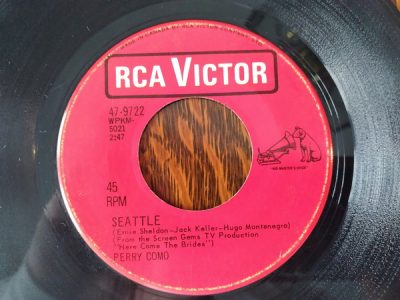
“Seattle” was written by Jack Keller with Ernie Sheldon. The music was composed by Hugo Montenegro. Jack Keller was born in Queens (NY) in 1936. He learned to play piano and accordion in his teens. Keller worked at a camera repair store from the age of 15, after his father’s death. In 1957, he cowrote “Just Between You And Me” which claimed to #8 for The Chordettes. In 1960, Keller teamed up with Howard Greenfield to write “Everybody’s Somebody’s Fool”, and “My Heart Has A Mind Of Its Own”, both number-one hits for Connie Francis. The following year, Greenfield and Keller penned “Breaking In A Brand New Heart” which was a Top Ten hit for Connie Francis. While in 1960 Keller’s “Just for Old Times Sake” was a Top 20 hit for The McGuire Sisters.
In 1961, Bobby Vee had a #2 hit with “Run To Him”, which Keller cowrote with Gerry Goffin. The next year, Keller’s “Please Don’t Ask About Barbara” reached #15 for Bobby Vee. While his “Venus In Blue Jeans” peaked at #7 for Jimmy Clanton. Keller had a Top 40 hit for Brenda Lee in 1963 titled “Your Used to Be”. In 1964, he cowrote (with Gerry Goffin) “Girls Grow Up Faster Than Boys” for The Cookies. He produced music for The Monkees TV series, and wrote the comical “Your Auntie Grizelda”. In 1969, Keller’s “Seattle” was the theme song for the TV series Here Come the Brides, and a Top 40 hit for Perry Como. In 1970, Keller’s “Easy Come, Easy Go” was a Top Ten hit for Bobby Sherman. And in 1979, Eruption had an international Top Ten hit with “One Way Ticket”.
Jack Keller also scored some music for the TV shows Wackiest Ship in the Army, The Flying Nun, and Rhoda. Most notably he cowrote the theme songs for both Bewitched and Gidget. He died at age 68 of leukemia in 2005.
Ernest Lieberman was born in Brooklyn, New York, in 1930. He was a member of the folk group The Limeliters. He took the stage name Ernie Sheldon. He was also an early editor of the old folk magazine Sing Out. had his first success in 1965 when Glen Yarbrough had a #12 hit with “Baby The Rain Must Fall”. Other songs he wrote were recorded by The Drifters, Johnny Cash, Peggy Lee, The Sandpipers, and the Spiral Starecase. Sheldon died at the age of 93 in 2023.
Hugo Montenegro was born in 1925 in New York City. He served in the United States Navy for two years at the end of WWII. He directed the orchestra that played in the studio for Dion DiMucci and the Timberlanes in 1957, on Dion’s first three single releases. Montenegro went on to work for RCA Victor. He wrote the score for the 1961 movie Teenage Millionaire, starring Jimmy Clanton. Other films he wrote music for include Advance to the Rear (1964), Charro! starring Elvis Presley (1969), in the John Wayne western The Undefeated (1969), the crime drama starring Frank Sinatra Lady in Cement (1968), the Matt Helm spy movies starring Dean Martin The Ambushers (1967) and The Wrecking Crew (1968). He composed music for many TV shows. These include the western The Outcasts, Hazel, I Dream of Jeannie, Gidget, one episode of The Monkees, Camp Runamuk, The Flying Nun, The Partridge Family, Nancy and the Professor, and others. Montenegro is best remembered for the soundtrack to The Good, the Bad, and the Ugly. The theme song to the film – “The Good, the Bad, and the Ugly” – became an instrumental pop hit reaching #2 on the pop charts in 1968. It ranked #8 for the year 1968 on the Billboard year-end pop chart. His 1968 album, Music From A Fistful Of Dollars, For A Few Dollars More & The Good, The Bad And The Ugly, reached #9 on the Billboard 200 album chart. His 1965 album, Original Music From The Man From U.N.C.L.E., was a notable seller. Montenegro suffered from emphysema and died at the age of 55 in 1981.
“Seattle” was written as the theme song for the TV show Here Come the Brides, set in 19th century Seattle, Washington. It is loosely based on the accounts of Asa Mercer (born 1839 in Princeton, Illinois). In 1861, as a member of one of the founding families of Seattle, young Asa Mercer assisted his brothers in clearing stumps to make way for the new territorial university. He became its first instructor, though he didn’t receive a salary. The young town of Seattle was attracting hordes of men to work in the timber and fishing industries, but few marriageable women were willing to make the trip to the remote northwest corner of the United States. In March 1864, with public support and private funding, Mercer traveled to the eastern United States in search of single women to work in Seattle as teachers. On May 16, 1864, he returned to Seattle with eleven women who all found employment as teachers in Seattle. Of these, eight eventually married and settled in the area. This and a subsequent trip introduced dozens of women to the Pacific Northwest, most of whom eventually married local men. The descendants of the Mercer Girls still represent a significant portion of Seattle’s citizenry. The Mercer Girls story formed the basis of the television show Here Come the Brides. Mercer himself married one of the Mercer Girls. Asa Mercer’s older brother, Thomas, has a street named after him in Seattle, as well as Mercer Island.
Here Come the Brides starred Bobby Sherman and David Soul, who both went on to have successful careers in acting and as recording artists. In the song “Seattle” evokes the dreams of the young pioneers who came to Seattle in the 1850s and 1860s, dreaming of marriage. The song boasts attributes of Seattle, perhaps recalling some of the advertisements placed that young women read in the eastern papers: a) The bluest skies you’ve ever seen, b) the hills the greenest green, c) the scent of pine trees in the air, and d) (a town) full of dreams to last the years.
In 1969, Bobby Sherman recorded “Seattle” as a track on his debut self-titled album.
Perry Como’s “Seattle” climbed to #1 in Seattle, Knoxville (TN), and Fort Worth (TX), #2 in Edmonton (AB), Cincinnati (OH), and Sacramento (CA), #3 in Cheyenne (WY), Spokane (WA), and Augusta (GA), #4 in Vancouver (WA), #5 in Stevens Point (WI), #6 in Phoenix, #7 in Denver, #8 in Troy (NY), #9 in Columbus (OH) and #10 in Albany (NY).
In 1970, Perry Como had his last Top Ten hit titled “It’s Impossible”. In the UK, “And I Love You So” was a #3 hit in 1973. Between 1944 and 1970, Como charted 48 songs into the USA Top Ten, and 54 songs into the Top Ten (USA & UK combined). Between 1960 and 1994, Perry Como hosted 41 TV specials. The last was Perry Como’s Irish Christmas.
Over the decades, Perry Como was a guest on The Frank Sinatra Show, Texaco Star Theater, Arthur Godfrey and His Friends, the game show Strike It Rich, Colgate Comedy Hour, Max Leibman’s Variety, The Bob Hope Show, The Dinah Chevy Shore Show, The Bing Crosby Show, Rowan & Martin’s Laugh-In, The Tom Jones Show, The Pearl Bailey Show, The Carrol Burnett Show, The Flip Wilson Show, The Arlene Herson Show, and many more.
Como died at age 88 in May 2001. In 2002, Como posthumously received a Grammy Lifetime Achievement Award. He has three stars on the Hollywood Walk of Fame respectively for radio, TV, and music.
April 18, 2026
Ray McGinnis
References:
James Warren, “Seattle at 150: Mercer brothers imprinted family name on the city,” Seattle Post-Intelligencer, October 8, 2021.
Stephanie Shapiro, “Chairman of the Leisure Board’s Fine : Pop music: After 59 years in the business, Perry Como isn’t about to retire. ‘Mr. Relaxation’ is still touring–and charming a new generation of fans,” Los Angeles Times, December 22, 1992.
“If I’m Lucky,” 20th Century Fox, 1946.
William D. Laffler “Chopin Tune Helped Bring Perry Como to Fame,” Sarasota Herald-Tribune, Sarasota, FL, August 2, 1983.
“Tobaccoland on Parade,” Periscope, 1950.
Jon Thurber, “Perry Como: Hollywood Star Walk,” Los Angeles Times, May 13, 2001.
“Perry Como: Winners and Nominees,” Emmy Awards, 2001.
“Teen-age Girls Choose Como as ‘Crooner of the Year’: New York Lasses Promise Canonsburg Singer Swooning Audience,” The Pittsburgh Press, September 19, 1943.
“Big Cheese,” Time, March 16, 1959.
Spencer Leigh, “Jack Keller: Writer of Sixties Pop Hits,” Independent, May 11, 2005.
“Ernest “Ernie” Lieberman,” San Jose Mercury News, September 12, 2023.
“Hugo Montenegro Is Dead at 55; Composed Themes for Westerns,” New York Times, February 8, 1981.
Bobby Sherman, “Seattle“, Metromedia Records, 1969.
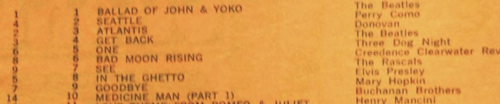
Top 30 Records CHED 630-AM Edmonton (AB) | June 23, 1969
Leave a Reply