
#43: Honky Tonk by Bill Doggett with Tommy Brown
City: Halifax, NS
Radio Station: CJCH
Peak Month: January 1957
Peak Position in Halifax ~ #9
Peak Position in Vancouver ~ did not chart
Peak Position on Billboard Hot 100 ~ did not chart
YouTube: “Honky Tonk”
William “Bill” Ballard Doggett was born in Philadelphia in 1916. From the mid-1930s, Doggett worked with bandleader Lucky Millinder, American Federation of Musicians (for black Americans) bandleader, musician and arranger Frank Fairfax, and jazz tenor saxophonist and arranger James Mundy. In 1942, he was hired as the Ink Spots pianist and arranger. In 1945 he recorded “Be-Baba-Leba” which climbed to #3 on the R&B charts in the USA. During the 40s and into the 50s, Bill Doggett worked with Louis Jordan, Wynonie Harris, Johnny Otis, Illinois Jacquet, and others. In 1951 he signed a record deal with King Records. Doggett had four Top 20 R&B hits in 1953-54: “Mooniest”, “Early Bird”, “No More In Life”, and “High Heels”.
In 1956, Bill Doggett recorded an instrumental titled “Honky Tonk pt 1 & 2”. It was written by Doggett, drummer, percussionist and trumpet player Berisford “Shep” Shepherd, guitarist Billy Butler, and saxophonist and flautist Clifford Scott. The instrumental version “Honky Tonk Pt. 2” peaked at #1 on the Billboard R&B chart and #2 on the Billboard pop chart. The hit instrumental single topped the pop charts in Detroit, Toledo (OH), Boston, New York City, Blytheville (AR), Tulsa (OK), Indianapolis (IN), and Chicago, #2 in Framingham (MA), New Orleans, Worcester (MA), Milwaukee (WI), Pittsburgh, Albany (NY), Baltimore, and Renton (WA), #3 in Waterloo (IA), Halifax (NS), Ottawa, St. Petersburg (FL), Oceanside (CA), Tampa (FL), Clearwater (FL), Pontiac (MI), Memphis, Minneapolis/St. Paul, and Dallas, #4 in Cambridge (MA), Providence (RI), Toronto, and Miami, #5 in Tucson (AZ), Troy (NY), Fairbanks (AK), and Salt Lake City, #6 in Houston, Huron (SD), Kansas City (MO), Montreal, San Francisco, and Scottsdale (AZ), #8 in Schenectady (NY), Dayton (OH), and Scranton (PA), #9 in Dubuque (IA), Chester (PA), Cleveland, Vancouver (BC), and Oklahoma City, #10 in Lubbock (TX), Baton Rouge (LA), Smiths Falls (ON), and Portland (ME).
“Honky Tonk” pt 1 & 2″ sold over four million records in 1956.
A follow-up single, “Slow Walk” was a Top 30 hit on the Billboard pop charts in 1956, and reached #4 on the Billboard R&B chart. In Canada, “Slow Walk” was a Top 30 hit in Vancouver in January 1957.
Meanwhile, a vocal version of “Honky Tonk” was released.
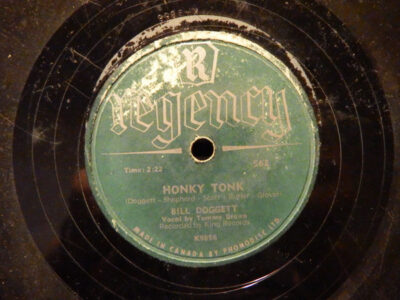
The lyrics to the vocal version of “Honky Tonk” begin with this line: “And when they dim the lights, and then they dance all night the Honky Tonk.” Tommy Brown sings about how people started dancing the Honky Tonk “in the south lands, a dance they really thought was new. But when the news got to the north lands, the folks up there were doing it too. Now you’ll hear everybody say, the Honky Tonk is here to stay.”
Tommy Brown sings these instructions:
Now when you hear the tenor (saxophone) honk,
you’ve got to do the Honky Tonk.
He blows the music on his sax.
And everybody answers back….
Just take some rock, and add some roll,
some Lindy Hop, that’s not too bold.
Put them together, that’s the Honky Tonk.
Count one, two, three, four,
cross the floor you’ll go glide.
Five, six, seven, eight,
dip, slide.
Hold your honey, flow lightly.
Dim the lights and then,
we’ll dance all night the Honky Tonk.
In the lyrics, “Honky Tonk” invites dancers to includes some steps from the Lindy Hop. A 1920s dance, the Lindy Hop has four steps.
1) Place your left foot back and keep your weight on your right foot. If you’re the lead, step back with your left foot. Keep the majority of your weight on your right foot and bend your right knee slightly. Make sure that only the toes of your left foot are on the ground, with your left heel pointing up. Keep your back straight but leaning forward toward your partner slightly. The follow steps back with their right foot and keeps the weight in their left foot.
2) Bounce back on your left foot and then shift your weight onto your right. The rock step is all about shifting your weight from foot to foot as you step. While your right foot is forward and your left foot is back, quickly shift your weight to your left foot and bounce on it lightly. Then shift your weight back to your right foot again and lift your left foot up from the ground. During this step, your weight starts and ends on your right foot. The follow bounces back on their right foot and then shifts their weight to their left foot. This is called the rock step.
3) Step forward with your left foot and hop to transfer your weight. Bring your left foot forward to just in front of your right foot. Hop lightly onto your left foot to transfer your weight from your right foot to your left foot. With the majority of your weight now on your left foot, keep only the toes of your right foot on the ground and your heel pointed upward. Make sure to bounce lightly as you step to keep the dance looking fun and smooth! The follow steps forward with their right foot. This is called the triple step.
4) Step onto your right foot then back to your left to “walk” on the spot. Keep your feet in the same position with your left foot being slightly in front of your right foot. Then quickly place your whole right foot on the ground and shift your weight into it, before repeating the movement with your left foot. Aim to “walk” in place on the spot for 2 steps. You’ll end the “walk” back on your left foot, just like how you started. The follow steps onto their left foot and then back to their right foot to “walk.”
Tommy Brown was born in 1931 in Lumpkin, Georgia, near the Alabama border. He performed as a dancer in the first grade. His father was an African-Methodist-Episcopal minister, and Tommy never drank. Brown formed a small band with himself as the drummer in the 1940s, and worked in clubs around Atlanta. In 1949 he recorded “Atlanta Boogie” on the Regent label that was among the first to refer in the lyrics to “rock and roll.” Brown had various nicknames on stage including Tommy “Weepin’ and Cryin'” Brown,
“Little” Tommy Brown, and “Cryin'” Tommy Brown. In 1951 he signed with Dot Records where he was teamed with the Griffin Brothers. This was a Norfolk, Virginia-based R&B orchestra led by brothers Jimmy Griffin (trombone) and Ernest “Buddy” Griffin (piano). They toured widely with Amos Milburn, Paul Williams, and others. The orchestra recorded as the backing band for Margie Day on two R&B Top 10 hits, “Street Walkin’ Daddy” and “Little Red Rooster”.
In August of that same year Brown was featured singer on the R&B Top 10 hit “Tra-La-La”, credited to the Griffin Brothers Orchestra. In January 1952, the Griffin Brothers Orchestra with Tommy Brown as vocalist reached #1 on the Billboard R&B chart for three weeks with “Weepin’ and Cryin'”.
In early 1952, Brown joined the United States Marine Corps. Instead of being sent to Korea, he was assigned to play in the Swinging Band Unit. During an audition before a general he performed “Weepin and Cryin”, and slid across the floor during another song and impressed the general. He soon became a hit among all the troops Black and White for his performances. When he returned in October of the same year, he got a contract with United Records and moved to Chicago. While Brown was away, his previous label released in March 1952 the “No News From Home” single, which was recorded from earlier sessions. While in Chicago, Tommy performed alongside a young man named Johnny Carson. By 1956 Brown was fronting Little Tommy Brown with the Four Students. He also played for a while in Bill Doggett’s band.
In 1958, Tommy Brown formed the group Tommy B. and his Teardrops. He went to St. Louis and chose musicians who had played with Billy Gayles and Ike Turner’s Kings of Rhythm. While he performed as a drummer for Ike Turner, Tommy stated “Ike Turner was mean as a snake and not to be trusted. The woman loved him because he was well-endowed and followed him everywhere. One time he tied a woman’s wrists to a long rope and tied the other end to the back fender of his car. He then drove down the street with her yelling and pleading how much she loved him and she was just running behind the car. Back then the stores had their groceries supplies left outside the doors real early for the next morning. Ike would regularly steal the food and eat on the road. I found out that Ike had been sleeping with my first wife Anna Mae and I caught them in the act. I came in the door and there was Ike naked in bed with my wife he jumped up and reached for a gun on a nightstand. I grabbed his wrist and arm and threw him with a Judo hold across the room. I picked up the gun and my wife screamed ‘Tommy please don’t kill him’. I almost pulled the trigger but I knew it wasn’t worth it. I told him he could have her and Ike was shocked when I left the house.”
Over the next decade Tommy Brown recorded R&B for a number of smaller labels, including his own T & L Productions. Brown performed as a comedian in the 1960s and 1970s. He released two live comedy albums, 1967’s I Ain’t Lyin’ and I Ain’t Lyin’ Vol. 2 in 1968.
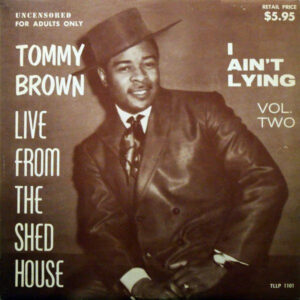
Tommy Brown on a comedy album he released in 1967
In 1977, Brown returned to Atlanta to run the Landmark Personal Care Center. After fans sought a return in his musical career, Brown made a comeback in 2001, recording and performing around the world in blues festivals. On May 6, 2015, Brown was inducted into the Blues Hall of Fame in Memphis. Brown died in 2016 at the age of 84.
The lyrics for “Honky Tonk” are credited to Henry Glover and Billy Butler. Henry Glover was born in Hot Springs, Arkansas, in 1921. While in public school he learned to play the trumpet. Following high school and college, he joined Buddy Johnson’s big band in 1944, and Lucky Millinder’s orchestra in 1945. That year he met Syd Nathan, who hired Glover as an A&R man at King Records. As well as A&R duties, Glover helped to construct King’s first recording studio. He wrote Bull Moose Jackson’s number-one R&B hits “I Can’t Go On Without You” and “I Love You, Yes I Do” both in 1948. The latter tune was recorded by Swing and Sway with Sammy Kaye and became a #10 pop hit that year. He had a number-one country hit in 1949 titled “Blues Stay Away From Me” by the Dellmore Brothers, which became a Top Ten pop hit that year for Owen Bradley. In 1950, “I’ll Sail My Ship Alone” became a number-one country hit for Moon Mullican. Tiny Bradshaw had two Top Five R&B hits in 1950 written by Glover titled “Well Oh Well” and “I’m Gonna Have Myself A Ball”. In 1951, “I’m Waiting Just For You” was a #2 hit on the R&B chart for Lucky Millinder and His Orchestra. In 1954, “Annie Had A Baby” reached number-one on the R&B chart, and Teardrops on Your Letter” reached #4 on the R&B chart in 1959. Both songs were hits for Hank Ballard and the Midnighters. Drown In My Own Tears” was a number-one R&B hit for Ray Charles in 1956. produced “Fever” for Little Willie John (1956). He co-wrote “Let The Little Girl Dance” which was a Top Ten hit for Billy Bland (1960), and “California Sun” for the Rivieras (1963). Henry Glover wrote other notable hits for Eddie “Cleanhead” Vinson, Rosemary Clooney, Wynonie Harris, Roy Brown, Sonny Thompson, Georgia Gibbs, Jerry Lee Lewis, The Ventures, Joe Jones, Ace Cannon, Dinah Washington, Aretha Franklin, Dave “Baby” Cortez, Pat Boone, The Fontane Sisters, Glover was inducted into the Alabama Jazz Hall of Fame in 1986. He died of a heart attack at the age of 69 in 1991. Glover was inducted into the Blues Hall of Fame in 2013.
Born in Philadelphia in 1924, Billy Butler Jr. Butler began his career in the 1940s behind the Harlemaires. In the 1950s he was a member of a trio led by Doc Bagby and accompanied keyboardist Bill Doggett. He worked with jazz clarinetist Bill Davison, jazz tenor saxophonist Eddie “Lockjaw” Davis, Fats Wallers guitar player Al Casey, R&B and rock saxophonist King Curtis, jazz pianist Tommy Flanagan, swing jazz drummer Panama Francis, jazz trumpeter Dizzy Gillespie, bandleader Benny Goodman, alto saxophonist Johnny Hodges, jazz saxophonist Floyd “Candy” Johnson, jazz and R&B saxophonist David “Fathead” Newman, jazz saxophonist Houston Person, boogie-woogie and jump blues pianist Sammy Price, Hammond Organ popularizer Jimmy Smith, flautist and saxophonist Norris Turney, and jazz and R&B singer Dinah Washington. Butler is credited as the lead guitarist on Joey Dee and the Starliters’ “Peppermint Twist Parts 1 & 2” recorded in September 1961 at the Peppermint Lounge in New York City. Part 1 of the song went to the top of the Billboard pop charts in January 1962. Billy Butler died of a heart attack at the age of 66 in 1991.
The vocal version of Bill Doggett’s “Honky Tonk”, featuring Tommy Brown on vocals reached #3 in Baltimore, #5 in New Orleans, #7 in Tallahassee (FL), and Toronto, #8 in Cincinnati (OH), and #9 in Halifax (NS).
In the spring of 1957, Bill Doggett’s “Ram-Bunk-Shush” was a #10 R&B hit and a minor pop hit. Later in ’57 both “Soft” and “Leaps and Bounds” were Top 15 R&B hits in the USA.
In 1958, “Blip Blop” charted in Vancouver and peaked at #11 on the Billboard R&B chart. While “Hold It” reached #3 on the R&B charts.
In the spring of 1959, “Monster Party” charted in Ottawa. In late 1960, cashing in on the Twist craze, Bill Doggett released “(Let’s Do) The Hully Gully Twist” which was a minor pop hit. In January 1961, “Honky Tonk Pts 1 & 2” was re-released. It reached the Top 30 in Vancouver and also charted in Regina (SK).
In 1962, Bill Doggett and Ella Fitzgerald released an album titled Rhythm is My Business. Between 1952 and 1969, Bill Doggett released over sixty singles and over thirty albums. Doggett also released over thirty EPs. Bill Doggett arranged for many bandleaders and performers including Louis Armstrong, Count Basie, Ella Fitzgerald, Thelonious Monk, and Lionel Hampton. Bill Doggett continued to perform, even as he was diagnosed with cancer. He died at the age of 80 in 1996.
April 25, 2026
Ray McGinnis
References:
Mo Barnes, “Atlanta early R&B legend Tommy Brown dies,” Rolling Out, March 14, 2016.
Fred Shuster, “R&B Keyboardist Bill Doggett Dies,” Tampa Bay Times, Tampa Bay (FL), November 21, 1996.
“William Billy Butler, Jazz Guitarist, dies at 66,” New York Times, March 26, 1991.
“Henry Glover, 69, Recording Official,” New York Times, April 13, 1991.
Bill Doggett, “Honky Tonk Pt. 2“, King Records, 1956.
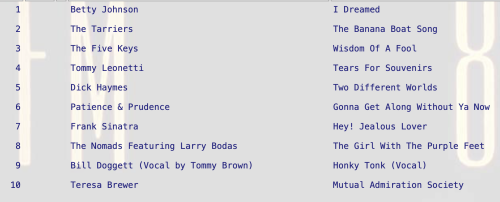
CJCH 920-AM Halifax (NS) | January 26, 1957
Leave a Reply