
#1: Macho Man by Village People
City: Hamilton, ON
Radio Station: CKOC
Peak Month: October 1978
Peak Position in Hamilton ~ #1
Peak Position in Vancouver ~ did not chart
Peak Position on Billboard Hot 100 ~ #25
YouTube: “Macho Man”
Lyrics: “Macho Man”
The Village People were formed in 1977 in San Francisco. French composer Jacques Morali had written some dance tunes. Around that time singer Victor Willis gave Morali a demo tape. Jacques Morali liked the demo and invited Willis to record four songs for an album credited to the Village People. The group name referenced New York City’s Greenwich Village neighborhood, at the time known for having a substantial gay population. Morali got the inspiration for creating an assembly of American male archetypes based on the gay men of ‘The Village’ who frequently dressed in various fantasy attire. The Village People debut single release was “San Francisco (You’ve Got Me)”. It topped the Billboard Dance Club songs chart in for seven weeks from September 3rd to October 15th, 1977. Other cuts from the Village People album, “In Hollywood” and “Fire Island”, shared the top spot on the Dance Club chart. At the time, the Village People only consisted of singer Victor Willis.
The single, and album Village People were successful. Demand for live appearances soon followed. Willis quickly built a group of dancers to perform with him in clubs and on American Bandstand. As Village People’s popularity grew, Morali and Willis saw the need for a permanent ‘group.’ They took out an ad, along with Morali’s business French Moroccan partner Henri Belolo, in a music trade magazine which read: “Macho Types Wanted: Must Dance And Have A Moustache.”
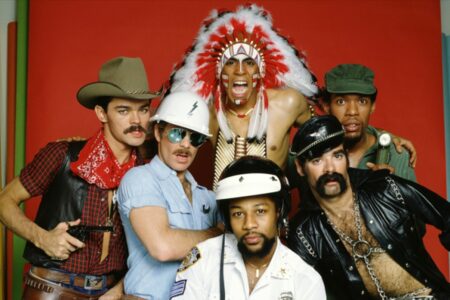
Victor Willis appeared at Village People concerts variously as a cop, admiral, athlete, and gigolo. He was born in 1951 in Dallas, Texas. His father was a Baptist preacher and Willis honed his vocal skills growing up in church. He trained in acting and dancing, and joined the Negro Ensemble Company. He performed in the Shakespearian play Two Gentlemen of Verona the The River Niger. He appeared in the 1976 Broadway production of The Wiz.
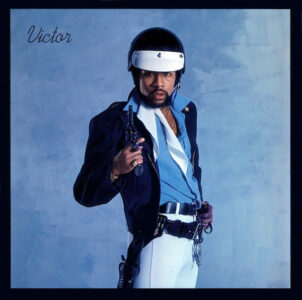
Other members of the classic lineup include Lakota native Felipe Rose. He was born in 1954 in Manhattan. He first dressed as an American Indian at an elementary school Christopher Columbus parade and celebration. In the early 1970s, Rose was working as a nightclub dancer. He describes being encouraged by an aunt to begin dancing in what he says was “his father’s tribal regalia,” which he says led to his costume, acting and neon face-paint in the Village People. The Washington Post reported in 2008, “His aunt, he has said, inspired him to work the Indian angle into his showbiz ambitions: ‘Why not honor your father’s heritage,’ Rose has recalled her saying, ‘and dress in your tribal regalia in your dance journey through culture?'” Rose was working as a dancer and a bartender in the New York gay club, The Anvil, dressed “as an Indian” when he was discovered by Jacques Morali. In the Village People lineup, Felipe Rose performed as The Indian, usually wearing a costume consisting of an imitation, “bespangled war bonnet”, loincloth, and theatrical face paint.
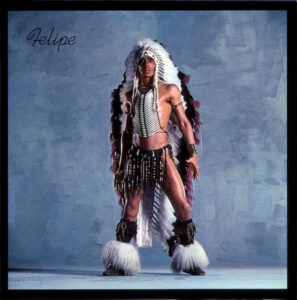
Alex Briley was born in 1947 and raised in Harlem, New York. His father was a Christian minister. He sang in church and studied voice at the University of Hartford. He has appeared in concert as both a soldier and a sailor.
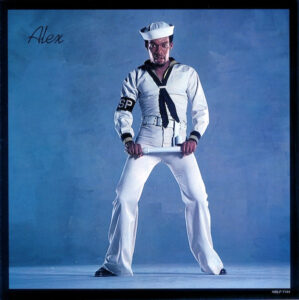
Glenn Hughes was born in 1950 in New York City. He studied music at Manhattan University. When he saw the ad placed by Jacques Morali and Henry Belolo he was working at the Brooklyn-Battery Tunnel as a toll collector. He appeared in the Village People lineup as the Leatherman. Hughes horseshoe moustache became iconic in the gay community and the disco scene.
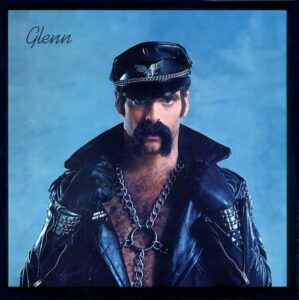
David Hodo (born Richard Davis Hodo) was born in 1947 in San Andreas, California, in the north-central region of the state. He went to university in Sacramento and majored in speech. Then he was working on a farm in Aptos, California, near Carmel re-weaving wicker furniture. He appeared in numbers of plays including the 1969 off-Broadway rock musical Salvation, a touring company in 1972 of Funny Girl, Broadway play Doctor Jazz in 1975, a Broadway production of Pal Joey in 1976. He was also a guest on What’s My Line as a roller skating fire eater. He joined the Village People in 1978 appearing in concert as a construction worker.

Randy Jones was born in 1952 in Raleigh, North Carolina. He studied at the North Carolina School of the Arts before moving to Manhattan. When he joined the Village People, Jones appeared in concerts as a cowboy.
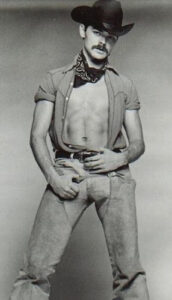
Randy Jones (1978)
A second album was released in 1977 titled Macho Man. The title track single was released with the album, a nod to the ‘macho man’ fantasy costumes in which the Village People performed.
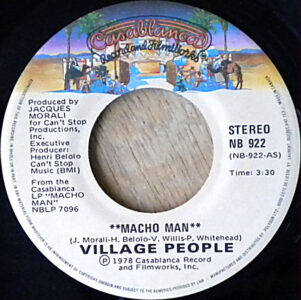
“Macho Man” was cowritten by Jacques Morali, Henri Belolo, Victor Willis, and P Whitehead. Jacques Morali was born in 1947 in Casablanca, Morocco. His family moved to France in 1956, following Moroccan independence. In the sixties he worked as a salesperson at a record shop at Orly Airport. In late 1960s in Paris, Morali composed for local orchestras and cabaret performances, including at the erotic cabaret named the Crazy Horse Saloon. In 1971, he got a position as an A&R man with Polydor Records in France. With Henry Belolo he cast three young women to become the disco group known as The Ritchie Family who had the hits “Brazil” and “The Best Disco In Town”. In the late 70s, Morali had a relationship with adult film star Wade Nichols. In 1977, he produced the french documentary Crazy Horse de Paris. In 1980, he produced the Village People film Can’t Stop The Music. Morali produced over 70 albums including for Cher and Eartha Kitt on “Where Is My Man”. In 1983, he produced “Street Dance” by Break Machine, which became a number-one hit in the Netherlands in 1983, and peaked at #3 in the UK. Morali contracted HIV in the mid-80s which prompted him to become a recluse. Jacques Morali died of complications related to AIDS in 1991 at the age of 44.
Henri Belolo was born in Casablanca, Morocco, in 1936. In addition to “Macho Man”, Belolo cowrote with Morali and Willis “Y.M.C.A.”, “In The Navy” and “Go West”. Henri Belolo died in 2019 at the age of 82. Both Morali and Belolo were Jewish.
The Village People performed “Macho Man” on both American Bandstand and the Merv Griffin Show. They also appeared on the cover of Rolling Stone magazine.
“Macho Man” reached #1 in Harrisburg (PA), Hamilton (ON), Winnipeg (MB), and Victoria (TX), #2 in New Orleans, and Tampa Bay (FL), #3 in Providence (RI), York (PA), Kansas City (MO), and Chicago, #4 in Portland (OR), Ottawa, Carbondale (IL), and Easton (PA), New York City, Youngstown (OH), and Fort Lauderdale, #5 in Houston, Miami, South Bend (IN), and La Crosse (WI), #6 in St. Louis, Boston, Toronto, and Cleveland, #8 in Seattle, and #9 in San Francisco, and Poplar Bluff (MO). In Hamilton, “Macho Man” spent four weeks at number-one on CKOC and eight more weeks in the Top Ten.
Internationally, “Macho Man” climbed to #3 in Australia, #7 in New Zealand, #16 in Canada, #25 on the Billboard
Hot 100, and #26 in Finland. Cashbox magazine reported in May 1979 that across Latin America “Macho Man” had sold over 2 million copies. In Saudi Arabia, “Macho Man” was banned as an example of decadent western culture. The song was parodied on the Mickey Mouse Disco album with Donald Duck singing “Macho Duck”. On a March 17, 1994 episode of The Simpsons, Homer Simpson sings “Nacho Man”. While in 1995, Old El Paso Tex-Mex food producer released a commercial with the lyrics “Nacho, nacho man, I want to be a nacho man…” “Macho Man” appeared in the soundtrack for the 1993 film Addams Family Values, the 1996 comedy film The Nutty Professor, and its sequel in 2000 The Nuty Professor II: The Klumps, the 1997 comedy film In & Out, the 2003 science fiction movie Terminator 3: The Rise of the Machines, the TV sitcom Friends, the supernatural horror TV show Buffy the Vampire Slayer, in RuPaul’s Drag Race, and at rallies for President Donald Trump in both the 2020 and 2024 American election campaigns.
In 1978, “Y.M.C.A.” topped the pop charts in Australia, Austria, Belgium, Canada, Finland, France, Ireland, Italy, the Netherlands, Sweden, Switzerland and West Germany. It peaked at #2 in Norway and the USA, #3 in South Africa, and #4 in Spain. Worldwide, the single sold over 12 million copies. The single was from the Village People album Cruisin’. The album climbed to #2 on the Canadian RPM Top pop album chart.
Victor Willis recalls what happened when the Village People performed “Y.M.C.A” on American Bandstand. “We performed ‘Y.M.C.A.’ on ‘Bandstand’. After we finished the song, Dick (Clark) called me into his office, and said: ‘Hey, Victor, did you notice what the people in the audience were doing (during the song)? I said: ‘No, what?’ So he played it back for me. “Dick said: ‘What do you think about that? Should you put that in your act? I said: ‘Yeah, I think we’ll have to!’”
Late in 1978, the Village People released “I Am What I Am” reached #4 on the U.S. Dance Chart. A different song with the same title from the Broadway musical La Cage Aux Folles was covered by Gloria Gaynor in 1983.
In March 1979, the Village People released their fourth album titled Go West. The lead single, “In The Navy”, topped the pop charts in Belgium, Canada, and the Netherlands, reached #2 in Ireland and Norway, #3 in Finland, Sweden, the USA and West Germany, #5 in Austria and Ecuador, and #7 in Australia, New Zealand and Switzerland.
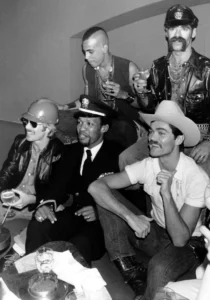
Five of the Village People at the Xenon Nightclub in NYC (June 1979)
The followup, “Go West” was a modest Top 20 hit in Belgium, Ireland and the UK. The song was successfully covered by the Pet Shop Boys. Their cover topped the pop charts in 1993 in Finland, Germany, Iceland, Ireland, climbed to #2 in Austria, Belgium, France, Sweden, Switzerland, and the UK, and cracked the Top Ten in Australia, the Netherlands, Norway, and Spain.
In 1980, the Village People had their last notable hit single titled “Can’t Stop the Music”. It peaked at number-one in Australia and South Africa, #2 in New Zealand, #7 in Belgium, #8 in Finland, #10 in West Germany, #11 in the UK, and also went Top 20 in Austria, Ireland and Sweden. The album, Can’t Stop the Music topped the pop album chart in Australia.
However, commercially, the music stopped – at least the record sales at scale – after 1980. The disco craze was virtually dead by 1981. The Village People and a host of other disco acts were swept away by ‘new wave’ and other emerging recording artists like Kim Carnes, Blondie, The Police, Devo, Human League, Soft Cell, The Cars, The Go-Gos, A Flock of Seagulls, Kim Wilde, the Buggles, Duran Duran, Wham!, the Boomtown Rats, Adam Ant, Spandau Ballet and other acts.
Between 1981 and 1985, the Village People released three more albums. Their ninth, Sex Over the Phone, sold poorly.
That year the group folded. They reformed in 1987 with Ray Simpson replacing Victor Willis – in 1979 and 1982 – and from 1987 until Willis’ return in 2017. Simpson was born in 1954 in The Bronx, New York. He majored in English and minored in music at City College of New York. With his sister, Valerie Simpson and her singing partner Nickolas Ashford, he performed on their records and in concert. In 1978, Ray Simpson released a solo album titled Tiger Love.
Since 1977, there have been 26 performers in the Village People lineup. As of 2926, Victor Willis is the only original member in the lineup.
Alex Briley retired from Village People at the age of 70 in 2017, after 40 years’ with the group. After he left the Village People in 1983, Victor Wills – disenchanted from industry infighting, lost master tapes, and legal matters – turned to drugs. He told the San Diego Union-Tribune “I spent the 1980s and ‘90s, well, I got kind of drugged out. Because I was disappointed with the way things were and got frustrated, and gave up for a bit, and decided I didn’t want to be a part of it. So much had been taken away from me that I just turned to drugs.” The 2012, a legal case saw Willis regain control over some of the Village People’s most popular songs, which he co-wrote, over the two companies that administered the songs’ publishing rights. In 2015, Victor Willis released his debut solo album titled Solo Man.
Glenn Hughes was named on People‘s 1979 list of ‘Most Beautiful People’. In 1996, Hughes retired from the group and launched a successful New York cabaret act until he was diagnosed with lung cancer. He had been a heavy smoker since he was a teenager. Hughes died in March 2001 at the age of 50 from lung cancer.
David Hodo released a solo album in 2008 titled The Kids’ll Be Fine. He retired from the Village People in 2013.
As recently as 2019, Felipe Rose was the media spokesperson for God’s Love We Deliver, a charity founded in the mid-80s that delivers meals to people living with AIDS. Rose is also a hobbyist cook, making dishes inspired by his Puerto Rican heritage. He cooks on his own YouTube channel show.
In 1996, Randy Jones published the book Out Sounds: The Gay and Lesbian Music Alternative. And in 2007, he released a solo album titled Ticket to the World. In 2014, Randy Jones appeared as Tiberius in the Off-Broadway musical, The Anthem.
In 2018 the Village People released their tenth studio album titled A Village People Christmas.
June 20, 2026
Ray McGinnis
References:
“The Village People – Great Disco Fun,” Sydney Morning-Herald, Sydney, Australia, November 11, 1979.
“The Amazing Story Of Harlem’s Alex Briley An Original Member Of The Village People,” Harlem World, March 19, 2024.
George Varga, “Victor Willis on life & music, post-Village People,” San Diego Union-Tribune, August 2, 2015.
Neil Strauss, “Glenn Hughes, 50, the Biker of the Village People Band,” New York Times, March 17, 2001.
Christian John Wikane, “Under the Hard Hat: An Interview with Village People’s David Hodo,” Pop Matters, May 30, 2014.
K.A. Dilday, “A Gay Icon Remembers Life in the Village, and in the Village People,” Bloomberg, June 26, 2019.
Alyssa Rashbaum, “Village People’s Cowboy Ropes Himself A Husband,” MTV.com, May 11, 2004.
“Village People Co-Founder, Songwriter Henri Belolo, Dies,” New York Times, August 7, 2019.
“Latin American Disco Boom Opens Area to U.S. Artists,” Cashbox, p. 40, May 19, 1979.
Benjamin Ivry, “The Secret Jewish History Of The Village People,” Forward, August 7, 2019.
“Jacques Morali,” Grokipedia.com.
“Jacques Morali,” Find a Grave.com.
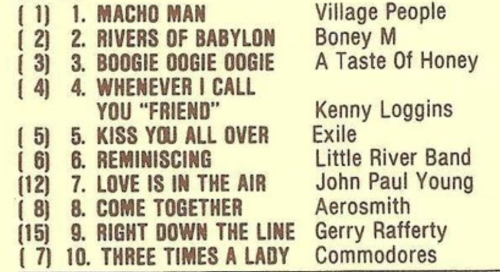
CKOC 1150-AM Hamilton (ON) | October 11, 1978
Leave a Reply