
#120: Johnny Remember Me by John Leyton
City: Hamilton, ON
Radio Station: CKOC
Peak Month: October 1961
Peak Position in Hamilton ~ #11
Peak Position in Vancouver ~ did not chart
Peak Position on Billboard Hot 100 ~ did not chart
YouTube: “Johnny Remember Me”
Lyrics: “Johnny Remember Me”
John Leyton was born in 1936 in the seaside town of Frinton-on-Sea in Essex, England. He served in the Royal Army Service Corps. He studied drama, paying his way through drama school with bit-part roles in films and on television. In 1958 these included bit parts in The Square Peg, Doctor at Sea, and The Devil’s Disciple. In 1959, he appeared as a prisoner in an uncredited role in the British war film Danger Within. Next, he has a minor part as a recruit in the 1959 British comedy film I’m All Right Jack. He also had small roles in The Captain’s Table (where he plays a bystander watching a beauty contest), and film about P.O.W.s in Italy who plan to escape from prison, titled Breakout. Leyton also appeared for one episode of the British TV series The Invisible Man. His first major acting role was his portrayal of Ginger in a 1960 Granada TV adaptation of Biggles. This earned him a large following of young female fans and led to the formation of a John Leyton fan club. Following the success of Biggles, Leyton was persuaded by his manager to audition as a singer for record producer Joe Meek.
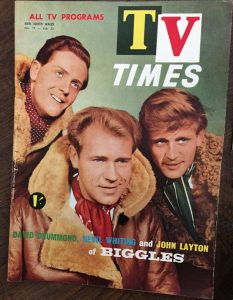
TV Times, Sydney, Australia, February 17, 1960.
On his first visit to the recording studio, John Leyton recorded a cover version of Ray Peterson’s North American Top Ten hit “Tell Laura I Love Her”. It was released on the Top Tank label. In 1961 though, the Top Rank label was bought out by EMI Records who then issued Leyton’s records on their His Master’s Voice label. However, EMI had already released Ricky Valance’s cover of the same song. As a result, EMI withdrew Leyton’s recording from commercial sales, while Valance’s version reached number one in the UK chart.
A second single, “The Girl on the Floor Above”, was released the His Master’s Voice label, but was not a success. His first big hit, “Johnny Remember Me”, coincided with his appearance as an actor in the popular ATV television series Harpers West One, in which he played a singer named Johnny Saint Cyr. Leyton performed “Johnny Remember Me” during the show, backed by a band called the Outlaws.
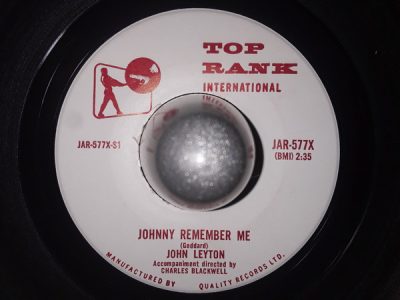
“Johnny Remember Me” was written by Geoff Goddard. He was born in 1937 in Reading, England. He sang in choir in a local church before going on to study the viola and piano at the Royal Academy of Music in London. He was with the national service out of high school, and then sought to become a pop singer. He met music producer Joe Meek. He initially attempted to establish himself as a Russ Conway/Liberace styled singer-pianist under the stage-name “Anton Hollywood”. Joe Meek promoted Goddard as Anton Hollywood, but he was unable to achieve success. In 1960, he wrote an instrumental for the Flee-Rekkers titled “Low Rider”. In 1961 Goddard co-wrote “Tribute to Buddy Holly” which was a Top 30 hit for Mike Berry and the Outlaws. It was later covered by Chad Allan and the Reflections.
Goddard also played keyboards on numbers of Joe Meek’s productions. One of these was the number-one international hit “Telstar” by the Tornadoes in 1962. In 1963, Goddard co-wrote “Just Like Me” – a tribute song to Eddie Cochran – which became a Top 5 hit in the UK for Heinz. Two more songs Goddard wrote for Heinz became Top 30 hits in the UK. Other recording artists Geoff Goddard wrote songs for include Gerry Temple, and Screaming Lord Sutch. Goddard wrote John Leyton’s second pop hit, “Wild Wind”, which reached #2 on the UK Singles chart in October 1961. This was followed by Leyton’s recordings of “Son This Is She” (#15 in UK in December 1961), “Lone Rider” (#40 in March 1962), and “Lonely City” (#14 in UK in May 1962). In early 1963, Geoff Goddard’s “Don’t You Think It’s Time” was a #6 pop hit in the UK for Mike Berry and the Outlaws. Later that spring, another Goddard-penned tune, “My Little Baby”, was a Top 40 hit for Mike Berry.
In July 1965, the British music magazine NME reported that it had been agreed in the London High Court that “Have I the Right?” was the work of Howard and Blaikley. Composer Geoff Goddard agreed to drop allegations that he, and not they, had written the song. Goddard had been Meek’s principal songwriter, but the two had fallen out in the winter of 1963-64. He claimed that the song was adapted from his earlier song “Give Me The Chance”, but was too shy to testify in court. Disillusioned with the music industry, Geoff Goddard withdrew from it to work in catering at the University of Reading. He died in 2000 at the age of 62.
“Johnny Remember Me” is a song that depicts a man haunted by his dead love imploring him to remember her. In the song he sings “I hear the voice of my darling, the girl I lost and loved a year ago.” Leyton sings “Well it’s hard to believe I know, but I hear her singing in the sighing of the wind blowin’ in the tree tops way above me.” Moreover, “Till the day I die, I’ll hear her cry ‘Johnny remember me’.” He concedes it’s possible “well someday I guess I’ll find myself another little girl to take the place of my true love.” (Given the ‘girl he loved and lost’ is his true love, it’s clear he didn’t end the relationship. Meanwhile, she is singing in the sighing of the wind with ghostly persistence). Even if he finds someone to replace his ‘true love,’ he’ll always hear her “blowing in the tree tops way above me.” Spooky! The original line “the girl I love who died a year ago” was softened to “the girl I loved and lost a year ago.” Nonetheless, it was banned by the BBC.
The ghostly female backup vocals were by a session singer named Lissa Gray. The song originally appeared in the British TV drama Harpers West One, in which John Leyton was playing Johnny St Cry, a Pop singer opening a record department.
Lissa Gray is a professional singer, who combined broadcasting with session work and television. This included on the 1965 Stanley Holloway album Stanley, I Presume, and another album that year titled The Words and Music of Noel Coward. After marrying and with two children, she and her family moved to Hampshire, where she started the Hampshire County Children’s Choir and later the National Children’s Choir of Great Britain.
Internationally, “Johnny Remember Me” reached #1 in Ireland, New Zealand, and number-one for four weeks in the UK, as well as reaching #4 in Norway, and #19 in West Germany. In local record markets the song peaked at #1 in Wellington (NZ), #8 in Hobart, Tasmania, and #11 in Hamilton (ON).
In 1961, Ivory Coast-born John William had a hit with “Johnny rappelled-toi” in France. British singer Bobby Stevens also covered “Johnny Remember Me” in 1961. While in Finland, Pekka Loukiala covered the song, Little Gerhard in Sweden, and Belgian pop star Fud Leclerc (“Johnny Vergil’s Mich Nie”) in 1961. Danish pop singer Bjørn Tidmand covered the song in 1967 (“Johnny, Du Svigted Mig”). The progressive rock band from The Netherlands, Christy Lane, covered the song in English in 1970. In 1975, Afrikaans country singer Jody Wayne covered “Johnny Remember Me”.
Johnny’s ghostly girl continues to call. Decades later the song was been covered by The Meteors (1983), the Dutch pop singer John Spencer (1983), the Swedish band Dead Scout (1984), Bronski Beat and Marc Almond on The Age of Consent album (1985), Dave Vanian’s Phantom Chords in 1990, and Spell in 1993.
“Johnny Remember Me” is one of a genre of songs in the teen tragedy zone where the heartthrob of a teenager has died. While in “Tell Laura I Love Her” by Ray Peterson, “Teen Angel” by Mark Dinning, “El Paso” by Marty Robbins, “Running Bear” by Johnny Preston, “Jimmy Love” by Cathy Carroll, “A Thousand Feet Below” by Terry Tyler, “Ebony Eyes” by the Everly Brothers, “Terry” by Twinkle, “The Leader Of The Pack” by the Shangri-las, “Last Kiss” by J. Frank Wilson and the Cavaliers, “Moody River” by Pat Boone, “Patches” by Dickie Lee, and others, the story of how the person died is told. In “Johnny Remember Me” we just know his “girl” died a year ago but not the circumstances.
Anytime a young person dies it is generally considered a tragedy. Of course, if a child or teenager has some illness – a death from a brain tumor or terminal cancer for example – there may be peace and relief mixed with the grief given the circumstances. But, death from a traffic accident, suicide, sports accident, or drug overdose, a gang related fight (think West Side Story) are a jolt. We generally expect to live for some time, and certainly beyond our teenage years (or early twenties). While the genre of songs about teen tragedies are sometimes cheesy, they were popular in their time because from time to time children and youth did die. And so there were members of the general public that connected with these songs at some level. Even Neil Scott’s “Bobby” about an unconscious girl lying in a hospital bed, who finally comes out of her coma, had an aura of suspense as listeners to the song waited to learn if she lives of dies.
In 1961, John Leyton had his debut studio album release with The Two Sides of John Leyton. He also appeared on an episode of the British TV show Harper’s West One – about the life and loves in a big department store in the West End of London.
On 15 April 1962, Leyton performed at the NME Poll-Winners Concert at London’s Wembley Pool. In the fall of 1962, “Down the River Nile” reached #14 in Sweden. But in 1963, Joe Meek and Goddard’s association with Leyton ended. That circumstance, combined with the British beat boom, cast Leyton adrift immediately. In early 1963, he managed to chart “Cupboard Love” to #22 on the UK pop chart which was written by Les Vandyke (who had written pop hits for Adam Faith and Eden Kane). Later in 1963, in Norway and Sweden, his cover of Stephen Foster’s “Beautiful Dreamer” climbed to #3 in both countries. In 1964, his cover of the Jo Stafford hit “Make Love To Me” in 1954 reached #15 in Sweden in 1964. And in 1964, his cover of “Tell Laura I Love Her” became a #3 hit in Sweden.
Meanwhile, John Leyton found a lot of acting work in television and film to keep himself busy. In 1962, he appeared in the musical comedy box-office hit It’s Trad Dad!
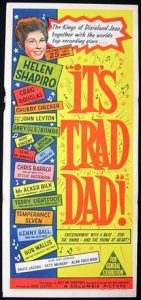
He appeared alongside Helen Shapiro, Chubby Checker, Gary U.S. Bonds, Craig Douglas, the UK skiffle group The Brooks Brothers, Del Shannon, Gene Vincent, Gene McDaniels, the Paris Sisters, Chris Barber’s Jazz Band, Kenny Ball’s Jazzmen, Mr. Acker Bilk, and The Temperance Seven.
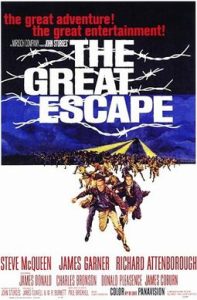
In 1963, he appeared in the Steve McQueen war film The Great Escape. Other stars on the set were Charles Bronson, Richard Attenborough, Donald Pleasence, James Donald, and James Garner.
In 1963, Leyton released his second studio album titled Always Yours.
In 1964, John Leyton appeared in Guns at Batasi – another war film about a coup in an African nation. It starred Richard Attenborough, Dame Flora Robson, Jack Hawkins, and Mia Farrow. In 1965, John Leyton got top billing in the musical comedy Every Day’s a Holiday. Other recording acts in the film included Mike Sarne and Freddie and the Dreamers.
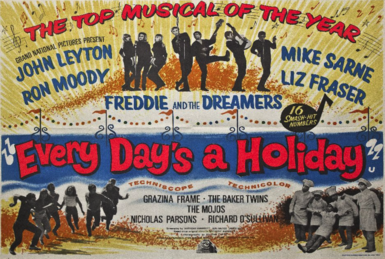
That year he was cast in the TV shows Convoy and 12 O’Clock High. Later in ’65, he appeared as a lieutenant in the WWII-themed film Von Ryan’s Express which starred Frank Sinatra and British actor Trevor Howard.
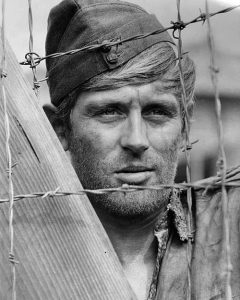
John Leyton (above) as Lt. Orde in Von Ryan’s Express
As a singer, John Leyton appeared on Bandstand (from Australia), Discs-A-Go-Go, Thank Your Lucky Stars, Ready Steady Go!, Holiday Music, Like…Music, and the Billy Cotton Band Show. Leyton also appeared as a guest panelist on Juke Box Jury. While a documentary short – The Johnny Leyton Touch – aired in 1962.
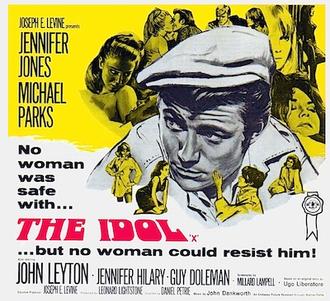
In 1966, Leyton starred in The Idol which was a movie about the ‘swinging sixties’ and rebellious students. John Leyton was cast as a medical student who considers giving up his career path to become an art student.
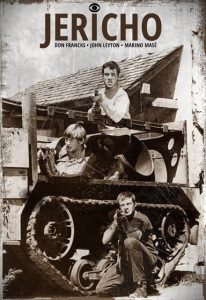
As well, in 1966-67, Leyton was cast as Nicholas Gage in a WWII spy American TV series titled Jericho.
Among hit later roles, Leyton was cast in the 1969 disaster film Krakatoa, East of Java, along with Sal Mineo and Maximilian Schell. In 1973, he released his third studio album titled John Leyton.
In 1974, he appeared in the British TV show Dixon of Dock Green. In 1975, he appeared in a number of episodes of the British TV series The Nearly Man. In 1976, he was an actor in the British horror film Schizo, co-starring Lynne Frederick. That year he appeared in a number of episodes of the TV series Crown Court. In 1978, he was in the TV series Send in the Girls. In 1980, he appeared in six episodes of the TV series The Square Leopard. The following year he was cast in the TV shows Play for Today and Dangerous Davies: The Last Detective.
In 1997, the singer released his fourth studio album, John Leyton Is Back. In 2001 he played a superintendent in the British TV series The Bill. In 2002, he appeared as himself being interviewed as a subject in the TV documentary Jukebox Heroes. In 2005, he appeared in the film Color Me Kubrick. In May 2006, Leyton released “Hi Ho, Come On England”, a re-working of Jeff Beck’s “Hi Ho Silver Lining”, to coincide with the World Cup in Germany.
In 2008, John Leyton appeared in the film Telstar: The Joe Meek Story. However, he was cast as Sir Edward, while Callum Dixon played a young John Leyton.
February 12, 2026
Ray McGinnis
References:
“John Leyton,” Alchetron, October 12, 2024.
“Highlights of a Conversation with John Leyton – About his Role in the 1960s Biggles TV series and Meeting Captain W.E. Johns,” Biggles.info, April 8, 2022.
Graham Young, “Film star who broke into big time with the greats,” Birmingham Post, UK, December 20, 2013.
Peter Robertson, “Where are they now… ? ‘Johnny Remember Me’ singer John Leyton,” Express, March 26, 2016.
“John Leyton Songs: Full Official Chart History,” Officialcharts.com.
Cathi Unsworth, “The Life of a Song: Johnny Remember Me,” Financial Times, December 4, 2015.
John William,”Johnny rappelled-toi,” 1961.
Bronski Beat and Marc Almond, “I Feel Love/Johnny Remember Me“, 1985.
John Spencer, “Johnny Vergeet Me Niet“, Avrotros Broadcasting, The Netherlands, November 19, 1983.
Low-Fi Drifters, “Johnny Remember Me“, CDBaby Music, 2007.
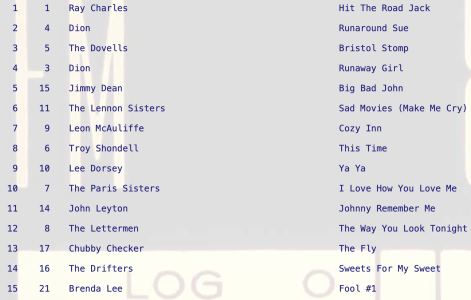
CKOC 1150-AM Hamilton (ON) | October 29, 1961
Thanks for this detailed report on one of my favourite sixties actor & singer.
You’re welcome – and thanks to Hamilton, Ontario, for charting the song. It never made airplay in my home town of Vancouver.
it did not make it in Toronto either. Hard to believe given it went to #1 in the U.K. I did a Moment In Time piece on this song in December 2021.
Thanks Tom. I’ll look for your Moments In Time review of Johnny Remember Me.
Ray