
#10: Baby Can I Hold You by Tracy Chapman
City: Burnaby, BC
Radio Station: CFML
Peak Month: January 1989
Peak Position in Burnaby ~ #6
Peak Position in Vancouver ~ did not chart
Peak Position on Billboard Hot 100 ~ #48
YouTube: “Baby Can I Hold You”
Lyrics: “Baby Can I Hold You”
Tracy Chapman was born in 1964 in Cleveland, Ohio. Her mother gave her a ukulele to play at the age of three. Her parents were divorced when she was four. Chapman began playing guitar and writing songs at age eight. She says that she may have been first inspired to play the guitar by the television show Hee Haw. Growing up she experienced frequent bullying and racially motivated assaults. She attended Tufts University. Chapman recorded demos of songs at the Tufts University radio station, WMFO, for copyright purposes while she was a student at Tufts, in exchange for the station’s right to play her songs. In 1987, she signed a contract with Elektra Records.
Her debut album, Tracy Chapman, was released in April 1988. The debut single from the album was “Fast Car”. She performed the song at Wembley Stadium in London at a tribute to Nelson Mandela on his 70th birthday. The song topped the pop charts in Belgium, Canada, Ireland, the Netherlands, and Portugal. “Fast Car” also charted into the Top Ten in Australia, Sweden, the UK, Uruguay, and USA. In July 2023, country singer Luke Combs cover of “Fast Car” topped the Billboard Hot Country Singles chart. This made Tracy Chapman the first Black American female to have a song top the country charts. The next track from the album released as a single was “Talkin’ Bout A Revolution”. It reached the Top Ten in Montreal, Boston and San Francisco.
From September 2 to October 15, 1988, Chapman was one of the performers on the six-week Human Rights Now! tour sponsored by Amnesty International. Others sharing the stage were Bruce Springsteen, Sting, Peter Gabriel and Youssou N’Dour.
A third track from Tracy Chapman’s self-titled debut album was “Baby Can I Hold You”.
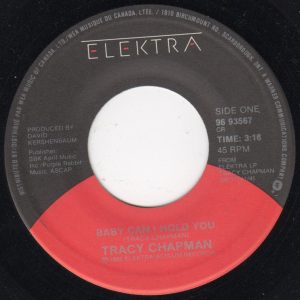
Tracy Chapman wrote “Baby Can I Hold You”. In this song, Tracy tells her lover all they need to do is treat her well, to say “sorry,” to love her and everything will be alright.
“Baby Can I Hold You” climbed to #4 in Boston, #6 in Burnaby (BC), and Salem (OR), #11 Arlington (TX), and #12 in Salt Lake City.
In 2000, Chapman and Luciano Pavarotti recorded a duet of “Baby Can I Hold You” which was featured in the album Pavarotti and Friends for Cambodia and Tibet. She has also recorded duets with B.B. King, Eric Clapton, Stephen and Ziggy Marley, Dave Matthews and blues guitarist Buddy Guy.
In October 2018, she sued the rapper Nicki Minaj over copyright infringement, alleging that Minaj had sampled her song “Baby Can I Hold You” without permission. Chapman stated that she had “repeatedly denied” permission for “Baby Can I Hold You” to be sampled. The lawsuit alleged that Minaj had engaged in copyright infringement (a) by creating the song “Sorry” and (b) by distributing it; she requested an injunction to prevent Minaj from releasing the song. According to the lawsuit, Chapman has a policy of declining all requests for permission to sample her songs. In September 2020, a judge granted summary judgment in favor of Minaj on the first count of her complaint, stating that Minaj’s experimentation with Chapman’s song constituted fair use rather than copyright infringement. However, the judge ruled that the second count of the complaint should go to trial. In January 2021, the dispute was settled when Minaj paid Chapman $450,000.
In February 1989, Tracy Chapman won a Grammy Award for Best New Artist. For the album, Tracy Chapman, she received a Grammy Award for Best Contemporary Folk Album, and a nomination in the Album of the Year category. While “Fast Car” was nominated for Song of the Year, and Record of the Year, losing in both categories to Bobby McFerin’s “Don’t Worry, Be Happy”. However, Chapman won a Grammy Award for the single in the Best Female Pop Vocal Performance category.
In 1990, her album Crossroads received a Grammy nomination in the Best Contemporary Folk Album category. The single “Crossroads” charted in the Top 40 in Canada, New Zealand and Switzerland.
In 1995, “Give Me One Reason” topped the pop charts in Canada and Iceland. It also peaked at #3 in Australia, and the Billboard Hot 100, while reaching #16 in New Zealand. In February 1997, Tracy Chapman received a Grammy Award nomination for Best Pop Album for New Beginnings. Her hit single, “Give Me One Reason”, received four Grammy nominations: Record of the Year, Song of the Year, Best Female Rock Vocal Performance, and Best Rock Song. The single won only in the later category.
Her final appearance in the Top 40 in any country was for “Telling Stories” which reached #22 in New Zealand in 2000.
In 2010, Tracy Chapman received her thirteenth Grammy Award nomination. This time for her eighth studio album, Our Bright Future, in the Best Contemporary Folk Album category.
On April 16, 2023, the South African Presidency announced that Chapman along with others would be bestowed with a National Order – The Order of the Companions of O.R. Tambo which “recognizes eminent foreign nationals for friendship shown to South Africa. It is therefore an Order of peace, cooperation and active expression of solidarity and support.” The Order was bestowed in Silver on her “for her contribution to the fight for freedom by participating in efforts to free Nelson Mandela and raising awareness of human rights violations globally.”
January 28, 2026
Ray McGinnis
References:
Steve Pond, “Tracy Chapman: On Her Own Terms: The “Fast Car” singer had a feeling she could be someone. Now she is,” Rolling Stone, September 22, 1988.
“Tracy Chapman sues Nicki Minaj over unauthorised sample,” Guardian, October 23, 2018.
Melinda Newman, “Tracy Chapman Now First Black Woman to Hit No. 1 on Country Airplay as Sole Writer – Who is the Only Black Male Writer to Have Achieved the Same?” Billboard, July 3, 2023.
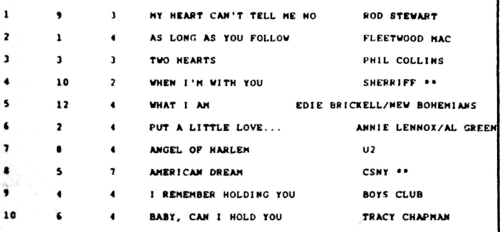
Hot Twenty – CFML 940-AM Burnaby (BC) | February 6, 1989
Enjoyed this Ray. I was so out of the pop culture scene in 1989 (busy creating a bookstore) I totally missed this BIG song for her. And like many I “rediscovered’ her when Luke Combs made a hit of Fast Car a couple or years ago as youreference. Absolutely love her voice, her way of being a musician with a mission. Bet she’s involved in the resistance down there now.
On with my day after morning zoom yoga.