
#33: Bow Down (To The Dollar) by Joshua
City: London, ON
Radio Station: CJOE
Peak Month: December 1971
Peak Position in London ~ #9
Peak position in Vancouver ~ #25
Peak Position on Billboard Hot 100 ~ did not chart
YouTube: “Bow Down (To The Dollar)”
Joshua was a band from Woodstock, Ontario. They first signed to GRT of Canada Ltd. in 1971 by Harry Hinde. Much of their vocal work comprised of intricate three-part vocal harmonies. There was also a good blend of raw rock ‘n roll, and funky rhythms with some pretty good guitar and keyboard work. The members of the band were Al Feth, Bill Broadhurst, Carl Burgess (on guitar), Don Dunlop, and Pat Gamble (born 1952) on drums.
Joshua released a single titled “Throw A Rope”. The single got some airplay in Hamilton (ON) in the fall of ’71. Their followup release in the fall of 1971 was titled “Bow Down (To The Dollar)”.
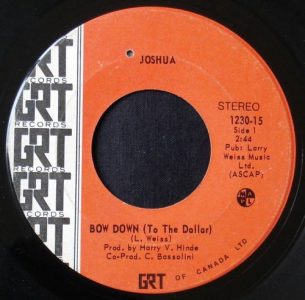
“Bow Down (To The Dollar)” is a song written by Larry Weiss. He was born in Newark (NJ) in 1941. He grew up in Queens (NY) and worked initially in his family’s textile business. Weiss got a break in 1962 when Pat Boone recorded “Ten Lonely Guys”, which climbed to #45 on the Billboard Hot 100. Nat “King” Cole recorded Weiss’ song “Mr. Wishing Well” in 1963, which stalled at #92 on the Hot 100. That year Baby Washington had a #21 R&B hit with Weiss’ “Leave Me Alone”. In 1966, Weiss had “Help Me Girl” recorded by both The Outsiders and The Animals, who both had Top 40 hits with the single. Weiss wrote Jeff Beck’s #14 UK hit in 1967 titled “Hi-Ho Silver Lining”. In the winter of 1967-68, Weiss’ song “Bend Me, Shape Me” was a #5 pop hit for the American Breed, and a #3 UK hit in 1968 for the Amen Corner.
Larry Weiss also penned songs recorded by The Shirelles, Timi Yuro, Chuck Jackson, Dionne Warwick, Lenny Welch, The Carpenters, Steve Alaimo, Adam Wade, Clyde McPhatter, Roy Hamilton, The Searchers, Vic Dana, Gene Pitney, The Toys, O.C. Smith, Bobby Sherman, Paul Anka, P.J. Proby, Pete Flint Quintet, Dusty Springfield, Ike & Tina Turner, Ben E. King, Ruby and the Romantics, and Janie Grant.
Larry Weiss’ biggest success was penning “Rhinestone Cowboy“, a number-one hit for Glen Campbell in 1975. The song earned two Grammy Award nominations in 1975: Best Pop Vocal Performance, Male, and Record of the Year. In the latter category it lost out to “Love Will Keep Us Together” by Captain and Tennille. In the former category, “Rhinestone Cowboy” lost out to Paul Simon’s “Still Crazy After All These Years”.
“Bow Down (To The Dollar)” is offers a social commentary about then thirty-year-old Weiss’ observations of early 1970s America. It asks “Tell me about your neighborhood. Is it really safe my friend? Do you have protection for the taxes that you spend?” Though the songwriter, Larry Weiss, grew up in Queens, for a band in Woodstock, Ontario, singing to local audiences in Woodstock, London (ON), Kitchener (ON), Waterloo (ON) and Stratford (ON) in 1971 the question might have been puzzling. Even big Canadian cities like Toronto, Vancouver, Montreal, and Hamilton (ON) had arguably safe neighborhoods in 1971. The protection (presumably police presence) for tax-paying citizens in large and small cities across Canada in 1971 wasn’t a hot topic. (In Vancouver, even East Hastings Street in 1971 was reasonably safe to walk – certainly compared to the 1980s or the 2020s). The lyrics go on to describe the “men in blue” (police) looking the other way when crimes are being committed.
The second verse asked “How about your “Indians, Navajo and Cherokee? They tamed the wilderness, and handed it to you and me.” Who tore up that register and tore apart a nation? Paid them back with solitude on a reservation?” The disconnect with this song playing on Top 40 AM radio stations in Canada in 1971 was that there were no Navajo or Cherokee in Canada. Our first nations people included Algonquin, Anishnaabeg, Chippewas, Cree, Mohawk, Ojibway and others. But, the Navajo were primarily in present day Arizona, Nevada, Utah, Colorado, California and Texas. (A few hundred persons of Navajo origin have moved to Canada in recent decades. However, Navajo were not found in Canada when it was settled by pioneers from European nations).
Similarly, when the pilgrims came to establish colonies on along the Eastern Seaboard of what is now the United States, the Cherokee resided in present-day western Virginia, southeastern Tennessee, western North and South Carolina, and northeastern Georgia – and later Alabama. It was only after the gold rush in Georgia (from a discovery in 1828) that Cherokee were expelled from the region. The Cherokee were displaced from their ancestral lands in northern Georgia and the Carolinas in a period of rapidly expanding white population. The majority of Cherokees were forcibly relocated westward to ‘Indian Territory’ in 1838–1839, a migration known as the Trail of Tears (Cherokee: The Trail Where They Cried). This took place under the authority of the Indian Removal Act of 1830. The harsh treatment the Cherokee received at the hands of white settlers caused some to enroll to emigrate west. This resulted in many Cherokee relocating to Oklahoma.
The third verse lampoons the state of American democracy. “Talk about your justice. Brag about your freedom. Privilege to own a gun. You can buy a rifle, load it with a bullet.” Larry Weiss saw a problem with the Second Amendment ‘right to bear arms.’ Freedom and justice, he argued wasn’t achieved by going to a gun show and buying ammunition.
The lyrics ask “Who can buy a home?… who can be a free man?” In January 1971, the average price of a house in Calgary, Edmonton, Montreal, Ottawa, Toronto, and Winnipeg, ranged between $94,900 in Calgary and $99,600 in Toronto. In 1971, the average income of an individual was $18,208, while an average family income that year was $43,437. Contrast this with the average price of a house in July 2022 in Toronto was $1,659,713. While the average income in Canada in 2022 was as follows: median family income $65,100, and median single (unattached) income was $32,800. An individual income had increased between 1971 and 2022 by 80%. While the price of a house in Toronto had increased by over 1565%. While the cost of a house in 1971 may have seemed expensive (compared to prices in 1961), it was attainable.
A fourth verse asks “What about the children who’ve never tasted honey. Hunger’s crying in their eyes while you count your money.” Of course, not all children had never tasted honey, or were all hungry. However, in America President Lyndon Johnson had commenced the ‘War on Poverty’ in his speech to Congress on January 8, 1964. Johnson stated, “Our aim is not only to relieve the symptom of poverty, but to cure it and, above all, to prevent it.” By 1973, the official poverty rate in America was 11.1%. The poverty rate in 1963 had been pegged at 19.5%.
“Bow Down (To The Dollar)” was first recorded in 1970 by UK soul/funk band J.J. Jackson’s Dilemma.
“Bow Down (To The Dollar)” peaked at #8 in Montreal, #9 in London (ON), #17 in Regina (SK) and #25 in Vancouver.
In the following months, Joshua released the singles “Come On Home”, and “Poor Folks”. The latter was a Top 30 hit for Joshua in Lethbridge (AB).
Pat Gamble left Joshua to join The Majority in 1972. In the following years, he joined Pete Dowan’s Woodstock-based Ontario band Dowan. Gamble died in Woodstock at the age of 62 in 2015.
Bill Broadhurst died in Woodstock in 2000. Carl Burgess was later part of the Burgess Trio. He died at the age of 74 in 2016.
If anyone has information about the musical careers (or other work) bandmates of Joshua pursued after the band dissolved, let me know.
December 27, 2025
Ray McGinnis
References:
Lizza Connor Bowen, “Larry Weiss – Cuts and Scratches,” Nashville Arts Magazine, November 2009.
“Obituary: Patrick Gamble,” Tribute Archive.
“Obituary: Carl Burgess,” Woodstock Sentinel-Review, October 6, 2016.
“New Housing Price Growth in the 1970s,” Statistics Canada.
“Income statistics by selected family type, Canada, 2019, 2021 and 2022,” Statistics Canada, April 26, 2024.
“Toronto Real Estate Price History: January 2001 to June 2025,” listing.ca.
Robert Rector and Rachel Sheffield, “The War on Poverty After 50 Years,” The Heritage Foundation, September 15, 2014.
“Our History: Explore the Interactive Timeline,” Cherokee National History Museum, 2019.
“Navajo History,” Navajo Nation Museum.
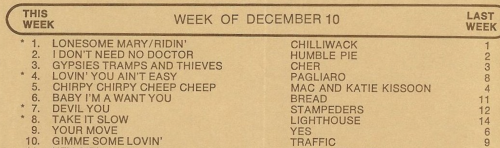
CJOE 1290-AM London (ON) Top Ten | December 10, 1971
Leave a Reply