
#32: Gimme Some Lovin’ by Traffic
City: London, ON
Radio Station: CJOE
Peak Month: December 1971
Peak Position in London ~ #9
Peak position in Vancouver ~ did not chart
Peak Position on Billboard Hot 100 ~ #68
YouTube: “Gimme Some Lovin’”
Lyrics: “Gimme Some Lovin’”
Stephen Lawrence Winwood was born in 1948 in suburban Birmingham, UK. Winwood began playing piano from the age of four, being raised in a musical family. He joined a boys choir and added drums and guitar to his repertoire. At age 14 he joined The Spencer Davis Group in 1963, with his older brother Muff. Both Stevie and Muff were playing at the Golden Eagle club as the Muff Woody Jazz Band, when Spencer Davis heard them and immediately approached them about forming a new band, the Spencer Davis Group.
When the Spencer Davis Group split in 1967, Steve Winwood formed Traffic. The band consisted of Winwood, Jim Capaldi, Chris Wood and Dave Mason.
James “Jim” Capaldi was born in Evesham, Worcestershire, England, in 1944. He studied piano and voice from his childhood. At age 14, Capaldi founded the band the Sapphires and served as their lead vocalist. At 16 he took an apprenticeship at a factory in Worcester, where he met Keith Miller and Dave Mason. In 1963 he formed the Hellions, with Mason on guitar and Gordon Jackson on rhythm guitar, while Capaldi himself switched to drums. The Hellions were a backing group for both Adam Faith and Dave Berry. In the mid-60s, Capaldi was one of the musicians who played with Jimi Hendrix at the Knuckles Club.
Chris Wood was born in 1944 in Birmingham, England. 18-year-old Wood joined the Steve Hadley Quartet, a jazz/blues group in 1962. He joined Shades of Blue in 1964. He was invited to join the psychedelic rock band, Traffic, as it was forming in 1967.
Dave Mason was born in 1946 in Worcester, England. He wrote a song for the Jaguars in 1963, and another for the Rockin’ Berries in 1965. Mason joined the Helions in ’63.
In April 1967 Traffic formed and released their debut single “Paper Sun”. The single shot to #5 on the UK Singles chart in early June. Their next single release was “Hole In My Shoe”, written by Dave Mason. Internationally, the single peaked at #2 in Vancouver, #6 in Brisbane (Australia), #8 in Nelson (New Zealand), #11 in Sydney (Australia), #13 in Hilversum (Netherlands), #14 in Melbourne (Australia) and #15 in Copenhagen (Denmark).
In 1967 and ’68 Winwood, Wood and Mason were each featured as session musicians on the Jimi Hendrix Experience album Electric Ladyland. In February 1969, Stevie Winwood announced he was forming a new band with Eric Clapton and Ginger Baker called Blind Faith. Meanwhile, Traffic disbanded. However, their record label put together a mix of songs for a third studio album release, Last Exit. Blind Faith lasted less than a year and Winwood reformed Traffic in 1970.
The lineup in the early 70s consisted of Steve Winwood, Jim Capaldi, Chris Wood, Dave Mason, Ric Grech, Jim Gordon and Rebop Kwaku Baah.
Ric Grech was born in 1946 in Bordeaux, France. He learned to play guitar, bass guitar, violin and cello. He was with the progressive rock band, Family, and Blind Faith, before joining Traffic.
“Rebop” Kwaku Baah was born in 1944 in Konogo, Gold Coast, Africa. In the Akan culture of Ghana, Kwaku is a name meaning “male born on Wednesday.” In 1969, Baah performed on Randy Weston’s album African Rhythms. In the same year he worked with Nick Drake on the song “Three Hours”, posthumously released in 2004 on the compilation album Made to Love Magic. He then joined Traffic in 1971, having met them in Sweden during a tour.
Jim Gordon was born in Los Angeles in 1945. He passed up a music scholarship to UCLA in order to begin his professional career in 1963, at age 17, backing the Everly Brothers. He went on to become one of the most sought-after recording session drummers in Los Angeles. The protégé of studio drummer Hal Blaine, Gordon performed on many notable recordings in the 1960s. These include Pet Sounds (including “Wouldn’t It Be Nice”, “God Only Knows” and “Sloop John B”) for the Beach Boys, The Spirit of ’67 (including “Good Thing” and “Hungry”) for Paul Revere and the Raiders, Who Knows Where the Time Goes for Judy Collins, “Classical Gas” for Mason Williams, “It Don’t Matter To Me” for Bread, “Wichita Lineman” for Glen Campbell, “Cry Me A River” (Joe Cocker), “Marrakesh Express” and “Suite: Judy Blue Eyes” (Crosby, Stills and Nash), “Different Drum” (Stone Poneys) and “After Midnight” (Eric Clapton). Before he joined Traffic, Jim Gordon was a member of Derrick and the Dominoes and played on the classic rock song “Layla”.
Traffic did well commercially in the early 70s. John Barleycorn Must Die, released in 1970, climbed to #11 in the UK, and #5 in both the Netherlands and USA, and #6 in Canada. Steve Winwood told a reporter in 2011 “Most of the Traffic stuff stands the test of time pretty well. All of those albums are like my children, so I really can’t pick a favourite, but in many ways, John Barleycorn is the core of what Traffic is, and it could be the most definitive album we did.”
In 1971 Traffic released The Low Spark of High Heeled Boys which went platinum in the USA. Traffic also released a non-album single “Gimme Some Lovin'” (Part One and Part Two).
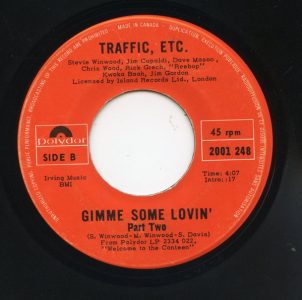
“Gimme Some Lovin'” was cowritten by Steve Winwood, Muff Winwood and “Spencer” Davis. The song was originally recorded by the Spencer Davis Group in 1966.
Mervyn “Muff” Winwood was born in 1943. He was nicknamed “Muff” after the popular British children’s TV character Muffin the Mule, which began appearing on the BBC in 1946 with Annette Mills interacting with the puppet. Growing up, Muff learned to play guitar and then bass guitar. He was with the Spencer Davis Group along with his younger brother Steve Winwood. After leaving the Spencer Davis Group in 1967, Muff Winwood moved became an A&R executive at Island Records. He was there until 1978, when he became an executive at the British office of CBS Records (which later became Sony Music), where he remained into the mid-1990s. As part of his A&R duties, Winwood signed Prefab Sprout, Terence Trent D’Arby, Sade, Shakin’Stevens, and The Psychedelic Furs amongst others.
In 1974, Muff Winwood produced the Sparks hit album, Kimono My House along with its hit singles, “This Town Ain’t Big Enough for Both of Us” and “Amateur Hour”. He also produced their other 1974 album, Propaganda (which included the “Never Turn Your Back on Mother Earth” single). Later, he produced records for Dire Straits, Marianne Faithfull, Traffic, Mott the Hoople, Love Affair, and others.
Muff Winwood recalls how “Gimme Some Lovin”” came about. “We started to mess about with riffs, and it must have been eleven o’clock in the morning. We hadn’t been there half an hour, and this idea just came. We thought, bloody hell, this sounds really good. We fitted it all together and by about twelve o’clock, we had the whole song. Steve had been singing ‘Gimme, gimme some loving’ – you know, just yelling anything, so we decided to call it that. We worked out the middle eight and then went to a cafe that’s still on the corner down the road. Blackwell came to see how we were going on, to find our equipment set up and us not there, and he storms into the cafe, absolutely screaming, ‘How can you do this?’ he screams. Don’t worry, we said. We were all really confident. We took him back, and said, how’s this for half an hour’s work, and we knocked off ‘Gimme Some Lovin’ and he couldn’t believe it. We cut it the following day and everything about it worked. That very night we played a North London club and tried it out on the public. It went down a storm. We knew we had another No. 1.”
The opening lines – “Well, my temperature’s rising and my feet hit the floor” – is a declaration reflecting a youth culture (including 17-year-old Steve Winwood and others) waking up to its own energetic potential. There are twenty people knocking, yearning for more. The lines reflect an insatiable hunger for life and its experiences. Desire throbs through the song. The band sings “Better take it easy, ’cause the place is on fire.” The seekers are finding relief in the night with its darkness, sweat and danceable beats. “Gimme Some Lovin'” is a hymn to the after-hours, the spaces where exuberance is unleashed, and music is in synch with the crowds’ heartbeat. In addition to the pulsing nightlife, the lyrics acknowledge the weary grind of the daily hustle: “Been a hard day and I don’t know what to do.” It’s a timeless theme that recognizes the weariness of routine, which the song contrasts with the drive to ultimately kick back and let loose.
“Gimme Some Lovin'” peaked at #7 in Youngstown (OH), #9 in London (ON), #15 in Detroit, and #19 in Windsor (ON).
Dave Mason left Traffic after the release of John Barleycorn Must Die to pursue a solo career. He released an album with the single “Only You Know And I Know”, which was more successfully covered by Delaney & Bonnie in 1971.
After two albums with Traffic, drugs increasing became a problem for Ric Grech. Steve Winwood and his bandmates eventually decided they had no alternative but to dismiss him. He got work as a session musician with Muddy Waters, Eric Clapton, Gram Parsons, and a few others. He unsuccessfully tried to launch a new rock band. In 1977 he left the music industry. Grech died of liver failure and alcoholism at the age of 43 in 1990.
And in 1973 Traffic saw Shoot Out at the Fantasy Factory crack the Top Ten album charts in both Canada and the USA. A seventh studio album in 1974, When the Eagle Flies, also made the Top Ten on the Billboard 200 album chart. Traffic disbanded in the mid-70s.
Chris Wood was a session musician in the years that followed Traffic disbanding. He died in 1983, after a bout of pneumonia and finally succumbing to liver disease.
Jim Capaldi released 13 studio albums between 1972 and 2004. His third album, Short Cut Draw Blood, included his cover of the 1961 Roy Orbison hit “Love Hurts”. Capaldi’s remake reached #4 in the UK, and #6 in Australia. He died of stomach cancer in 2005 at the age of 60.
Dave Mason has released 16 studio albums to date, his most recent being A Shade Of Blues in 2023. His biggest single hit was “We Just Disagree” in 1977 which climbed to #12 on the Billboard Hot 100 and #14 in Canada. Mason has been a studio musician for Paul McCartney and Wings (“Listen To What the Man Said”), Phoebe Snow, Graham Nash, George Harrison (All Things Must Pass), The Rolling Stones (“Street Fighting Man”), The Jimi Hendrix Experience (acoustic guitar on “All Along the Watchtower”, backing vocals on “Crosstown Traffic”), Donovan, Eric Clapton, Fleetwood Mac, and others.
Steve Winwood released his first solo album in 1977. In 1980 he released Arc of a Diver, which included his hit single “When You See A Chance”, co-written with Will Jennings. He also had a minor hit with “Arc Of A Diver“. And in 1982 he released Talking Back to the Night, which included his minor hit “Still In The Game”.
In 1986 Winwood sang a duet with Chaka Khan titled “Higher Love”, which topped the Billboard Hot 100, the Canadian RPM chart and made the Top Ten in Australia. The song was co-written with Will Jennings, and received a Grammy Award nomination. A follow up single from his Back In The High Life album, “The Finer Things”, also made the Top Ten in the USA. The title track from the album, which was written by Winwood and Jennings peaked at #13 on the Billboard Hot 100.
In 1988 Steve Winwood returned to the number-one spot on the Billboard Hot 100 with “Roll With It”. He co-wrote the song with Will Jennings. His followup singles from Roll With It, “Don’t You Know What The Night Can Do?” and “Holding On”, were Top Ten hits in the USA. Winwood and Jennings both cowrote those hits. Between 1977 and 2008 Steve Winwood released nine studio albums. In 2024 Winwood toured North America with the Doobie Brothers.
“Rebop” Kwaku Baah remained with Traffic on percussion between their third and seventh studio albums. He played on Steve Winwood’s debut 1974 self-titled album. In 1977, he joined the German rock band Can. Baah died of a cerebral hemorrhage during a performance in Stockholm, Sweden, in January 1983, where he was on tour with Jimmy Cliff. His final album, Melodies in a Jungle Man’s Head, was released in its unfinished state.
Jim Gordon continued to work as a session musician. He was in the studio for “On and On” (Stephen Bishop), Diamonds and Rust (Joan Baez), “Here Come Those Tears Again” (Jackson Browne), “Only Yesterday”, “Please Mr. Postman”, “There’s A Kind Of Hush” and “Solitaire” (The Carpenters), “All I Know”, “My Little Town” and “I Only Have Eyes For You” (Art Garfunkel), “Sara Smile” and “Rich Girl” (Hall and Oates), “Power To The People” (John Lennon and Plastic Ono Band), “Sundown”, Carefree Highway”, “Rainy Day People”, and “The Wreck of the Edmund Fitzgerald” (Gordon Lightfoot), “Midnight At the Oasis” (Maria Muldaur), “Summer Breeze” (Seals and Crofts), “Rock And Roll Heaven” (Righteous Brothers), “Rockin’ Pneumonia and the Boogie Woogie Flu”, “Everybody’s Talkin'”, “Without You” and “Coconut” (Nilsson), “Rikki Don’t Loose That Number” (Steely Dan), “The Right Thing To Do”, “You’re So Vain”, “Mockingbird”, “Haven’t Got Time For the Pain”, and “Attitude Dancing” (Carly Simon), “I Never Cry” and “You And Me” (Alice Cooper), “It Never Rains in Southern California” (Albert Hammond), “Stand Tall”, “I’m Scared”, “Break It To Them Gently” and “I Will Play A Rhapsody” (Burton Cummings), and “Rock The Boat” (Hues Corporation), Country Joe McDonald, Emitt Rhodes (of Merry-Go-Round), Frank Zappa, Manhattan Transfer, Cher, Chad & Jeremy, Donovan, B.B. King, Carole King, and others. In 1983, Jim Gordon, in a psychotic episode associated with undiagnosed schizophrenia, murdered his mother. He was sentenced to 16 years to life in prison, remaining incarcerated until his death in 2023.
January 7, 2026
Ray McGinnis
References:
Jonathan Cott, “Traffic: The Rolling Stone Interview: British Band Talks Jams – then Breaks Up,” Rolling Stone, May 3, 1969.
Jonathan Wingate, “Growing Up in Public: An Interview with Steve Winwood,” Express, February 22, 2011.
Anthony Decurtis, “Steve Winwood: From Mr. Fantasy to Mr. Entertainment,” Rolling Stone, December 1, 1988.
“EML’s Favorite Songs – SPENCER DAVIS GROUP: “Gimme Some Lovin’” Electric Music Lover, July 27, 2020.
Bill DeYoung, “We Just Disagree: The Story of Dave Mason,” Goldmine, February 16, 1996.
Paul Rees, “Traffic’s Chris Wood: Gifted, troubled and perpetually overlooked,” Louder Sound.com, November 6, 2019.
Richard Williams, “Obituary: Jim Capaldi,” Guardian, January 29, 2005.
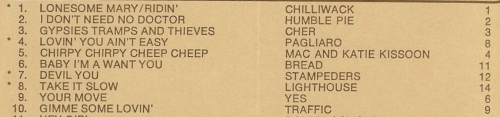
CJOE 1290-AM London (ON) Top Ten | December 10, 1971
Leave a Reply