
#56: Listen To The Radio by Pukka Orchestra
City: Regina, SK
Radio Station: CJME
Peak Month: May 1984
Peak Position in Regina ~ #10
Peak position in Vancouver ~ Hit Bound
Peak Position on Billboard Hot 100 ~ did not chart
YouTube: “Listen To The Radio”
Lyrics: “Listen To The Radio”
The Pukka Orchestra was formed in Toronto in 1979. The core of the band consisted of vocalist/guitarist/songwriter Graeme Williamson (born in Glasgow, Scotland) and guitarists/co-songwriters Neil Chapman and Tony Duggan-Smith. The band’s name is derived from the Hindi word pukka, which means “Genuine”, “Authentic”, “First Class”. The name was coined by Duggan-Smith’s extremely British grandfather who had been the harbourmaster of Calcutta and had later worked for Marconi. When Duggan-Smith told him he was playing music for a living his grandfather replied, “That’s all very nice Tony, but don’t bother with any mediocre bands, get yourself into a Pukka Orchestra”. The band made frequent use of numerous guest musicians, jokingly commenting “Are you in the Pukka Orchestra? Why not, everyone else is.”
The band released an independent single, “Rubber Girl”, in 1981. After that they released the singles “Wonderful Time To Be Young” and “Spies Of The Heart”.
They performed regularly in Toronto’s Queen Street West club scene, usually at The Bamboo, The Cameron House, The Horseshoe Tavern and Grossman’s Tavern and signed to Solid Gold Records, releasing their self-titled debut album in 1984. In the summer of 1984, the band released “Listen To The Radio”.
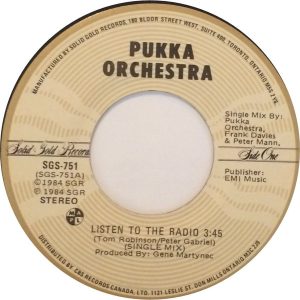
“Listen To The Radio” is a song written by Tom Robinson and Peter Gabriel. Born in Cambridge, England in 1950, his debut album in 1975 was with an acoustic trio and the album was Café Society. Robinson formed the Tom Robinson Band in the 70s. He was an advocate of LGB equality. In the late ’70s, Tom Robinson enjoyed considerable success with the albums Power In The Darkness and TRB2. But in 1980, his new band Sector 27 ended in financial disaster when the management company went bankrupt. In addition, he had just broken up with a boyfriend. Robinson he fled to Hamburg to escape the taxman. In the song Robinson writes “leave the bureau in the snow,” (British tax bureau) and “catch the tram to Onkel Pö.” This was the name of a music venue in Hamburg whose full name was Onkel Pös Carnegie Hall. From there Robinson moved to East Berlin, and over the next couple of years he appears to have led a fairly low key life learning German while he got his act back together working with a local band NO55. The lyrics to “Listen To The Radio: Atmospherics” arose out of Robinson’s time in Germany.
Lines in “Listen To The Radio” include “show your papers” which is in reference to police in East Berlin stopping pedestrians on the streets to show their ID. This was a common practice in the former East Germany.
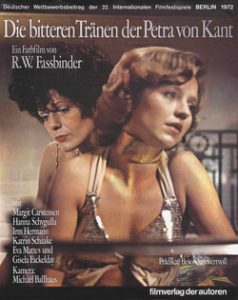
As well, Robinson describes “in the city late tonight, double-feature black and white” what the two films are that he saw on one occasion. The double bill was “Bitter Tears” (short for The Bitter Tears of Petra von Kant – which was a 1972 psychological romantic drama with an all-female cast. It was directed by Werner Fassbinder. Petra has been married twice but now finds herself falling in love with a woman who does not return the attraction).
The second feature Tom Robinson saw was Taxi zum Klo, a film made in 1981 in the post gay-liberation era before the onset of AIDS. The title of the film refers to a public toilet as a place for casual gay sex.
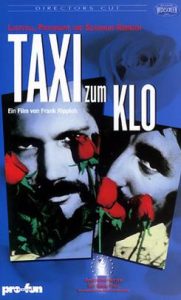
Poster for Frank Ripploh film Taxi zum Klo
After seeing the double-feature, Tom Robinson once again goes back to his friend’s spare room. He throws off his coat, picks up a note, puts on a coffee, lies down on his bed, smokes a cigarette and listens to the radio. He thinks about people tuning in to radio stations that he can get in East Berlin across Europe from Moscow to Cologne (West Germany). Late at night you can get static on different radio channels, depending on how strong the signal is.
Robinson writes, “Interference in the night, thousand miles on either side. Stations fading into the unknown…” Robinson contemplates the experience of listening to the radio, which is distinct from a record player or television. “Atmospherics after dark, noise and voices from the past…” On the radio, with each song there is a distinct atmosphere the music, vocals and lyrics provide. One minute you are listening to a brand new song. Another moment, the listener hears a song from a decade or more ago. And on some radio stations, one could hear classic radio network dramas like The Shadow, Dragnet, or Suspense.
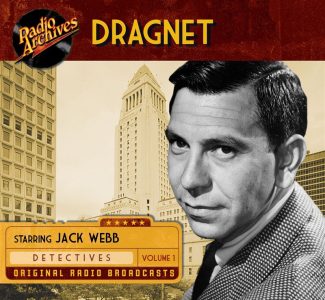
Just the facts, ma’am. Before it was a TV staple,
Dragnet ruled the radio waves with its no-nonsense
approach to crime drama.
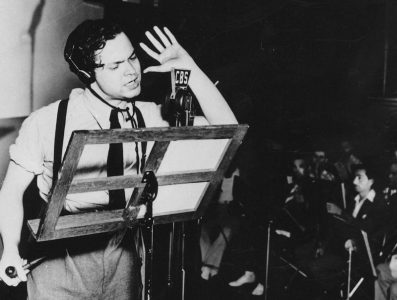
The night aliens invaded New Jersey—or so the story goes.
Orson Welles’ War of the Worlds broadcast on October 30, 1938,
became the gold standard of viral panic and storytelling. Radio listeners
believed the fiction (from H.G. Wells 1898 novel The War of the Worlds),
and chaos ensued, proving the power of radio to captivate and provoke.
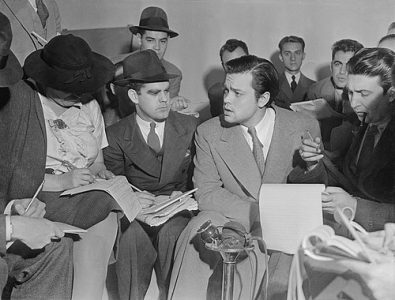
Orson Welles telling reporters at a press conference on
October 31, 1938, that he had not intended to cause panic
among the general population, and that no Martian invasion
had occurred.
Co-writer for the music to “Listen To The Radio: Atmospherics” was Peter Gabriel. Peter Brian Gabriel was born in 1950 in Surrey, England. He learned to play piano and drums in his childhood. In 1965, at the age of 15, Gabriel became part of a trio rock band called Garden Wall. In 1967 Garden Wall merged with two members of another band from the same school to form Genesis. In 1973 Genesis had their first Top Ten selling album, Selling England by the Pound, which peaked at #3 in the UK and #4 in Italy. But by 1975 Peter Gabriel left the band for a solo career. Gabriel had a Top 20 hit on the UK singles charts in 1977 with “Solsbury Hill”. In 1980 he released an album titled Peter Gabriel 3, with the lead single titled “Games Without Frontiers”. A few years later he released “Shock The Monkey”.
In 1986 Peter Gabriel released his So album. The debut single was “Sledgehammer”. It soon became a Top Ten international hit and won nine MTV Awards in 1987. A duet from the album with Kate Bush titled “Don’t Give Up” was a Top Ten hit in the UK, Ireland, the Netherlands and Australia. In 2006 Peter Gabriel was awarded the Man of Peace award by the Nobel Peace Laureates for his humanitarian work. He’s released six live albums and nine studio albums.
Tom Robinson has released 14 studio albums. His biggest hit single, “War Baby” reached #6 in the UK in 1983. His recording of “Listen to the Radio: Atmospherics” climbed to #39 on the UK singles chart in 1983.
“Listen To The Radio” reached #10 in Regina (SK), #15 in Toronto, #16 in Hamilton (ON), #17 in Ottawa, and a Top 30 hit in Halifax (NS), Montreal and Sherbrooke (PQ).
Other singles “Cherry Beach Express” and “Might As Well Be on Mars” received widespread FM radio play. The Toronto Police Service attempted to block radio airplay of “Cherry Beach Express” due to its themes of opposition to police brutality. Williamson sang “I got a bone to pick with you, not-so-friendly boys in blue. That’s why I’m riding on the Cherry Beach Express. My ribs are broken and my face is in a mess. And a name on my statement’s under duress.” The lyrics pointed to police brutality by 52 Division of the Toronto Police Service.
In May 1985, The Pukka Orchestra received a a ‘people’s choice’ U-Know/CASBY Award (Canadian Artists Selected By You) for ‘Most Promising Group’. However, they soon suffered two setbacks. Their record company Solid Gold went into receivership as the album was climbing the charts. In addition, while visiting relatives in Scotland in late 1984, Graeme Williamson developed kidney problems. Williamson ended up staying in a Glasgow hospital for several months. In 1985, Chapman, Duggan-Smith, Canadian children’s book author and singer-songwriter Robert Priest, folk singers Colin Linden and Gwen Swick and other Toronto musicians held a benefit concert at The Bamboo Club. This was to help defray Williamson’s living expenses while receiving dialysis treatment. He eventually received a kidney transplant and returned to Toronto.
In 1986, the single “Weekend (Come Alive!)”/”Knocking On Open Doors” was a minor hit in Thunder Bay (ON). The band recorded a four-song EP called Palace of Memory in 1987. However, in the midst of recording their second full-length album in 1988, Williamson’s health took another turn and he went back to Scotland for treatment. The band dissolved in 1988.
However, in 1992, a final Pukka Orchestra album studio album, Dear Harry, was released. This was a compilation of three tracks from the 1987 EP (two of them remixed), and completed tracks from the temporarily shelved 1988 sessions. [The same set of tracks (plus the fourth track from the EP) were overdubbed and again remixed, and issued as Chaos Is Come Again in 2024].
Williamson, Duggan-Smith and Chapman continued to work together as Neotone. In 1996 Neotone released a new CD called Oh My.
Williamson was also fiction writer, and published a book titled Strange Faith in 2001. The band regrouped, minus Williamson, for the Spirit of Radio Reunion show in 2003.
Duggan-Smith and Chapman collaborated in 2008 to record a concept album under the name Autocondo. Graeme Williamson died in Glasgow in June 2020.
December 31, 2025
Ray McGinnis
References:
Calum Slingerland, “R.I.P. Graeme Williamson of Toronto’s Pukka Orchestra: The group famously took on the Toronto police department with their 1984 protest song “Cherry Beach Express” Exclaim!, June 25, 2020.
“CASBY Awards: The People Speak,” Billboard, May 11, 1985.
Edward Brown, “Toronto Urban Legends: Cherry Beach Express: Is there any truth to the stories about police using Cherry Beach as a place to rough up perps?,” Torontoist, October 3, 2012.
Graeme Williamson, “Pukka Orchestra,” Canadian Pop Encyclopedia, January 15, 2013.
Tom Robinson, “Listen To The Radio: Atmospherics“, 1983.
Tom Robinson, “Tom Robinson Full Bio,” Tomrobinson.com.
Steve Pond, “Peter Gabriel Hits the Big Time,” Rolling Stone, January 29, 1987.
“Peter Gabriel’s Concert History,” concert archives.org.
Andy Greene, “Q&A: Peter Gabriel Reflects on His 1986 Landmark Album ‘So’,” Rolling Stone, September 4, 2012.
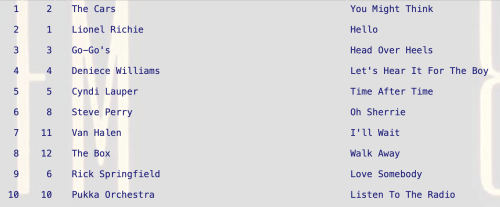
“Top 40” CJME-1300 AM, Regina (SK), May 26, 1984
Leave a Reply