
#102: Rubber Duckie by Ernie
City: Hamilton, ON
Radio Station: CHAM
Peak Month: September 1970
Peak Position in Hamilton ~ #2
Peak Position in Vancouver ~ did not chart
Peak Position on Billboard Hot 100 ~ #16
YouTube: “Rubber Duckie”
Lyrics: “Rubber Duckie”
Jim Henson was born in 1936 in Greenville, Mississippi, by the Mississippi River. His family moved to a Maryland suburb of Washington DC in the late ’40s. Henson recalled the arrival of the family’s first television as “the biggest event of his adolescence.” He was heavily influenced by radio ventriloquist Edgar Bergen and the early television puppets of Burr Tillstrom on Kukla, Fran and Ollie, (an ad-libbed television show with puppets that ran from 1947 to 1957) and Bil and Cora Baird (best known for the puppetry sequence in “The Lonely Goatherd” in The Sound of Music).
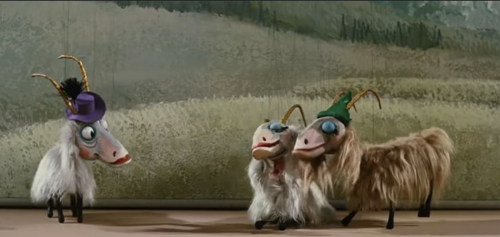
Puppets made by Bil and Cora Baird for “The Lonely Goatherd” sequence in The Sound of Music.
In the spring of 1954, at the age of 17, Jim Henson got a position at WTOP-TV in Washington DC at age 17, hired to “manipulate marionettes” on a Saturday morning children’s show called The Junior Morning Show. Though the show was cancelled three weeks later. Still, his talent landed him and his puppets an opportunity to continue working at WTOP-TV, lip synching on Roy Meachum’s Saturday show. Henson’s employment at WTOP-TV lasted only until August, when Saturday was also cancelled. Meachum then referred Jim to the local NBC-affiliate station WRC-TV, where Henson continued performing his puppets with his spouse, Jane, helping alongside him. The two were eventually offered a nightly segment for which they created Sam and Friends, a three-to-five-minute puppet show that afforded Henson much more freedom to develop his own creative work. The characters on Sam and Friends were forerunners of the Muppets, and the show included a prototype of Henson’s most famous character, Kermit the Frog. He remained at WRC until Sam and Friends aired its last episode on December 15, 1961.
In the show, Henson began experimenting with techniques that changed the way in which puppetry was used on television, foregoing the convention of pointing the camera at a stationary puppet theatre proscenium and instead using the image created by the TV camera and lens to dynamically engage with his characters. He believed that television puppets needed to have “life and sensitivity”. Rather than carving wooden puppets Henson built characters from softer, and flexible materials like foam rubber. Henson’s first iteration of Kermit was made from a halved table tennis ball table and fabric from an old coat belonging to his mother, with denim from a pair of jeans forming the sleeve for the puppeteer’s arm.[16]
Though Henson told people that “Muppet” was a portmanteau of “marionette” and “Puppet”, many early Muppets were actually hand puppets, rod puppets, or some combination of the two. Direct control over the puppet’s mouth, in combination with the softer construction materials, allowed the puppeteer to express a wider range of emotions and to more accurately move the puppet’s mouth along with the character’s dialogue or while lip syncing to music. Commenting on his puppet design philosophy, Henson said,
“A lot of people build very stiff puppets—you can barely move the things—and you can get very little expression out of a character that you can barely move. Your hand has a lot of flexibility to it, and what you want to do is to build a puppet that can reflect all that flexibility.”
The popularity of his work on Sam and Friends in the late 1950s led to a series of guest appearances on network talk and variety shows. He appeared as a guest on many shows, including The Steve Allen Show, The Jack Paar Program, and The Ed Sullivan Show.
These television broadcasts greatly increased his exposure, leading to hundreds of commercial appearances by Henson characters throughout the 1960s. Among the most popular of Henson’s commercials was a series for the local Wilkins Coffee company in Washington DC, beginning in 1957. Most of the Wilkins advertisements followed a similar formula: two Muppets, in this case named Wilkins and Wontkins (usually both voiced by Henson), would appear. Wilkins would extol the product while Wontkins would express his hatred for it, prompting physical retaliation from Wilkins. Wontkins might be shot with a cannon, struck in the head with a hammer or baseball bat, or have a pie thrown in his face.
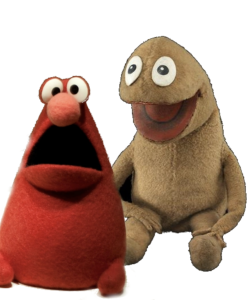
Wilkins and Wontkins (1957)
While working to pay the rent, as a freshman at the university, Jim took a newly offered puppetry class at University of Maryland College Park. He graduated in 1960. In 1964, Henson’s first appearance of who would later be named Kermit the Frog appeared in McGarry’s Sausage commercials. His puppets were also featured in other commercials like Royal Crown Cola.
In 1969, television producer Joan Ganz Cooney and her staff at the Children’s Television Workshop were impressed by the quality and creativity of the Henson-led team, so they asked Henson and staff to work full-time on Sesame Street, a children’s program for public television that premiered on National Educational Television on November 10, 1969. Part of the show was set aside for a series of funny, colorful puppet characters living on Sesame Street, including Grover, Cookie Monster, Bert and Ernie, Oscar the Grouch, and Big Bird. Henson performed the characters of Ernie, game-show host Guy Smiley, and Kermit, who often appeared as a roving television news reporter.
“Rubber Duckie” was featured on Sesame Street in the first half of 1970, and released as a single.
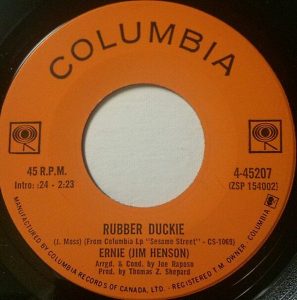
On Sesame Street, Ernie is Bert’s best friend, who is mischievous and free-spirited. He likes playing practical jokes on Bert, and loves playing musical instruments, singing, and “taking baths with Rubber Duckie.”
Jeff Moss wrote “Rubber Duckie”. He was born in New York City in 1942. His father was Arnold Moss, a stage and screen actor. His mother, Stella Reynolds, gave up acting to become a soap-opera writer. He attended the Browning School, a prestigious New York private school, and was first in his class. Jeff Moss later attended Princeton University and was a member of the Princeton Triangle Club theater company. After graduating in 1963, he took a job as a production assistant at the children’s television show Captain Kangaroo. In 1969, he became the first head writer, composer, and lyricist, for Sesame Street. He would eventually win fourteen Emmy Awards for his work on the show. Songs he wrote for its characters to sing include “I Love Trash” which Oscar the Grouch sang on the show, “People in Your Neighborhood”, “I Don’t Want to Live on the Moon” and “Rubber Duckie”. Moss also created the Cookie Monster.
In 1975, Moss wrote “Nasty Dan” which was sung by Johnny Cash when he appeared on The Muppets. The song later appeared on The Johnny Cash Children’s Album. In 1976, it was a surprise #5 hit in France when it was covered by Claude François under the French-language title “Sale Bonhomme”.
In 1984, Jeff Moss wrote eleven of the songs for the score in the animated musical The Muppets Take Manhattan. He was nominated for an Academy Award for Best Original Score. But he lost out to Prince’s Purple Rain.
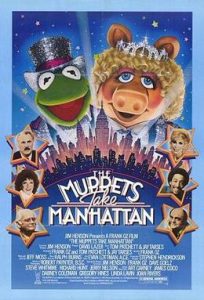
The animated film was a hit with sales at the box office of over $25 million (USD).
Jeff Moss wrote many children’s books. These include he Butterfly Jar (1989), The Other Side of the Door (1991), Bob and Jack: A Boy and His Yak (1992), Hieronymus White: A Bird Who Believed That He Always Was Right (1994), The Dad of the Dad of the Dad of Your Dad (1997), and Bone Poems (1998). He also wrote some under the Sesame Street brand name, such as The Sesame Street Book of Poetry and The Sesame Street Songbook.
Moss was diagnosed with cancer in early January 1994, and died in 1998, at the age of 56. “From the beginning, Jeff played a critical role in the educational and creative standards of Sesame Street which led to the instant success of the show. He was a true music visionary. His wonderful lyrics and music reflected the mood and the style of the show: fun, energetic, sometimes sentimental and always entertaining,” said Joan Ganz Cooney. Newsday, a New York City daily paper, had already nicknamed him the children’s poet laureate.
The voice for Ernie on Sesame Street was Jim Henson, and so the vocalist for “Rubber Duckie”.
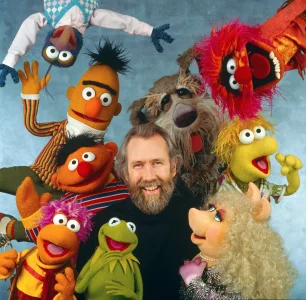
Jim Henson with some of the muppets on Sesame Street
In the song, Ernie sings about his very special pal in the bathtub. Ernie likes suds, his washcloth, nifty brush, but most of all his pal ‘Rubber Duckie.’ The song is sung in a Vaudevillian style. “Everyday when I make my way to the tubby, I find a little fellow who’s cute and yellow and chubby.” The song is accompanied by spoken word where Ernie volunteers to scrub behind the rubber duckie’s ears, its tummy etc.
“Rubber Duckie” climbed to #1 in Lansing (MI), Phoenix, Erie (PA), Lincoln (NE), Columbus (OH), Sioux Falls (SD), New Haven (CT), and Salt Lake City, #2 in Buffalo, Hamilton (ON), St. Louis, Rockville (MD), Milwaukee (WI), Manchester (NH), Tulsa (OK), and Dubuque (IA), #3 in Akron (OH), Saginaw (MI), Fort Wayne (IN), York (PA), Salem (OR), Seattle, and Harrisburg (PA), #4 in Norfolk (VA), La Crosse (WI), Albany (NY), Easton (PA), Kansas City (MO), and Wilmington (DL), #5 in Wilkes-Barre (PA), Charlottesville (VA), Denver, and Louisville (KY), #6 in Chicago, Oshkosh (WI), Muncie (IN), Dallas, Minneapolis/St. Paul, and Eau Claire (WI), #7 in Reading (PA), Dothan (AL), and Troy (NY), #8 in Pittsburgh, #9 in Allentown (PA), and Carthage (MO), #10 in Rochester (NY) and Chilliwack (BC).
Internationally, “Rubber Duckie” reached #10 in Australia, #11 in New Zealand, and #16 on the Billboard Hot 100.
“Rubber Duckie” was nominated for a Grammy Award in 1971 in the Best Recording for Children category. However, the single lost out to The Sesame Street Book & Record which contained “Rubber Duckie”.
In 1972, Henson directed a made-for-TV special The Muppet Musicians of Bremen. In 1976, The Muppet Show debuted as a TV series in England, continuing on ATV until 1981. In 1979, The Muppet Movie was released and earned $65,000,000 (USD) at the box office.
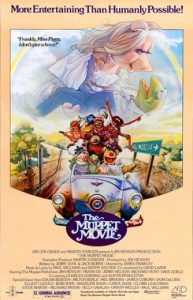
In The Muppet Movie Kermit the Frog (voiced by Jim Henson) sings “The Rainbow Connection” in a Florida swamp. The single reached #14 in Australia and #25 on the Billboard Hot 100. In 1982, Henson directed The Dark Crystal which was an otherworldly fantasy. In 1983, Henson and his team released the TV series Fraggle Rock.
From 1984 to 1991, CBS aired Muppet Babies with toddler versions of the Muppets living together. And in 1985 there was a TV series ton CBS titled Little Muppet Monsters. The following year Henson directed Labyrinth, a musical fantasy film. He won several Emmy Awards for The Storyteller (1987-88) – which retold European folk tales; And for The Jim Henson Hour (1989).
On May 6, 1990, Henson and his crew released The Muppets at Walt Disney World. It aired on NBC and coincided with Henson’s negotiations to sell his Sesame Street characters and his company to The Walt Disney Company.
Ten days later, on May 16, 1990, Jim Henson died of Streptococcus pneumoniae which caused bacterial pneumonia. He was 53-years-old.
March 13, 2026
Ray McGinnis
References:
Trailer, The Muppets Take Manhattan, Tri-Star Pictures, 1984.
Claude François, “Sale Bonhomme“, Flèche Records, 1976.
“Obituary: Jeffrey Moss,” The Independent, October 7, 1998.
Jim Henson, “McGarry’s Sausage commercial,” McGarry’s Sausage, 1964.
Jim Henson, “Royal Crown Cola,” RC Cola, 1966.
“Muppets creator Jim Henson, 53, dies,” UPI, May 16, 1990.
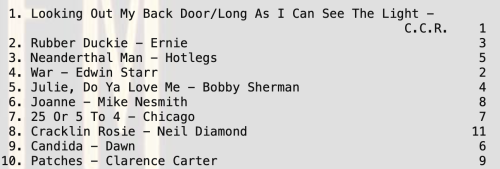
Music Power Survey CHAM 1280-AM Hamilton (ON) | September 17, 1976
Leave a Reply