
#60: Russians by Sting
City: Saskatoon, SK
Radio Station: CKOM
Peak Month: March 1986
Peak Position in Saskatoon ~ #8
Peak Position in Vancouver ~ #22
Peak Position on Billboard Hot 100 ~ #16
Peak Position on Italian Singles chart ~ #1
Peak Position on French Singles chart ~ #2
Peak Position on West German Singles chart ~ #4
Peak Position on Belgian Singles chart ~ #7
Peak Position on Dutch Singles chart ~ #7
Peak Position on Australian Singles chart ~ #11
Peak Position on Irish Singles chart ~ #11
Peak Position in UK Singles chart ~ #12
Peak Position on Swiss Singles chart ~ #13
Peak Position on Swedish Singles chart ~ #16
YouTube: “Russians”
Lyrics: “Russians”
Gordon Matthew Thomas Sumner was born in Wallsend on Tyne, North Tyneside, Northumberland, England, in 1951. His mother was a hairdresser and his father was a milkman and engineer. When he was ten-years-old, young Sumner got introduced to Spanish guitar, when a family friend left it at the Sumner residence. After high school he was variously a bus conductor, building labourer and tax officer. He went to college and from 1974-76 was a public school teacher. Sumner performed jazz in the evening, weekends and during breaks from college and teaching, playing with the Phoenix Jazzmen, Newcastle Big Band, and Last Exit. He gained his nickname, “Sting,” due to his habit of wearing a black and yellow sweater with hooped stripes with the Phoenix Jazzmen. Bandleader Gordon Solomon thought Sumner looked like a bee which prompted the name “Sting.” According to Sting, in an interview with CBS Sunday Morning, “they thought I looked like a wasp, and they’d joke. They called me Sting. They thought it was hilarious…That became my name.”
In January 1977, Sting moved from Newcastle to London. It was in London that he met up with Steward Copeland and Henry Padovani to form the Police. (Padovani was replaced by Andy Summers at the end of August 1977). In 1979 the Police had a hit single about a man who falls in love with a prostitute titled “Roxanne”. The song climbed to #1 in Montreal and #8 in New Zealand.
In 1981 the Police won a Grammy Award for Best Rock Instrumental Performance with “Reggatta de Blanc”. They were winners of the same Grammy Award the following year for “Behind My Camel”. In addition in 1982, the Police won a second Grammy Award with “Don’t Stand So Close To Me” in the category for Best Rock Performance by a Duo or Group with Vocal. (Another hit single from the album was “De Do Do Do, De Da Da Da”). In 1984, the that category, the Police won a Grammy Award for Synchronicity. While in the category for Best Pop Performance by a Duo or Group with Vocal, the Police won a Grammy Award in 1984 for “Every Breath You Take”. The song was also nominated for a Grammy Award in the Record of the Year category, but lost to “Beat It” by Michael Jackson. While Synchronicity lost the Grammy Award to Thriller by Michael Jackson that same year in the Album oof the Year category. Then in 1986 the Police received a Grammy Award nomination for Best Music Video, Long Form for The Police Synchronicity Concert. But they lost to Huey Lewis and the News Huey Lewis & The News: The Heart of Rock ‘n Roll.
Subsequently, the Police enjoyed hits from Ghost in the Machine with “Every Little Thing She Does Is Magic”, “Invisible Sun” and “Spirits In The Material World”. They released Synchronicity, which included the international number-one hit single “Every Breath You Take”, and the international Top Ten hits “Wrapped Around Your Finger” and “King Of Pain”.
According to Sting, appearing in the documentary Last Play at Shea, he decided to leave the Police while onstage during a concert of 18 August 1983 at Shea Stadium in New York City because he felt that playing that venue was “[Mount] Everest.”
In June 1985 Sting released his debut solo album The Dream of the Blue Turtles. His debut single release from the album, “If You Love Somebody Set Them Free”, was a Top Ten hit in Canada, Italy, New Zealand and the USA. A second single release, “Love Is The Seventh Wave” reached #7 in the Netherlands, and the Top 20 in Belgium and the USA. A third single, “Fortress Around Your Heart”, charted to #8 on the Hot 100. the fourth single release from The Dream of the Blue Turtles, was “Russians”.
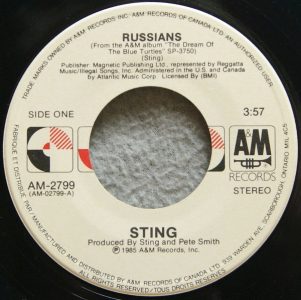
Sting wrote “Russians” during the Cold War. This was a prolonged time when Russia and America felt threatened by the nuclear missiles they had pointed at each other. The melody was inspired by Russian composer Sergei Prokofiev’s Romance melody from the Lieutenant Kije Suite (compiled from the 1933 film Lieutenant Kije). Sting’s lyrics rhetorically ask if Russians love their children too. Sting questions the “feeling of hysteria.” He explains “there’s no such thing as a winnable war,” so why would the Russians and Americans participate in mutually assured destruction from a nuclear war? According to United States president Ronald Reagan, Russia was the “Evil Empire” out to destroy them. This song finds compassion amid the rhetoric, a viewpoint rarely heard at the time.
On August 11, 1984, President Ronald Reagan said ahead of a speech “My fellow Americans, I’m pleased to tell you today that I’ve signed legislation that will outlaw Russia forever. We begin bombing in five minutes.” The comment was caught on a live microphone. Reagan was getting ready for a 9 a.m. live broadcast from his ranch, Rancho del Cielo, near Santa Barbara, California. He later explained he was ‘joking around’ with the National Public Radio audio engineers during the microphone check before the broadcast. The comments were not broadcast. However, during the election year Reagans’ comment was leaked to the public. In October 1984, Talking Heads member Jerry Harrison collaborated with Bootsy Collins of Parliament-Funkadelic to record “Five Minutes”. The song sampled Reagan’s quote and was credited to Bonzo Goes To Washington. The song reached #36 on Billboard’s Hot Dance/Disco chart.
In “Russians” Sting quotes Nikita Krushchev’s statement “We will bury you.” Sting says “I don’t subscribe to that point of view.” Historians have commented that Krushchev’s 1956 comment, “We will bury you,” is a mistranslation. A more faithful rendering is “We will outlast you” or “We will survive you.” In the context of what Khrushchev was saying in his speech, he was predicting that since capitalism was in his view toxic, it would crumble in time while the Soviet Union would remain.
Sting asks in the song, “How can I save my little boy from Oppenheimer’s deadly toy?” Here he is referring to J. Robert Oppenheimer who directed the Manhattan Project and after successful detonation of an atomic bomb early in the morning of July 16, 1945 near Alamogordo, New Mexico, in the Chihuahuan Desert. After the test that July morning, Oppenheimer told a reporter in the mid-sixties, “We knew the world would not be the same. A few people laughed, a few people cried. Most people were silent. I remembered the line from the Hindu scripture, the Bhagavad Gita; Vishnu is trying to persuade the Prince that he should do his duty and, to impress him, takes on his multi-armed form and says, “Now I am become Death, the destroyer of worlds.” I suppose we all thought that, one way or another.
With both Russia and America possessing nuclear weapons far more powerful than Oppenheimer’s test in July 1945, Sting is aware 41 years later – in 1986 – of the worlds that could now be destroyed. He sings, “There’s no monopoly of common sense on either side of the political fence. We share the same biology regardless of ideology…”
In 2026, Russia and the Ukraine are into a fourth year of war. Some commentators believe Russia aims to have its military reach the beaches of Normandy, France. Some argue the only way for the war to end is for NATO troops to defeat Russia in Moscow. Still others argue that the war has its roots in American and NATO orchestrating a coup in 2014 in the Ukraine. This is reflected in Oliver Stone’s documentary Ukraine on Fire. Whatever side one finds themselves, some commentators have warned that this is a war that could escalate to going nuclear. Is there any will to end the war diplomatically? Or must one side defeat the other completely in order for the destruction to cease? Some NATO chiefs have bragged in the past few months that NATO can outmatch Russia in any military campaign. It seems forty years after “Russians” there remains no monopoly of common sense.
Sting recalled in Lyrics By Sting: “In this political climate a friend of mine, who was doing research at Columbia University in New York, had a computer system sophisticated enough to intercept the Soviet’s TV signal from their satellite above the North Pole. On a Saturday night in New York City we could watch Sunday morning programs for the kids in Russia. The shows seemed thoughtful and sweet, and I suddenly felt the need to state something obvious in the face of all this rhetoric: Russians love their children just as we do.”
“Russians” reached #1 in Kansas City (MO), #2 in Dallas, #4 in Buffalo, #5 in Washington DC, #6 in Wake Forrest (NC), #7 in Lewiston (ME), New Haven (CT), Los Angeles, Seattle, and Rochester (NY), #8 in Portland (OR), Oklahoma City, Leavenworth (KS), Saskatoon (SK), and Baltimore (MD), #9 in Rensselaer (NY), Columbus (OH), New Orleans, Newport News (VA), Louisville (KY), and Fort Lauderdale (FL), #10 in Mesa (AZ), and San Jose (CA), and #11 in Boston and Tacoma (WA).
Internationally, “Russians” peaked at #1 in Italy, #2 in France, #4 in West Germany, #7 in Belgium and the Netherlands, #11 in Australia and Ireland, #12 in the UK, #13 in Switzerland, and #16 in Sweden and the USA. Sting performed the song at the 1986 Grammy Awards. His performance of the song was released on the 1994 album Grammy’s Greatest Moments Volume 1. In 1986, Sting was nominated for a Grammy Award in the Best Male Pop Vocal Performance. This was for his album The Dream of the Blue Turtles, which included the track “Russians”. Sting received a second Grammy Award nomination for Album of the Year (won by Phil Collins). Sting’s third Grammy nomination for the album was in the Best Engineered Recording category was won by Dire Straits.
The Dream of the Blue Turtles also received Grammy Award nominations for Best Jazz Instrumental Performance (won by Wynton Marsalis), aand Best Male Pop Vocal Performance (won by Phil Collins). Sting also received a nomination for “Money For Nothing” recorded by Dire Straits (which he co-wrote with Mark Knopfler).
In the fall of 1987, Sting released his studio album …Nothing Like the Sun. From the album he released “We’ll Be Together”, a #4 hit in Italy and Top Ten hit in Canada and the USA. The second single release from the album was “Be Still My Beating Heart”.
Sting won two Grammy Awards for the music documentary Bring On the Night (Best Music Video, Long Form), and in Best Male Pop Vocal Performance. In 1989, …Nothing Like the Sun was nominated for Album of the Year (won by George Michael).
A third single from the album was “Englishman In New York”. In the composition, Sing told Guitar magazine, “One of my favorite little jokes is from an ‘Englishman In New York,’ where at one point we’re playing ‘God Save The Queen’ in a minor key. It really tickles me but nobody else hears it!” The song charted well in Sydney (NS), and peaked at #12 in Ireland, #13 in the Netherlands, and #16 in Belgium. A subsequent single, “Fragile”, shot to #11 in Belgium and #12 in the Netherlands.
In 1991 Sting released his third studio album, The Soul Cages, which won him a Grammy Award for the title track in the Best Rock Song category. The lead single, “All This Time”, became a Top Ten hit in Canada, Denmark, Finland, Italy, Norway, Portugal, and the USA.
In 1993 Sting released his album Ten Summoner’s Tales. The debut release from his album was “If I Ever Lose My Faith In You“. The single won Sting a Grammy Award for Best Male Pop Vocal Performance, and nominations for Record of the Year and Song of the Year. Soon after, his next single from the album was released titled “Fields of Gold”.
As well, in the 1990s Sting was heard in movie theaters singing a duet with Eric Clapton in 1992 titled “It’s Probably Me” in Lethal Weapon 3, and with Bryan Adams and Rod Stewart on “All For Love” in the soundtrack for The Three Musketeers. The song received a Grammy Award nomination for Best Pop Collaboration with Vocals. The single became the number-one song of the year in Canada in 1994, and also topped the weekly pop charts in over a dozen other countries in 1993-94. In the mid-90s, Sting released a Fields Of Gold: The Best of Sting.
In 1994, Sting’s fourth studio album Ten Summoner’s Tales won him Grammy Awards for Best Music Video (long form) and Best Engineered Album. He also received a third Grammy nomination for Album of the Year.
Sting had a last Top 20 hit in some international markets in 2000 with “Desert Rose” from his Brand New Day album. Sting has continued to chart his album releases into the Top Ten of album charts internationally. This includes Sacred Love (2003), Songs from the Labyrinth (2006), If on a Winter’s Night… (2009), Symphonicities (2010), The Last Ship (2013), 57th & 9th – in reference to an intersection in New York City near the studio where the album was being recorded (2016).
Of these, The Last Ship is the soundtrack from a musical with theater runs in 2014 in Chicago and on Broadway. The Broadway production received two Tony Award nominations for Best Original Score and Best Orchestrations. The 2020 production in the UK and Ireland featured Sting in the role of character Jackie White. The musical has also appeared in Germany, Norway, Finland, Canada and Denmark.
Sting collaborated with Shaggy on the album 44/876 which won the duo a Best Reggae Grammy Award in 2019. Sting’s more recent albums, My Songs (2019) and The Bridge (2021), have been international Top Ten hits in Europe, Asia and Australia. Over the years, Sting has received 17 Grammy Awards and been nominated on 37 occasions. Since he went solo in 1984, Sting has released fifteen studio albums.
Since 1979, Sting has performed in seventeen films. As well, Sting has appeared as himself in several dozen screen productions (TV and film). Most recently, in 2023 he appeared in the French film The Book of Solutions.
February 4, 2026
Ray McGinnis
References:
Sting, “How I Started Writing Songs Again,” TED Talks, November 20, 2016.
Glen Gamboa, “‘Last Play at Shea’ documentary tells stadium’s story,” Newsday, April 20, 2010.
Kristine McKenna, “Sting: The Rolling Stone Interview,” Rolling Stone, September 1, 1983.
Elizabeth Day, “Interview: The Thing About Sting,” Guardian, September 25, 2011.
Nick Clark, “Sting to join cast of his own Broadway show The Last Ship,” The Independent, November 24, 2014.
Michael de Groote, “Ronald Reagan’s Ten Best Quotes,” Deseret News, February 7, 2011.
“We will bury you,” Time, November 26, 1956.
Ferenc M. Szasz, The Day the Sun Rose Twice, (University of New Mexico Press, 1984) 88.
“Explosive Truth Bomb: ‘Ukraine on Fire’ Shatters Western Narratives!,” Factual America.com.
Thomas Graham, “The Limits of Putin’s Ambitions,” Council on Foreign Relations, June 20, 2025.
George Allison, “NATO ‘phenomenal overmatch’ over Russia says forces chief,” UK Defence Journal, June 12, 2025.
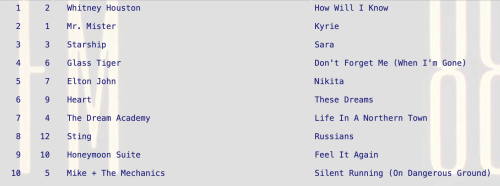
Hot Hits – CKOM 650-AM Saskatoon (SK) | March 14, 1986
Really interesting and loaded post, Ray!
Not that you need any more tangents to follow but I can’t help mentioning the two Canadian connections. One, the dazzling, unforgettable gold medal winning skate by Tessa & Scott to Roxanne. Second, two of the backup singers on his soulful show a Winter’s Night from Durham Cathedral were Laila Biali (who as you likely know is from north van now Toronto and received her first Grammy nomination in 2026, lost to Lady Gaga) and KD Lang. .
Elaine