
#38: Still by the Sunrays
City: London, ON
Radio Station: CFPL
Peak Month: May 1966
Peak Position in London ~ #9
Peak position in Vancouver ~ #42
Peak Position on Billboard Hot 100 ~ #93
YouTube: “Still”
Lyrics: “Still”
Eddy Medora was born in Los Angeles in 1945. He writes about the backstory to the Sunrays. “We were called the Renegades. We were a garage band rehearsing in my parents home in Pacific Palisades. We were in 7th and 8th grade. I saw a band perform called the Riptides – they had a local hit called Machine Gun….After I saw the response from the crowd, I knew I wanted to start a band. We played all over West L.A. There were five of us – Marty, Darrol, Mike, Ricky, and myself. We were doing pretty well when Mike moved away. Darrol also left. In the first year of high school, I met Steve and Vince. These guys did not have a band. They were both good musicians. They asked if they could join our band. We auditioned them. After we heard them play, I knew they had all of our votes.”
Medora knew a lot of people who went on to become recording stars when he was in his teens. He recalls in the late 50s “We’d have Sandy Nelson come over to my house…and we’d have Danny Hutton of Three Dog Night come over to my house. A lot of friends would come over to rehearse. Dino of Dino, Desi and Billy would come over. And of course I know Billy Hincshe from Carl Wilson.”
The first place the Renegades got paid for performing was in the late 50s at the Seaside Session at Palisades Park in Pacific Palisades. In 1961 they teamed up with Larry Tremaine, and became Larry Tremaine and the Renegades, covering rock ‘n roll hits or the early rock era. The band was made up of Larry Tremaine, Steve O’Riley, Marty DiGiovanni, Rick Henn, Eddy Medora (who billed himself as “Eddie” while with the band), and Vince Hozier (February 26, 1946). Tremaine booked the Renegades every week at radio dances, UCLA, clubs, celebrity parties, and corporate events.
Medora recalls “we continued to perform throughout California as the Renegades. I played saxophone, Marty played keyboard, Ricky played drums, Steve played lead guitar, and Vince played bass and rhythm guitar.”
The Renegades appeared at Crescendo Interlude on the Sunset Strip with Joey Dee and the Starliters, the Teen Age Fair at Pacific Ocean Park, the after party for the 1963 Academy Awards, The Bob Eubanks TV Dance Party, and every Friday night as the house dance party band at the San Bernardino Civic Auditorium in San Bernardino (CA).
Medora recalls “In 1963, I met Carl and Dennis Wilson of the Beach Boys. At that time the Beach Boys had ten double-sided hits on the charts. Carl heard our band, The Renegades, and thought we were fabulous.” In the winter of 1963 Eddie Medora, Marty DiGiovanni and Byron Case were in an instrumental surf-rock band called The Snowmen. They released an instrumental in the winter of ’63 titled “Ski Storm” which charted in St. Louis as well as several radio markets in southern California.
The Renegades changed their name to the Rangers and released several singles in early 1964.
In 1964 “Carl [Wilson] mentioned us to his dad, Murry Wilson, who was looking for another group to manage. Carl set the audition up. We were at the Beach Boys home in Hawthorne until 4 AM. He said if we listened to him we would have a hit record in six weeks. Murry told us to go home and write songs.” As their new manager, Murry Wilson also gave the band a new name: the Sunrays. At first it had been suggested they change their name to the Souvenirs. But the bandmates rejected that name, so they agreed on the Sunrays.
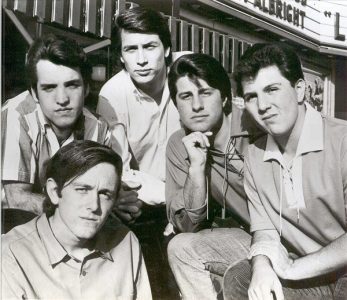
The Sunrays
In the fall of 1964 the Sunrays first single release “Car Party” charted in Salt Lake City and a few other radio markets. It was written by Murry Wilson. At the time, there were a number of surf-rock songs about cars. These included “G.T.O.” by Ronny & The Daytonas, “Little Honda” by the Hondells and also the Beach Boys, “Little Deuce Coup” by the Beach Boys, “Drag City” and “Dead Man’s Curve” by Jan & Dean, and “Hey Little Cobra” by the Rip Chords.
But it was the second single, “I Live For The Sun” that introduced radio listeners to the Sunrays in over twenty states across the USA, and in a number of Canadian record markets – especially Vancouver, Winnipeg and Thunder Bay.
The Sunrays followup hit was “Andrea“. Eddie Medora reveals “we were on a plane ride from New York back to Los Angeles and there was this beautiful stewardess, just lovely. And I said, ‘when we get back home we’re gonna write a song about you, what’s your name?’ By the time we had our next rehearsal Rick had it down! I said, ‘you know Rick, I’ve leaving my mouth shut – you never give me any ideas!’ We had an ‘Andrea Contest’ nationwide to try and find Andrea. Letters came in from all over the country, we had full-page ads in Tiger Beat and all those teen magazines – ‘Send in your pictures to the Sunrays and become their dream girl’. We did find a beautiful girl, it was not the one we were looking for – if she [the original Andrea who was the stewardess on the plane] knew the song was about her, she would probably flip.” “Andrea” peaked in Vancouver at #12.
While “Andrea” was still on the pop charts, on the March 26, 1966, airing of American Bandstand, Dick Clark had a telephone interview with Rick Henn and Marty DiGiovanni of The Sunrays.
With the release of “Andrea”, the Sunrays released their only album Andrea. On the album was a track they recorded “A Little Boy and His Dog”. The song was written from the point of view of a dog missing its owner who had been drafted and sent to Vietnam.
In May 1966, the Sunrays next single was titled “Still”.
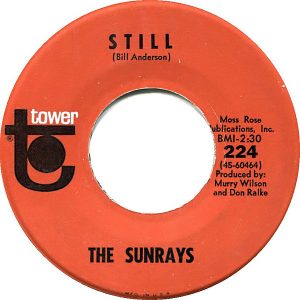
“Still” was written by Bill Anderson. Nicknamed “Whisperin’ Bill”, Bill Anderson is a country singer and songwriter born in 1937 in Columbia, South Carolina. He wrote his first song, “Carry Me Home to Texas” in the late 1940s and formed his first band in 1952. Whilst studying for his journalism degree at the University of Georgia and working as a disc jockey, he wrote “City Lights”, which Ray Price recorded in 1958 and took to No. 1 for 13 weeks. This same year, Anderson signed to Decca Records and Tree Publishing and had a Top 20 country hit with “That’s What It’s Like To Be Lonesome”. In 1960, Anderson had his own Top 10 hit with “The Tips Of My Fingers”, and recorded his first No. 1 in 1962 with “Mama Sang a Song”. Having permanently moved to Nashville a year before, Anderson joined the Grand Ole Opry as a cast member in 1961. In 1963, he wrote “Still” which topped the Hot Country Singles chart, and reached #8 on the pop chart in New Zealand. In 1965, he began appearing in his own syndicated television series, “The Bill Anderson Show”, which stayed on the air for 9 years.
Over the decades Bill Anderson had more number-one hits. These include “I Get The Fever” (1966), “For Loving You” w/Jan Howard (1967), “Wild Weekend” and “Happy State of Mind” (1968), “My Life (Throw It Away If You Want To)” (1969), “The Corner Of My Life” and “World Of Make Believe” (1973), “Sometimes” w/Mary Lou Turner (1975), and “I Can’t Wait Any Longer” (1978). In addition to these number-one songs, he charted 27 more singles into the Top Ten on the country charts. He bought a radio station in 1975 in Provo, Utah. However, he couldn’t get the advertisers to support the country station and is failed in 1981. He was also a partner of the Po’ Folks restaurant chain, named after his 1961 hit single. However, several restaurants in the chain got into difficulty, and Bill Anderson had to file for bankruptcy. However, Conway Twitty helped bail him out. With the support of Twitty, Anderson helped pay off the company’s financial entanglements. “Even as it stood, my little foray into the restaurant business wiped out a large chunk of my life’s savings”, he later said in his memoir. Anderson published a memoir in 2016 titled Whisperin’ Bill Anderson: An Unprecedented Life in Country Music. Bill Anderson has been inducted into the Nashville Songwriters Hall of Fame, the Country Music Hall of Fame, and the Songwriters Hall of Fame.
“Still” had extended spoken word verses. The first verse began “Baby, I’ve read your letter five times. I’m writing back to tell you that you’re all wrong about me. The other day in school when you passed me in the hall; the reason I didn’t come up to you and say hello was because I was too embarrassed to let you see me crying. Please take me back. And if you do, baby, I’ll never be jealous anymore.” And in the second verse the guy let’s his “baby” know how unique she is: “I’ve been going around to all the dances. And I’ve found nobody that can compare with you.”
“Still” peaked at #3 in Columbia (TN), #9 in London (ON), and #22 in Portland (ME). It stalled at #93 on the Billboard Hot 100.
While the Sunrays were on the pop charts in 1965-66, they appeared in concert with a number of other recording artists. This includes the Rolling Stones, the Beach Boys, the Byrds, Jefferson Airplane, the Doors, Neil Sedaka, the Loving Spoonful, the Righteous Brothers and Neil Diamond. They played such venues as the Hollywood Bowl, Disneyland and the Cow Palace, and were featured on every major television show devoted to music during the fifties and sixties, including Dick Clark’s American Bandstand, Casey Kasem’s Shebang, the Los Angeles-based Shivaree and Hollywood-a-Go-Go. The Sunrays performed in concert in Vancouver on August 18, 1966, at the Queen Elizabeth Theatre. They also gave a concert in Victoria (BC) that same month.
Later in 1966, the Sunrays “Don’t Take Yourself Too Seriously” and “Hi, How Are You” were both commercial failures, as was “Loaded With Love” in the spring of ’67. The band did some more concerts, including at Santa Monica City College in April 1967. But they split up by the end of the year.
After the breakup of the Sunrays in 1967 Vince Hozier was one of the founding members of Jimmy Lloyd Rea & The Switchmasters. On that band’s website it states “In 1981 at Blues Hat Studio in Walla Walla, JLR first recorded his new band with Vince Hozier ~ famed member of the Sunrays ~ on lead guitar.” Hozier was also lead guitarist for the Los Angeles based Blues diva Zola Moon, and bassist for the ground breaking country-rock band Deer Creek. Hozier later was lead man for the Portland, Oregon, based Hudson Rocket Band. Vince Hozier died in 2007 of leukemia.
Eddy Medora went on to a successful career as Director of National Sales for Walt Disney Records, starting in 1970 until he retired in 2002. In his later years he became a painter “and he was in high demand for his portraits in Beverly Hills.” Eddy Medora died in 2006.
Richard Henn formed Richard Henn & Co. who made some recordings in the early 70s. In 1973 Henn released a surf single titled “Girl On The Beach”. However, it got little attention. He was also briefly in a rock band called the Protein Bros. A YouTube video in 2010 featured Rick Henn surfing at one of the beaches at Malibu.
Steve O’Riley died some years after the Sunrays split. According to Eddie Medora, O’Riley “was smoking in a van and it caught on fire, and he burned to death, which is a tragic way to go.”
In 2010 Byron Case was playing with Peter Giri’s Alliance Party Band in Eugene, Oregon. And within the past few years Byron Case has been playing with the jazz oriented Gerry Rempel Trio, also based in Eugene.
Former Sunrays keyboard player, Marty DiGiovanni, has left no trace of his activities since the band broke up in 1967.
December 20, 2025
Ray McGinnis
References:
“Eddy Medora: Guitarist with the Sunrays,” Independent, UK, November 16, 2006.
Ronnie, “Interview with Eddy Medora (10-28-03): Part I: The Renegades,” earcandymag.com.
“Sunrays – Canada concerts,” setlist.fm.
Eddy Medora, “The Sunrays Story,” sunrays718.tripod.com.
“Rick Henn surfing in 2010,” YouTube.com.
Bill Anderson and Peter Cooper, Whisperin’ Bill Anderson: An Unprecedented Life in Country Music, (University of Georgia Press, 2016).
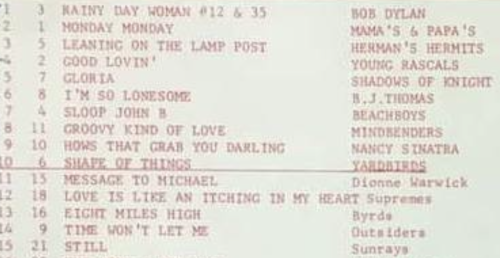
CFPL 980-AM London (ON) Top 15 | May 13, 1966
Leave a Reply