
#11: The Windmills Of Your Mind by Dusty Springfield
City: Pointe Claire, PQ
Radio Station: CFOX
Peak Month: July 1969
Peak Position in Pointe Claire ~ #3
Peak position in Vancouver ~ #9
Peak Position on Billboard Hot 100 ~ #31
Peak Position on Philippine Singles chart ~ #34
Peak Position on Australian Singles chart ~ #40
YouTube: “The Windmills Of Your Mind”
Lyrics: “The Windmills Of Your Mind”
Mary Isobel Catherine Bernadette O’Brien was born in West Hampstead in north London, in 1939. Along with her oldest brother, Dion, she recorded her first tape of a song they sang while still children. Her dad was an unhappy accountant who dreamed of becoming a concert pianist, but never became one. While Mary’s mother, according to the Karen Bartlett autobiography, Dusty: An Intimate Portrait, “was continuously drunk and sat all day in cinemas.”As she grew up, Mary went to school at a Roman Catholic Convent. At the age of 18 she became a member of a female group named the Lana Sisters. The group sang backup to pop singer Al Saxton who had several Top 30 hits in the late 50’s in the UK, including a cover of Sam Cooke’s “Only Sixteen” and “You’re The Top Cha.” While Saxton enjoyed his moments of fame, Mary teamed up with her brother, Dion, and a friend of theirs named Tim Field. By the end of 1959 she had taken the stage name of Dusty Springfield. The trio, now known as The Springfields, got a record deal with Philips Records in 1961.
In 1962 The Springfields had an international hit with “Silver Threads And Golden Needles,” which climbed to #1 in Australia and went Top 20 in the USA. The song climbed to #3 in Toronto, #4 in Winnipeg, #14 in Montreal and #17 in Vancouver. Canadian Radio listeners liked the sound of that female voice they were hearing on the single and wanted to hear more. The Springfields were the first British group to have such success, predating The Beatles. In 1963 Dusty released her first solo single, “I Only Want to Be With You.”
Dusty Springfield had a series of hit records including the Burt Bacharach tune, “Wishin’ and Hopin’” in 1964, her follow-up to “Stay Awhile.” In 1964, she also charted “I Just Don’t Know What to Do with Myself” to #3 in the UK and New Zealand, and #5 in both Ireland and the Netherlands. More Top Ten hits in the UK cracked the Top 40 in Vancouver: “Losing You” and “In The Middle Of Nowhere”.
In January, 1965, Dusty in San Remo, Italy, was an entrant in Italian Song Festival where she reached the semi-final. At the festival she heard Pino Donaggio perform a song titled “Io Che Non Vivo (Senza Te).” Its English version, “You Don’t Have to Say You Love Me” was sung by American country singer, Jody Miller. Dusty fell in love with the song and recorded it. Her version became a #1 hit in the UK in the spring of 1966 and on the June 19, 1966, the top of the CKLG pop chart in Vancouver.
She continued to make the Top Ten in 1966 with “Goin’ Back” and “All I See Is You”.
Dusty Springfield was a booster of American R&B music and her covers of soul singers across the Atlantic introduced the record buyers in the British Isles to people like Aretha Franklin and Gladys Knight. On one of her singles she was backed by Doris Troy of “Just One Look” fame. A forerunner of the Northern Soul genre, Dusty Springfield’s covers of soul music was an ear-catching fusion and record-buyers rewarded her with her album, Dusty in Memphis, and others. After that her album, The Look of Love, the title track was featured in the 1967 spoof film of James Bond titled Casino Royale. The film starred David Niven, Peter Sellers, Ursula Andress, Orson Welles and Woody Allen. A second single from the album was “What’s it Gonna Be”.
In 1968, Dusty Springfield had a #4 hit in the UK with “I Close My Eyes And Count To Ten”. In the winter of 1968-69, Dusty Springfield had another Top Ten hit with “Son Of A Preacher Man”. This was a track from her album Dusty in Memphis. In the spring of 1969, she had another Top 40 hit with another track from the album titled “The Windmills Of Your Mind”.

In the original 1968 film The Thomas Crown Affair, the “The Windmills Of Your Mind” is heard – sung by Noel Harrison – during opening credits. It was Harrison who recorded the original version. During the film, in a scene in which the character Thomas Crown flies a glider at the glider airport in Salem, New Hampshire. The Thomas Crown Affair starred Steve McQueen and Faye Dunaway.
Producer/director Norman Jewison had edited the rough cut for the glider scene using the Beatles’ “Strawberry Fields Forever”. However, he decided to commission an original song. It would suggest the ambivalent feelings of Thomas Crown as he engages in a favorite pastime while experiencing the tension of preparing to commit a major robbery.
The song was written by Michel Legrand, with English lyrics by Alan and Marilyn Bergman.
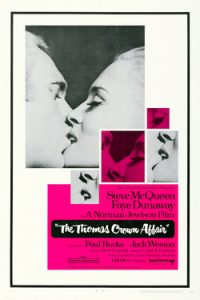
Alan Bergman said of the creation of the song: “Michel [Legrand] played us [Marilyn Bergman and me] seven or eight melodies. We listened to all of them and decided to wait until the next day to choose one. We three decided on the same one, a long baroque melody… The lyric we wrote was stream-of-consciousness. We felt that the song had to be a mind trip of some kind” – “The [eventual] title was [originally] a line at the end of a section… When we finished we said: ‘What do we call this? It’s got to have a title. That line is kind of interesting.’ So we restructured the song so that the line appeared again at the end. It came out of the body of the song. I think we were thinking, you know when you try to fall asleep at night and you can’t turn your brain off and thoughts and memories tumble.”
Harrison took issue with the couplet “Like a tunnel that you follow to a tunnel of its own / Down a hollow to a cavern where the sun has never shone”, singing the word “shone” British-style with a short vowel sound making the rhyme with “own” imperfect. Marilyn Bergman: “We said ‘No, it’s shone [long vowel sound].’ And he said ‘No, it’s our language!’ And we said: ‘Yes, but it’s our song.’ So reluctantly, he sang shone [long vowel sound] and our rhyme was intact.” However, in the finally released version Harrison sings “shone” with a short vowel.
Noel Harrison recorded the song after Andy Williams passed on it. According to Harrison: “It was recorded live on a huge sound stage at Paramount, with the accompanying film clips running on a giant screen and Michel blowing kisses to the orchestra.” “The Windmills Of Your Mind” won Best Original Song at the April 14, 1969 Academy Awards for the films of 1968.
In “The Windmills Of Your Mind” the stream-of-consciousness lyrics make a list similes likening the inner state of someone’s mind.
a) A circle in a spiral
b) A wheel within a wheel, never ending or beginning
c) A snowball down a mountain
d) A carnival balloon
e) A carousel that’s turning running rings around the moon
f) A clock whose hands are sweeping past the minutes of its face
g) And the world being like an apple whirling silently in space
h) A tunnel that you follow to a tunnel of its own
i) A door that keeps revolving in a half-forgotten dream
j) Ripples from a pebble someone tosses in a stream
k) Keys that jingle in your pocket
l) Words that jangle in your head
m) (like) lovers who walk along the shore and leave their footprints in the sand
n) (to wonder) is the sound of distant drumming just the fingers in your hand
o) Pictures hanging in a hallway
p) fragments of a song
q) Half-remembered names and faces…
“Trippy,” as they’d say in 1968.
Composer Michel Legrand was born in Paris, France, in 1932. He studied music at the Conservatoire de Paris from age 11, and graduated with top honors as both a composer and a pianist. He burst upon the international music scene at 22 when his album I Love Paris became a surprise hit in 1954. He established his name in the United States by working with such jazz stars as Miles Davis and Stan Getz. In 1965 “I Will Wait For You” was nominated for Best Original Song from the 1964 film The Umbrellas of Cherbourg. As well, Legrand was nominated for an Academy Award for Best Original Score for The Umbrellas of Cherbourg. In addition to winning Best Original Song for “The Windmills Of Your Mind”, Legrand received a Best Original Score nomination for The Thomas Crown Affair. He also received a Best Original Song Score nomination for The Young Girls of Rochefort. In 1969, he received a Best Original Song nomination for “What Are You Doing the Rest of Your Life?” from The Happy Ending. While in 1970, Legrand received another Academy Award nomination for Best Original Song for “Pieces of Dreams” from the film of the same title. In 1971, Michel Legrand won his second Academy Award for Best Original Dramatic Score for Summer of ’42. In 1982, he received his fifth Best Original Song nomination with “How Do You Keep the Music Playing?” from Best Friends. He won his third Academy Award for Best Original Song Score for Yentl. Tracks from the soundtrack also earned him two more Academy Award nominations in the Best Original Song category: “Papa, Can You Hear Me?” and “The Way He Makes Me Feel”.
Michel Legrand has been nominated eight times for Best Original Score at the Golden Globes, and on six occasions for Best Original Song. On fourteen occasions Michel Legrand has been nominated for a Grammy Award, and won four times. Over the decades he wrote scores for over 200 films and TV shoes. His last score was for the posthumously released Orson Welles film. The Other Side of the Wind. He is a subject of the 2018 documentary Michel Legrand, Let the Music Play. He died in hospital of sepsis in January 2019. Legrand was 86.
Alan Bergman was born in Brooklyn in 1925. Marilyn Bergman was born in Brooklyn in 1929, and is the daughter of Edith and Alan Katz. Both were raised in Jewish families. In his early twenties, Alan Bergman worked as a television director and songwriter at WCAU-TV in Philadelphia. He was persuaded by Johnny Mercer to move to Los Angeles to advance his career as a songwriter. Marilyn Katz moved to Los Angeles, and after an injury that hampered her piano playing, she switched to songwriting. Alan and Marilyn met while collaborating with a fellow songwriter in LA. They married in 1958.
Alan and Marilyn Bergman wrote the title track for Dean Martin’s 1958 album Sleep Warm. And in 1960, Frank Sinatra recorded their song “Nice ‘n’ Easy”. The following year they wrote music for the film The Right Approach. And in 1964 composed music for the Broadway musical Something More! In 1967 the songwriting couple wrote the title track for the movie In the Heat of the Night, starring Sidney Portier and Rod Steiger. Over the decades the Bergmans have written songs for 23 films. Most notably “The Way We Were” in 1973, for The Way We Were starring Barbra Streisand and Robert Redford. “The Way We Were” won Best Song at the 46th Academy Awards in April 1974. And in 1977 the Bergman’s co-wrote with Neil Diamond “You Don’t Send Me Flowers”. They also wrote “It Might Be You” for the film Tootsie. Alan Bergman died at the age of 99 in July 2025. Marilyn Bergman died in 2022 at the age of 93.
“The Windmills Of Your Mind” reached #3 in Pointe Claire (PQ), and Ann Arbor (MI), #5 in Boston, #6 in Denver, and Fresno (CA), #7 in Santa Ana (CA), and Los Angeles, #8 in San Bernardino (CA), and Washington DC, #9 in Vancouver (BC), Tulsa (OK), Bloomington (IL), and San Diego,#10 in Rochester (NY), and #11 in Beaumont (TX). Internationally, Springfield’s version reached #21 in Canada, #31 on the Billboard Hot 100, #34 in the Philippines, and #40 in Australia.
Noel Harrison’s recording of “The Windmills Of Your Mind” on Reprise Records had his annunciation of “shone” with the short vowel sound. The release reached #5 in South Africa, #8 in the UK, and #17 in New Zealand. José Feliciano had a #4 hit in Turkey and reached #11 in the Netherlands with his cover. Jimmie Rodgers also released a cover, but it stalled at #123 below the Billboard Hot 100.
In 1969, a French-language version of the song was a minor hit on the French pop charts for Michel Amont: “Les Moulins de mon cœur” (“The Windmills of My Heart”). Vicky Leandros recorded “The Windmills of Your Mind” in Greek (“Η Μικρή Μας Iστορία”) and German (“Wie sich die Mühlen dreh’n im Wind”) . The song has also been a pop hit in Czech (Helena Vondráčková) and Dutch (Herman van Veen). There was a remake of The Thomas Crown Affair in 1999. In that film Sting sang the song for the soundtrack. It was also been recorded in 1969 by Petula Clark, Johnny Mathis and Mel Tormé, the latter whose cover was in the psychological thriller “Cold Harbor” (2025) a finale episode in the TV series Severance.
“The Windmills Of Your Mind” was also featured on The Muppets in a 1977 episode sang by the Three-legged Screaming Thing. The puppet tells viewers, “I’m very relaxed, and terribly calm and tranquil, and very, very, very calm indeed, on the outside. But on the inside “I’m like a circle in a spiral, like a wheel within a wheel, never ending or beginning on an ever-spinning reel…” as it sings a sped-up version of the song.
Other minor hits in ’69 for Dusty were “A Brand New Me” and “Willie & Laura Mae Jones”. During her career she had four Top Ten hits on the Billboard Hot 100 and eleven Top Ten hits on the UK Singles Chart between 1963 and 1987. Her last Top Ten hit was a collaboration with The Pet Shop Boys titled “What Have I Done To Deserve This?” It was her first time in the Top 30 on the Billboard Hot 100 since “Son Of A Preacher Man” in 1969.
In 1989, her single “In Private” was a #4 hit in West Germany, #8 in the Netherlands, #13 in Ireland, and #14 in the UK. A second single from her album Reputation “Nothing Has Been Proved”, was a Top Ten hit in Ireland. Her 19th studio album, A Very Fine Love, was released in 1995. It included a duet with Daryl Hall of Hall & Oates.
Her personal life was challenged by living in a pre-Gay liberation era. Her exploration of lesbian relationships made her one newspaper headline away from having her career disintegrate. She had relationships with numbers of women including fellow recording artists Norma Tanega (1966-73) and Carole Pope (1981). Springfield also had addictions to alcohol and drugs and was sent to a psychiatric ward on at least one occasion. Referred to as a “bachelor woman” by some in the press, Dusty Springfield told the press in 1970 she didn’t care about who slept with who. “People are people” she said. Dusty Springfield died in 1999 after several years suffering with breast cancer. She was 59 years of age.
December 15, 2025
Ray McGinnis
References:
Dusty Springfield – Biography, Let’s Talk Dusty.org
Roger Lewis, “The mad, bad and sad life of Dusty Springfield,” Spectator, London, UK, August 2, 2014.
Penny Valentine and Vicki Wickham, Dancing With Demons: The Authorized Biography of Dusty Springfield, (St. Martin’s Press, New York, NY, 2001).
Noel Harrison, “The Windmills Of Your Mind“, The Thomas Crown Affair, 1968.
Three-legged Screaming Thing, “The Windmills Of Your Mind“, The Muppets, 1977.
Vernell Hackett, “Marilyn Bergman Drifted Into Songwriting,” American Songwriter, 2003.
Bruce Haring, “Marilyn Bergman Dies: Multiple Oscar-Emmy- & Grammy-Winning Lyricist Was 93,” Deadline, January 8, 2022.
Greg Evans, “Alan Bergman Dies: Co-Lyricist With Wife Marilyn Of “The Way Were Were”, Many Film & TV Themes Was 99,” Deadline, July 18, 2025.
“Windmills of Your Mind composer Michel Legrand dies aged 86,” BBC, January 26, 2019.
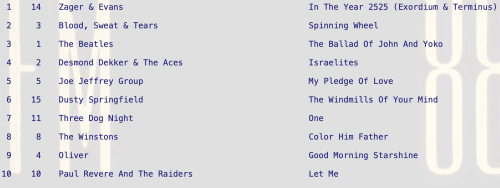
CFOX 1470-AM, Pointe Claire (PQ) July 11, 1969
Leave a Reply