
#1: Secret Love by Billy Stewart
City: Saguenay, PQ
Radio Station: CKRS
Peak Month: November 1966
Peak Position in Saguenay ~ #3
Peak Position in Vancouver ~ #8
Peak Position on Billboard Hot 100 ~ #48
YouTube: “Secret Love”
Lyrics: “Secret Love”
William Larry Stewart II was born in Washington D.C. in 1937. In 1949, at the age of 12 Stewart he and his three younger brothers began singing under the billing The Four Stewart Brothers. Singing gospel music, they were given a weekly spot on Sundays from 1949 to 1954 on WUST-AM in Washington D.C. In his teens he also won a talent singing contest performing George Gershwin’s “Summertime”. In 1955 Bo Diddley encountered Billy Stewart playing piano. Diddley was impressed and invited Stewart to become one of his backing musicians. During his time with Bo Diddley, Billy Stewart was able to expand his musical repertoire to include playing organ, bass and drums. In 1956 Bo Diddley played guitar on Stewart’s first single titled “Billy’s Blues” recorded on the Chess label. In 1957, Stewart released “Billy’s Heartache” which featured backing vocals from 18-year-old Marvin Gaye. In 1962, Stewart recorded a tune based on his nickname called “Fat Boy”. The song climbed to #18 on the Billboard R&B charts.
From 1962 to 1963 Billy Stewart was an R&B counterpoint to Bobby Vinton, casting himself in song after song as a lonely guy in search of the perfect “girl.” His lonely guy songs include “Reap What You Sow”, “Strange Feeling” and “Count Me Out”. He got more popular in 1965 when he crossed over to the Billboard Hot 100 with two singles that made the Top 30. These were “I Do Love You” (#6 R&B/#26 Hot 100) and “Sitting In The Park” (#4 R&B/#24 Hot 100). In 1966 Billy Stewart recorded an improvisational cover of the standard “Summertime” from George Gershwin’s 1935 English-language opera Porgy and Bess. The drummer for Stewart’s recording, Maurice White, went on to form a band called Earth, Wind & Fire.
After the success of “Summertime” Billy Stewart went to the recording studio to make an album of classic pop tunes. The album was titled Billy Stewart Teaches Old Standards New Tricks. Stewart’s next single, a track from the new album, was a cover of the #1 hit for Doris Day in February 1954 titled “Secret Love”. The cover featured Stewart’s trills and scat singing.
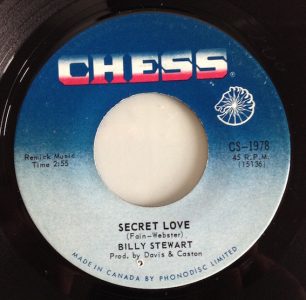
“Secret Love” was written by Paul Webster and Sammy Fain. In 1902, Sammy Fain – born Samuel Feinberg – was born in New York City. In 1923, Fain appeared in the short sound film, Sammy Fain and Artie Dunn. In 1927, he wrote “Let a Smile Be Your Umbrella”, a #6 hit for Roger Kahn and his Orchestra. In 1930, he wrote “You Brought a New Kind of Love to Me”, introduced by Maurice Chevalier in the film The Big Pond. The song reached #3 in 1930 for Paul Whiteman. for In 1932, he appeared in the short film The Crooning Composer. In the early 30s, Sammy Fain wrote “When I Take My Sugar to Tea” (from the 1931 Marx Brothers movie Monkey Business), which peaked at #6 for the Boswell Sisters. “Was That the Human Thing To Do” was a Top Ten hit for both the Boswell Sister and for Bert Lown and his Orchestra in 1932. By a Waterfall” (from the 1933 film Footlight Parade), was a #6 hit for both Leo Reisman and Guy Lombardo. and the title song from the 1934 film Easy to Love.
In 1937, Fain wrote “That Old Feeling”. Shep Field and His Rippling Rhythm Orchestra had a number-one recording with the song on the Your Hit Parade chart for four weeks in October 1937. The song appeared in the 1937 film Walter Wanger’s Vogues of 1938.
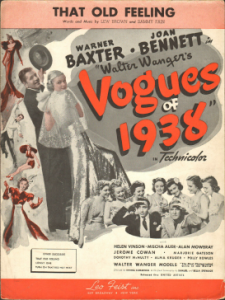
“That Old Feeling” was nominated for Best Original Song at the Academy Awards at the Biltmore Hotel in Los Angeles on March 10, 1938. In 1938, Fain wrote “I’ll Be Seeing You”, popularized in the 1944 film I’ll Be Seeing You. In 1938, “Who Blew Out the Flame” was a Top Ten hit for Larry Clinton and his Orchestra, as well as Dolly Dawn and her Dawn Patrol. Then in 1939, Lawrence Welk had a hit with Sammy Fain’s “The Moon is a Silver Dollar”.
In 1948, The Dickey Bird Song” was a Top Ten hit for Freddy Martin and his Orchestra. In 1949, his song “Dear Hearts and Gentle People” was successfully recorded by Dinah Shore and also Bing Crosby. In 1950, his song “I Can Dream, Can’t I” was a number-one hit for the Andrews Sisters. In 1953, Fain co-wrote with Paul Webster “Secret Love”, from the film Calamity Jane, which won Best Original Song at the 26th Academy Awards. At the 28th Academy Awards, Sammy Fain and Paul Webster won Best Original Song with “Love Is A Many Splendored Thing”. In 1958 he was nominated again (with Paul Francis Webster) for Best Original Song with “April Love”, the theme song for the film April Love. The following year, Fain was nominated once more (with Paul Webster) for “A Certain Smile”, from the movie A Certain Smile. In 1963, Fain received another Best Original Song nomination (with Paul Webster) for “Tender Is the Night”, from Tender Is the Night.
And in 1973, Sammy Fain (with Paul Webster) received yet another Best Original Song nomination for “Strange Are the Ways of Love” from The Stepmother. In 1976, Fain received his eighth Best Original Song nominated for “A World That Never Was” from Half A House. Then in 1977, he got another Best Original Song nomination for “Someone’s Waiting For You” from The Rescuers. Sammy Fain died in 1989 of a heart attack at the age of 87.
Paul Francis Webster was born in New York City in 1907. He worked on ships and later became a dance instructor at an Arthur Murray studio. In 1931 he wrote “Masquerade” which became a #3 hit the following year for Ted Black. And in 1933, “The Whisper Waltz” was a #6 pop hit for Rudy Vallee. In 1934, “Two Cigarettes In the Dark” was a Top Ten hit for four recording artists, and most successful for Johnny Green & His Orchestra which reached #2. In 1941, “I Got It Bad (and That Ain’t Good)” charted to #13 on the Billboard pop chart for Duke Ellington, with vocals by Ivie Anderson. In 1944, Webster received his first nomination for Best Original Song at the Academy Awards for “Remember Me to Carolina” from the film The Minstrel. In 1946, his song “Doctor, Lawyer, Indian Chief”, by Betty Hutton climbed to #1 on the pop charts in the USA. While in 1950, “The Loveliest Night of the Year” was a #3 hit for Mario Lanza. In 1954, “Blowing Wild” reached #2 on the UK Singles chart for Frankie Laine. And in 1955, “Honey Babe” peaked at #6 for Art Mooney. In 1956, Paul Webster wrote “The Twelfth of Never”, which became a Top Ten hit the following year for Johnny Mathis. It was an international Top Ten hit for Cliff Richard in 1964-65, and also a Top Ten hit for Donny Osmond in 1973.
In 1956, Paul Webster got an Academy Award nomination for “Friendly Persuasion (Thee I Love)” as sung by Pat Boone, from the film of the same name. In 1958, in addition to his nomination for “A Certain Smile“, Paul Webster earned a second Best Original Song nomination for “A Very Precious Love” from the film Marjorie Morningstar. In 1960, Webster earned another Best Original Song nomination with “The Green Leaves of Summer” from The Alamo. And in 1961, he was nominated in the same category for “Love Theme from El Cid (The Falcon and the Dove)”. While he scored two Best Original Song nominations in 1962 for “Love Song From Mutiny on the Bounty (Follow Me)”, as well as “Tender is the Night”. In 1963, Paul Webster received his eleventh Best Original Song nomination at the Academy Awards in eleven years with “So Little Time” from 55 Days in Peking. More Best Original Song nominations came in 1965 with “The Shadow Of Your Smile” (which he won) and in 1966 with “A Time For Love” from An American Dream. The song won a Grammy Award for Song of the Year.
In 1966, Paul Webster wrote lyrics to the theme from Doctor Zhivago, “Lara’s Theme”, which became a hit for the Ray Conniff Singers titled “Somewhere My Love”. In 1967, Webster wrote the theme song for the Spider-Man cartoon. In 1976, Paul Webster received his sixteenth Best Original Song nomination for “A World That Never Was” from Half a House. Paul Webster died at the age of 76 in 1984.
“Secret Love” was a number-one hit for Doris Day in 1954, and featured in the 1953 film Calamity Jane. The song is about someone who has adored someone but kept their desires a secret. They tell “a friendly star” how much they are in love with the object of their desire. A subsequent verse tells their shyness has been overcome: “Now I shout it from the highest hill. Even told the golden daffodil.” Now both a friendly star and a golden daffodil are in the know. Hopefully, she will have told the guy she fancies that she loves him.
“Secret Love” climbed to #2 in Tuscaloosa (AL), #3 in Saguenay (PQ), #4 in Greensboro (NC), #6 in Denver, and Harrisburg (PA), #7 in Flint (MI), #8 in Vancouver (BC), and Quincy (IL), #9 in Syracuse (NY), and Chattanooga (TN), #10 in New Smyrna Beach (FL), and Medicine Hat (AB), and #11 in Jackson (MI).
In January 1967, Billy Stewart entered the CKLG record charts with “Every Day I Have The Blues”, another track from his album of standards. It was a cover of a song popularized in 1955 by Count Basie with Joe Williams, as well as B. B. King. Stewart’s rendition cracked the Top 40 of the ‘LG’s Boss 40. Other standards from Billy Stewart’s album included “Temptation”, “When I Fall In Love”, “Moonlight In Vermont”, the Harold Arlen classic “Let’s Fall In Love” and Bart Howard’s “Fly Me To The Moon”. But the novelty of Billy Stewart scatting his words and trilling his lips began to wear off during the summer of love with the release of The Beatles Sgt. Pepper’s Lonely Hearts Club Band album, and new recording acts like The Doors and Jefferson Airplane, Procul Harum and the Fifth Dimension. As well, Aretha Franklin was having her breakthrough onto the pop charts with “Respect”. Although he released five more singles in the late 60’s, Billy Stewart fell off the radar. In 1969, Billy Stewart had a motorcycle accident and suffered minor injuries. He also developed diabetes due to his increasing weight.
Married with three children, 32-year-old Billy Stewart was on his way with his band to a nightclub engagement in Columbia, South Carolina. On January 16, 1970, Stewart and his band performed late into the evening and quit at 2:00 a.m. on January 17th. They went to bed around 2:45 a.m. and woke up that morning around 7:30 a.m. It was clear and sunny on January 17 when the new Ford Thunderbird he’s purchased 12 days earlier drove south on the I-95 through Smithfield, North Carolina, three hours northeast of their destination. Suddenly, at 9:15 a.m. his car left the highway and crashed through a bridge on the I-95, plunging Stewart and his three bandmates into the Neuse River. All four drowned. The Ford Thunderbird odometer read 1,400 miles.
His widow, Sarah Stewart sued the Ford Motor Company due to the crash resulting from a mechanical failure. The plaintiff’s trial brief stated that their experts would “testify that the front end of the 1970 Ford Thunderbird was delivered to their laboratory for examination, and after having conducted an exhaustive examination, reached the conclusion that the cause of the incident was a dislocated or cracked thread of the left adjusting sleeve in the steering control area, creating a point of incipient failure, their opinion that the proximate cause of the accident was failure of the sleeve resulting in lack of control of the left wheel, the vehicle pulling to the left. . . . The experts will testify that these tests established that the failure in the Thunderbird was caused by fatigue and no other type of force.” The conclusion of the trial was May 16, 1977, which led to an out-of-court settlement for Sarah Stewart.
March 6, 2026
Ray McGinnis
References:
“Singer Billy Stewart Dies in Car Crash-Plunge,” Jet Magazine, February 5, 1970.
553 F. 2d – 130 Stewart V Ford Motor Company Rich, Open Jurist.org, May 16, 1977.
Chris Haire, “The Top 10 versions of Gershwin’s ‘Summertime’ …And the Listening is Easy,” Charleston City Paper, Charleston, SC, May 27, 2016.
George Gershwin biography, Biography.com.
Mike Boone, “If I Could Sing I Would Want My Voice To Sound Like Billy Stewart,” Soul Patrol.com.
“Sammy Fain: Top Broadway and Hollywood Tunesmith for 60 Years,” Songwriters’ Hall of Fame.
“Paul Francis Webster: Top Hollywood Lyricist won three Oscars: His “Shadow of Your Smile” won both Grammy and Oscar for Best Song,” Songwriter’s Hall of Fame.
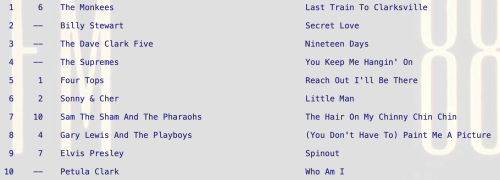
CKRS 590-AM Saguenay (PQ) | November 9, 1966
Always liked Billy Stewart’s voice. This is a top drawer rendition of “Secret Love.”