
#1: Words by the Monkees
City: Prince George, BC
Radio Station: CKPG
Peak Month: August 1967
Peak Position in Prince George ~ #2
Peak Position in Vancouver ~ #3
Peak Position on Billboard Hot 100 ~ #11
YouTube: “Words”
Lyrics: “Words”
Robert Michael Nesmith was born on December 30, 1942 in Houston, TX. His mother, Bette invented liquid paper and would later leave the $20 million estate to him. Affectionately nicknamed “Nez,” he learned to play saxophone as a young child and joined the United States Air Force years later. After two years in the Air Force, he left to pursue a career in folk music. In 1962 Nesmith won a talent contest at San Antonio College. He left Texas and moved to Los Angeles, with the intent of getting into the movie business. He became the “hoot master” at a regular hootenanny at the Troubadour in West Hollywood. In 1963 Nesmith released a 45 of a song he wrote called “Wanderin’”. In 1964 Nesmith wrote “Different Drum”, which was a #13 hit for Linda Ronstadt and the Stone Poneys on the Billboard Hot 100 and #5 in Vancouver in 1967.
During this time he formed the trio named Mike and John and Bill. They recorded a single in 1965 called “How Can You Kiss Me,” which was a Top 40 hit in San Antonio, Texas, in May of ’65. Later that year Nesmith released a solo disc titled “A Journey With Michael Blessing” that made the Top 50 in a few radio markets in Pennsylvania and Ohio, credited to Michael Blessing. With hopes of getting a job as a songwriter, Mike auditioned for The Monkees in late-1965.
In September 1965, Daily Variety, a Los Angeles entertainment industry paper, placed an ad that read: “MADNESS!! Auditions. Folk & Roll Musician-Singers for acting roles in new TV series. Running parts for 4 insane boys.” Over 400 older boys and young men lined up at the studio near Sunset Boulevard, hopeful for a chance at stardom. Stephen Stills and Harry Nilsson were among the hopefuls waiting to be discovered. Walking to the front of the line and right into the producer’s office was 19-year old Davy Jones.
Born in suburban Manchester, UK, in 1945, Davy Jones had been in the acting business since he was a child. In 1959, his Aunt Jessie answered an ad in the Manchester Evening News calling for “school boys to audition for a radio play” with the BBC She helped David, at 13, get the lead role in There is a Happy Land. He was on an episode of Coronation Street in March 1961, when he was 15 years of age. He appeared on stage as Little Michael in Peter Pan, and than as the Artful Dodger in Oliver! in the early 60’s in the West End of London. In 1964 he was in a Broadway production of Oliver! and nominated for a Tony Award at the age of 18. In 1965, Jones released several singles and had two Top Ten hits in Australia, including #4 hit “The Girl From Chelsea”.
One of the people David Jones walked past in the lineup was Mickey Dolenz. Born in 1945 in Los Angeles, Dolenz started his career in show-business at the age of eleven, in 1956, in a TV show called Circus Boy. Dolenz was given the acting name, Mickey Braddock, and the role he was cast in was to play Corky, an orphaned water boy for the elephants in a one-ring circus set around 1900. The show ran through to the spring of 1958. By the mid-60’s Dolenz was in a band playing mostly covers of R&B hits, including many by Chuck Berry. Dolenz sang Berry’s “Johnny B. Goode” in his audition for The Monkees. In 1965 Dolenz cut recorded several singles, one of these, “Don’t Do It” was released in 1967 and made the Top 20 in Edmonton and Ottawa.
Another person lining up hoping to be chosen for the new TV show was Peter Halsten Thorkelson. Born in Washington D.C. in 1942, he studied piano from the age of nine and lived in New York City. Peter got involved in the folk music scene in Greenwich Village and met Stephen Stills and other folk singers. Before he moved to California in the early 60’s, Peter Thorkelson shortened his surname to Tork.
Jones, Nesmith, Dolenz and Tork were all successful in auditioning for The Monkees TV show. Their lineup was international: British and American. David Jones was introduced on the first episode of The Monkees as Davey Jones and “Davey” was how he was know from that day forward. On their debut single, Micky Dolenz sang the lead vocal on “Last Train To Clarksville.” The B-side to “Last Train To Clarksville”, a gentle anti-war song, was “(I’m Not You) Steppin Stone”.
Micky Dolenz sang lead vocals on “I’m A Believer,” the bands second #1 hit in a row. Dolenz would later sing lead vocals on their summer hit in 1967, “Pleasant Valley Sunday,” written by Carole King and Gerry Goffin. Davey Jones sang lead vocals on their other Top Ten hits in ’67, “A Little Bit Me, A Little Bit You” and their third #1 hit, “Daydream Believer”.
While initially a TV series about a band that didn’t actually exist, The Monkees did a live promotional tour of seven cities in the USA beginning on September 1 in Hollywood. The tour featured previews of The Monkees TV show on large screens and The Monkees playing a few tunes. KHJ radio in Los Angeles staged the most ambitious event of the tour on September 11, 1966. KHJ had a contest and the 400 winners rode on a train to the coastal town of Del Mar, California, twenty miles north of San Diego. The town’s mayor renamed Del Mar on September 11 as Clarksville for the day in honor of The Monkees appearance. The Monkees landed on the beach in two helicopters, dressed in their signature double-breasted shirts, greeted by the KHJ contest winners. After the event, The Monkees rode in the train train with the contest winners back to Los Angeles. On one of the train cars, The Monkees gave their first true live public performance. As the train was traveling at 80 miles per hour, Micky Dolenz drum set fell over several times as no one had thought about securing the drums to the floor.
The Monkees went on tour with 16 scattered concert dates between December 3, 1966 (Honolulu) and May 6, 1967 (Wichita, KS). The concert in Honolulu was The Monkees first full length live concert. They were one of the acts performing at the Monterey Pop Festival in mid-June, 1967. They mounted a tour with dates in the USA and Britain between June and August. The tour included Jimi Hendrix as the opening act for seven of these concerts between July 8th (Jacksonville, FL) and 16th (New York City).
In the midst of the fan fever over the Monkees, the B-side to “Pleasant Valley Sunday” titled “Words” also began to chart.
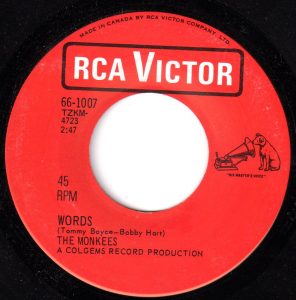
This song was a departure from the Monkees’ typical work, and they had to put up a fight with their management to get it recorded. They long had felt some of the songs foisted on them were bubblegum pop, and they wanted a more mature and relevant sound as musical tastes were dramatically changing. “Words,” written by Bobby Hart and Tommy Boyce, is a rather dark breakup song sung by Micky Dolenz. It’s about a man discovering his girlfriend is a deceitful player who will lie to him just as easily as look at him. He’s badly conflicted by this, as she really had him wrapped around her finger but is now tired of him.
Sidney Thomas “Tommy” Boyce was born in 1939 in Charlottesville, Virgina. He was one half of the pop duo with Bobby Hart. The two wrote numbers of songs for other recording artists including The Monkees, Jay and The Americans and Little Anthony and The Imperials. Boyce was separately pursuing a career as a singer. After being rejected numerous times, Boyce took his father’s suggestion to write a song called “Be My Guest” for rock and roll star Fats Domino. In 1959 the song hit #8 in the US and #11 in the UK.
In 1961 Boyce also wrote “Pretty Little Angel Eyes” for Curtis Lee, which climbed to #7 on the Billboard Hot 100. In 1961 Boyce wrote and recorded “Along Came Linda”.
Robert Luke Harshman was born in 1939 in Phoenix, Arizona. Boyce met Harshman in 1959. The following year Boyce played guitar on Harshman’s single “Girl in the Window”, which flopped. But it marked the first time Harshman used the name Bobby Hart, since his manager shortened and altered his surname to fit the label. Boyce and Hart’s partnership made a breakthrough with a song recorded by Chubby Checker, “Lazy Elsie Molly”, in 1964. They also co-wrote “Come A Little Bit Closer,” a Top Ten hit for Jay and the Americans in 1964.
In 1965, Bobby Hart went on tour as a “Dazzler” with Teddy Randazzo and the Dazzlers. He co-wrote, with Rendazzo, “Hurt So Bad”, which was a Top Ten hit that year for Little Anthony and the Imperials.
In the mid-60’s, with Bobby Hart, Tommy Boyce co-wrote “Last Train to Clarksville”, “I’m Not Your Steppin’ Stone”, “Words” and “Valleri”, all hits for The Monkees. While they were gaining attention for co-writing numerous hit songs for The Monkees, Tommy Boyce and Bobby Hart were invited to appear on numbers of TV shows in guest appearances. These included Bewitched, The Flying Nun and I Dream of Jeannie.
Boyce and Hart also wrote the theme song for the daytime soap opera, Days of Our Lives. When Days of Our Lives premiered in 1965, the show revolved around the tragedies and triumphs of the suburban Horton family. Over time, additional families were brought to the show to interact with the Hortons and serve as springboards for more dramatic story lines. In 2017, Days of Our Lives is in its 52nd season.
In 1968 Boyce and Hart campaigned to support Robert F. Kennedy in his run for the Presidency, and they spearheaded the “Let Us Vote”, or “L.U.V.” campaign, which ultimately helped to lower the US voting age to 18 from 21. In December 1967, Boyce and Hart released their only Top Ten hit on the Billboard Hot 100 titled “I Wonder What She’s Doing Tonight”.
The duo also were featured in a psychedelic Coca-Cola commercial in 1969 called “Wake Up Girl”, and earlier a “Things Go Better With Coke” commercial. In 1973, Hart cowrote “Something’s Wrong With Me”, a #12 hit on the Billboard Hot 100 for Austin Roberts. In the 1980’s Boyce and fell into a depression. A brain aneurysm added to his health troubles in 1993, and Boyce died by suicide on November 23, 1994.
Meanwhile, Bobby Hart released his own music, collaborated with Austin Roberts, and continued to perform in concert with Peter Tork of The Monkees into the mid-2010s before Tork died in 2019.
“Words” climbed to #1 in Toronto, Oxnard (CA), Seattle, Nashville, Aberdeen (WA), Toledo (OH), Wilmington (DL), Hammond (IN), Minneapolis/St. Paul, Manitowoc (WI), Grand Rapids (MI), Orlando, Sioux Falls (SD), Medford (OR), Tucson (AZ), Quincy (IL), Birmingham (AL), Kansas City (MO), Louisville (KY), Phoenix, Los Angeles, Cincinnati, Columbus (OH), Dayton (OH), Pine Bluff (AR), Flint (MI), Lansing (MI), Jacksonville (FL), Omaha (NE), Greensboro (NC), San Bernardino (CA), and Halifax (NS), #2 in Des Moines (IA), Windsor (ON), Indio (CA), Pittsburgh, Lancaster (PA), Erie (PA), Prince George (BC), Boston, Johnstown (PA), Geneva (NY), Dallas, Corpus Christi (TX), Houston, Memphis, Detroit, Denver, Santa Maria (CA), Chicago. Cleveland, Rochester (NY), Canton (OH), Sandusky (OH), Simcoe (ON), Edmonton (AB), Milwaukee (WI), Winnipeg (MB), Providence (RI), and St. Thomas (ON), #3 in Syracuse (NY), Vancouver (WA), Madison (WI), Latrobe (PA), Oklahoma City, Charleston (WV), Davenport (IA), Pointe Claire (PQ), Reading (PA), Akron (OH), Springfield (MA), Lowell (MA), Saginaw (MI), Atlanta, Vancouver (BC), Raleigh (NC), Keane (NH), Santa Rosa (CA), Fort Worth (TX), and Hamilton (ON), #4 in Kitchener-Waterloo (ON), Coffeyville (KS), Tulsa (OK), Endicott (NY), Miami, La Crosse (WI), Buffalo, Troy (NY), Pensacola (FL), Lakeland (FL), Monterey (CA), Ann Arbor (MI), Philadelphia, and San Francisco, #5 in Green Bay (WI), Montreal, Sacramento (CA), Beaumont (TX), and Fredericton (NB), #6 in Gainesville (FL), Racine (WI), Vernon (BC), and Jackson (MI), #7 in San Diego, Eau Claire (WI), and Ocala (FL), #8 in Fresno (CA), San Antonio (TX), and Monroe (MI), #9 in Brownwood (TX), Rutland (VT), and Manchester (NH), and #10 in Quesnel (BC) and Easton (PA).
In 1968, The Monkees TV show featured one last song to make the Top Ten on the Billboard Hot 100 called “Valleri”. Mike Nesmith coined the Tommy Boyce/Bobby Hart tune “the worst record ever.” The B-side to “Valleri” was “Tapicoa Tundra”, written by Michael Nesmith.
After their two-season run on TV, The Monkees had a tour to Australia in September and Japan in October. In November ’68, The Monkees were featured in a psychedelic film titled Head. The script was co-written by Jack Nicholson. In addition to the bandmates, the film’s cast included Annette Funicello, Frank Zappa, Toni Basil, Jack Nicholson and Sonny Liston. The film was a commercial failure only managing $16,111 at the box office. The film both alienated The Monkees fan base and caused Columbia Pictures to abandon plans for any future Monkees films. A single from the Head soundtrack, “Porpoise Song” was released in the fall of 1968.
Unhappy with the bands’ direction, Peter Tork left The Monkees at the end of December, 1968, after filming the bands last TV appearance that was to air on NBC in April ’69. Later in 1969, the remaining three Monkees released a number of singles. This included a Top Ten hit in Australia titled “Mary Mary”, and “Tear Drop City” from the album Instant Replay.
The followup to “Tear Drop City” was a song penned by Michael Nesmith titled “Listen To the Band”. In the fall of 1969, the Monkees released “Mommy And Daddy”.
Another track from The Monkees , “Good Clean Fun”, climbed to #13 in the fall of ’69 in Australia.
Jones, Nesmith and Dolenz went on a tour with 46 concert dates in Canada, the USA and Mexico. The tour opened in Vancouver (BC) on March 29, 1969. The final concert that year was in Salt Lake City, Utah, on December 6th. The Salt Lake City concert was Mike Nesmith’s last performance as Monkee until a reunion concert in 1986. He did a few promotional TV ads for The Monkees which was now airing in reruns.
In 1970, Nesmith left The Monkees to form The First National Band. That year he enjoyed a Top 30 hit in the USA called “Joanne,” which climbed to #3 in Vancouver. On their own, Davey Jones and Micky Dolenz appeared in concert a number of times in 1970 and released a few singles that were commercial failures. The Monkees officially split at the end of 1970.
In their brief life as a recording act, The Monkees sold over 50 million records. While they officially split in after Mike Nesmith left the band, the bulk of their record sales occurred between August 16, 1966, with the release of “Last Train To Clarksville,” and their final Top Ten album, The Birds, The Bees and The Monkees, in the spring of 1968. They remain the only recording act to chart four albums to #1 in a twelve month span on the Billboard 200 album chart.
In 1975 Jones and Dolenz teamed up with Tommy Boyce and Bobby Hart to do a tour of 38 cities across 13 states. In 1976, they performed in twenty cities across the USA, Japan, Singapore and Thailand. Boyce and Hart had written numbers of songs for The Monkees and were a singer-songwriting team in their own right. In 1986 Davy Jones and Peter Tork went on a 17 concert tour of Australia. An even more ambitious tour saw Jones and Tork joined by Micky Dolenz across the USA for 145 concerts between May 24 and December 3. For one of these concerts ~ the Greek Theatre in Los Angeles ~ Mike Nesmith joined the concert for an original lineup on their 20 year reunion tour. Jones and Tork returned to Australia to perform in 42 concerts in 1987. There were more tours to follow in the USA, Australia and Japan. And in 1989 Jones, Tork and Dolenz went on a 32 concert tour of Europe. The trio went on a 30th Anniversary tour of the USA in 1996. And in 1997 they were joined by Mike Nesmith on a tour of the UK.
Jones, Dolenz and Tork continued to tour as Monkees in different combinations at a trio and a duo with their last big tour in 2011, 45 years after The Monkees TV show debuted.
Davy Jones died in 2012 at the age of 66. On Friday evening, September 16, 2016, in Los Angeles, four days after the 50th Anniversary of the debut of The Monkees on NBC, Michael Nesmith walked onto the stage with Micky Dolenz and Peter Tork at the historic, and sold out, Pantages Theatre to perform what he professed would be his final concert with The Monkees. In 2016, the Monkees released their 17th studio album, Good Times! From the album they released “You Bring the Summer” which reached #12 in Belgium. Peter Tork died in February 2019.
Micky Dolenz and Mike Nesmith planned to be on 17 concert tour in the winter of 2019-2020 billed as “The Monkees Present: The Mike Nesmith & Micky Dolenz Show.” Due to the COVID-19 pandemic, the tour was postponed to 2021. Continuing travel restrictions between Canada and the USA precluded any Canadian stops on their tour when it resumed in ’21.
Mike Nesmith died in December 2021 at the age of 78.
March 14, 2026
Ray McGinnis
References:
Andy Greene, “Davy Jones: The Life of a Monkee: How a Child Actor Joined the Best Fake Band of All Time – and Never Escaped,” Rolling Stone, March 29, 2012.
Davey Jones bio, Davey Jones.net.
Damian Fanelli, “Interview: Michael Nesmith, Micky Dolenz and Peter Tork Talk Monkees Summer Tour, ‘Headquarters’ and What They Learned from Jimi Hendrix,” Guitar World, New York, NY, July 26, 2013.
Peter Tork bio, Wizard World.com
Micheal Nesmith bio, Monkees Rule 43.com
Micky Dolenz biography, Micky Dolenz.com
Monkees 1967 U.S. & British Tour (dates), Monkees Live Almanac.com
Bob Rafaelson ~ Director, Head ~ trailer, Columbia Pictures, 1968.
Ryan Schwartz, “The Monkees’ Peter Tork dead at 77,” TV Line, February 21, 2019.
Andrew Danby, “Texas native, great Michael Nesmith, dies,” San Antonio Express-News, December 10, 2021.
The Monkees, “Words“, The Monkees, April 10, 1967.
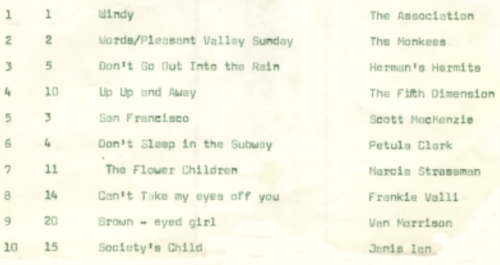
Centre City Survey CKPG 550-AM Prince George (BC) | August 5, 1967
Leave a Reply