
#3: Everybody’s Out Of Town by B.J. Thomas
City: Bathurst, NB
Radio Station: CKBC
Peak Month: April 1970
Peak Position in Bathurst ~ #5
Peak Position in Vancouver ~ #18
Peak Position on Billboard Hot 100 ~ #26
YouTube: “Everybody’s Out Of Town”
Lyrics: “Everybody’s Out Of Town”
Billy Joe Thomas was born in Hugo, Oklahoma, in 1942. His family eventually moved to Houston, Texas. When he was in his teens playing baseball, Billy Joe Thomas took the name of BJ. This was because there were too many boys on the baseball team with the name of Billy Joe. During his teens he sang in a church choir. In 1958, BJ Thomas heard “To Be Loved” by Jackie Wilson. He credits the song as being a catalyst for his love of singing. In the late 50’s, in grade eleven, his Junior year, BJ Thomas became lead singer for a local band named The Triumphs. He got to know Roy Head and the Traits. The Traits and The Triumphs participated in several Battle of the Bands events in the early 60’s. In 1966, BJ Thomas got a record contract with Scepter Records.
He released an album, I’m So Lonesome I Could Cry. The title track, “I’m So Lonesome I Could Cry”, climbed into the Top Ten in the USA and #3 in Vancouver. A follow up single from the album was “Mama”.
BJ Thomas struggled to find a hit single after his initial chart success in 1966. With his 1968 release of “The Eyes of a New York Woman”, he found his way back into the Top 30 in the USA and #7 in Vancouver. His next single, “Hooked On A Feeling” didn’t chart in Vancouver, but climbed to #5 on the Billboard Hot 100. However, it was his song, “Raindrops Keep Falling On My Head”, from the 1969 film, Butch Cassidy and The Sundance Kid, that took him to the top of the charts. It was a number-one hit in Argentina, Canada, Mexico, Norway, Singapore and the United States. “Raindrops Keep Falling On My Head” also climbed to #2 in South Africa, and #3 in New Zealand. At the 1970 Grammy Awards, B.J. Thomas was nominated in the Best Male Pop Vocal Performance category. But he lost out to Harry Nilsson’s recording of “Everybody”s Talkin'”. “Raindrops Keep Falling On My Head” was inducted into the Grammy Hall of Fame in 2014.
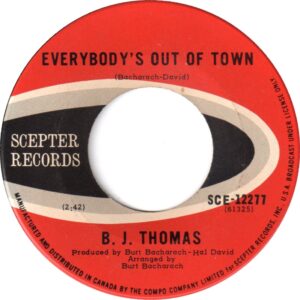
“Everybody’s Out Of Town” was cowritten by Burt Bacharach and Hal David. The song is about neighborhoods where no one is around. The houses are empty. Thomas sings “seems like no one’s around.”
All of the streets are bare,
no traffic tie-ups anywhere.
Don’t have to wait for a seat at the movie.
The people have vanished. They’ve left the ghettos. All the apartments in the apartment buildings are empty too. On the upside, there’s no pollution. There’s “plenty of classrooms everywhere” that are empty of students too. Thomas sings, “I’m gonna send out a message to Noah, “hey, better send some people down.” The song depicts an eerie solitude resulting from the disappearance of people. Thomas is the only human being left in the city. The song depicts a societal reset: “looks like we’re ready to give it one more try. This time there’ll be no alibis.” Whatever has caused the exodus from the cities, it’s time people learned the hard lessons and took advantage of the opportunity to try to refashion a new society. The Biblical reference to Noah, who built an ark to save humanity (and each species on earth) from a flood, suggests a cataclysm caused people to evacuate the city. But somehow, this one guy is left on the empty streets and is doing fine breathing unpolluted air.
The 1960s were a time of growing concern about the human impact on the environment.
- In June 1960, President Dwight D. Eisenhower signed a bill for a two-year Public Health study into air pollution from cars. At the time most vehicles used leaded gas.
- On January 3, 1961, an experimental nuclear reactor in Arco, Idaho, had a meltdown and exploded.
- January 23, 1961 two Mark 39 hydrogen bombs were accidentally dropped over Goldsboro, North Carolina. The bombs fell to earth after a B-52 bomber broke up in mid-air.
- Rachel Carson published Silent Spring. Some agronomists asked whether Carson was intending to starve people by banning pesticides. By 1970, DDT was banned in the US for agricultural use. Silent Spring accelerated the ‘Environmental Movement’.
- The anti-nausea drug, Thalidomide, was banned after the anti-nausea drug for pregnant women caused birth defects in tens of thousands of children. In the United States Senate there were amendments to the Food Drug and Cosmetic Act to stipulate that drugs need to be “effective as well as safe.” The German company that made Thalidomide finally apologized to the families impacted by the drugs severe adverse effects fifty years later in 2012. The company explained that it took them fifty years to apologize because they were in a “state of shock” over the news that their drug had caused so many harms.
- In 1970, Exxon stopped selling leaded gasoline at their gas stations.
- The smog is so thick in London, England, that the city comes to a standstill as the smog settles in from December 4th to 7th, 1962. It is the worst since 1952, when 4,000 sudden deaths were attributed to the smog. This time about 106 “die suddenly” and the final toll is counted around 750.
- On May 20, 1964 the New York Times reported “The city’s millions narrowly escaped catastrophe last October when atmospheric inversion nearly caused smog such as … in London in 1952. These somber findings of the Public Health Committee of the NY Academy of Medicine were presented to the Air Pollution Control Board a few days ago. In the light of such dismaying medical testimony, what can be said of the attitude of the fuel companies that assert they can’t supply enough low-sulphur fuel for the needs of the city because it would cost more? Echoing the positions of the cigarette manufacturers and the makers of pesticides, the oil companies contend there is no evidence that their product is a health hazard. More research is needed, they blandly argue; meanwhile, they want to continue business as usual. When public health is involved, we think the stakes are much too high to permit such a gamble. A conflict between disinterested medical evidence and economic arguments advanced by those who have a strong vested interest in the matter should be resolved without delay in favor of public, not private, good.”
- On June 8, 1966, public hearings on leaded gasoline begin in U.S. Senate and include testimony from Robert Kehoe, a scientist working for industry, and Clair Patterson, a UCLA scientist who exposed Kehoes’ fraudulent industry research. Patterson told the Senate committee, “It is not just a mistake for public health agencies to cooperate and collaborate with industries in investigating and deciding whether public health is endangered – it is a direct abrogation and violation of the duties and responsibilities of those public health organizations.”
- On October 21, 1966, a coal mine pile collapsed in Aberfan, Wales, burying 116 children and 28 adults.
- On March 18, 1968 Senator Robert F. Kennedy announced his campaign to run for the Democratic ticket as Presidential candidate in that year’s election. In his remarks he said, “Too much and too long, we seem to have surrendered community excellence and community values in the mere accumulation of material things. Our gross national product … if we should judge America by that — counts air pollution and cigarette advertising, and ambulances to clear our highways of carnage. It counts special locks for our doors and the jails for those who break them. It counts the destruction of our redwoods and the loss of our natural wonder in chaotic sprawl. It counts napalm and the cost of a nuclear warhead, and armored cars for police who fight riots in our streets. It counts Whitman’s rifle and Speck’s knife, and the television programs which glorify violence in order to sell toys to our children.
Yet the gross national product does not allow for the health of our children, the quality of their education, or the joy of their play. It does not include the beauty of our poetry or the strength of our marriages; the intelligence of our public debate or the integrity of our public officials. It measures neither our wit nor our courage; neither our wisdom nor our learning; neither our compassion nor our devotion to our country; it measures everything, in short, except that which makes life worthwhile. And it tells us everything about America except why we are proud that we are Americans.” - In 1969, auto makers settled a suit by the United Staes Department of Justice for conspiracy to stifle the development of pollution-control devices started in the mid-1950s.
- On June 22, 1969 the Cuyahoga river in Ohio bursts into flames five stories high from oil and chemical pollution. The incident illuminated the extent of pollution. This river fire became a defining moment for the new environmental movement. River fires were routine during the age of petroleum, from 1859 – to the early 21st century. The incident led to the creation of the Clean Water Act in the USA. “I will never forget a photograph of flames, fire, shooting right out of the water in downtown Cleveland. It was the summer of 1969, and the Cuyahoga River was burning.” – Carol Browner, Environmental Protection Agency Administrator 1993-2001.
Burt Bacharach was born in Kansas City, Missouri, in 1928. He studied at McGill in Montreal, and music schools in New York City and California. In 1948 he was drafted into the United States Army. While in West Germany he met singer Vic Damone, and when he was discharged Burt Bacharach worked with Damone for three years.
Bacharach was in several successful songwriting teams, including with Bob Hillier. They co-wrote “Any Day Now (My Wild Beautiful Bird)” for Chuck Jackson, and “Tower Of Strength” for Gene McDaniels.
Harold “Hal” David was born in 1921 in New York City. In 1949, his song “The Four Winds and The Seven Seas” was a #3 hit for Swing and Sway with Sammy Kaye. In 1959, he cowrote “My Heart Is An Open Book”, a #3 hit for Carl Dobkins Jr. Later that year Sarah Vaughan had a Top Ten hit with “Broken Hearted Melody”. In 1961, David cowrote “Sea Of Heartbreak” for Don Gibson. The following year, his song “Johnny Get Angry” was a Top Ten hit for Joanie Sommers.
Burt Bacharach and Hal David were composers working in the Brill Building starting in the late 50s. They co-wrote “The Story Of My Life” which became a #1 hit for Michael Holliday in 1958 in the UK, and “Magic Moments” for Perry Como another #1 hit in the UK and #4 on the Billboard Hot 100 later that year. In 1961 Bacharach wrote “Tower Of Strength” for Gene McDaniels and “Baby It’s You” for The Shirelles. Bacharach and David had a banner year in 1962 with hits that included “(The Man Who Shot) Liberty Valance” (Gene Pitney), “Make It Easy On Yourself” (Jerry Butler), “Don’t Make Me Over” (Dionne Warwick) and “Only Love Can Break A Heart” (Gene Pitney). In 1963 the songwriting team enjoyed more accolades with “Wishing And Hoping” (Dusty Springfield), “Blue On Blue” (Bobby Vinton), “(They Long To Be) Close To You” (The Carpenters, #1 in 1970) and “Anyone Who Had A Heart” (Dionne Warwick). 1964 continued Buurt Bacharach and Hal David’s winning ways with “Walk On By” (Dionne Warwick) and “There’s Always Something There To Remind Me” (Sandie Shaw, #1 UK).
In 1965, Bacharach and Hal David were nominated for an Academy Award in the Best Song category for “What’s New Pussycat?”. They received nominations again in 1966 for “Alfie” and in 1967 for “The Look of Love”. In 1969, Bacharach and Hal David won Academy Awards for “Raindrops Keep Falling On My Head” (BJ Thomas, #1 US) in the Best Song category, and Best Score for an Original Motion Picture with Butch Cassidy and the Sundance Kid. In 1970, Bacharach and David won a Grammy Award for Best Score from an Original Caste Album for Promises, Promises. In 1981, Burt Bacharach shared an Academy Award for Best Original Song with “Arthur’s Theme (Best That You Can Do)”. Over the years, Burt Bacharach received six Academy Award nominations and won three of these. He also received seven Golden Globe nominations and won two of these.
At the Grammy Awards, Burt Bacharach shared award nominations with Hal David for “Wives and Lovers” (1963), “What the World Needs Now Is Love” (1965), “Casino Royale” (1967). They won a Grammy in 1967 for “Alfie” in the Best Instrumental Arrangement category. The songwriting duo also received Grammy nominations for both “I’ll Never Fall In Love Again” and “Raindrops Keep Falling On My Head” (both losing out to “Games People Play” by Joe South).
In 1981, Bacharach received a Grammy nomination for “Arthur’s Theme”. In 1986 he shared the Grammy Award for Record of the Year in 1986 for “That’s What Friends Are For” with Carol Bayer Sager. In 1995, he shared a Grammy nomination with Elvis Costello in the Best Pop Collaboration with Vocals category for “God Give Me Strength”. Bacharach and Costello won in that category in 1998 for “I Still Have That Other Girl”.
In 2005, Burt Bacharach won a Grammy Award for At This Time in the Best Contemporary Instrumental Album category. In addition, he received a second Grammy nomination for the track “In This Time”.
In 2020, Burt Bacharach received a Grammy nomination in the Best Traditional Pop Vocal Album category for Blue Umbrella. In 2021, Burt Bacharach received a Grammy nomination for Burt Bacharach and Steven Sater’s Some Lovers in the Best Musical Theatre Album category. Over the decades Burt Bacharach received 22 Grammy Award nominations, winning on six occasions.
Over the years Burt Bacharach wrote the soundtracks to eleven movies, and seven theatrical works. He also released eight solo albums, among his many accomplishments. Burt Bacharach died in 2023 at the age of 94. Hal David died in 2012 at the age of 91.
“Everybody’s Out Of Town” reached #3 in Washington DC, #4 in Wausau (WI), Atlanta, and St. Louis, #5 in Stevens Point (WI), Bathurst (NB), and Santa Barbara (CA), #6 in Lincoln (NE), Kansas City (MO), Des Moines (IA), and Salt Lake City, #7 in Dothan (AL), Valdosta (GA), #8 in Clarksburg (WV), Minneapolis/St. Paul, and Columbus (OH), #9 in Fresno (CA), and Waupaca (WI), #11 Calgary and #12 in Ottawa.
In 1970, B.J. Thomas released “I Just Can’t Help Believing”. The single topped the Easy Listening chart, and was a Top Ten hit in the USA. Elvis Presley covered the song and his version was a Top Ten hit in Australia, Belgium, the Netherlands, South Africa, Sweden and the UK. In the winter of 1970, “No Love At All” reached #2 on the Easy Listening chart. He had a number-one Adult Contemporary single in 1972 titled “Rock And Roll Lullaby”. In 1975, “(Hey Won’t You Play) Another Somebody Done Somebody Wrong Song” topped both the Billboard Hot 100 and Hot Country Singles charts. It was nominated for Single of the Year by the Country Music Association. But B.J. Thomas lost out to Freddy Fender’s “Before The Next Teardrop Falls”.
BJ Thomas has struggled with addictions over both alcohol and drugs. Looking back on his years as an addict, Thomas reflects, “You say ‘Well, you know if I do this, it’s probably going to kill me’ and you go ‘Ah, I don’t care.’ And that’s the addiction talking, not really you. Finally you have to get to the point where you realize, ‘You know what? I don’t want to die. I want to live.’”
Thomas has been sober since 1976. Around this time he and his wife, Gloria, became Christian. That same year BJ Thomas released Home Where I Belong. The album was a huge hit on the Christian album charts. Thomas received a Grammy Award for Best Inspirational Performance. He repeated the feat the following year with a Grammy Award in the same category for his 1978 album Happy Man. In 1979, his album You Gave Me Love (When Nobody Gave Me a Prayer) earned him his third Grammy Award in the Best Inspirational Performance category. But B.J. Thomas wasn’t finished. In 1980, he shared a Grammy Award for Best Gospel Performance – Contemporary with Reba Rambo, The Archers, Tremaine and Walter Hawkins, Andrae Crouch and others for the album The Lord’s Prayer. And he won his fifth consecutive Grammy Award in five years when he won for a fourth time in the Best Inspirational Performance category for his album Amazing Grace. All of this established BJ Thomas as a leading artist in the contemporary Christian singles and album charts. Between 1979 and 1983, he had seven Top Ten hits on the American Christian charts. This included a #1 hit on that chart titled “Jesus On My Mind”. In addition, BJ Thomas charted two number one hits on the Billboard Country charts in the mid-80’s.
In addition to his inspirational recordings, in 1977 B.J. Thomas released a cover of the Beach Boys 1964 song “Don’t Worry Baby”. While the Beach Boys release stalled at #24 that year, Thomas’ cover peaked at #17 and outsold the original recording by the Beach Boys. This was thanks to airplay on the Adult Contemporary radio stations where “Don’t Worry Baby” topped the chart in Canada and reached #2 in the USA. As well, B.J. Thomas sang a duet with Ray Charles on the R&B singers album Friendship titled “Rock and Roll Shoes”. In 1999, Thomas covered Elvis Presley’s “Suspicious Minds” for the album Remembering Elvis: Louisiana Hayrides & Tribute.
Over the years BJ Thomas charted eight pop songs into the Top 20 on the Billboard Hot 100. Between 1966 and 2014, B.J. Thomas released 55 studio albums and three live albums.
In 2021, B.J. Thomas announced he was diagnosed with lung cancer. He died in May of that year at the age of 78.
May 2, 2026
Ray McGinnis
References:
“B.J. Thomas, Grammy-winning singer who topped charts across genres, dies at 78,” CBC, May 29, 2021.
BJ Thomas From Then to Now, BJ Thomas.net
Howard Kerbel, “A Conversation With BJ Thomas: Love, Near Tragedy And A Song That Saved Him,” Huffington Post, August 6, 2016.
John W. Kennedy, “Conversation: BJ Thomas,” Pentecostal Evangel, March 13, 2014.
Richard Williams, “Hal David Obituary: Lyricist Behind Some of the Greatest Pop Hits of the 20th Century,” Guardian, September 2, 2012.
Richard Barber, “Burt Bacharach at 88: ‘Why Would I Ever Want To Stop?’,” Telegraph, June 10, 2016.
Lauren Huff, “Dionne Warwick says loss of Burt Bacharach is ‘like losing a family member’,” Entertainment Weekly, February 9, 2023.
“Environmental History: Timeline and Historical Insights,” Environmentalhistory.org.
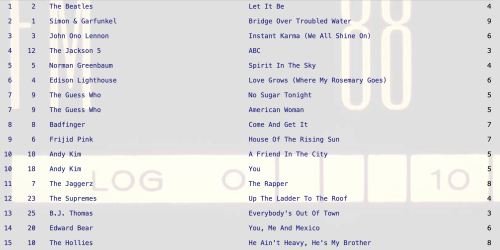
Top 30 Playlist CKBC 1360-AM Bathurst (NB) | April 5, 1970
Leave a Reply