
#128: Beautiful Second Hand Man by Ginette Reno
City: Toronto, ON
Radio Station: CHUM
Peak Month: November-December 1970
Peak Position in Toronto ~ #6
Peak Position in Vancouver ~ #26
Peak Position on Billboard Hot 100 ~ did not chart
YouTube: “Beautiful Second Hand Man”
Lyrics: “Beautiful Second Hand Man”
Ginette Raynault was born in 1946 in Montreal. She began singing in 1960 at the age of 14, and won the talent contest “Les Découvertes de Jean Simon” (Jean Simon’s Discoveries). With this success, three Montreal clubs – Café Caprice, le Café de l’Est and the Café Provincial – offered her a professional contract. Jean Simon suggested Ginette adopt the stage name Reno—a phonetic spelling of her real last name (as pronounced in Francophone). In 1962, Ginette Reno released her debut single “J’aime Guy”, a French version of the minor pop hit “Yessiree”, released earlier that year by American pop singer Linda Scott. The following year, Reno released “Roger” which was a hit on French-language pop stations across Quebec. The single was accompanied by a self-titled debut album in 1963. It included the track “Le Jour Viendra”, a French version of the Ruby and the Romantics number-one hit “Our Day Will Come”, and “Avec Toi” which was a French-language cover of Marcie Blaine’s “Bobby’s Girl”. The flip side, “Roger”, was a big hit in 1963.
As well in 1963, Ginette Reno covered Canadian pop singer Pat Hervey’s “I Wouldn’t Blame You” with her single “Tout peut recommencer”. In 1964, Reno covered Lesley Gore’s “She’s A Fool” with “Entre nous, il est fou”. The flip side was her cover of The Secrets “The Boy Next Door” titled “Le P’tit Voisin”. Later in 1964, Reno released the English-language song “Find Me A Boy” on the Coral label. She had a number-one hit in Quebec in 1964 titled “Tu vivras toujours dans mon coeur”. The following year she had a big hit in Quebec titled “Les yeux fermés”.
Reno recorded a few more English-language songs in the mid-60s, including compositions from the songwriting duo Sid Tepper and Roy C. Bennett. Tepper and Bennett had been successful with “Red Roses For A Blue Lady” for Vaughn Monroe, and “The Naughty Lady of Shady Lane” for The Ames Brothers. Ginette Reno released eight French-language singles in 1965-66. Of these was a cover of the Dusty Springfield hit “All I See Is You” rendered as “Je ne vois que toi”.
In 1967, Reno reached for a cover of Kay Starr’s number-one pop hit in 1952 titled “Wheel Of Fortune”. Her nostalgic treatment of “Ma roue de fortune” continued to expand her fan base. That year she successfully covered Engelbert Humperdinck’s “The Last Waltz” with “La Derniere Valse”. The single topped the Quebec pop charts for eleven weeks. She also covered Jefferson Airplane’s “Somebody To Love” with “Quelqu’un à aimer”. In 1968 she covered Dionne Warwick’s “Do You Know the Way to San Jose” with “Le chemin pour San Jose”.
In 1969, one of her hits in Quebec was a cover of the Andy Williams tune “Happy Heart”. Her French-language cover was titled “C’est mon coeur qui chante clair”. She recorded a duet with Jacques Boulanger titled “Le sable et la mer”. It became a number-one hit in Quebec in 1969. He final single release in the 1960s – her 26th single – was an English-language cover of The Animals “Don’t Let Me Be Misunderstood”.
In 1970, Ginette Reno recorded an English-language version of the Italian song “Giochi Proibiti” with her English-titled disc “Forbidden Games”. The song was originally popularized via Narciso Yepes’s soundtrack for the 1952 film Jeux interdits/Giochi proibiti. The instrumental was later covered by Italian pianist Luciano Sangiorgi in 1958. French-Italian singer Eva recorded a vocal Italian-language version of the song in 1965. Her biggest English-language hit across Canada was released in 1970 titled “Beautiful Second Hand Man”.

“Beautiful Second Hand Man” is a song written by Johnny Worth and Les Reed. Worth was born in Battersea, England, in 1931. His Greek father christened him at a Greek Orthodox church as Yannis Skordalides. But his Welch mother subsequently christened him at the Church of England as John Worsley. After public school, he worked as a draughtsman before compulsory two-year in the National service. From there, he determined to become a professional singer. He was spotted performing in a pub and was signed to sing for five years with the Oscar Rabin Band into the mid-50s. Next Worth joined a quartet called The Raindrops and appeared on the British variety show Drumbeat. Worth ended up writing hit songs for Adam Faith. These include the chart-topping British hits “What Do You Want?” and “Poor Me”, as well as “Ain’t That Funny”, and Top 5 hits for Adam Faith: “As You Like It”, “How About That!”, “Someone Else’s Baby”, “This Is It!”, “The Time Has Come” and “Who Am I”. Johnny Worth composed Eden Kane’s #3 UK hit in 1962 titled “Forget Me Not”, and in 1963 Jet Harris and Tony Meehan’s instrumental hit “Applejack”. Worth also penned a few hits in the early 70s, including “Jack In The Box” for Clodagh Rodgers, and Jimmy Helms 1973 Top Ten hit “Gonna Make You An Offer You Can’t Refuse”. Johnny Worth also wrote music for over a half dozen low budget British movies in the sixties and seventies. He died at the age of 90 in 2021.
Les Reed was born in the suburbs of Surrey, England, in 1935. In school he learned to play piano, vibraphone and accordion. While with the National service he played piano and clarinet in the Royal East Kent Military Band. In 1959, he joined The John Barry Seven as their pianist. His first hit was “Tell Me When” for the Applejacks which reached #7 in the UK in 1964. He went on to pen “It’s Not Unusual” by Tom Jones which topped the UK pop charts in 1965. He later wrote the number-one hit “Delilah” (1968), and “Daughter of Darkness” which was a hit for Tom Jones in 1970. Other hits Reed wrote include the number-one UK hit “The Last Waltz” (1968), “Les Bicyclettes de Belsize” and “Winter World of Love” for Englebert Humperdinck, “Here It Comes Again” for The Fortunes, “There’s A Kind Of Hush” for Herman’s Hermits, “Kiss Me Goodbye” for Petula Clark, and a number-one hit in 1968 titled “I Pretend” for Des O’Connor. Les Reed has been awarded the British Academy’s Gold Badge of Merit in 1982, and the Order of the British Empire for valuable service to the nation in 1998. Les Reed died at the age of 83 in 2019.
“Beautiful Second Hand Man” is a song giving credit to a guy who romances the narrator of the song. She finds that he’s broken a string of hearts. He comes on to her, and other women with his “dated routines.” Though he’s not the man to have a permanent relationship with, she let him know “you taught my eyes to see” and inspired her to find love. Reno sings, “goodbye and may love smile upon you. Goodbye, goodbye, goodbye, you second hand man.”
“Beautiful Second Hand Man” reached #6 in Toronto, #12 in Ottawa, and #15 in Calgary.
After “Beautiful Second Hand Man” became a Top Ten hit across Canada, Ginette Reno was awarded Top Female Vocalist at the Gold Leaf Awards (later named the Juno Awards). In 1972 and 1973 she received Juno Awards in the category Outstanding Performance of the Year – Female. In 1998, she was nominated for a Juno Award in the Best Selling Francophone Album category for Versions Reno. The following year she received a nomination for Best Female Vocalist. In 2001 she won a Juno Award for Francophone Album of the Year for Un Grand Noël d’amour. In 2011, she was nominated for the Juno Fan Choice Award.
Between 1969 and 1974 she had 9 songs in the RPM Canadian Top 100 Singles chart, a survey populated almost entirely with English-language pop hits.
In 1974, Ginette Reno reached the top of the Quebec pop charts again with “Des croissants de soleil”. Later that year she had a number-one hit in a duet with Jean-Pierre Ferland titled “T’es mon amour, t’es ma maîtresse”. The following year, her duet with Jean-Pierre Ferland, “Un peu plus haut, un peu plus loin”, became a major hit. In 1977, she had another number-one hit in her province of Quebec with “La vie”. One her most loved songs, “Je ne suis qu’une chanson”, was released in 1979 and became a huge hit across Quebec. It relaunched her career and remains one of her most iconic tracks.
In 1991, Ginette Reno released “L’essentiel”. It became another huge hit in Quebec.
Ginette Reno played the mother in Jean-Claude Lauzon’s 1992 coming-of-age film Léolo. She played Laura Cadieux in Denise Filiatrault’s 1998 film It’s Your Turn, Laura Cadieux (C’t’à ton tour, Laura Cadieux). The role earned her a Genie Award nomination for Best Actress. She reprised her role for the 1999 sequel Laura Cadieux II (Laura Cadieux…la suite). She was again nominated at the 2000 Genie Awards. She played the role of Maria Barberini in the 2003 Canadian independent film Mambo Italiano. She played Blanche in the 2006 film A Family Secret (Le secret de ma mère), earning her a Best Actress in a leading role Genie Award nomination.
In 2022, Ginette Reno came back to the big screen after 16 years in Martin Villeneuve’s The 12 Tasks of Imelda (Les 12 travaux d’Imelda), co-starring playwright Robert Lepage, in which she plays Martin and Denis Villeneuve’s maternal grandmother Simone, Imelda’s lifelong adversary. In 2023, she provided a the voice of the grandmother in the animated film Katak: The Brave Beluga.
During the course of her six-decade career, Ginette Reno has been made an officer of the Order of Canada; A Lifetime Achievement Award at the Governor General’s Performing Arts Awards; Inducted into Canada’s Walk of Fame; Made a Knight of the National Order of Quebec; Appointed as a Knight of the Order of Arts and Letters by the President of the French Republic; And made a Knight of the National Order of the Legion of Honour by the President of France. She has also received the Queen Elizabeth II Golden Jubilee Medal (in 2002), and also the Queen Elizabeth II Diamond Jubilee Medal (in 2012).
She has sung the Canadian national anthem, O Canada, at the 64th Grey Cup game in 1976, at Stanley Cup playoffs in 2014, 2015 and 2017; And also for Quebec Nordiques games in the 1980s and 1990s.
October 24, 2026
Ray McGinnis
References:
“Inductee of the Day,” Canada’s Walk of Fame, April 27, 2011.
“Ginette Reno: Biography,” northern stars.ca.
Ginette Reno, “La Jour Viendra“, Apex Francais, 1963.
Ginette Reno, “Avec Toi“, Apex Francias, 1963.
Ginette Reno, “Roger“, Apex Francais, 1963.
Ginette Reno, “Entre nous, il est fou“, Apex Francais, 1964.
Ginette Reno, “Find Me A Boy (Tous les garçons et les filles),” Coral Records, 1964.
Ginette Reno, “Les yeux fermés“, Disques Apex, 1965.
Ginette Reno, “Je ne vois que toi“, Disques Apex, 1966.
Ginette Reno, “Ma roue de fortune“, Disques Apex, 1967.
Ginette Reno, “La Derniere Valse“, Grand Prix, 1967.
Ginette Reno, “C’est mon coeur qui chante clair“, Grand Prix, 1969.
Ginette Reno and Jacques Boulanger, “Le sable et la mer“, Grand Prix, 1969.
Ginette Reno, “Don’t Let Me Be Misunderstood“, Parrot Records, 1969.
Ginette Reno,”Forbidden Games (Giochi proibiti)“, Parrot Records, 1970.
Ginette Reno, “Des croissants de soleil“, Trans-World International, 1974.
Ginette Reno and Jean-Pierre Ferland, “T’es mon amour, t’es ma maîtresse”, Jaune, 1974.
Ginette Reno and Jean-Pierre Ferland, “Un peu plus haut, un peu plus loin“, Trans-World International, 1975.
Ginette Reno, “La vie“, Melon-Miel, 1977.
Ginette Reno, “Je ne suis qu’une chanson”, Melon-Miel, 1979.
Ginette Reno, “L’essentiel“, Melon-Miel, 1991.
“Singer, songwriter and producer Johnny Worth has died aged 90,” Cypress Mail, August 13, 2021.
“Les Reed: Delilah songwriter dies aged 83,” BBC, April 16, 2019.
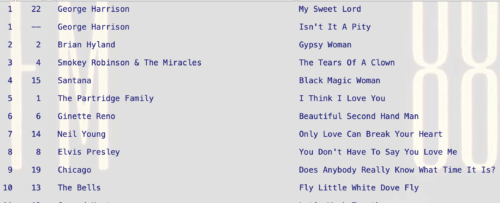
CHUM 30 | CHUM 1050-AM Toronto (ON) | December 5, 1970
Leave a Reply