
#70: Black Slacks by Joe Bennett and the Sparkletones
City: Toronto, ON
Radio Station: CJBC
Peak Month: September 1957
Peak Position in Toronto ~ #1
Peak Position in Vancouver ~ did not chart
Peak Position on Billboard Hot 100 ~ #17
YouTube: “Black Slacks”
Lyrics: “Black Slacks”
Joe Bennett and the Sparkletones formed in 1955 at Cowpens High School in Spartanburg, South Carolina, when the group’s members were between the ages of 13 and 16. Initially, there was group called the Jamborettes with Joe Bennett and Wayne Arthur. But they tired of the name and Joe Bennett’s mother came up with the Sparkletones – as she liked Sparkletones from Spartanburg (it had a ring to it) – as they added Sparky Childress and Jimmy Denton to the lineup. In January 1957, Bob Cox, a talent scout for CBS, held auditions at the Spartanburg Memorial Auditorium. The Sparkletones came in second place at the event, Jimmy Denton would recall in a 2023 interview. Convinced they would be a success, Cox quit CBS to manage the group and flew them out to New York City to sign with ABC-Paramount. At their first recording session they recorded the 12-bar blues tune “Black Slacks”.
Band members Joe Bennett (born Joseph H. Bennett, February 21, 1940) and drummer Jimmy Denton (born in 1941 in Spartanburg) co-wrote “Black Slacks”. Other bandmates were Sparky Childress (born in April 1943 in Spartanburg) on guitar, and Wayne Arthur (born in 1941 in Spartanburg) on double bass.
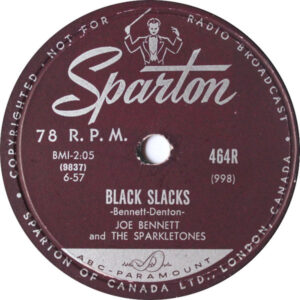
“Black Slacks” was written on the front porch of Joe Bennett’s mother’s home. Jimmy Denton had been in touch with his mother and asked her, on the way to the grocery store, to drop off his pair of black slacks because Jimmy and Joe were going out that evening. That incident was the catalyst for the boys to start writing “Black Slacks”. Originally, the opening line “Black slacks, B-B-B-B-Black slacks,” was not part of the song. However, when Sparky Childress arrived at the studio in New York City he remarked on how cold it was, compared to South Carolina. “Bl-bl-bl-bl” exclaimed Childress to underscore the chill outside. When the producer heard Sparky, he turned to the group and said, “can you all do that in harmony?” Jimmy Denton concludes, “so that is how the hook got into that song.”
In the song the narrator explains that their black slacks are “pegged fourteen.” “Pegged” (or “pegged pants/slacks”) meant trousers that were tightly tapered from the knee down to a narrow cuff/leg opening at the ankle. This was a popular “cool” look among teenagers and rock & roll fans at the time—sharper and more fitted than regular baggy pants. “Fourteen” refers to the circumference of that narrow cuff in inches (i.e., the pant legs were pegged down to a 14-inch opening). So the full line “Black slacks pegged fourteen” means the singer is wearing stylish, tightly tapered black pants with a 14-inch leg opening—part of the sharp, hip outfit (along with the red bow-tie, cat-chain, etc.) that makes him a “cool daddy-o.”
As well, the singer has a cat-chain. A “cat-chain” (also written “cat chain”) is a long decorative chain worn as a fashion accessory by stylish “hep cats” (cool, hip young men) in the 1950s. It was typically a watch-style or key/wallet chain attached to a belt loop or pocket and hanging down the side of the pants—often quite long (in the song, “down to my knees”). It was a flashy part of the sharp, rebellious teen/rockabilly look, similar to later wallet chains but rooted in earlier “cat” (cool guy) and zoot-suit fashion. In the song, it’s one of the details (along with the pegged black slacks, red bow-tie, and derby) that makes the singer a “real cool breeze.”
In addition, the singer wears a red bow-tie. In 1957, a red bow-tie was a bold, stylish accessory that signaled a sharp, dapper, and attention-grabbing look—especially in the youthful “hep cat” / rockabilly / teen fashion scene. In the context of “Black Slacks,” it was part of a carefully put-together cool outfit (pegged black slacks, red bow-tie, cat-chain, derby, etc.) meant to make the wearer stand out and impress the girls (“they say ‘Me, oh my!’”). Bow ties had a modest resurgence around 1957 as “formal yet fun,” often in textured fabrics, modern prints, or brighter colors. Red was particularly vibrant and eye-catching compared with the more conservative black, navy, or neutral ties common in everyday or business wear.
To top it off, the guy wears a derby. In 1957, wearing a derby (bowler hat) was not a common or everyday choice for teenage boys. Most teens either went hatless or wore more typical styles such as fedoras, trilbies, pork-pie hats, or casual caps. Hat-wearing in general was already declining among younger people. A derby stood out as a distinctive, slightly old-fashioned or quirky accessory. In the context of the “Black Slacks” lyrics (“Man you ought to see me with my derby on / I know that you would say, ‘He’s gone’”), it functioned as the finishing flourish of a carefully assembled sharp, flashy “hep-cat” or rockabilly look. Pairing a derby with pegged black slacks, a red bow-tie, and a cat-chain created an eye-catching, dapper, almost theatrical outfit. It helped the wearer look polished and different from the average teen.
In “Black Slacks” the singer boasts that once you see him in his outfit “I know that you would say ‘He’s gone. “In 1950s slang, “gone” meant extremely hip, far-out, or impressively stylish. The derby was presented as the detail that would make people notice and declare the wearer especially cool. The outfit in “Black Slacks” is stylish and sets the wearer apart from the rebellious and roguish guys who wore leather jackets, had a “greaser look” with an air of delinquency about them.
Now that the guy has his outfit on, he is rarin’ to go. In 1957, “Rarin’ to go” (also spelled “raring to go”) meant very eager, enthusiastic, and ready to start something right away. It described someone full of energy, who couldn’t wait to begin: an impatient, excited readiness.
The word “keen” in “Black Slacks” originally comes from Old English cēne, meaning bold, brave, or sharp. By the mid-20th century (especially the 1940s–1950s), American teenagers and “hep cats” adopted it as positive slang for something desirable or impressive. Keen was a synonym for “cool,” “neat,” “groovy,” or “sharp.” The phrase “daddy-o” was a friendly, admiring term used by teenagers, “hep cats,” and rock & roll fans. In “Black Slacks”, calling someone a “cool daddy-o” meant he was sharp, fashionable, and in-the-know — basically the epitome of 1950s cool.
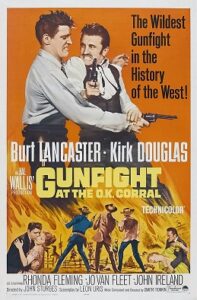
“Black Slacks” became a local hit and slowly built up national recognition as the group set out on a tour that crisscrossed the U.S. several times over, also performing on The Nat King Cole Show, American Bandstand, and The Ed Sullivan Show. T After the group recorded “Black Slacks” they headed to Chattanooga, Tennessee, for a concert. They had a whole tour lined up. Wayne Arthur recalls, “by the time we got to California “Black Slacks” was going up the charts. Theaters were getting full. The Sparkletones manager brought a copy of the film Gunfight at the O.K. Corral starring Burt Lancaster and Kirk Douglas. The audience would see the film and hear a set of songs by the Sparkletones during the intermission.
On the tour, Joe Bennett and the Sparkletones had a 12-week gig in Las Vegas. They were doing a 30-minute set prior to the headliner big band. During the stint, one night Elvis Presley was in the audience at the Royal Nevada Hotel. Wayne Arthur thinks this was in October 1957 . Elvis came back to the dressing room after the show. The ‘King of Rock ‘n Roll told the Sparkletones he wanted to talk to some people “from the south.” Elvis was also impressed with the formal jackets the band were wearing, which they had tailor-made in Las Vegas.
On September 17, 1957, the Sparkletones appeared on The Nat King Cole Show from the Sands Hotel in Las Vegas. On November 3, 1957, Joe Bennett and the Sparkletones joined Jimmy Rodgers, Carol Burnett, Paul Anka, and Sam Cooke, on The Ed Sullivan Show. Next up, the band appeared on American Bandstand on November 5, 1957.
“Black Slacks” peaked at #1 in Toronto, #3 in Albany (NY), Augusta (ME), and Phoenix, #4 in Pontiac (MI), and Smiths Falls (ON), #5 in Hartford (CT), Dauphin (MB), and Chicago, #7 in Worcester (MA), St. Louis (MO), La Crosse (WI), London (ON), and Boston, #8 in Allentown (PA), Rochester (MN), and San Antonio (TX), #9 in Woonsocket (RI), Cambridge (MA), Fairfax (VA), and Detroit, and #10 in Houston and Indianapolis (IN). “Black Slacks” remained on the Billboard pop chart for over four months, and peaked at #17.
“Black Slacks” was sampled on the Buchanan and Goodman novelty tune “Santa and the Satellite” released in December 1957. The gimmick in the song was spoken-word narration from news anchors and on-the-spot reporters, interspersed with samples of hit records. The song began “Here is a news bulletin. Santa Claus has been kidnapped by spacemen from a flying saucer which landed at the North Pole.” A police all points bulletin alerts officers to “be on the lookout for Santa Claus, last seen wearing” “Black slacks,
The B-side to “Black Slacks” was “Boppin’ Rock Boogie”. Fellow ABC-Paramount artist, Paul Anka, had been in the recording studio earlier that day recording a song called “Diana”, and Anka provided falsetto backing vocals to the B-side of the Sparkletones 78 RPM.
The Sparkletones’ next single, “Penny Loafers and Bobby Socks”, reached #42 on the Billboard pop chart early in 1958, staying on the charts for eight weeks. Joe Bennett and the Sparkletones played venues as part of rock ‘n roll shows headlined as “Alan Freed Presents.” In particular, they played for two nights at one of Alan Freed’s rock ‘n roll shows in Hartford, Connecticut, at the State Theater. Others sharing the stage those two nights included Chuck Berry, Bill Justis, Lee Andrews & the Hearts, The Dubs, Jo Ann Campbell, The Moonglows, and King Curtis. Because of the demands for touring, in 1957-58, the bandmates dropped out of school for a year. But they went back to school in the 1958-59 year.
Subsequent releases, “Cotton Pickin’ Rocker”, “We’ve Had It”, “Late Again”, and “Run Rabbit Run”, all failed to chart over the course of the next two years. In 1959, the group’s contract with ABC-Paramount expired. Next, they released three singles on Paris Records. But only the single “Boys Do Cry” had any amount of success, peaking at #105 in 1959. Around this time original guitarist Sparky Childress and drummer Jimmy Denton left and were replaced by Gene Brown and Donnie Seay, respectively. The group broke up in October 1960 after final regional chart runs with “Are You From Dixie” (February 1960) and “Softly” (April 1960).
Sparky Childress went on to play country music in the 1960s. He died in November 2019 at the age of 76.
Joe Bennett got drafted to serve in the United States Air Force in August 1960. He ended up seeing action in the Vietnam War. During that time he was exposed to Agent Orange. In his later years he suffered from complications related to Parkinson’s disease and Lewy body dementia. Bennett continued in music as a publisher and teacher. He died at the age of 75 in 2015.
The Sparkletones were inducted into the Rockabilly Hall of Fame and the Spartanburg Music Trail. Wayne Arthur and Jimmy Denton were interviewed by the Spartanburg Music Trail on November 2023. As of this November 2026 post both are around 85 years of age.
November 16, 2026
Ray McGinnis
References:
Buchanan and Goodman, “Santa and the Satellite“, Luniverse Records, 1957.
“Obituaries: Howard Dean “Sparky” Childress Sr.,” Spartanburg Herald-Journal, December 3, 2019.
“Wayne Arthur and Jimmy Denton of the Sparkletones,” Spartanburg Music Trail, November 30, 2023.
“Joseph Herbert ‘Joe’ Bennett,” Find A Grave, June 27, 2015.
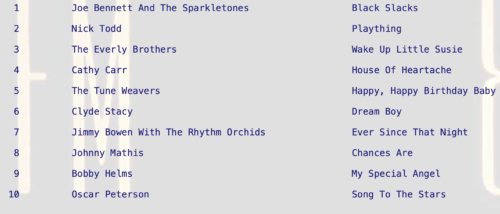
CJBC 860-AM Toronto (ON) | September 20, 1957
Leave a Reply