
#97: Border Song by Elton John
City: Edmonton, AB
Radio Station: CHED
Peak Month: September 1970
Peak Position in Edmonton ~ #14
Peak Position in Vancouver ~ #21
Peak Position on Billboard Hot 100 ~ #92
YouTube: “Border Song”
Lyrics: “Border Song”
Reginald Kenneth Dwight was born in 1947. When he was three years old he astounded his family when he was able to play The Skater’s Waltz by Émile Waldteufel by ear at the piano. When he was eleven years old he won a scholarship as a Junior Exhibitor at the Royal Academy of Music. Between the ages of 11 and 15 he attended the Academy on Saturday mornings. In 1962, by the age of 15, he was performing with his group, The Corvettes, at the Northwood Hills Hotel (now the Northwood Hills Public House) in a northern borough of London. While he was playing with a band called Bluesology in the mid-60s he adopted the stage name Elton John. His stage name, which became his legal name in 1967, was taken from Bluesology saxophonist Elton Dean, and their lead singer, Long John Baldry.
In 1967 John met Bernie Taupin, a songwriter. Since they teamed up they’ve worked together on 32 studio albums between 1969 and 2016. In the same five-decade span Elton John has released 128 singles. Of these 42 reached the Top Ten in Canada on the RPM singles chart, 29 made Top Ten on the UK charts and 26 singles made Top Ten on the Billboard Hot 100. Elton John holds the distinction of having the most successful single release in the rock ‘n roll era ~ 1955 to the present ~ with his 1997 version of “Candle in the Wind” which has sold over 33 million copies. The biggest selling single remains “White Christmas” by Bing Crosby which has sold 50 million copies.
In 1969, Elton John released his debut album, Empty Sky. He received critical acclaim for his musicianship and heralded as a great new singer-songwriter. John didn’t disappoint his critics, as his next album, the self-titled, Elton John, included “Your Song” which peaked at #1 in Vancouver on CKVN. The next release from the album was “Border Song”.
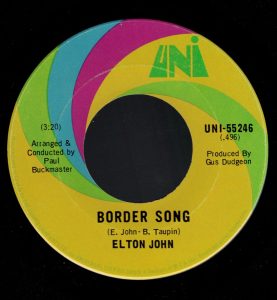
The “Border Song” is a song contemplating alienation based on nationality and ethnicity. Political winds change direction and animosity between people who are different from one another is exacerbated. Elton John sings “There’s a man over there. What’s his colour, I don’t care. He’s my brother, let us live in peace.” The song appeals to look past differences, look past national boundaries and find a way to live in harmony.
“Border Song” climbed to #8 in Memphis, #14 in Edmonton (AB), and #21 in Vancouver (BC).
A third song from the album was “Sixty Years On“.
Elton John’s next release was from the 1971 teen-romance film, Friends. This was the title track “Friends” and “Honey Roll”. For the soundtrack for Friends, Elton John received a Grammy Award nomination for Best Original Score Written for a Motion Picture. The award went to Issac Hayes for Shaft.
His third album was Tumbleweed Connection, released in the fall of 1970. The album peaked in the Top 5 of the Billboard 200 Album chart. One of the tracks from the album is “Love Song.” The tune did not appear on the Billboard Hot 100 in the USA. However in 1976, Vancouver record buyers liked the song and took it to #10 on CKLG five years after its release on Tumbleweed Connection.
In 1971, Elton John received Grammy Award nominations for Best Contemporary Male Vocalist and Album of the Year both for Elton John. Album of the Year went to Bridge over Troubled Water by Simon & Garfunkel. He received a third Grammy Award nomination for Best New Artist, which was given to The Carpenters.
“Levon”, from Madman Across The Water, climbed to #3 in Vancouver, but stalled at #24 on the Billboard Hot 100. “Tiny Dancer” also made it into the Top 20 in Vancouver, while stalling at #41 on the Billboard Hot 100.
From his album Don’t Shoot Me I’m Only the Piano Player, Elton John released “Daniel” as a single. It earned him a Grammy Award nomination for Best Male Pop Vocal Performance, which was won by Stevie Wonder for “You Are The Sunshine Of My Life”.
Though Elton John is from the UK, his first #1 single was “Crocodile Rock” which that went to #1 in America, Canada, Italy, New Zealand, and Switzerland. It stalled at #5 on the UK singles chart. Later in 1973, “Goodbye Yellow Brick Road” topped the charts in New Zealand and Canada. 1974 was one of the singers best years with “Bennie And The Jets” topping the charts on the Billboard Hot 100 and “The Bitch Is Back” climbing to #1 in Vancouver.
In 1975, John had #1 hits in the USA with “Lucy In The Sky With Diamonds”, “Philadelphia Freedom” and “Island Girl”. That year he received two Grammy Award nominations for his recording of “Don’t Let The Sun Go Down On Me”. One was in the Best Male Pop Vocal Performance category and the other for Record of the Year. As well, he also received a Grammy Award nomination for Album of the Year for Caribou.
In the midst of this string of hits came Elton John’s cover of The Who single “Pinball Wizard”. In 1976, Elton John finally had a #1 hit in the UK in a duet with Kiki Dee titled “Don’t Go Breaking My Heart”. It earned him his eleventh Grammy Award nomination, this time in the category for Best Pop Performance by a Duo or Group. He had a Top Ten hit late that year titled “Sorry Seems to be the Hardest Word”. At the Grammy Awards, Elton John received two nominations for Captain Fantastic and the Brown Dirt Cowboy. One was for Album of the Year and the other for Best Male Pop Vocal Performance.
Between 1977 and 1991 Elton John released 57 singles. In 1980, “Mama Can’t Buy You Love” earned him his twelfth Grammy Award nomination in the category for Best R&B Vocal Performance – Male. Other singles: “Little Jeannie” “I Guess That’s Why They Call It The Blues”, “Sad Songs (Say So Much)”, “Nikita”, “Candle In The Wind” from 1987 and “I Don’t Want To Go On With You Like That” made the Top Ten on the Billboard Hot 100. In 1983, “Blue Eyes” received a Grammy Award nomination for Best Male Pop Vocal Performance. Elton John also received a Grammy Award nomination for Best Video of the Year for Elton John: Visions.
In 1985, Elton John received a Grammy Award nomination for Best Male Rock Vocal Performance for “Restless”. The singer had a #1 hit in 1985, a duet with Dionne Warwick titled “That’s What Friends Are For”. The duet earned Elton John two Grammy Award nominations, one was for Record of the Year. The other he won in the Best Pop Performance by a Duo or Group with Vocals category. And in 1988, the singer received his eighteenth Grammy Award nomination. This time it was in the Best Pop Performance by a Duo or Group with Vocals category.
In August 1990 Elton John released a single called “You Gotta Love Someone”.
For many years Elton John was an addict to alcohol and drugs. His frequent use of cocaine is said to have been a catalyst for debilitating epileptic seizures. Facing up the the grim state of his health, Elton John went into rehab in 1990. He emerged with a focus on helping others and founded the Elton John AIDS Foundation in 1992. The foundation has raised has brought in more than $225 million to support HIV/AIDS programs around the world. In 1992, Elton John received a Grammy Award nomination for “Basque” in the Best Instrumental Composition category.
Elton John also experienced a resurgence in his chart-topping ways that resembled the 1973-76 period. He had a #1 duet of “Don’t Let The Sun Go Down On Me” with George Michael in 1992.
“The One”, “Can You Feel The Love Tonight”, and “Something About The Way You Look Tonight/Candle In The Wind” all climbed to #1 in Canada on the RPM singles chart. For “Can’t You Feel The Love Tonight” Elton John won an Academy Award for Best Original Song in the film Lion King. In 1998, for “Candle in the Wind ’97” Elton John won a Grammy Award for Best Male Pop Vocal Performance.
“Blessed”, “Simplest Life” and “Circle Of Life” all charted into the Top 5 positions. For “Circle Of Life” Elton John received an Academy Award nomination for Best Original Song, also from the film Lion King. As well, he received two Grammy Award nominations for the recording in Song of the Year and Best Song Written for Visual Media categories. From Lion King the singer-songwriter received a third Academy Award nomination for Best Original Song for “Hakuna Matata”.
In 1994 Elton John was inducted into the Rock and Roll Hall of Fame. In 1996, he was nominated for a Grammy Award in the Best Male Pop Vocal Performance category for the single “Believe”. The song topped the pop charts in Canada, Iceland, and Italy. In 1998 he became Sir Elton John when he was knighted by Queen Elizabeth II in recognition of his “services to music and charitable services.” In 1999, he was given a Grammy Legend Award. In 2001, Elton John received a Grammy Award for Elton John & Tim Rice’s Aida in the Best Musical Show Album.
In 2002, he received a Best Male Pop Vocal Performance Grammy nomination for “I Want Love”, and the following year in the same category Elton John received another Grammy Award nomination for “Original Sin”. In 2002, Elton John received a Grammy Award nomination for Best Pop Vocal Album which was Songs from the West Coast. In 2005, Elton John and Ray Charles recorded “Sorry Seems to be the Hardest Word” which earned them a Grammy Award for Best Pop Collaboration with Vocals. In 2011, he received another Grammy Award nomination in the same category for a duet with Leon Russell for “If it wasn’t for Bad”.
Among the many performances he has given include the funeral for Princess Diana at Westminster Abbey in 1997, and Queen Elizabeth II’s Diamond Jubilee Concert outside Buckingham Palace in 2012.
In 2019, from the biopic Rocketman Elton John won an Academy Award nomination for “(I’m Gonna) Love Me Again”. In 2021, he received a Grammy Award in the Album of the Year category as a featured artist on ‘Lil Nat X on the album Montero. In 2024, he received a Best Original Song Academy Award nomination for “Never Too Late” from the documentary film Never Too Late about the singer’s Yellow Brick Road farewell concert tour.
February 11, 2026
Ray McGinnis
References:
Elton John bio, Rolling Stone.
Elton John bio, Elton John.com.
Jordan Bassett, “Elton John: “I’m not interested in the past – not even Elton John’s past,” NME, October 22, 2021.
Tumbleweed Connection, Rolling Stone, New York.
Pete Townsend, “Meaty, Beaty, Big and Bouncy: Pete Townshend on the Who’s ‘Tommy’,” Rolling Stone, December 9, 1971.
“Farewell Yellow Brick Road Tour,” Wikipedia.org.
“Elton John Concert Dates – Canada,” setlist.fm.
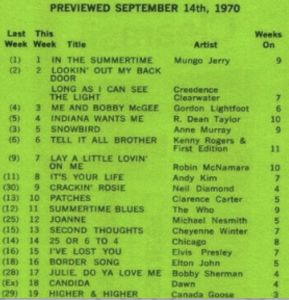
CHED 630-AM Edmonton (AB) | September 14, 1970
Leave a Reply