
#68: Clap Your Hands by Beau-Marks
City: Edmonton, AB
Radio Station: CJCA
Peak Month: March 1960
Peak Position in Edmonton ~ #8
Peak Position in Vancouver ~ #14
Peak Position on Billboard Hot 100 ~ #45
YouTube: “Clap Your Hands”
Lyrics: “Clap Your Hands”
Originally named the Del Tones when they formed in Montreal in 1958, the groups’ first single, called “Moonlight Party”, climbed to #1 in Montreal in May 1959. However, there were other bands with the same name. The Deltones had a single on Vee-Jay Records that was a minor hit in Chicago. That group had a minor hit in Philadelphia on another label in 1960 called “Strollin’ the Blues”. There was also a band from Australia called the Delltones. To avoid confusion, the Del Tones from Montreal changed their name to the Beau-Marks in 1959 in response to a political controversy. Their new name was a pun on the Bomarc, the worlds first supersonic long-range, anti-aircraft missile, developed by Boeing. The development of the Bomarc missile was accompanied by problems with its propulsion system. In 1958 the Conservative Government, led by Prime Minister John Diefenbaker, was faced with two strategies for Canadian air defense. One was to produce the Avro Arrow, a very fast missile at a cost of over 12 Million per aircraft. It was created by the Canadian company, Avro Canada. The other option was to purchase Bomarc missles made by Boeing in Seattle, Washington, for 2 Million. The later missiles would be tipped with nuclear warheads. However, the Conservatives opted eventually not to have nuclear tipped missiles in Canada. With the cancellation of the Avro Arrow, the company lost over 14,000 jobs.
As the missile controversy swirled in the halls of the Canadian Parliament, the Beau-Marks had fun with their version of the missile’s name. Their debut album, The High Flying Beau-Marks, had the Beau-Marks wearing red and blue plaid suit jackets, white collared shirts, black ties and navy blue pants. Smiling in the sun, they stood and squatted on a tarmac in front of a jet plane.
The Beau-Marks were comprised of lead vocalist and guitarist Raymond “Ray” Hutchinson, bass and guitar player Michel “Mike” Robitaille, pianist Joseph “Joey” Frechette and drummer Gilles Tailleur. Born in Montreal, in 1940, as a child, Ray Hutchinson had tuberculosis for twelve years. He got better and at the age of seventeen was writing and performing “Moonlight Party,” that became the Del Tones first hit, prior to the group’s name change. Two of the Beau Marks, guitarist and vocalist Ray Hutchinson, and bass player Mike Robitaille, were polio victims. They met at a school for handicapped children in Montreal.
Hutchinson and Robitaille were among many children and adults stricken with polio. Stars visited polio victims, including the King of Rock n’ Roll, Elvis Presley.
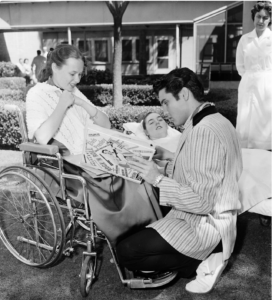
Elvis Presley (above) meets fans with polio in 1957
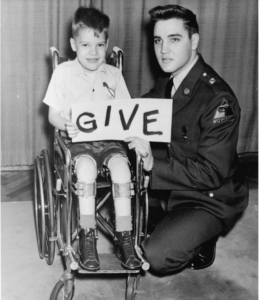
On February 6, 1959, Elvis Presley met with Robert Marquette to launch the
March of Dimes campaign to raise money to combat polio, arthritis and birth defects
The first single credited to The Beau-Marks was “Clap Your Hands”.
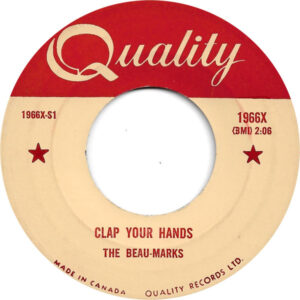
The Beau-Marks recorded and paid for all their recordings. They also wrote all their songs. Initially, they released “Clap Your Hands” without any hand clappers on the recording. Gary Copeland, who knew the group when they recorded in the studio recalls “they were finished, but they had some studio time left. Ray suggested to Joey that they record the Clap your Hands song, but Joey said that nobody would like it. Well, Ray won and the rest is history.” They recorded “Clap Your Hands” twice. The second time they added hand clapping. It was the response to “Clap Your Hands” that got The Beau-Marks bookings in both Manhattan’s Carnegie Hall and Peppermint Lounge’s as well as on American Bandstand. They also were among the first Canadian groups to appear on the Ed Sullivan Show. (The Four Lads had performed a number of times on the Ed Sullivan Show, including on July 11, 1954. And The Crew Cuts had been on Ed Sullivan’s Toast Of The Town on December 12, 1954).
Chick
In “Clap Your Hands”, the Beau-Marks sing “You’ve got the beat, you’re in the groove. Now grab your chick and start to move.” The modern slang where chick refers to a young woman – often implying an attraction, casual interest, or date – emerged from American vernacular in the 1920s. It appeared in black communities and jazz scenes in the 1920s, and into the 1940s. It was first documented in print in Sinclair Lewis’s 1927 novel Elmer Gantry: “He didn’t want to marry this brainless little fluffy chick.” [The novel tells the story of the young, womanizing college athlete, Elmer Gantry, who abandons an early ambition to become a lawyer. After college, he attends a Baptist seminary, and is ordained as a minister. He successfully hides sexual involvements that are prohibited.] Beatnik culture in the late 1950s helped popularize the usage of chick further (e.g., references to “beatniks and their chicks”).
The Bop
“Clap Your Hands” reminds listeners “You’ve danced the Bop, and done the Stroll.” The Bop dance style derived from the Jitterbug and East Coast Swing in the 1950s. But it is not to be confused with the Bop a Lindy-based partner dance that was done by all ages in the black community started in the 40s. The ‘Bop’ term actually comes from Be-Bop jazzy tunes from the ’40s. However, it was not danced to Be-bop but to much faster rockabilly, and rock ‘n’ roll songs of the era like those of Gene Vincent [“Be-Bop-A-Lula”]. The Bop was the first rock and roll dance introduced on American Bandstand in the summer of 1957 by a visiting teenagers to Philadelphia from California. American Bandstand held a Rock ‘N Roll Bop National Teen Dance on their TV show. The Bop used many of the same moves as swing, including partners moving around each other, but was usually done with almost no touching and much, much faster. The Bop’s more carefree, Charleston jumpy-like moves and independent dance style also encouraged dancers to go solo. Dancing the bop entailed jumping up and down as if on a pogo stick and grinding your heels into the floor each time you landed.
The Stroll
One of the most popular dances of the 50s, the Stroll was a dance popularized on American Bandstand. The stroll was introduced on the show by Chuck Willis. The Stroll is a group dance dance done in two parallel. lines , with boys on one side the girls on the other, facing each other. The basic step is a 12-count movement phrase, which is actually a 6-count phrase simply repeated on the other side. the boys start with the left foot, the girls with the right. beginning with the feet together, the boy’s side with a left diagonal step ( count 1)and then with a touch of the left foot as it drags as it drags back into place next to the right (count). Next comes a forward diagonal step out onto to the left (count 3) followed by a step onto the right that as it cuts tightly behind the left (count 4) The phrase finishes with a step to the side with the left foot (count 5) and a tough, next to it with the right (count 6). The entire sequence is then repeated with the right foot
The other element is the solo stroll by each couple. While the two lines perform the basic step, a couple formed from the boy and girl at the far end of the line ( the end that is towards the boy’s right and the girl’s left) dances together down the middle. The pair can then take the opportunity to improvise their steps or execute a forward traveling variation of the basic Stroll step. When the couple reaches the end of the lane, they split apart and replace the boy and girl at the end of the line., as a new couple forms at the opposite end.
How to Stroll
The basic move for the Stroll gradually moves the dancer, foot by foot, up the line until he gets to the very front, at which point the two partners abandon the basic and do their own “shine” dance down the center aisle with everyone clapping and appreciating them.
For Him
Step forward on your left foot. Slide your right foot up even. Move your right foot to the right. Slide your left foot over to meet it. Step back on your right foot.
Slide your left foot back to meet it. Move your left foot to the left. Slide your right foot over to meet it and return to the original position.
For Her
Step back on your right foot. Slide your left foot back even. Move your left foot to the left. Slide your right foot over to meet it. Step forward on your left foot.
Slide your right foot forward to meet it. Move your right foot to the right. Slide your left foot over to meet it and return to the original position..
Conga Rock
The Beau-Marks also contend that by 1960 when “Clap Your Hands” was released, that “the Conga-rock is getting old.” The Conga-rock combined the conga line formation (dancers in a single file, holding the waist of the person in front, with a basic step-kick rhythm) with rock ‘n’ roll energy — more bouncy, improvisational, and “rocking” than the traditional Latin conga. Panama Francis released an instrumental that teens did the Conga-rock to in 1958-59.
The Most
As well, in “Clap Your Hands”, The Beau-Marks sing “This is the dance that is the most.” In the 1950s, the most was slang for ‘You’re the greatest,” “You’re amazing,” “You’re the best.” It was commonly used as a compliment like calling someone attractive, cool, or exceptional. Similar slang phrases to “the most” included telling someone you’re a “cool cat,” a “dreamboat,” “sharp,” or “the ginchiest.”
At the end of the song, The Beau-Marks sing “Don’t go away”, and then wait for a second of silence, before picking up the melody and singing “Let’s get together once again…”
Hand clapping
There were numbers of pop songs in the 1950s that included hand clapping. These include
“Rockin’ Robin” by Bobby Day
“Susie Q” by Dale Hawkins
“Little Bitty Pretty One” by Thurston Harris
“Buzz Buzz Buzz” by the Hollywood Flames
“Let’s Go, Let’s Go, Let’s Go” by Hank Ballard & the Midnighters
“Shake, Rattle and Roll” Big Joe Turner and his Blues Kings
“Honey Hush” by Big Joe Turner and his Blues Kings
“Hound Dog” by Elvis Presley
“Hand Clappin'” by Red Prysock
“Runaround Sue” by Dion
“A Lover’s Question” by Clyde McPhatter
“Short Shorts” by the Royal Teens
“Tallahassee Lassie” by Freddy Cannon
“Quarter To Three” by Gary U.S. Bonds
(and many others)
Hand claps were a way to punctuate a song and add energy to the beat.
“Clap Your Hands” peaked at #2 in Chicago, and Utica (NY), #3 in San Bernardino (CA), Seattle, and Fort Dodge (IA), #4 in La Crosse (WI), Waterloo (IA), Oklahoma City, and Albany (NY), #5 in Wheaton (MD), Davenport (IA), Baton Rouge (LA), and Des Moines (IA), #6 in Jacksonville (Florida), and Potsdam (NY), #7 in Duluth (MN), Shreveport (LA), and Troy (NY), #8 in Edmonton (AB), Dallas, Minneapolis/St. Paul, and Los Angeles, #9 in Rochester (NY), and Kansas City (MO), #10 in Calgary, Omaha (NE), and Akron (OH), #11 in Birmingham (AL), and Phoenix, #12 in Buffalo, and Kalamazoo (MI), #13 in Ventura (CA), and #14 in Vancouver (BC), San Francisco, and Toronto.
“Clap Your Hands” climbed to #1 in Australia for four weeks in August 1960. In the USA “Clap Your Hands” peaked at #45 on the Billboard Hot 100 and #40 on the Cashbox Top 100 Singles chart.
The Beau Marks debut album contained a dozen tracks, five of which would be released on 45 RPM singles. The first four of these were “Clap Your Hands,” “‘Cause We’re In Love”, “Billy, Billy Went A Walking” and “Oh Joan” released through 1960. “Moonlight Party”, which was released as a single in 1959 by the Del Tones, also was a track on The High Flying Beau-Marks.
The second single from The High Flying Beau-Marks was “Billy, Billy Went A Walking”. The Beau Marks second album had no hit singles. However, their third album, The Beau Marks, included five single releases. (The spelling in the album created some ongoing confusion regarding whether or not to include a hyphen in the group’s name). The first single release from this album was “Classmate”. It was ready for the record buying public in June 1961.
From The Beau Marks album, there were other single releases. “Yours” climbed to #18 in Vancouver in October 1961. “Little Miss Twist” saw the group trying to cash in on the twist craze, and it climbed to #15 in Vancouver in January 1962. The 1930’s standard, “Summertime” was a B-side to the commercial failure, “Clap Your Hands Once Again”, in April 1962. A final single release from their self-titled third album was “The Tender Years”. Though the song didn’t chart in Vancouver, it made the Top 20 on CHUM in Toronto in the summer of ’62.
At the peak of their popularity in 1960, the Beau Marks appeared on American Bandstand and the CFTO (Toronto) show Hi-Time. They also did some touring in the USA which included a gig at Carnegie Hall in New York City. After releasing their three albums in the early sixties the group split coinciding with the British Invasion.
In 1963 Ray Hutchinson joined Dave Nichol and The Coins. Eventually Hutchinson became a lounge act, as well as owning a restaurant in Montreal called Le Sentiment where he also performed. Ray Hutchinson died on October 31, 2021.
Gilles Tailleur lost his life in 1976 at the age of 35 from a cerebral hemorrhage.
Mike Robitaille went on build a career in video production. According to Grok, he is deceased.
Lastly, Joey Frechette became the CEO of Capitol Records’ April Blackwood publishing. From there he moved on to work as a program director at CHOO radio in Ajax, Ontario. He released his own version of “Clap Your Hands” in 1987 billing himself as Joey Conrad. Frechette died on December 19, 2021.
August 10, 2026
Ray McGinnis
References:
Gary Copeland, The Beau-Marks/Ray Hutchinson, Russ & Gary’s “The Best Years of Music,”August 1, 2010.
The Beau-Marks bio, Rockabilly.nl.
The Beau-Marks, The Canadian Encyclopedia.ca.
Ray Hutchinson bio, Ray Hutchinson.tripod.com.
Don McBrearty, The Arrow, Tapestry Pictures/CBC, 1996.
Sh-Boom, Wikipedia.org.
The Ed Sullivan Show (1948-1971), Episode 7.43, July 11, 1954, IMDb.com.
Cashbox Top 100 Singles, July 2, 1960, Cashbox Magazine, USA.
Number One Singles of 1960 (Canada), CHUM charts, Wikipedia.org.
Rick Jackson. Encyclopedia of Canadian Rock, Pop and Folk Music. Quarry Press, 1994.
Email from local music reporter, Richard Skelly, January 30, 2019.
Greg Davis, “Ray Hutchinson of The Beau-Marks, one of Canada’s first rock ‘n’ roll bands, dead at 81,” Global News, November 2, 2021.
Jeffrey Tucker, “The Polio Pandemic of 1949-52: No Closures, No Restrictions,” Brownstone.org, September 12, 2021.
“Dancing in the 50s and 60s,” History of Rock.
“1950s slang,” Fiftiesweb.com.
Panama Francis, “Conga Rock“, Warner Brothers Records, 1959.
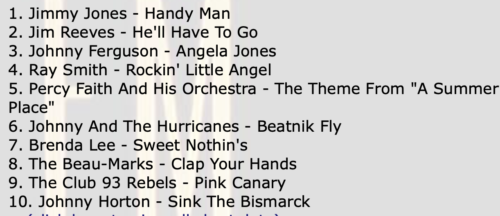
CJCA 930-AM Edmonton (AB) Top Ten | March 26, 1960
Leave a Reply