
#34: Fashion Victim by Rough Trade
City: Regina, SK
Radio Station: CJME
Peak Month: February 1981
Peak Position in Regina ~ #6
Peak Position in Vancouver ~ did not chart
Peak Position on Billboard Hot 100 ~ did not chart
YouTube: “Fashion Victim”
Lyrics: “Fashion Victim”
Kevan Staples was born in Toronto, Ontario, in 1950. His parents were musicians and artists. Carole Pope was born in Manchester, UK, also in 1950. Her father was a stilt walker and her mother a music hall performer. The Popes moved from Manchester to Montreal in 1955. They later moved to Toronto. Growing up, Carole studied sculpture. Kevan Staples and Carole Pope met at an audition in 1968 for Deva Loca Sideshow, a band that never ended up forming. In 1969, Staples and Pope began performing as a folk duo named O. They appeared in clubs in Toronto’s Yorkville neighborhood. In the 1960’s, Yorkville showcased the hippie movement for the rest of Canada, at least on the TV news. Yorkville was hyped as a magnet for intellectuals, artists and musicians. Writers, Margaret Atwood and Gwendolyn MacEwan, and singer-songwriters Gordon Lightfoot, Joni Mitchell and Neil Young were all part of the scene. Staples and Pope subsequently formed the Bullwhip Brothers in 1971. Finally, they changed their name to Rough Trade in 1974. O, Bullwhip Brothers and Rough Trade each drew on sexual satire, the latter from gay male iconography. In 1976, Carole Pope appeared in a concert titled Torch Showcase at a venue named A Space, in Toronto. She performed “The One Who Really Loves You” by Mary Wells and “You’re My World” by Cilla Black.
Rough Trade released their first album in 1977, Rough Trade Live!, which was actually a studio album. That year, remake impersonator and gay icon, Divine, came to Toronto to promote Rough Trade in a concert titled Restless Underwear in Massey Hall. In 1978, Staples and Pope wrote music for a film titled One Night Stand. The pair won a Genie Award for Best Film Score. In 1979 the band recorded the single, “Shakedown”. It was featured in the film, Cruising, starring Al Pacino. The controversial movie was about a serial killer of gay men, especially associated with the leather scene. The word cruising had several meanings: police on patrol duty and the act of walking or driving in a locale known for anonymous sexual pick-ups. Gay rights groups at the time picketed movie theatres showing a film they perceived as stigmatizing gay men. Having “Shakedown” featured in the film added an edge to Rough Trade’s persona.
According to Joseph Levy on the laventure.net website, Rough Trade toured in Canada, a few cities in Australia, Europe and New York. In his 1993 book, Not Simply Divine, Jay Bernard, manager for gay icon Divine, recalled the catastrophe of a concert on February 14, 1980. The show was at the Beacon Theatre on West Broadway on Manhattan’s Upper West Side. Rough Trade was the opening act in a show billed as “DIVINE in RESTLESS UNDERWEAR.” After the 1977 event with Divine and Rough Trade in Toronto, Staples and Pope wanted to team up with Divine in New York to have a repeat of Restless Underwear. Divine’s contract specified that he would only perform for seven minutes and have ten male dancers on stage with him. While his performance was a hit, the audience naturally expected more. Jay Bernard described the scene at the Beacon Theatre: “The theatre was full of gay men, all of whom had obviously come to see this new comedy… The sound system installed for the evening was totally inadequate and the audience couldn’t’t even hear the feeble attempts at sketches… They booed and hissed at poor Carol [sic] Pope and Rough Trade, who really didn’t stand a chance for success the way the promoters had advertised the event. When, in the second part of the show, Divine performed his two songs with his male chorus line, he received a standing ovation, which only made things worse as [he] had nothing to follow it with–and the audience’s frustration, quickly turning into anger, was therefore increased. The promoters were swamped in the intermission with demands to return ticket money. Many in the audience had left before the final set from Rough Trade. Divine fled back to his home…”
In 1980, Rough Trade released their second album titled Avoid Freud. The album’s first single, “What’s the Furor About the Fuhrer?”, was a hit in some radio markets in Ontario. However, the B-side, “Fashion Victim”, cracked the Canadian RPM Top 40.
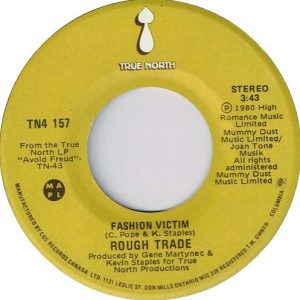
Pope and Staples wrote “Fashion Victim”. In it they declare, “we’re all victims of fashion and accessories.” The song is told from the perspective of someone who is on the receiving end of complaints from their romantic partner. First off, they complain the singer is “lacking in passion,” and is “a narcissist.” The singer responds, they’re just image conscious and being true to themselves. Secondly, the partner complains about her “avant-garde friends.” Thirdly, they want to be seduced. However, she protests that if she takes off her clothes “my carefully contrived image goes. I’m so afraid to show the real me.”
The singer lists some of the fashion designers they’re victims of: Montana, Fendi, Lagerfeld, Mugler, Kenzo, Chloé, Maud Frizon, Yamamoto, Rykiel, Daily, Blue, Zapata, Kamali, Dorthy Biś, Yaki, Torii, Pinky and Diane.
Claude Montana was also nicknamed “King of the Shoulder Pad,” designing aggressive silhouettes which came to define the ‘power-dressing’ era of the 1980s. Montana was born in Paris in 1947. The House of Montana was founded in 1979.
The house of Fendi was launched in 1925 by Adele and Edoardo Fendi (1904–1954) as a fur and leather shop in Via del Plebiscito, Rome. In 1932 Adele and Edoardo Fendi opened a boutique in via Piave; the shop became a popular destination for tourists in Rome.
Karl Lagerfeld was born in Hamburg in 1933. Lagerfeld began his career in fashion in the 1950s, working for several top fashion houses including Balmain, Patou, and Chloé, before joining Chanel in 1983. As the creative director of Chanel from 1983 until his death, he oversaw every aspect of the fashion house’s creative output, from designing collections to photographing advertising campaigns and arranging store displays. He was instrumental in revitalizing the Chanel brand, helping it regain its position as one of the top fashion houses in the world.
Thierry Mugler was born in 1948 in Strasbourg, France. In the 1970s he launched his eponymous fashion house; and quickly rose to prominence in the following decades for his avant-garde, architectural, hyperfeminine and theatrical approach to haute couture. He created outfits for Michael Jackson, Madonna, Grace Jones, Duran Duran, David Bowie, Diana Ross and others. The dress he created for Demi Moore in the 1993 film Indecent Proposal was called “the most famous dress of the 1990s.”
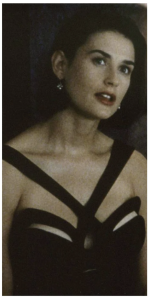
Demi Moore in Indecent Proposal
Kenzō Takada was born in Japan in 1939. He moved to France in 1965, and opened a designer shop in 1970. He soon caught the attention of fashion magazine Elle and never looked back. At first he designed clothes for women. In 1984, he expanded to men’s fashion and several years later to children’s fashion. His brand has expanded to perfumes and skincare products.
Chloé is a luxury fashion house founded in 1952 by Gaby Aghion. In 1953, Aghion joined forces with Jacques Lenoir, formally managing the business side of the brand, allowing Aghion to purely pursue the creative growth of Chloé. Its headquarters are located in Paris. Among its customers have been Jacqueline Kennedy, Brigitte Bardot, Maria Callas, Grace Kelly, Natalie Portman, Kirsten Dunst and others. Angelina Jolie has collaborated with the fashion house to launch Atelier Jolie.
Maud Frizon de Marco was born in 1941 in Paris. She opened her first shoe boutique in 1969, after working in some of the leading houses of fashion that sold shoes. She was at the height of her success in the 1980s.
Yohji Yamamoto was born in Tokyo in 1943. Yamamoto debuted a collection of women’s clothing in Tokyo in 1977, followed by two more shows; a debut in Paris in 1981 and in New York in 1982. His first collection under the label Y’s, focused on a collection for women that reflected typical men’s garments, with clothes cut in uncluttered shapes with washed fabrics and dark colors.
Sonja Rykiel was born in Neuilly-sur-Seine, France, in 1930. She was born to Jewish parents. In 1948, at the age of 17, she was employed to dress the window displays in a Parisian textile store, the Grande Maison de Blanc. In 1962, unable to find something to wear during her pregnancy, Rykiel used an Italian clothing supplier to design and create a dress and a sweater, which incorporated high cut arm holes and a shrunken fit to cling to the body. The practical and modern style led to orders from her friends and became known as the Poor Boy Sweater. Rykiel started selling the sweaters from her husband’s store and the Poor Boy Sweater made the cover of French Elle magazine, bringing Rykiel fame.
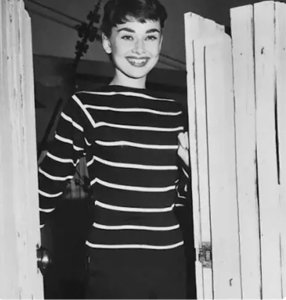
Poor Boy sweater
Actress Audrey Hepburn bought 14 sweaters in every colour. She created the Sonia Rykiel Company in 1965. In 1968, Rykiel opened her first boutique store on the Left Bank. She was the first designer to put seams on the outside of a garment, leave hems unfinished and use slogans on her sweaters.
Dorothee Bis is a French ready-to-wear line. It got its start in 1958 when Elie Jacobson opened a boutique, Dorothee. In 1962 Jacobson and wife Jacqueline opened Dorothee Bis, which was geared toward a young market, much in the line of the way London designers were beginning to take notice of the youth market.
Yuki Torii made her debut as a fashion designer in Tokyo in 1962. She broke into the Paris fashion scene in 1975. Diane von Fürstenberg was born in 1946 in Brussels, Belgium. She initially rose to prominence in 1969 when she married into the German princely House of Fürstenberg, as the wife of Prince Egon von Fürstenberg. Following their separation in 1972 and divorce in 1983, she continued to use his family name. Her fashion company, Diane von Furstenberg (DvF), is available in over 70 countries and 45 free-standing shops worldwide.
Truly. It can be expensive to keep up with the latest fashions, and accessories, just to be current. But, if you have the means, you’ll be sure to keep up with the latest fashions.
In 2022, a film was released titled Mrs. Harris Goes to Paris. Starring Lesley Manville, the film is based on a historical novel set in London in 1957. Mrs Ada Harris, a widow, works as a cleaning lady. Though she is hardworking and generous, Ada’s clients offer her little consideration in return. She has two close friends in Vi and Archie, both her own age.
Ada becomes obsessed with a client’s haute couture Dior dress and longs for a similar dress of her own. After unexpectedly receiving a war widow’s pension, she travels to Paris to try to purchase one. She stumbles into a showing of Dior’s 10th-anniversary collection and is befriended by André, the Dior accountant, and Natasha, a Dior model. However, the Dior director, Claudine, resents Ada’s intrusion into the exclusive world of haute couture and initially declines to accept Ada as a client. Fortunately for Ada, Dior has fallen on hard times and the company eventually agrees to accept a commission for payment in cash.
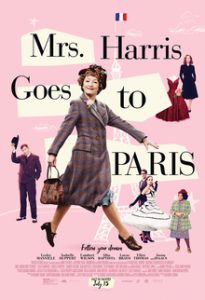
There are some unexpected twists and turns in the plot, and finally Mrs. Harris gets a designer dress.
“Fashion Victim” peaked at #6 in Regina (SK), #8 in Ottawa, #10 in Toronto, #12 in Hamilton (ON).
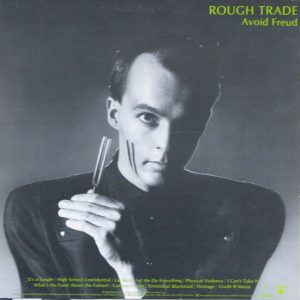
Kevan Staples photo on Avoid Freud album
Their second single from the album was titled “High School Confidential”.
In the early 1980’s Pope was in a relationship with British pop singer, Dusty Springfield, according to Pope’s autobiography, Anti-Diva. Rough Trade went on a final tour in 1986 before splitting up. Their last show of the tour was in Montreal. The show had to stop when a curtain burst into flames. After the flames were put out Rough Trade finished the show. But it was hard to top the flaming curtain for spectacle.
As a member of the LGBTQ community, Carole Pope has lent support to various efforts within the “Gay Rights” movement. Pope has been an Ambassador for the Harvey Milk High School, established in 1985 in New York City. The school, named after the San Francisco Board of Supervisors member Harvey Milk. Milk was the first openly gay person to run for, and be elected, to public office in America. He won his election to on November 8, 1977. Harvey Milk was assassinated on November 27, 1978. His killer was San Francisco Board of Supervisor Dan White. On November 10, the 32-year-old White, a Vietnam War veteran, had resigned his position on the Board. White also killed Mayor George Moscone that same afternoon at the San Francisco City Hall.
The Harvey Milk High School was an effort to provide a safe space for students who in the mid-1980’s were identifying themselves as gay, lesbian or bisexual. In view of bullying of students attracted to the same gender, the New York City Department of Education established a first for school boards in America. In 2009 California Governor, Arnold Schwarzenegger, signed a law establishing an annual Harvey Milk Day on May 22 for the state of California. Harvey Milk was born on May 22.
Since Rough Trade disbanded in 1988, Kevan Staples has composed music for many commercials as well as TV and film documentaries. In 1999, playwright Bryden Macdonald wrote a musical revue about Rough Trade called Shaking the Foundations. It was performed at Toronto’s Buddies in Bad Times Theatre, a company dedicated to “the promotion of queer theatrical expression.”
In 1989, Carole Pope moved to Los Angeles. Though she has lived at times back in Toronto in the years since. She moved back to California in the early 2000s, and took part in a California AIDS ride, cycling from San Francisco to Los Angeles. In 2001, Carole appeared in a Toronto production of the Off-Broadway play The Vagina Monologues. The play comprised of a series of monologues about different experiences of being female. These subjects included giving birth, love, sex, witnessing the birth of a granddaughter, rape, menstruation, masturbation, female genital mutilation and orgasm.
On March 29, 2018, Carole Pope was scheduled to perform along with the Barenaked Ladies at a concert in support of the LGBTQ community in Toronto. The occasion was in the aftermath of charges brought by the Toronto Police against landscaper Bruce McArthur, the alleged serial killer of eight gay men. The concert was intended as a vigil for the LGBTQ community in the wake of the arrest, and to celebrate the resilience of the community. However, the concert was cancelled when some people felt it was not appropriate to have a concert in the middle of an investigation.
On July 15, 2018, Carole Pope appeared at the Vancouver International Folk Festival playing an alternate rock music set that evening. She had been expected to appear at a workshop stage at 12:40 p.m. hour long concert, taking turns performing songs along with Wallis Bird and Skye Wallace. However, Pope was a no show. She explained later that night that something had gone wrong with her health and she had to go to the hospital. She was given something that day that made her high she told a receptive crowd.
January 23, 2026
Ray McGinnis
References:
Brad Wheeler, “What Carole Pope Loves (and doesn’t love) About Living in Los Angeles,” Globe and Mail, Toronto, March 27, 2018
2010–2017 Toronto Serial Homicides, Wikipedia.org
Carole Pope – Vancouver Folk Music Festival, July 15, 2018
Rudy Blair, “Interview: Carole Pope Discusses Documentary on Her Life,” CKNW 1130, Vancouver, BC, June 26, 2014
Linda L. Richards, “Auntie Diva: An Interview with Carole Pope,” January Magazine, January 2001.
Charlotte Robinson, “Carole Pope Talks New EP Music for Lesbians and LGBT Equality,” Huffington Post, August 14, 2014
Jason Clevett, “Carole Pope: Anti-Diva Still Trades Rough,” Gay Calgary.com, Calgary, Alberta, March 2007
Joseph Levy, “A Brief History of Rough Trade With Carole Pope and Kevan Staples,” Laventure.net, December 2014.
Carolyn Twersky Winkler, “R.I.P. Claude Montana, ’80s Fashion Titan and Master of Power Dressing, Dies at 76,” W Magazine, February 23, 2024.
Sonia Rykiel, “‘I could no longer keep my illness secret’,” Guardian, August 5, 2012.
“Karl Lagerfeld, iconic Chanel fashion designer, dies,” BBC, February 19, 2019.
“The Philosophy of a Living Fashion Design Legend: Yohji Yamamoto,” Spectr, December 6, 2017.
Sarah White, “Japanese fashion designer Kenzo Takada dies from COVID-19,” Reuters, October 4, 2020.
“French fashion designer Thierry Mugler dies aged 73,” Guardian, January 24, 2022.
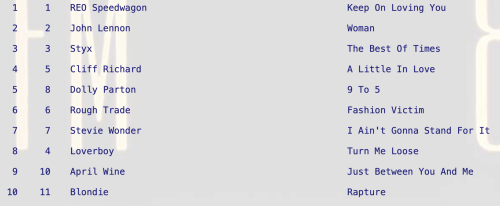
Top 30 CJME 1300-AM Regina (SK) February 27, 1981
Leave a Reply