
#78: Forty Days by Ronnie Hawkins
City: Toronto, ON
Radio Station: CHUM
Peak Month: July 1959
Peak Position in Toronto ~ #4
Peak Position in Vancouver ~ #44
Peak Position on Billboard Hot 100 ~ #45
YouTube: “Forty Days”
Lyrics: “Forty Days”
Ronnie Hawkins was born in Huntsville, Arkansas, on January 10, 1935, two days after Elvis Presley. Hawkins’ mother was a teacher; his father, a barber. Known affectionately over the years as “Mr. Dynamo,” “Sir Ronnie,” “Rompin’ Ronnie,” and “The Hawk,” Hawkins’ love of music started in high school. He formed the first version of his band The Hawks while studying at the University of Arkansas in the 1950s. Ronnie remembers, he’d commandeer an old gas station on Dickson street for rehersals. “We’d unplug their outside Coke machine and plug in our instruments,” Hawkins said. “They had the warmest Cokes in town.” In 1958, on the recommendation of Conway Twitty – who considered Canada to be the promised land for a rock’n roll singer – Hawkins came to Hamilton, Ontario to play a club called The Grange. He never left. Adopting Canada as his home, Hawkins became a permanent resident in 1964. In 1958 he released his first single, “Hey, Bo Diddley”.
This was followed the next year by “Mary Lou”. “Mary Lou” turned Hawkins into a teenage idol, along with his next single release in 1959, “Forty Days”.
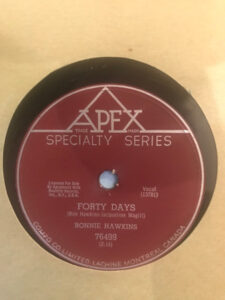
In 1955, Chuck Berry wrote “Thirty Days (To Come Back Home)”. The single reached #2 on the Billboard Rhythm and Blues chart in 1955. It was Berry’s followup to his debut smash hit “Maybellene”. When Ronnie Hawkins covered the song he gave it the title “Forty Days”. In the song the narrator is giving his woman 40 days to get back home. In the meantime, he’s going to call a gypsy woman on the telephone. He’ll get her to create a “worldwide hoodoo.” “Hoodoo is an African American-based tradition that makes use of natural and supernatural elements in order to create and effect change in the human experience. It is an effort to conjure up something for protection, or resistance against something (for example: slavery). Hoodoo can also be used to cast spells. In addition to seeking out a gypsy woman, the narrator wants to get help from the local judge who almost got him in touch with the local sheriff. The consequences of his woman not returning home in 40 days are left to the listeners imagination.
Chuck Berry was born in 1926 in St. Louis, Missouri. He learned to play guitar in high school and performed his first concert at his public school. However, while still a high school student, he was convicted of armed robbery and was sent to a reformatory, where he was held from 1944 to 1947. After his release, Berry settled into married life and worked at an automobile assembly plant. By early 1953, influenced by the guitar riffs and showmanship techniques of the blues musician T-Bone Walker, Berry began performing with the Johnnie Johnson Trio. His break came when he traveled to Chicago in May 1955 and met Muddy Waters, who suggested he contact Leonard Chess, of Chess Records. With Chess, Chuck Berry recorded “Maybellene”—Berry’s adaptation of the country song “Ida Red”—which sold over a million copies, reaching number one on Billboard‘s rhythm and blues chart. It also reached #5 on the Billboard pop chart.
Berry followed up with more R&B hits including “Roll Over Beethoven” in 1956. In 1957, he had more crossover R&B to pop Top Ten hits. These included “School Days”, “Rock and Roll Music”, “Johnny B. Goode”, and “Sweet Little Sixteen”.
By the end of the 1950s, Berry was an established star, with several hit records and film appearances and a lucrative touring career. He had also established his own St. Louis nightclub, Berry’s Club Bandstand. He was sentenced to three years in prison in January 1962 for offenses under the Mann Act—he had transported a 14-year-old girl across state lines for the purpose of having sex. After his release in 1963, Berry had several more successful songs that year and in ’64. These included “No Particular Place to Go”, “Nadine” and “You Never Can Tell”. Chuck Berry had one final hit, “My Ding-A-Ling”, which reached #1 in 1972 on the pop charts in Canada, Ireland, the UK, and USA, and #7 in Norway, and #19 in New Zealand. He continued to perform until 2017 when he died at the age of 90 in March of that year. At the time of his death, Chuck Berry was recording his final and twentieth album, Chuck. It reached the Top Ten on the pop charts in New Zealand, Scotland, and the UK.
“Forty Days” peaked at #4 in Toronto, and Wheaton (MD), #7 in North Platte (NE), #10 in Albany (NY), and #13 in Columbus (OH).
The song was covered in the early sixties by both Cliff Richard, and also Bill Black and His Combo.
In 1959, Morris Levy signed Hawkins to Roulette Records for five years. Levy tried to lure him back to the United States, but Hawkins had fallen in love with Canada and didn’t want to leave his new home.
In 1960 Hawkins had a Top Ten hit in Toronto with “Southern Love”. He repeated Top Ten success in southwestern Ontario in 1963 on the powerful CHUM 1050 AM radio with a cover of “Bo Diddley”. He was again in the Top Five on CHUM in 1965 with “Bluebirds Over The Mountain”. In January 1968 “Home From The Forest” became a #1 hit for Hawkins in Vancouver.
Over the years Ronnie Hawkins gained recognition for recruiting and grooming outstanding Canadian talent. The membership of his band, The Hawks, kept changing as the talent flowed in and out, but the name stayed the same. One edition of The Hawks (with Canadians Richard Manuel, Garth Hudson, Rick Danko, and drummer Levon Helm) moved on to become Bob Dylan’s backup band and recorded with Dylan on Blonde On Blonde, Self Portrait and The Basement Tapes.
Later the Hawks achieved superstardom as The Band, recording “Up On Cripple Creek”, “The Weight” and other memorable songs. Another incarnation became Janis Joplin’s Full Tilt Boogie Band, and another Robbie Lane and the Disciples. Other famous Hawk alumni include David Clayton Thomas of Blood Sweat and Tears, actor Beverly D’Angelo, musician Lawrence Gowan, and fellow Canadian Music Hall of Fame inductees Burton Cummings and David Foster.
At the height of the 1960s peace movement, Hawkins invited John Lennon and Yoko Ono to his Ontario farm to plan a peace festival during the couple’s peace crusade. John Lennon signed his erotic “Bag One” lithographs during his stay at Hawkins’ farm. He also accompanied them on the train to Ottawa in December 1969 for Lennon and Ono’s famous visit with Prime Minister Trudeau. Hawkins later toured the world at Lennon’s request as a peace emissary for Lennon’s “Love Not War” message.
In the midst of Ronnie Hawkins’ political activism with John Lennon and Yoko Ono, Hawkins released the single, “Down In The Alley”. It was a Top Ten hit in Vancouver (BC) in March 1970. By 1970 Ronnie Hawkins was at the twilight of his appeal on the pop charts. However, he began to chart eight singles on the Canadian country charts in 1970, his last climbing the country charts in 1995.
Hawkins won a Juno for best Country Male Vocalist in 1984 for his hit, “Making It Again”. In 1989, Ronnie was reunited with The Band at the concert marking the destruction of the Berlin Wall. In 1992, he performed at the inaugural party of former President Bill Clinton, one of The Hawks’ biggest fans. That same year he received another Juno Award nomination. Hawkins has also performed in a handful of films including, The Last Waltz (with The Band), Heaven’s Gate (with Kris Kristofferson) and Renaldo & Clara (which Bob Dylan produced). Ronnie Hawkins released his 27th album Still Cruisin’ in Canada in 2002. In 2013 Hawkins received the Order of Canada for his many contributions to culture through his music.
November 7, 2026
Ray McGinnis
References:
“Ronnie Hawkins Biography,” Ronniehawkins.com.
Lennon and Ono’s famous visit with Prime Minister Trudeau, Beatles Bible.com
Bed-ins for Peace, Wikipedia.org
Martin Scorsese, The Last Waltz, United Artists, 1978.
Michael Cimino, Heaven’s Gate, United Artists, 1980.
“Chuck Berry, Father of Rock ‘n’ Roll, Dies at 90,” NBC, March 18, 2017.
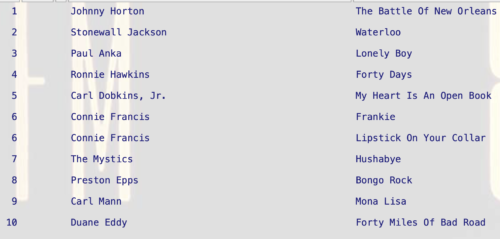
“CHUM Hit Parade” | CHUM 1050-AM Toronto (ON) | July 6, 1959
Leave a Reply