
#31: Happiness Street (Corner Sunshine Square) by Tony Bennett
City: Halifax, NS
Radio Station: CJCH
Peak Month: October 1956
Peak Position in Halifax ~ #6
Peak Position in Vancouver ~ #3
Peak Position on Billboard Hot 100 ~ #38
YouTube: “Happiness Street (Corner Sunshine Square)”
Lyrics: “Happiness Street (Corner Sunshine Square)”
Anthony Dominick Benedetto was born in New York City in 1926. His parents were grocer John Benedetto and seamstress Anna (nee Suraci), and he was the first member of his family to be born in a hospital. Both parents had come from the Calabria region in southern Italy. With a father who was ailing and unable to work, Anthony and his brother and sister grew up with their parents in poverty. Anthony had an uncle in vaudeville who inspired him as a young child to consider entertaining as a career. By age 10 Anthony was already singing, and performed at the opening of the Triborough Bridge, standing next to Mayor Fiorello La Guardia who patted him on the head. He began singing for money at age 13, performing as a singing waiter in several Italian restaurants around Queens. Though he had an aptitude to study painting and music, he dropped out at age 16 to help support his family. He worked as a copy boy and runner for the Associated Press in Manhattan and in several other low-skilled, low-paying jobs. Anthony mostly set his sights on a professional singing career, returning to performing as a singing waiter, playing and winning amateur nights all around the city, and enjoying a successful engagement at a nightclub in Paramus, New Jersey.
Benedetto was drafted into the United States Army in November 1944. As an infantry rifleman, he served on the front lines as the Allies reached the Danube River. He also took part in the liberation of the Kaufering concentration camp, a sub-camp of Dachau. This turned the young soldier into a pacifist. He later wrote, “Anybody who thinks that war is romantic obviously hasn’t gone through one.” Adding of his WWII fighting experience, “It was a nightmare that’s permanent. I just said, ‘This is not life. This is not life.'” He escaped death on several occasions. He later wrote in his autobiography of the liberation of the concentration camp, “I saw things no human being should ever have to see.”
Benedetto stayed in Germany as part of the occupying force, but was assigned to an informal Special Services band unit that would entertain nearby American forces. He dined with a black friend from high school—at a time when the United Staes Army was still racially segregated. Consequently, he was demoted and reassigned to Graves Registrations Service duties. Subsequently, he sang with the 314th Army Special Services Band under the stage name Joe Bari.
After he was discharged from the Army in 1946, he returned to America. Benedetto developed an unusual approach that involved imitating, as he sang, the style and phrasing of other musicians—such as that of Stan Getz’s saxophone and Art Tatum’s piano—helping him to improvise as he interpreted a song. He made a few recordings as Joe Bari in 1949 for an independent label called Leslie Records, but they failed to sell.
In 1949, Pearl Bailey was taken with his singing style and arranged for him to open for her show. Bob Hope heard Anthony Benedetto perform and took him on tour, shortening his name to Tony Bennett. In 1949, Bennett recorded a demo of the 1930s pop standard “Boulevard of Broken Dreams”. On the strength of the recording, Mitch Miller signed Bennett to Columbia Records. “Boulevard of Broken Dreams” was later included as a track on Tony Bennett’s debut album in 1952, Because of You.
In 1951, the war drama I Was an American Spy featured the song “Because of You”, a number-one pop standard for Larry Clinton and His Orchestra in 1941. The film had its general release on April 7th.
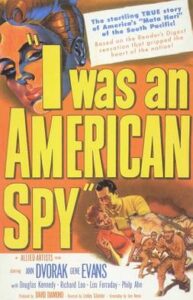
In I Was an American Spy Ann Dvorak sings “Because of You”
Meanwhile, Columbia Records learned that “Because of You” was including in the film. This inspired the record company to have Tony Bennett record the tune which was released on April 4, 1951. “Because of You” became his first hit, climbing to number-one on Billboard magazine’s Best Sellers in Stores list from September 8th. It remained there for eight consecutive weeks until October 27, 1951. It was also atop the Billboard Honor Roll of Hits chart for ten weeks from September 8th to November 10th. It also topped the pop chart in Australia. “Because of You” was knocked off the Best Sellers in Stores top position by Bennett’s second number-one single “Cold, Cold Heart”. It remained there for six weeks until December 8, 1951. “Cold, Cold Heart” was also a number-one hit in Australia.
As well in 1951, Tony Bennett released the original version of “Blue Velvet” that peaked at #16. It was later a number-one hit for Bobby Vinton in 1963. Though Al Martino had a number-one hit in 1952 with “Here In My Heart”, Tony Bennett was one of several crooners who covered the song. His cover reached #16.
In 1953, Tony Bennett had his third number-one hit titled “Rags to Riches”. The song was based on a famous Russian tune called “Volga Melody” by Yuri Shchetkov. It topped the Billboard Most Played in Jukeboxes chart for eight weeks from December 5, 1953, to January 23, 1954. The single was also a chart-topper on the New Musical Express chart in Britain. While in early February 1954, Tony Bennett’s recording of the Broadway musical Kismet tune, “Stranger In Paradise”, topped the Cashbox Magazine Best Selling Singles Chart for two non-consecutive weeks. The recording also topped the pop charts in Australia and Britain. (It was also a big hit for the Four Aces, and for Tony Martin).
Later in 1954, Bennett scored two more Top Ten hits with “There’ll Be No Teardrops Tonight” and “Cinnamon Sinner”. In September 1956, Tony Bennett’s “From the Candy Store on the Corner to the Chapel on the Hill” peaked at #11 on the Most Played in Jukeboxes chart on Billboard. The B-side was “Happiness Street (Corner Sunshine Square)”.
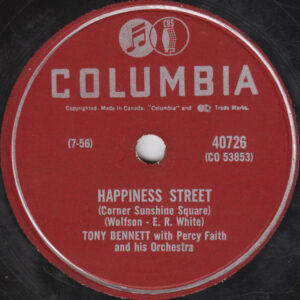
“Happiness Street” was originally recorded by Georgia Gibbs who saw her disc climb to #20 on the Billboard chart. It was written by self-taught British composer Edward White who was born in London in 1910. He became a violinist in a trio and various dance bands, performing also on saxophone and clarinet. He became known as an arranger of music and, after service in the RAF during World War II. White ran a ballroom orchestra at the Grand Spa Hotel in Bristol, England. White’s main claim to fame was “Puffin’ Billy”, which was the signature tune for the British comedy puppet television show The Telegoons (1963-64). It was also featured on the BBC Light Children’s Favourites radio request show from 1952 to 1966. In America, “Puffin’ Billy” was used as the theme music for the children’s television show Captain Kangaroo from 1955 to 1974. In 1946, White composed the novelty tune “The Runaway Rocking-Horse”. It was used as the theme tune for the CBS afflicted station KTTV in Los Angeles for the television series Life with Buster Keaton (1951–1952). Edward White died in 1994 at the age of 84.
White’s co-writer, Mack Wolfson, wrote a number of songs with White. These include “The Crazy Otto Rag” for The Stargazers which was a Top 20 hit on the British pop charts in 1955. While “C’est la vie” by Sarah Vaughan was a #11 hit on the Billboard Best Sellers in Stores chart that same year. In 1956, Frank Sinatra recorded “Flowers Mean Forgiveness” which climbed to #21 on the Billboard pop charts. The writing duo also had a minor hit for The Playmates in 1959 titled “Star Love”. Wolfson wrote “Merry Twistmas” which was recorded by the Marcels in 1961 and performed on American Bandstand. In 1963, Mack Wolfson became vice-president of Golden Crest Records in New York City.
The lyrics to “Happiness Street” explain that this is the street, at the corner of Sunshine Square, where people never quarrel. They’ve never heard of the blues, fears, woes, or tears. The singer advises:
So, pack up your troubles, take my advice
You and your baby can find paradise:
Happiness Street, corner Sunshine Square
“Happiness Street (Corner Sunshine Square)” peaked at #2 in Hannibal (MO), #3 in Vancouver (BC), #4 in Centerville (TN), #5 in Albany (NY), and Milwaukee (WI), #6 in Halifax (NS), #8 in Meridian (MS), and #9 in Smiths Falls (ON) and Huntington (NY).
In 1957, Tony Bennett had his last Top Ten hit titled “In the Middle of an Island”. It reached #3 in Australia, and #9 on the Billboard Best Sellers in Stores chart. Though in Australia, “Young And Warm And Wonderful” climbed to #3 on the pop chart, but stalled at #59 in the USA.
In 1962, Columbia Records released “Once Upon a Time”. The A-side got little attention. However, DJs flipped the record over and began to play the B-side titled “I Left My Heart in San Francisco”. The song slowly climbed the Billboard Hot 100 reaching #19, and spending over six months on the national pop charts in the USA. The album I Left My Heart in San Francisco reached #5 on the Billboard pop album chart. In 1962, the song won Tony Bennett a Grammy Award for Record of the Year, and a second Grammy for Best Male Solo Vocal Performance. In 1994, the song was inducted into the Grammy Hall of Fame.
From 1963 to 1968, Tony Bennett saw eleven of his single recordings reach the Top Ten on the Easy Listening (or Adult Contemporary) chart. These include In 1964, “I Wanna Be Around” received Grammy Award nominations for Record of the Year and Best Vocal Performance – Male. In 1965, “Who Can I Turn To (When Nobody Needs Me)” also received a Grammy Award nomination for Best Vocal Performance – Male. While in 1966, “The Shadow of Your Smile” was nominated at the Grammy Awards for both Record of the Year and Best Vocal Performance – Male. Bennett also had Top Ten Easy Listening hits with “The Good Life”, “If I Ruled the World” (from the West End musical Pickwick), “Song from the Oscar”, and “Yesterday I Heard the Rain”.
In 1966, Bennett attempted an acting career as he starred in the film The Oscar. His performance was panned. By 1970, Columbia Records was trying to revive Tony Bennett’s slumping career as a singer. It released Tony Sings the Great Hits of Today. The album is viewed as a low point in his career. Aside from the track “Is That All There is”, Bennett’s heart wasn’t in it. And so his partially spoken word version of the Beatles’ “Eleanor Rigby” was described as Shatneresque in reference to Star Trek TV star William Shatner’s spoken word recordings.
In 1992, Bennett’s Frank Sinatra tribute album, Perfectly Frank, topped the Billboard Contemporary Jazz Album chart. It earned him a Best Traditional Pop Vocal Performance Grammy Award. The following year he released a Fred Astaire tribute album titled Steppin’ Out. It peaked at #2 on the Contemporary Jazz Album chart. The album also won Tony Bennett a Best Traditional Pop Vocal Performance Grammy Award. While Here’s to the Ladies showcased hits by famous female recording artists and topped the Traditional Jazz Album chart and won Tony Bennett a Grammy Award for Best Traditional Pop Vocal Performance.
In 1995, Bennett won Grammy Awards for both Album of the Year and Best Traditional Pop Vocal Performance for MTV Unplugged. The album showcased the Great American Songbook.
In 1997, Tony Bennett won his fifth Best Traditional Pop Vocal Performance Grammy Award for his Billie Holiday tribute album Tony Bennett on Holiday. In 1999, he released Bennett Sings Ellington: Hot & Cool. He won at the Grammy Awards for Best Traditional Pop Vocal Album. In 2002, Tony Bennett and k.d. lang released an album of duets titled A Wonderful World. The singers won a Grammy Award for Best Traditional Pop Vocal Album. And in 2004, the sing won yet another Grammy Award for Best Traditional Pop Vocal Performance for his album The Art of Romance.
In 2007, Bennett’s Duets: An American Classic earned him another Best Traditional Pop Vocal Album Grammy Award. The album climbed to #3 on the Billboard 200 album chart, and topped the Jazz Album chart. The track “For Once In My Life” with Stevie Wonder earned Bennett and Wonder a Grammy for Best Pop Collaboration with Vocals. In 2008, Tony Bennett and the Count Bassie Big Band earned a Grammy Award nomination for A Swingin’ Christmas in the Best Traditional Pop Vocal Album category. But they lost to the album Michael Bublé Meets Madison Square Garden.
In 2012, Bennett was back with Duets II. The album earned him his another Best Traditional Pop Vocal Album Grammy Award. Internationally, the album topped the Billboard 200 Album chart and the Jazz Album chart in the USA. It climbed to #2 on the pop album charts in Australia, Canada, and New Zealand, and reached the Top Ten in Austria, Croatia, the Netherlands, Norway, Poland, Portugal, Scotland, Spain, Sweden and the UK. As well, he and Amy Winehouse shared a Grammy Award for Best Pop Duo or Group Performance for the track “Body and Soul”.
In 2014, Tony Bennett and Lady Gaga released an album of duets titled Cheek to Cheek. The album won Best Traditional Pop Vocal Album at the Grammy Awards. The tracks included selections written by Jerome Kern, Irving Berlin, Oscar Hammerstein II, Jimmy McHugh, Cole Porter, Billy Strayhorn and others. The album topped both pop and jazz album charts in the USA, and Jazz Album charts in Australia, Sweden, Taiwan, and the UK. It was also a Top Ten pop album seller in Argentina, Australia, Austria, Belgium, Brazil, Canada, Croatia, the Czech Republic, Denmark, France, Greece, Italy, Japan, Mexico, New Zealand, Portugal, South Korea, Spain, Switzerland, and the UK.
Later in 2015, Bennett won Best Traditional Pop Vocal Album Grammy Award for The Silver Lining: The Songs of Jerome Kern. In 2018, Tony Bennett teamed up with Diana Krall to record an album of Gershwin tunes titled Love Is Here to Stay. It topped album charts in Australia, Portugal, Sweden, the UK and USA. In 2021, Tony Bennett released another album of duets with Lady Gaga. The album, Love for Sale, topped album charts in Australia, France, Sweden, the UK and USA. It also climbed into the Top Ten on pop album charts in Austria, Belgium, Croatia, Germany, Italy, the Netherlands, Poland, Portugal, Scotland, and Switzerland. The album earned Tony Bennett his 14th and final Best Traditional Pop Vocal Album Grammy Award. The Guinness Book of World Records announced that Love for Sale made Tony Bennett the oldest recording artist to release an album with new material.
In August 2021, Tony Bennett’s son Danny Bennett announced his father would be retiring. Since 2016, Tony Bennett had suffered from Alzheimer’s. However, Bennett’s twice-weekly singing practices are thought to have kept his brain stimulated and spared him from symptoms such as disorientation, depression, and a detachment from reality. As a result he was able to record with Lady Gaga for his final duet album in 2021, with most of the tracks recorded between 2018 and 2020.
Tony Bennett died in July 2023 at the age of 96, two weeks before what would have been his 97th birthday.
June 13, 2026
Ray McGinnis
References:
Robert Sullivan, “Tony Bennett: The musician and the artist,” Today.com, September 23, 2007.
“He Keeps Coming Back Like a Song (Tony Bennett: Singer),” Good Housekeeping, April 1, 1995.
“Tony Bennett: Legendary singer retires from stage aged 95,” BBC, August 13, 2021.
Andrew R. Chow, “Tony Bennett Was a Master at Bridging Generational Divides,” Time, July 21, 2023.
“Legendary Tony Bennett officially the oldest person to release an album of new material,” Guinness Book of World Records, October 8, 2021.
Tony Bennett, “Because of You“, The Ed Sullivan Show, September 21, 1951.
Tony Bennett, “I Left My Heart In San Francisco“, The Ed Sullivan Show, November 22, 1964.
Tony Bennett, “Eleanor Rigby“, Columbia Records, 1970.
William Shatner, “Lucy In the Sky With Diamonds“, Decca Records, 1968.
The Marcels, “Merry Twistmas“, American Bandstand, December 2, 1961.
The Melodi Light Orchestra, “Puffin’ Billy“, Chappell Records, 1952.
“Theme Song,” Captain Kangaroo, CBS, 1960.
Tony Bennett and k.d. lang, “Exactly Like You“, A Wonderful World, Columbia Records, 2002.
Tony Bennett and Stevie Wonder, “For Once In My Life“, Duets, Columbia Records, 2007.
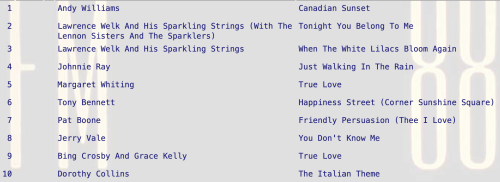
CJCH 920-AM Halifax (NS) | October 27, 1956
Leave a Reply