
#66: Homecoming by Hagood Hardy
City: Toronto, ON
Radio Station: CHUM
Peak Month: October 1975
Peak Position in Toronto ~ #3
Peak Position in Vancouver ~ #9
Peak Position on Billboard Hot 100 ~ #41
YouTube: “Homecoming”
Hagood Hardy was born in 1937 in Angola, Indiana, near the borders of Michigan and Ohio. Hardy came to Canada as an infant settling in Brantford and grew up in Oakville (ON). He received a Bachelor of Arts degree from Trinity College in Toronto. Hardy studied music privately in Toronto with composer and trumpeter Gordon Delamont. As a young man he participated in bebop jam sessions on Gerrard Street in Toronto. He led his own group from 1957 to 1961. In the 1961 he played vibraphone for bandleader Gigi Gryce, and for Herbie Mann on tour in 1961-62. He also played vibes for bandleader Martin Denny in Hawaii and Las Vegas from 1962 to 1964. And from 1964 to 1967, he was in touring in a band led by George Shearing.
Hardy performed with Herbie Mann on the latter’s 1961 recording Herbie Mann at the Village Gate. The session includes the jazz standard “Comin’ Home Baby” and the Gershwin classic, “Summertime”. The tracks blend Afro-Cuban and Brazilian sounds with modern jazz. He recorded with Herbie Mann on four consecutive albums, the fourth in 1962 being Brazil, Bossa Nova & Blues.
In 1967, Hagood Hardy released his first solo studio album Stop 33. When he stopped touring in late 1967, Hagood Hardy settled in Toronto. He created commercial jingles for a number of companies, including Kelloggs, General Motors, London Life, and Canadian Pacific.
Hardy released a number of singles in the early 1970s. His single “Just a Little Lovin'” appeared on the RPM Adult Contemporary chart in 1971, and “The Garden Path” was on the chart in 1972. Hardy’s tune “The Homecoming” was used 1972 as music to a TV commercial for Salada tea. It was later included on an album of the same name. Hardy set up an independent record label, Isis, through his Toronto company, Hagood Hardy Productions, and released “The Homecoming” as a single in 1975. It was the feature track from his third album The Homecoming.
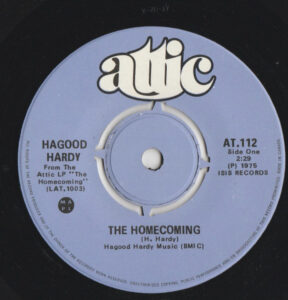
Hagood Hardy wrote “The Homecoming”. The pretty piano treatment made it a Top Ten hit on the Adult Contemporary charts. Wiki Hits comments, “The response to the television commercial was immediate and unexpected. Canadian audiences, struck by the quiet emotional power of the melody, began contacting Salada Foods and broadcasting stations asking about the music. The piece communicated something genuinely affecting: a sense of arrival, of return, of the particular warmth associated with familiar places and reunited families. Without a single word of lyric, Hardy had captured a universally recognizable emotional experience in a few minutes of piano melody. The demand for a commercially available recording became impossible to ignore.”
Without any lyrics, “The Homecoming” title also evoked associations. Wiki Hits adds, “Homecoming” brought to mind the return of the traveler, the reunion of separated family members, the moment when belonging is restored after a period of absence. These associations are culturally specific in certain respects yet broadly recognizable across cultures that value home and family as organizing social structures.”
“The Homecoming” climbed to #1 in Anniston (AL), and La Crosse (WI), #2 in Nashville, #3 in Toronto, #4 in Hamilton (ON), and San Angelo (TX), #6 in Montreal, Dayton (OH), and Regina (SK), #8 in Winnipeg (MB), #9 in Vancouver, and Hartford (CT).
The mid-70s were a time populated with numbers of instrumental hits. Other instrumental hits of note include “Love’s Theme” by the Love Unlimited Orchestra, “The Hustle” by Van McCoy, “A Fifth of Beethoven” by Walter Murphy and the Big Apple Band, “TSOP (The Sound of Philadelphia)” by MSFB with The Three Degrees, “Theme From SWAT” by the Rhythm Heritage, “The Entertainer” by Marvin Hamlisch, “Dueling Banjos” by Eric Weissberg and Steve Mandell, “Pick Up The Pieces” by the Average White Band, “Also Sprach Zarathustra (2001)” by Deodato, “Express” by BT Express, “Soul Malissa” by Manu Dibango, “Rock and Roll Pt. 2” by Gary Glitter, and “Popcorn” by Hot Butter.
Over the decades, Hagood Hardy released a dozen albums. Hardy won Juno Awards in 1976 and 1977 as instrumentalist of the year, and in 1976 as composer of the year. He was named instrumental artist of the year by Billboard magazine.
Hardy wrote the scores for the 1982 film Mazes and Monsters, the 1985 film Anne of Green Gables and the sequel, Anne of Avonlea.
In 1992, he was made a Member of the Order of Canada. In the 1995 Ontario provincial election Hagood Hardy was the candidate for the Ontario Liberal Party in the riding of York South and faced local MPP and Premier of Ontario, Bob Rae. The Ontario Liberals faltered in the election, and Hardy lost to Rae.
In 1996, Hardy received the Toronto Arts Foundation’s Lifetime Achievement Award. In 1997, Hagood Hardy died at the age of 59 of lymphoma, several weeks before what would have been his 60th birthday.
November 18, 2026
Ray McGinnis
References:
“Biography: Hagood Hardy,” Canadian Jazz Archive.
Betty Nygaard King, “Hagood Hardy,” The Canadian Encyclopedia. August 29, 2013.
Robert Williston, “Hagood Hardy,” Citizen Freak.ca.
“Hagood Hardy and the Unlikely Journey of “The Homecoming“, Wiki Hits.com.
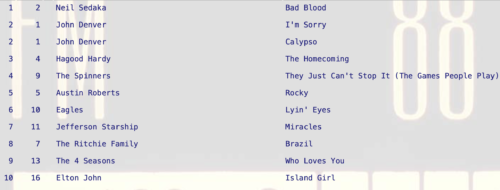
“CHUM 30” CHUM 1050-AM Toronto (ON) |October 25, 1975
Leave a Reply