
#15: I Feel Good by Lewis and Clarke Expedition
City: St. John’s, NL
Radio Station: VOCM
Peak Month: September 1967
Peak Position in St. John’s ~ #4
Peak Position in Vancouver ~ did not chart
Peak Position on Billboard Hot 100 ~ did not chart
YouTube: “I Feel Good”
Lyrics: “I Feel Good”
Lewis and Clarke Expedition were a group formed in 1966 in Los Angeles. They were comprised of Travis Lewis (Michael Martin Murphey) on vocals, guitar and harmonica; Boomer Clarke (Owen Castleman) on vocals and guitar; John London on guitar and bass; Ken Bloom on guitar and keyboards; and John Raines on drums. Prior to 1964, while still in high school, Michael Martin Murphey and Owens “Boomer” Castleman were bandmates in a Dallas, Texas group called the Lost River Trio. John London formed a folk duo with future Monkee Mike Nesmith while both were attending San Antonio College in 1963. Ken Bloom started playing the flute at the age of ten. The following year he learned both the clarinet and saxophone. As a teenager Ken Bloom played in a band called the Robin Hood Band. He was also with the Gas Company from 1965 to 1967. Bloom was later part of what he describes as an “old timey string band” called the Main Street Shuffle Kings. Drummer Johnny Raines was from Los Angeles. Raines met John London when both were playing for Chris and Craig.
John London was born John Carl Kuehne. He was born in Brazos County, Texas, in 1942. John moved to L.A. and took the stage name John London. When in 1966 Mike Nesmith was cast in The Monkees, he recruited London as his stand-in on the set, and when the originally-fictitious band began playing on their own recordings, London sometimes served as bassist, allowing Peter Tork to play keyboards, banjo, or another instrument. London also co-wrote “Don’t Call On Me” with Nesmith, which was featured on the Monkees’ album Pisces, Aquarius, Capricorn & Jones Ltd. and a second-season TV episode. John London also appeared in bit parts on The Monkees show.
Owen Castleman was born in 1945 in Farmer’s Ranch, Texas.
Michael Murphy was born in Dallas, Texas, in 1945. When he was six years old, he began riding horses on his grandfather and uncle’s ranches. Years later, he recalled sleeping on his grandfather’s porch under the stars, listening to his grandfather’s stories and cowboy songs. During these early years, he developed a special love for cowboy songs and stories. He learned to play the guitar, piano, mandolin, banjo and harmonica. In 1962, at the age of 17, Murphey took his first “professional” music job, playing western songs around a campfire at a Texas ranch. By the early 1960s, Murphey was playing the clubs in Dallas. With Michael Nesmith, John London and Johnny Raines, in 1964 Michael Murphey formed the Trinity River Boys.
In 1967 the Lewis And Clarke Expedition released “I Feel Good (I Feel Bad)”.
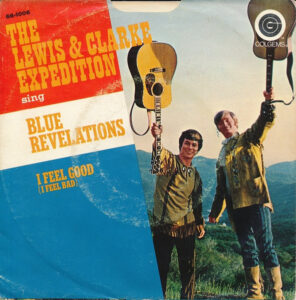
45 RPM of “I Feel Good (I Feel Bad)” with Owen “Boomer Clarke” Castleman and Michael “Travis Lewis” Murphey on cover
The song is about a guy who is single. He feels good. It’s a sunny day. However, he’s “annoyed” because he’s single and there’s no one by his side to enjoy his company. He recalls all the good times he had with his last relationship. On rainy days he feels more in sync with the weather. He confides, “It’s just a sunny day and it’s destroying me.”
As part of the promotion for “I Feel Good”, the Lewis And Clarke Expedition appeared on August 17, 1967 on The Groovy Show. This was a local Los Angeles variety music show.
“I Feel Good” reached #4 in St. John’s (NL), #7 in Lubbock (TX), #10 in Evansville (IN), and Brownwood (TX), #11 in Milwaukee (WI), #14 in Starke (FL), and Dubuque (IA), and #17 in Toronto.
In November 1967, the group’s followup, “Freedom Bird”, received airplay in just four radio markets across the USA. In the summer of 1968, “Chain Around The Flowers” climbed to #5 in Marshfield (WI), and #6 in Regina (SK). The group appeared on the variety show Pat Boone in Hollywood, on March 7, 1968.
In 1968, Lewis and Clarke Expedition appeared in the film For Singles Only. They performed “This Town Ain’t the Same Anymore”, “Destination Unknown”, and “Why Need They Pretend?”. After this appearance, both Johnny Raines and Ken Bloom left the group. Bo Wagner and Doug Dillard took their place. (Bo Wagner, also a drummer, started as a young child in the entertainment business, playing drums as a ten-year-old on The Mickey Mouse Club and appearing on The Lawrence Welk Show). In this iteration they also appeared in the Screen Gems sitcom I Dream of Jeannie (with Bo Wagner) performing “Bring On the Sundown”. Dillard and John London subsequently left the band, and London joined Mike Nesmith’s First National Band. A final release by the Lewis and Clarke Expedition, “Daddy’s Plastic Child”, was released late in 1968. Then the band dissolved.
As the band dissolved, Owen “Boomer” Castleman became the inventor of the palm pedal. This is a device that allows guitar players to execute pedal steel-style string bends. Castleman made his original prototype in 1968, and the device is now marketed under the name Bigsby Palm Pedal (formerly the Bigsby/Castleman). He went on to find success with his controversial Top 40 hit “Judy Mae”. He also wrote and produced the million-selling Top 20 novelty hit “Telephone Man” for singer Meri Wilson in 1977. He founded the small country music record label BNA Records. He died at the age of 70 in 2015.
Johnny Raines became a studio musician and played drums on the Top Ten hit for Climax titled “Precious And Few” in 1972. He later was in the studio for recordings by the Five Man Electrical Band, Pat Boone, David Cassidy, The Monkees, Johnny Rivers, and on Dave Loggins Top Ten hit “Please Come To Boston” in 1974.
Ken Bloom later recorded several bluegrass-folk albums. He also worked as a studio engineer and a musical instrument builder. On his 1978 self-titled album, Ken Bloom variously played on the balalaika, bandura, bouzouki, clarinet, dulcimer, guitar and Northumbrian pipes. On other albums he also played the banjo, domra, finger cymbals, tin whistle, and zither.
Michael Murphey moved to the San Gabriel Mountains in 1968 to work on his songwriting. He wrote songs recorded by the Royal Guardsmen, Bobbie Gentry, The Monkees, Jerry Jeff Walker, George Hamilton IV, Kenny Rogers and the First Edition, Johnny Rivers, the Nitty Gritty Dirt Band, Cher, Ray Conniff, “Boy From The Country” for John Denver, Charlie Rich, Johnny Cash, Lyle Lovett, The Back Porch Majority, Billy Joe Royal, Earl Scruggs and others. In 1975, Michael Murphey had a #3 hit on the Billboard Hot 100 titled “Wildfire”. It topped the RPM Top 100 Canadian pop Singles chart. In 2009 he received a Grammy Award nomination for Best Bluegrass Album, for Buckaroo Blue Grass. Over the decades, Michael Murphey has recorded over thirty studio albums. In the 1980s, a dozen of his singles reached the Top Ten on the Hot Country Singles chart in the USA. Two of these – “What’s Forever For” and “A Long Line of Love” topped the chart.
Years after the Monkees and the First National Band, John London served as key grip on several movie productions. These included 48 Hours, Who Will Love My Children?, The Karate Kid, Long Time Gone, and Hudson Hawk. He also worked as a studio musician for James Taylor and Linda Ronstadt. He later worked in advertising sales for the San Antonio Express-News, the San Antonio Light, and later the Corpus Christi Caller-Times. After 1995, John London was semi-retired and worked at finishing and carpentry. He died in 2000 at the age of 58.
April 20, 2026
Ray McGinnis
References:
O.J. Sikes, “Michael Martin Murphey,” Western Music Association, April 16, 2013.
“John Kuehne, musician who performed with Monkees,” Fort Worth Star-Telegram, 2000.
Ken Bloom, “My Life Story: Meet Lewis and Clarke!,” Flip, April 1968.
Robert K. Oermann, “LifeNotes: Singer-songwriter Owens “Boomer” Castleman Dies,” Music Row, September 3, 2015.
John Denver, “Boy From The Country“, An Evening With John Denver, RCA, 1974. (Michael Murphey credit).
Michael Murphey, “Wildfire“, Epic Records, 1975.
“Lewis and Clarke Expedition,” Monkees.fandom.com.
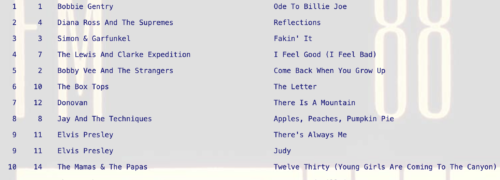
Newfoundland’s Only Official Survey VOCM 590-AM St. John’s (NFLD) | September 15, 1967
Leave a Reply