
#117: I’m Confessin’ by Frank Ifield
City: Montreal, PQ
Radio Station: CJAD
Peak Month: October 1963
Peak Position in Montreal ~ #1
Peak position in Vancouver ~ #33
Peak Position on Billboard Hot 100 ~ #58
YouTube: “I’m Confessin’”
Lyrics: “I’m Confessin’”
Frank Ifield was born in Coventry, England, in 1937. His parents were Australians, and the family moved back to Australia in 1948 aboard the RMS Orion. The family settled 30 miles outside of Sydney. It was a rural district and young Frank listened to hillbilly music while milking the family’s cow. He was given a guitar in 1949 by his grandmother and was self-taught. Ifield also taught himself to yodel, by imitating country stars. At the age of 13, he performed his version of Bill Showmet’s “Did You See My Daddy Over There?” and appeared on local radio station 2GB’s talent quest, Amateur Hour. This track was issued as his first single, in 1953. By November of that year, he appeared regularly on Brisbane radio station 4BK’s Youth Parade, playing guitar and singing.

RMS Orion
In 1956, Frank Ifield hosted Campfire Favourites on TV station TCN-9, which “was the first weekly ‘Western’ programme by a local artist on Australian television.” From that year to late 1957, he recorded six singles with a backing group, Dick Carr Buckaroos. In 1957, he recorded the track “Whiplash”, which was used as the theme song for the British/Australian TV series Whiplash from September 1960 to mid-1961. He toured the North Island of New Zealand in early 1959 where his single, “Guardian Angel”, reached #1 on local radio charts.
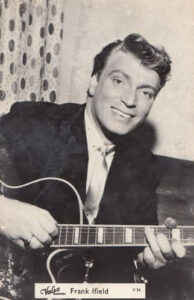
Ifield had two top 30 hits in that year in Australia. These were “True” and “Teenage Baby”. He returned to the United Kingdom in November 1959.
Ifield’s first UK single in January 1960 was “Lucky Devil”, a cover of the Carl Dobkins Jr. hit in the USA and Canada. Ifield’s cover reached #22 on the UK Singles Chart. His next six singles had less commercial success, including his cover of Paul Evans’ “Happy-Go-Lucky-Me”. However, fortunes changed when he released a cover version of the 1941 song “I Remember You”.
“I Remember You” was written by Victor Schertzinger and Johnny Mercer. In 1940 (some say 1941), Johnny Mercer had an affair with Judy Garland. Mercer’s wife, Ginger Mercer, wasn’t happy when she learned about his infidelity. To the astonishment and dismay of his friends, Johnny Mercer decided, as he wrote in “That Old Black Magic” effused that Garland was “the lover I have waited for. The mate that fate had me created for.” Ever after, he called Judy Garland his one great love: “You’re the one who made my dreams come true,” as he wrote of her in “I Remember You.” Even Hollywood considered their affair scandalous. Mercer was married and Garland had played Dorothy in The Wizard of Oz only a year before; she was viewed as “scarcely out of childhood.” During the affair, Judy Garland was 18 years of age when the affair began. The affair ended when Garland abruptly married British bandleader David Rose in July 1941. (Garland was then 19, and Rose was 31). In 1942, “I Remember You” became a #9 hit on the Billboard pop chart for Jimmy Dorsey and His Orchestra.
Frank Ifield’s cover of “I Remember You” in 1962 reached number-one in the UK and remained there for seven weeks. It also reached #1 in Australia, #4 in Canada and #5 in the USA. His album, I Remember You, reached #3 on the UK pop Album chart in 1962.
Later in 1962, Ifield recorded “Lovesick Blues”. The song first appeared in the 1922 musical “Oh, Ernest”. It was not a commercial hit until Hank Williams took it to number-one on the country charts in 1949. In the UK “Lovesick Blues” topped the pop charts in June and July 1962 with Ifield’s cover for five weeks.
Next, Frank Ifield covered the 1956 Gogi Grant chart-topper “The Wayward Wind”. For his effort, in early February 1963 Ifield earned his third consecutive number-one hit in the UK. It remained on top of the UK Singles chart for three weeks. In Australia, Ifield’s cover cracked the Top 20. Later in ’63, a cover of the 1937 tune “Nobody’s Darlin’ But Mine” reached #4 in the UK.
Continuing to enjoy success by covering pop standards, Frank Ifield reached for a song from 1930 titled “Confessin’ (That I Love You)”.
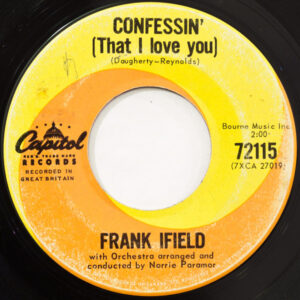
On the Canadian Capitol Record printing, A. J. Neiburg was omitted.
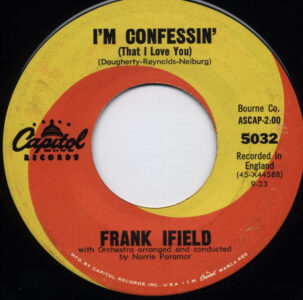
On American Capitol Record printing, A.J. Neiburg is credited
In 1930, “Confessin’ (That I Love You)” was first recorded by Rudy Vallee and His Connecticut Yankees. The single climbed to #4 on the American pop chart. Later that year, Guy Lombardo and His Royal Canadians took the song to #2. The song was written by Allen J. Neiburg. He was born in St. Albans, Vermont, in 1902. He studied at Boston University. Neiburg continued to enjoy hits in the 1930s with “Strictly Culled Affair” for Cab Calloway (1932), “(When It’s) Darkness In The Delta” for Ted Fio Rito and His Orchestra (1933), “It’s The Talk Of The Town” and “Under A Blanket Of Blue” both in 1933 by Glen Grey and the Casa Loma Orchestra, “I’ve Got An Invitation To A Dance” by Paul Pendarvis & His Orchestra (1934), “It’s A Hap Hap Happy Day” for Eddy Duchin (1939), and in 1944 “Sweet Slumber” became a number-one R&B hit for Lucky Millinder and His Orchestra.
Initially, “Confessin'” was first produced with different lyrics, as “Lookin’ For Another Sweetie”, credited to Chris Smith and Sterling Grant and recorded by Fats Waller & His Babies on December 18, 1929. Neiburg’s co-writers, Doc Dougherty and Ellis Reynolds only co-wrote this song. Otherwise, there is no trace of either of them as songwriters. A. J. Neiburg died in 1978 at the age of 75.
“I’m Confessin'” peaked at #1 in Montreal, and #10 in Endicott (NY).
Ifield performed “I’m Confessin'” on The Ed Sullivan Show on September 22, 1963. “I’m Confessin'” has also been recorded by April Stevens & Nino Tempo, Louis Prima and Keely Smith, Dean Martin, Ricky Nelson (on The Adventures of Ozzie and Harriet), Anne Murray, Diana Krall, Thelonius Monk, Django Reinhardt, Timi Yuro, Frankie Laine, The McGuire Sisters, Vic Dana, Mr. Acker Bilk, Ella Fitzgerald, Benny Carter, Count Basie, Willie Nelson, Teresa Brewer, Rosemary Clooney, Louis Armstrong and His Sebastian New Cotton Club Orchestra, Erroll Garner, Judy Garland, Ben Bernie and His Orchestra, Nat Gonella and His Georgians, The Clovers, The Chantels, Van Morrison, and many others.
In 1963, Ifield’s album Born Free peaked at #3 on the UK pop album chart.
After “I’m Confessin'”, Frank Ifield covered a 1932 hit by Bing Crosby titled “Please” and took it to number-five hit in Australia. In January 1964, Frank Ifield had one last Top Ten hit in the UK titled “Don’t Blame Me”. That year his album, Blue Skies, reached #10 on the UK pop Album chart. Nonetheless, Frank Ifield, along with numbers of other recording artists from the late 50s and early 60s, was swept away by Beatlemania and the new British Invasion recording acts. Still, Ifield managed six more single releases in the UK between 1964 and 1966 that cracked the Top 30.
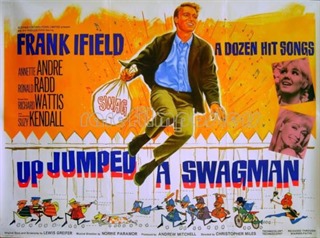
In 1965, Frank Ifield starred in the film Up Jumped A Swagman.
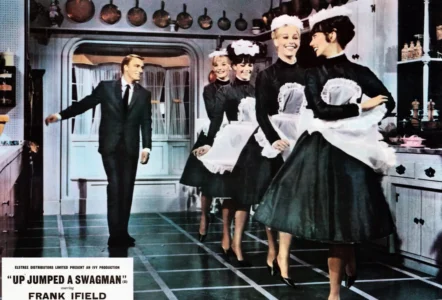
The film’s plot: An aspiring Australian singer moves to London in the hope of a big breakthrough. He chases after a popular model, not noticing the beautiful daughter of a pub owner who loves him. He also gets involved with a gang of thieves. In the film, Ifield sang numbers of songs, including “I Remember You” and “Waltzing Matilda”.
In 1972, he covered Wayne Newton’s “Daddy Don’t You Walk So Fast” which stalled at #68 on the Australian pop singles chart. In 1986, Ifield contracted pneumonia, which resulted in removal of part of a lung and damage to his vocal cords. He relocated to Sydney in 1988 and was unable to sing or yodel for years as he recovered. A remix of Ifields “The Yodeling Song” reached #40 on the UK Singles chart in 1991.
In 2003, Ifield was inducted into the Australian Roll of Renown. In 2005, he co-wrote his autobiography I Remember Me: the First 25 Years, with Pauline Halford. Ifield was inducted into the ARIA Hall of Fame in 2007 (Australian Record Industry Association). In June 2009, he was presented with the Medal of the Order of Australia for “service to the arts as an entertainer”. In 2012, he was inducted into the Coventry Music Wall of Fame.
Frank Ifield died at the age of 86 in 2024, of pneumonia.
July 25, 2026
Ray McGinnis
References:
Glen A. Baker, “Australian music icon Frank Ifield dies aged 86,” Sydney Morning Herald, Sydney, Australia, May 20, 2024.
Rudy Vallee and His Connecticut Yankees, “Confessin’ (That I Love You)“, RCA Victor, 1930.
Guy Lombardo and His Royal Canadians, “Confessin’ (That I Love You)“, Columbia Records, 1930. (Vocal Carmen Lombardo)
Lionel Hampton and His Orchestra, “Confessin’ (That I Love You)“, Decca Records, 1937.
Perry Como, “I’m Confessin’ (That I Love You)“, RCA Victor Records, 1945.
Les Paul and Mary Ford, “I’m Confessin’ (That I Love You)“, Capitol Records, 1952.
Cab Calloway, “Strictly Cullud Affair“, Brunswick Records, 1932.
Ted Fio Rito and His Orchestra, “(When It’s) Darkness On The Delta“, Brunswick Records, 1933.
Glen Grey and the Casa Loma Orchestra, “It’s The Talk Of The Town“, Brunswick Records, 1933.
Glen Grey and the Casa Loma Orchestra, “Under A Blanket Of Blue“, Brunswick Records, 1933.
Paul Pendarvis & His Orchestra, “I’ve Got An Invitation To A Dance” Columbia Records, 1934.
Eddy Duchin and His Orchestra, “It’s A Hap, Hap, Happy Day“, Columbia Records, 1939.
Lucky Millinder and His Orchestra, “Sweet Slumber“, Decca Records, 1944.
Frank Ifield, “Please“, Capitol Records, 1963.
Frank Ifield, “Lovesick Blues“, VeeJay Records, 1962.
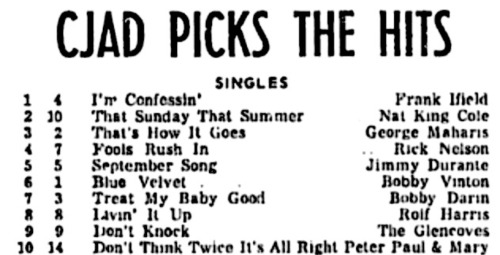
CJAD 800-AM Montreal Top Ten | October 19, 1963
Leave a Reply