
#52: Mommy and Daddy by the Monkees
City: Regina, SK
Radio Station: CJME
Peak Month: October 1969
Peak Position in Regina ~ #6
Peak position in Vancouver ~ did not chart
Peak Position on Billboard Hot 100 ~ #109
YouTube: “Mommy And Daddy”
Lyrics: “Mommy And Daddy”
Robert Michael Nesmith was born on December 30, 1942 in Houston, TX. His mother, Bette invented liquid paper and would later leave the $20 million estate to him. Affectionately nicknamed “Nez,” he learned to play saxophone as a young child and joined the United States Air Force years later. After two years in the Air Force, he left to pursue a career in folk music. In 1962 Nesmith won a talent contest at San Antonio College. He left Texas and moved to Los Angeles, with the intent of getting into the movie business. He became the “hoot master” at a regular hootenanny at the Troubadour in West Hollywood. In 1963 Nesmith released a 45 of a song he wrote called “Wanderin’”. In 1964 Nesmith wrote “Different Drum”, which was a #13 hit for Linda Ronstadt and the Stone Poneys on the Billboard Hot 100 and #5 in Vancouver in 1967.
During this time he formed the trio named Mike and John and Bill. They recorded a single in 1965 called “How Can You Kiss Me,” which was a Top 40 hit in San Antonio, Texas, in May of ’65. Later that year Nesmith released a solo disc titled “A Journey With Michael Blessing” that made the Top 50 in a few radio markets in Pennsylvania and Ohio, credited to Michael Blessing. With hopes of getting a job as a songwriter, Mike auditioned for The Monkees in late-1965.
In September 1965, Daily Variety, a Los Angeles entertainment industry paper, placed an ad that read: “MADNESS!! Auditions. Folk & Roll Musician-Singers for acting roles in new TV series. Running parts for 4 insane boys.” Over 400 older boys and young men lined up at the studio near Sunset Boulevard, hopeful for a chance at stardom. Stephen Stills and Harry Nilsson were among the hopefuls waiting to be discovered. Walking to the front of the line and right into the producer’s office was 19-year old Davy Jones.
Born in suburban Manchester, UK, in 1945, Davy Jones had been in the acting business since he was a child. In 1959, his Aunt Jessie answered an ad in the Manchester Evening News calling for “school boys to audition for a radio play” with the BBC She helped David, at 13, get the lead role in There is a Happy Land. He was on an episode of Coronation Street in March 1961, when he was 15 years of age. He appeared on stage as Little Michael in Peter Pan, and than as the Artful Dodger in Oliver! in the early 60’s in the West End of London. In 1964 he was in a Broadway production of Oliver! and nominated for a Tony Award at the age of 18. In 1965, Jones released several singles and had two Top Ten hits in Australia, including #4 hit “The Girl From Chelsea”.
One of the people David Jones walked past in the lineup was Mickey Dolenz. Born in 1945 in Los Angeles, Dolenz started his career in show-business at the age of eleven, in 1956, in a TV show called Circus Boy. Dolenz was given the acting name, Mickey Braddock, and the role he was cast in was to play Corky, an orphaned water boy for the elephants in a one-ring circus set around 1900. The show ran through to the spring of 1958. By the mid-60’s Dolenz was in a band playing mostly covers of R&B hits, including many by Chuck Berry. Dolenz sang Berry’s “Johnny B. Goode” in his audition for The Monkees. In 1965 Dolenz cut recorded several singles, one of these, “Don’t Do It” was released in 1967 and made the Top 20 in Edmonton and Ottawa.
Another person lining up hoping to be chosen for the new TV show was Peter Halsten Thorkelson. Born in Washington D.C. in 1942, he studied piano from the age of nine and lived in New York City. Peter got involved in the folk music scene in Greenwich Village and met Stephen Stills and other folk singers. Before he moved to California in the early 60’s, Peter Thorkelson shortened his surname to Tork.
Jones, Nesmith, Dolenz and Tork were all successful in auditioning for The Monkees TV show. Their lineup was international: British and American. David Jones was introduced on the first episode of The Monkees as Davey Jones and “Davey” was how he was know from that day forward. On their debut single, Micky Dolenz sang the lead vocal on “Last Train To Clarksville.” The B-side to “Last Train To Clarksville”, a gentle anti-war song, was “(I’m Not You) Steppin Stone”.
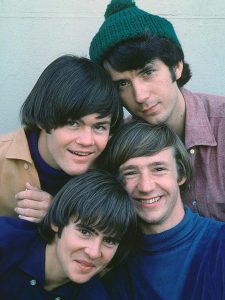
Micky Dolenz sang lead vocals on “I’m A Believer,” the bands second #1 hit in a row. Dolenz would later sing lead vocals on their summer hit in 1967, “Pleasant Valley Sunday,” written by Carole King and Gerry Goffin. Davey Jones sang lead vocals on their other Top Ten hits in ’67, “A Little Bit Me, A Little Bit You” and their third #1 hit, “Daydream Believer”.
While initially a TV series about a band that didn’t actually exist, The Monkees did a live promotional tour of seven cities in the USA beginning on September 1 in Hollywood. The tour featured previews of The Monkees TV show on large screens and The Monkees playing a few tunes. KHJ radio in Los Angeles staged the most ambitious event of the tour on September 11, 1966. KHJ had a contest and the 400 winners rode on a train to the coastal town of Del Mar, California, twenty miles north of San Diego. The town’s mayor renamed Del Mar on September 11 as Clarksville for the day in honor of The Monkees appearance. The Monkees landed on the beach in two helicopters, dressed in their signature double-breasted shirts, greeted by the KHJ contest winners. After the event, The Monkees rode in the train train with the contest winners back to Los Angeles. On one of the train cars, The Monkees gave their first true live public performance. As the train was traveling at 80 miles per hour, Micky Dolenz drum set fell over several times as no one had thought about securing the drums to the floor.
The Monkees went on tour with 16 scattered concert dates between December 3, 1966 (Honolulu) and May 6, 1967 (Wichita, KS). The concert in Honolulu was The Monkees first full length live concert. They were one of the acts performing at the Monterey Pop Festival in mid-June, 1967. They mounted a tour with dates in the USA and Britain between June and August. The tour included Jimi Hendrix as the opening act for seven of these concerts between July 8th (Jacksonville, FL) and 16th (New York City).
In 1968, The Monkees TV show featured one last song to make the Top Ten on the Billboard Hot 100 called “Valleri”. Mike Nesmith coined the Tommy Boyce/Bobby Hart tune “the worst record ever.” The B-side to “Valleri” was “Tapicoa Tundra”, written by Michael Nesmith.
After their two-season run on TV, The Monkees had a tour to Australia in September and Japan in October. In November ’68, The Monkees were featured in a psychedelic film titled Head. The script was co-written by Jack Nicholson. In addition to the bandmates, the film’s cast included Annette Funicello, Frank Zappa, Toni Basil, Jack Nicholson and Sonny Liston. The film was a commercial failure only managing $16,111 at the box office. The film both alienated The Monkees fan base and caused Columbia Pictures to abandon plans for any future Monkees films. A single from the Head soundtrack, “Porpoise Song” was released in the fall of 1968.
Unhappy with the bands’ direction, Peter Tork left The Monkees at the end of December, 1968, after filming the bands last TV appearance that was to air on NBC in April ’69. Later in 1969, the remaining three Monkees released a number of singles. This included a Top Ten hit in Australia titled “Mary Mary”, and “Tear Drop City” from the album Instant Replay.
The followup to “Tear Drop City” was a song penned by Michael Nesmith titled “Listen To the Band”. In the fall of 1969, the Monkees released “Mommy And Daddy”.
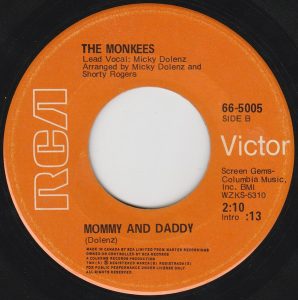
“Mommy And Daddy” was written by Mickey Dolenz. It was a track from the album The Monkees Present, which showed the faces of the three remaining Monkee bandmates – Davy Jones, Mickey Dolenz and Michael Nesmith.
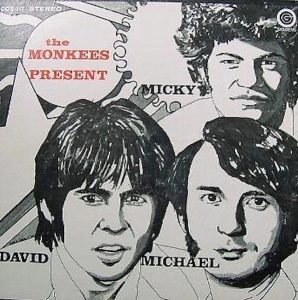
Graphic art album cover of The Monkees Present in Canada and the USA
“Mommy And Daddy” is a song that was on the radio overlapping the sixth anniversary of the assassination of American president John F. Kennedy. It contains a series of questions posed by a precocious child to their mother and father.
The first question the child asks their parents is “What happened to the (American) Indian?” “Is it as bad as people make it seem?” What happened to “the Indian” included the trail of tears. After the discovery of gold in 1828 in the state of Georgia, President Andrew Jackson launched a policy of removal of the Cherokee, Chickasaw, Choctaw, Muscogee, and Seminole nations to lands west of the Mississippi. Between 1830 and 1850, 60,000 American Indians were relocated west of the Mississippi. It is estimated that between 13,000 and 17,000 natives died.
One verse conjures a scenario where a child is asking one parent a question. The answer of that parent is to tell the child to go ask the other parent instead. And so, in “Mommy And Daddy” the father tells the child “Ask your mommy why everybody swallows all those little pills.” While the mother tells the child, “Ask your daddy ‘Why doesn’t that soldier care who he kills?'” In the face of being given the runaround to “go ask your father,” and “go ask your mother,” the child whispers in bed “Mommy and Daddy, would you rather that I heard it from my friends instead?”
The question about the “little pills,” related to news headlines in the mid to late 1960s about addiction to prescription drugs. The other question assumed a soldiers’ state of mind that featured indifference to killing in a theatre of war. On March 16, 1968, Lt. William Calley led around 100 soldiers of Charlie company into the village of My Lai, South Vietnam. Although they faced no resistance, they entered the village shooting. They murdered hundreds of civilians consisting mostly of South Vietnamese elderly men, women, children, and infants using automatic weapons, grenades and bayonets. Infants and children were killed with bayonets, and females were raped and shot. A Vietnamese memorial at the site lists 504 names, with ages ranging from 1 to 82. In the My Lai museum in Vietnam, a marble plaque lists the names and ages of the victims. 504 people from 247 families were killed, including 17 pregnant women, 173 children and 53 infants. The massacre shocked Americans following the nightly news. The story may have factored into Mickey Dolenz’ question “Why doesn’t that soldier care who he kills?” What made Lt. William Calley into the kind of solider who would lead a company of soldiers to massacre a village full of unarmed civilians?
In some versions of the song, the narrator tells the child:
“Ask your mommy and daddy to tell you where you really came from.
Then mommy and daddy will probably turn and quickly walk away.
Then ask your mommy and daddy who really killed J.F.K.”
On November 22, 1963, United States President John F. Kennedy was riding in a presidential motorcade in Dallas, Texas. Once his limousine entered Dealey Plaza, multiple shots rang out including those which hit the president, and Texas Governor John Connally. Kennedy died later that day. On November 25, 2022 Deputy Attorney-General Nicholas Katzenbach wrote a memo to the White House recommending a high-level government commission to investigate the assassination and put to rest the inevitable conspiracy theories. His memo to White House aide Bill Moyers stated, “The public must be satisfied that Oswald was the assassin; that he did not have confederates who are still at large. Speculation about Oswald’s motivation ought to be cut off, and we should have some basis for rebutting thought that this was a Communist conspiracy or a right-wing conspiracy to blame it on the communists.” Katzenbach’s memo led to the creation of the Warren Commission, which was tasked with the Deputy Attorney General’s directive that the inquiry find that Oswald was the lone gunman.
Before he was assassinated, President Kennedy had made enemies within the United States government.
a) Kennedy avoided a war against Cuba in the Bay of Pigs invasion in April 1961
b) Kennedy collaborated with Soviet leader Nikita Khrushchev to end the Cuban Missile Crisis, which U.S. military leaders were hoping could trigger a war with Cuba (and maybe a nuclear war with the USSR)
c) Kennedy had signed National Security Action Memorandum 263 in October 1963. In it he ordered 1,000 U.S. personnel leave Vietnam by Christmas 1963, and all U.S. military to return home by the end of 1965
d) The president had announced in his June 10, 1963 address at American University a challenge to the Soviet Union to engage in a Peace Race, instead of an Arms Race
e) In September 1963, President Kennedy had begun secret negotiations with Cuban leader Fidel Castro to explore the possibility of normalization of Cuban-American relations
f) John F. Kennedy had signed the Partial Nuclear Test Ban Treaty on August 5, 1963, and on September 24, 1963, the United States Senate voted 80–14 to approve ratification of the treaty. The USSR followed suit and the treaty was signed between the USA and USSR on October 10, 1963
As early as the 1970s, several of the seven official members of the Warren Commission questioned its work. Congressman Hale Boggs criticized the influence of J. Edgar Hoover, the director of the FBI from 1924 to 1972, who had centralized all of the information from the FBI agents before synthesizing it and transmitting it to the Warren Commission. Boggs campaigned for a reopening of the file considering that the director of the FBI had lied to the Warren commission. He disappeared in a plane crash in October 1972. Commission member Richard Russell told the Washington Post in 1970 that Kennedy had been the victim of a conspiracy, criticizing the commission’s no-conspiracy finding and saying “we weren’t told the truth about Oswald.” John Sherman Cooper also considered the ballistic findings to be “unconvincing.”
One of the members of the Warren Commission was Gerald R. Ford, who would become President of the United States after Richard Nixon resigned in September 1974 over the Watergate affair. After Ford became President, at a White House luncheon for New York Times publisher Arthur Sulzberger and its editors, Ford made a blunder so egregious it launched four separate investigations of the CIA. Toward the end of the conversation, the subject of the Rockefeller Commission came up. One editor, noting the predominantly conservative and defense-oriented membership of the commission, asked what credibility it would have. President Ford explained that he needed trustworthy citizens who would not stray from the narrow confines of their mission because they might come upon matters that would damage the national interests and blacken the reputation of every President since Harry Truman. “Like what?” asked the irrepressible Times managing editor, A. M. Rosenthal. “Like assassinations!” President Ford shot back, quickly adding, “That’s off the record!” It bears repeating that the Rockefeller commission was only to look into the CIA’s domestic activities. If that were the case, why should Ford worry that an investigation of the CIA domestic activities would reveal information about foreign assassinations? Of course, the unasked question was this: Was there some domestic assassination the CIA had been involved with that Ford knew about? This led to the creation of the Church Committee, headed by Idaho Senator Frank Church.
In 1975, the Church Committee questioned the Warren Commission’s process of obtaining the information. The Church Committee blamed federal agencies for failing in their duties and responsibilities. They concluded that the Warren Commission investigation into the assassination had been flawed. Church Committee member Senator Richard Schweiker said in a television interview on June 27, 1976: “The John F. Kennedy assassination investigation was snuffed out before it even began (and) the fatal mistake the Warren Commission made was to not use its own investigators, but instead to rely on the CIA and FBI personnel, which played directly into the hands of senior intelligence.” The report of the Church Committee led to the creation of the House Committee on Assassinations.
In its 1979 report, the United States House Select Committee on Assassinations (HSCA) concluded that Kennedy was likely “assassinated as a result of a conspiracy”. The HSCA did not identify possible conspirators, but concluded that there was “a high probability that two gunmen fired at [the] President”. The HSCA called for a new investigation into the assassination of president John F. Kennedy. The investigation never took place.
On the eve of the fortieth anniversary of the assassination of JFK, Gallup released a poll showing only 19% of Americans believed there was no conspiracy to assassinate the president.
In 2008, theologian James W. Douglass published JFK and the Unspeakable: Why He Died and Why It Matters. Douglass meticulously argued that the assassination of John F. Kennedy was the work of a conspiracy, ordered by unknown parties and carried out by the CIA with help from the Mafia and elements in the FBI. This was executed to halt Kennedy’s effort to end the Cold War after the Cuban Missile Crisis. Ironically, President Kennedy had fired CIA Director Allen Dulles in November 1961 after the Bay of Pigs. Dulles was named by President Lyndon Johnson as one of the seven members of the Warren Commission. And it was Dulles who directed much of the investigation.
In 2015, David Talbot published The Devil’s Chessboard: Allen Dulles, the CIA, and the Rise of America’s Secret Government. In it he charges that Allen Dulles orchestrated the assassination of John F. Kennedy at the behest of corporate and military leaders.
“Mommy And Daddy” invites the parents to walk a mile in the shoes of the circumstances of the next of kin of President Kennedy:
Whisper Mommy and Daddy,
“Would it matter if the bullet went through my head?
If it was my blood spilling on the kitchen floor
If it was my blood, mommy, would you care a little more?”
Don’t be surprised when they turn and start to cry.
And tell your Mommy and Daddy, tell your mommy and daddy,
scream it to your mommy and daddy
they’re living in a lie, a lie, a lie…
(The ‘lie’ might be accepting the Warren Commission conclusion that Lee Harvey Oswald was the lone gunman who alone bore responsibility for the assassination of President John F. Kennedy).
“Mommy And Daddy” climbed to #1 in Phoenix, Salt Lake City, #3 in Albany (NY), Schenectady (NY), #5 in Kansas City (MO), #6 in Regina (SK), #7 in Troy (NY), Fredericton (NB), and Salem (OR), #9 in Oklahoma City, #10 in Tucson (AZ), and #12 in Orlando (FL). Internationally, the song reached #13 in Australia, and #109 beneath the Billboard Hot 100.
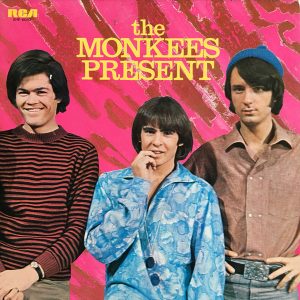
RCA release album cover in Japan of The Monkees Present
Another track from The Monkees , “Good Clean Fun”, climbed to #13 in the fall of ’69 in Australia.
Jones, Nesmith and Dolenz went on a tour with 46 concert dates in Canada, the USA and Mexico. The tour opened in Vancouver (BC) on March 29, 1969. The final concert that year was in Salt Lake City, Utah, on December 6th. The Salt Lake City concert was Mike Nesmith’s last performance as Monkee until a reunion concert in 1986. He did a few promotional TV ads for The Monkees which was now airing in reruns.
In 1970, Nesmith left The Monkees to form The First National Band. That year he enjoyed a Top 30 hit in the USA called “Joanne,” which climbed to #3 in Vancouver. On their own, Davey Jones and Micky Dolenz appeared in concert a number of times in 1970 and released a few singles that were commercial failures. The Monkees officially split at the end of 1970.
In their brief life as a recording act, The Monkees sold over 50 million records. While they officially split in after Mike Nesmith left the band, the bulk of their record sales occurred between August 16, 1966, with the release of “Last Train To Clarksville,” and their final Top Ten album, The Birds, The Bees and The Monkees, in the spring of 1968. They remain the only recording act to chart four albums to #1 in a twelve month span on the Billboard 200 album chart.
In 1975 Jones and Dolenz teamed up with Tommy Boyce and Bobby Hart to do a tour of 38 cities across 13 states. In 1976, they performed in twenty cities across the USA, Japan, Singapore and Thailand. Boyce and Hart had written numbers of songs for The Monkees and were a singer-songwriting team in their own right. In 1986 Davy Jones and Peter Tork went on a 17 concert tour of Australia. An even more ambitious tour saw Jones and Tork joined by Micky Dolenz across the USA for 145 concerts between May 24 and December 3. For one of these concerts ~ the Greek Theatre in Los Angeles ~ Mike Nesmith joined the concert for an original lineup on their 20 year reunion tour. Jones and Tork returned to Australia to perform in 42 concerts in 1987. There were more tours to follow in the USA, Australia and Japan. And in 1989 Jones, Tork and Dolenz went on a 32 concert tour of Europe. The trio went on a 30th Anniversary tour of the USA in 1996. And in 1997 they were joined by Mike Nesmith on a tour of the UK.
Jones, Dolenz and Tork continued to tour as Monkees in different combinations at a trio and a duo with their last big tour in 2011, 45 years after The Monkees TV show debuted.
Davy Jones died in 2012 at the age of 66. On Friday evening, September 16, 2016, in Los Angeles, four days after the 50th Anniversary of the debut of The Monkees on NBC, Michael Nesmith walked onto the stage with Micky Dolenz and Peter Tork at the historic, and sold out, Pantages Theatre to perform what he professed would be his final concert with The Monkees. In 2016, the Monkees released their 17th studio album, Good Times! From the album they released “You Bring the Summer” which reached #12 in Belgium. Peter Tork died in February 2019.
Micky Dolenz and Mike Nesmith planned to be on 17 concert tour in the winter of 2019-2020 billed as “The Monkees Present: The Mike Nesmith & Micky Dolenz Show.” Due to the COVID-19 pandemic, the tour was postponed to 2021. Continuing travel restrictions between Canada and the USA precluded any Canadian stops on their tour when it resumed in ’21.
Mike Nesmith died in December 2021 at the age of 78.
January 5, 2026
Ray McGinnis
References:
Andy Greene, “Davy Jones: The Life of a Monkee: How a Child Actor Joined the Best Fake Band of All Time – and Never Escaped,” Rolling Stone, March 29, 2012.
Davey Jones bio, Davey Jones.net.
Damian Fanelli, “Interview: Michael Nesmith, Micky Dolenz and Peter Tork Talk Monkees Summer Tour, ‘Headquarters’ and What They Learned from Jimi Hendrix,” Guitar World, New York, NY, July 26, 2013.
Peter Tork bio, Wizard World.com
Micheal Nesmith bio, Monkees Rule 43.com
Micky Dolenz biography, Micky Dolenz.com
Monkees 1967 U.S. & British Tour (dates), Monkees Live Almanac.com
Bob Rafaelson ~ Director, Head ~ trailer, Columbia Pictures, 1968.
Ryan Schwartz, “The Monkees’ Peter Tork dead at 77,” TV Line, February 21, 2019.
Andrew Danby, “Texas native, great Michael Nesmith, dies,” San Antonio Express-News, December 10, 2021.
“Trail of Tears,” Wikipedia.org.
Andrew Katz, “Field of Dishonor: Famous American Court-Martials,” Time, August 17, 2013.
“Nicholas Katzenbach dead at 90,” Politico, May 9, 2012.
James W. Douglass, JFK and the Unspeakable: Why He Died and Why It Matters, (Orbis, 2008).
Lydia Saad, “Americans: Kennedy Assassination a Conspiracy,” November 21, 2003.
John Galbraith, “JFK Had Ordered Full Withdrawal from Vietnam: Solid Evidence,” Whowhatwhy.org, September 26, 2017.
President John F. Kennedy, “Commencement Address at American University, Washington, D.C., June 10, 1963,” John F. Kennedy Presidential Library and Museum.
Salim Lamrami, “25 Truths on the Secret Negotiations between Fidel Castro and President Kennedy,” Global Research, June 25, 2015.
“Treaty Banning Nuclear Weapon Tests in the Atmosphere, In Outer Space and Under Water (Partial Test Ban Treaty – PTBT),” Center for Nonproliferation Studies, December 1989.
David Talbot, The Devil’s Chessboard: Allen Dulles, the CIA, and the Rise of America’s Secret Government, Kirkus Reviews, October 13, 2015.
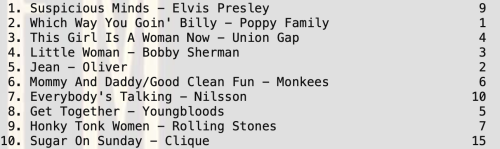
Top 30 CJME 1300-AM Regina (SK) October 17, 1969
Leave a Reply