
#23: Pretty Flamingo by Manfred Mann
City: Regina, SK
Radio Station: CJME
Peak Month: August 1966
Peak Position in Regina ~ #6
Peak Position in Vancouver ~ #8
Peak Position on Billboard Hot 100 ~ #29
Peak Position on Irish Singles chart ~ #1
Peak Position on Rhodesian Singles chart ~ #1
Peak Position on UK Singles chart ~ #1
Peak Position on Norwegian Singles chart ~ #3
Peak Position on Swedish Singles chart ~ #6
YouTube: “Pretty Flamingo”
Lyrics: “Pretty Flamingo”
Manfred Sepse Lubowitz was born in Johannesburg, South Africa, in 1940. Raised in a Jewish family, Manfred studied music at the University of the Witwatersrand, and formed a rock ‘n roll band called The Vikings in 1959. Lubowitz was against the South African system of Apartheid, first introduced in 1948, and becoming entrenched and expanded under the leadership of Prime Minister Hendrik Verwoerd. So Manfred Lubowitz moved to Britain. He began to write for Jazz News under the pseudonym, Manfred Manne. In time he shortened his adopted surname to Mann. In 1962 he met Mike Hugg at a holiday camp at Clacton-on-Sea. (Mike Hugg was born in Hampshire, England, in 1940, and had studied jazz growing up). They decided to start a band and named it the Mann-Hugg Blues Brothers. They added Paul Jones and Tom McGuiness to the band, the latter who was with Eric Clapton’s band The Roosters.
Hugg knew another Hampshire lad named Paul Jones (born 1942). Jones began singing in the early 1960s as “P.P. Jones”, where he performed duets with Elmo Lewis. Jones had been asked to join the Rolling Stones, but turned Mick Jagger and Keith Richards down. However, he said yes to Mike Hugg and joined what was now billed as Manfred Mann in late 1962. Jones was a vocalist and went on to sing lead on many of the bands biggest hits between 1964 and 1966. Another musician from Hamshire was Mike Vickers. He lived in Southampton and played guitar, flute and saxophone. A bass player, Dave Richmond, joined the band in 1962 but quit in 1963. Both Manfred and Mike Hugg were excellent keyboard players. But it was decided that Hugg would become the band’s drummer.
In late 1963, Manfred Mann was asked to provide a new theme tune for the ITV pop music TV program Ready Steady Go! They responded with “5-4-3-2-1” which, aided by weekly television exposure, climbed to #5 in the UK in February 1964. In 1963, the band covered The Exciters’ “Do Wah Diddy Diddy”, which had stalled for the girl group at #78. “Do Wah Diddy Diddy” was the third Top 20 hit in the UK, but the first Top 40 hit for the band in North America. It climbed to #1 on the Billboard Hot 100 in October 1964. In Canada the single reached number-one in Edmonton (AB), Halifax (NS), Montreal, North Bay (ON), Saskatoon (SK), Toronto, Vancouver, Windsor (ON) and Winnipeg (MB). Once “Do Was Diddy Diddy” became a Top Ten smash hit in Canada and the USA, “5-4-3-2-1” and “She-La-La” were added to playlists from coast to coast.
Manfred remembers trying to adjust to stardom. “In the summers of 1964 and ’65, we played Blackpool Pier every Sunday evening. To avoid fans, we’d finish playing and dash in panic down the pier towards our waiting car, hoping to be past the front of the theatre before the audience spotted us. But it only partly worked and every week we were chased by screaming fans.”
The next hit, “Sha-La-La,” climbed to #5 in Vancouver. It was a cover of a song by The Shirelles. They would later cover the Carole King-Gerry Goffin song, “Oh, No Not My Baby”, which climbed to #11 in the UK in the spring of 1965. However, it was not a hit in North America. In 1964, “Come Tomorrow” reached #3 in South Africa and #4 in the UK.
In 1965, Manfred Mann covered song written by Bob Dylan titled “If You Gotta Go, Go Now”. It peaked at #2 in the UK, Ireland and South Africa, and #7 in Sweden. In 1966, Manfred Mann covered the Bob Dylan tune “Just Like A Woman”. It topped the pop charts in Sweden, and reached #5 in South Africa, #6 in Denmark, #7 in Finland, #8 in the UK and #9 in Rhodesia. That year Mike Vickers left the band to pursue a solo career. Jack Bruce, later with Cream, was with Manfred Mann for a brief eight-month stint.
Klaus Voorman joined the band. He was born in Berlin in 1938. In 1965, he designed the cover for the Beatles album Revolver. In 1966, the album won a Grammy Award for Best Album Cover, Graphic Arts. He also designed cover art for some albums by the Bee Gees. Voorman played bass guitar with Manfred Mann from 1966 to 1969, including on the singles “Just Like A Woman” and “Pretty Flamingo”.
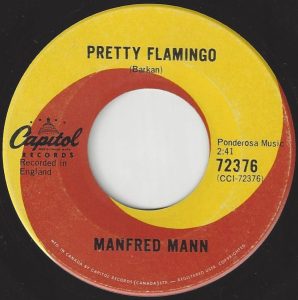
Mark Barkan wrote “Pretty Flamingo”. He was born in 1934 in Brooklyn (NY). He had his first commercial success as a songwriter in 1961 with “The Writing On the Wall” which became a #5 hit for Adam Wade. He also wrote a minor hit that year for Johnny Maestro titled “Mr. Happiness”. As well in ’61 he penned “Flying Blue Angels” for George Johnny and the Pilots which became a number-one hit in Vancouver. Among his other songwriting successes are “I’m Gonna Be Warm This Winter” for Connie Francis – a Top 20 hit in 1962; “She’s Fool” – a #5 hit for Lesley Gore in 1963, as well as “That’s The Way Boys Are” (also for Lesley Gore). He wrote other songs for Sonny & Cher, the Archies, the Monkees, Vic Dana, Chuck Jackson, Dusty Springfield, Shelley Fabares, Nat “King” Cole, Tommy Steele, Billy Fury, the Dupree’s, Paul Anka, Elvis Presley, Jay & The Techniques, BT Express and others. In 1968, Marcus Barkan was the musical director for NBC cartoon series The Banana Splits Adventure Hour. This included composing the theme “Tra-La-La Song”. Marcus Barkan died at age 85 in 2020.
“Pretty Flamingo” is a song that is not about a flamingo. Instead, the flamingo is a metaphor for a love interest concerning particularly attractive young woman who lives on the same block of the guy who is attracted to her. It’s not just the narrator of the song who notices her. He sings “On our block all of the guys call her ‘flamingo.’ Her hair glows like the sun and her eyes “can light the skies.” She has lots of sex appeal: “When she walks she looks so fine like a flamingo. Crimson dress that clings so tight, she’s out of reach and out of sight.” If the guy singing about her is able to win her as his girlfriend, he predicts “every guy will envy me, ’cause paradise is where I’ll be.”
“Pretty Flamingo” was written by Mark Barkan for a short-lived psychedelic band from Philadelphia, called The Deep. Initially, when first introduced to the song by producer John Burgess, Paul Jones was underwhelmed. He thought it didn’t have enough soul. It was also recorded by Tommy Vann and the Echoes. However, when “Pretty Flamingo” shot to #1 in the UK, Jones conceded “I was absolutely wrong.”
“Pretty Flamingo” reached #4 in Hamilton (ON), #6 in Milwaukee (WI), and Regina (SK), #8 in Bakersfield (CA), Phoenix, Harrisburg (PA), Birmingham (AL), Vancouver (BC), and Syracuse (NY), #9 in Jamestown (ND), #10 in Seattle, and Arlington Heights (IL), and #11 in Fresno (CA), and Omaha (NE). Internationally, “Pretty Flamingo” topped the pop charts in Ireland, New Zealand, Rhodesia, and the UK. It also climbed to #2 in Canada, #3 in Norway, #6 in Sweden, #12 in West Germany and #15 in the Netherlands.
“Pretty Flamingo” was recorded by Tommy Roe, the Everly Brothers, Tommy Vann and the Echoes, Mel Torme, Sounds Orchestral, Harold Betters, Tony Hatch, Billy Strange & the Challengers, Gerry & the Pacemakers, The Sandpipers, Rod Stewart, Bruce Springsteen, Tight Fit, Huxton Creepers, The Queers, Rolf Harris, West German pop star Heinz Harden, The Vanguards, Italian pop singer Cino Benci, Serbian pop artist Zafir Hadžimanov, and others.
In 1966, lead singer Paul Jones left Manfred Mann and was replaced by Michael David d’Abo. The band ended the year with another international Top Ten hit, “Semi-Detached, Suburban Mr. James”. The song with lead vocals by d’Abo concerned an ex-boyfriend who boasts to the bride that no one can love her like he can. The song climbed to #1 in Rhodesia, #2 in the UK, #3 in New Zealand, #5 in Finland and Ireland, #7 in Denmark, #10 in Sweden, and #11 in South Africa.
In 1967, Manfred Mann released “Ha! Ha! said the Clown”. The single shot to number-one in Austria, Belgium, the Netherlands, South Africa and West Germany. It also charted into the Top Five in Denmark, France, New Zealand, Norway, Rhodesia, Sweden and the UK.
Their last North American hit in the 60’s was “The Mighty Quinn (Quinn The Eskimo)”, which peaked at #10 on the Billboard Hot 100 in 1968. It topped the pop charts in Ireland, New Zealand, Sweden, the UK and West Germany. As well, it cracked the Top 5 on pop charts in Austria, Canada, the Netherlands, Norway, and Switzerland. That same year, “My Name Is Jack” peaked at #1 in Austria, and was a Top Ten hit in Australia, Ireland, New Zealand, the UK and West Germany.
Manfred Mann’s final release in 1968 was “Fox On The Run”. Internationally, “Fox On The Run” peaked at #1 in New Zealand, #2 in Ireland, #3 in Australia, #5 in the UK, #6 in Norway, #7 in West Germany, and #13 in Austria.
Manfred Mann had one more single release titled “Ragamuffin Man”. It reached #5 in New Zealand, #8 in the UK, #10 in Ireland, and cracked the Top 20 in both Australia and West Germany.
Manfred Mann disolved as a band in 1969. Later that year Manfred Mann and Mike Hugg formed an experimental jazz band named Manfred Mann Chapter Three. In 1971 their band took a new direction and they renamed it Manfred Mann’s Earth Band. In this fourth incarnation they had three Top Ten hits in the UK in the 1970’s. One of these, “Blinded By The Light”, became an international hit that topped the pop charts across North America in 1977.
In the early 1972’s Hugg released two solo albums, Somewhere and Stress & Strain. In 1975, he was with the band named Hug who released the album Neon Dreams. Through the 1970’s he composed music for radio and TV commercials. He also produced a hit single, the theme for The Likely Lads written for a popular BBC TV Show. In 2015, Mike Hugg formed the acoustic jazz trio PBD.
Paul Jones, who left Manfred Mann in 1966 starred as a deified pop star in the 1967 film Privilege. The title track was a #4 hit in Sweden. In 1968, Jones starred in a British satire film noir titled The Committee. And in 1972, he starred in the horror film Demons of the Mind. Between 1966 and 1969, Paul Jones released four solo albums. These were My Way (1966), Sings Songs From The Film Privilege (1967), Love Me, Love My Friends (1968), and Come into My Music Box (1969). His 1966 single, “High Time”, reached #4 in the UK and #10 in New Zealand. While in 1967 “I’ve Been a Bad, Bad Boy” was a Top Ten hit in Ireland, New Zealand, Sweden and the UK. And “Poor Jenny”, “Sons and Lovers” and “When I Was Six Years Old” were Top Ten hits variously in both New Zealand and Sweden.
In 1975, Paul Jones performed on a BBC TV special of 1975 Christmas production Great Big Groovy Horse, a rock opera of the Greek legend of The Trojan Horse. In 1976, Paul Jones played Juan Perón for the concept album of the forthcoming stage musical Evita by Andrew Lloyd Webber and Tim Rice. From 1985 to 1986, Jones was the host of a children’s game show on BBC called Beat the Teacher. He also variously appeared in productions of Guys and Dolls, John Gays’ 1728 musical A Beggar’s Opera, Drake’s Dream about the life of Sir Francis Drake, and a West End production of the Broadway musical Pump Boys and Dinettes. In 2009 Jones released the studio album Starting All Over Again, and in 2015 Suddenly I Like It.
Tom McGuinness formed McGuinness-Flint with Hughie Flint (of John Mayall & the Bluesbreakers). Their debut single, “When I’m Dead and Gone” peaked in early 1971 at #2 in the UK and #5 in Ireland. A followup, “Malt and Barley Blues”, was a #5 hit in the UK later that year. In 1979, McGuinness and Paul Jones co-founded The Blues Band. Over the next four decades the band released over twenty albums.
After Manfred Mann split in 1969, Klaus Voorman was a session musician with the Plastic Ono Band, Badfinger, Dion, Hoyt Axton, Donovan, Peter Frampton, Art Garfunkel on “My Little Town” and others, George Harrison on “Give Me Love (Give Me Peace On Earth)” and others, John Lennon on “Imagine”, “Whatever Gets You Thru The Night”, and many others, Maria Muldaur, Randy Newman on “Short People” and others, Harry Nilsson on “Without You” and others, Yoko Ono, Billy Preston, Lou Reed, Leon Russell, Martha Reeves, Carly Simon on “You’re So Vain”, “Mockingbird”, “Haven’t Got Time For the Pain” and others, Ringo Starr on “It Don’t Come Easy”, “Photograph”, You’re Sixteen”, “No No Song”, “Back Off Boogaloo” and others, Howlin’ Wolf, and Louden Wainwright III. Voorman was also part of George Harrison’s band at The Concert for Bangla Desh at Madison Square Garden, New York City, August 1, 1971. Voorman went into semi-retirement in the late 80s. But in 2009 released his first studio album. In 2016, Klaus Voorman published a graphic novel titled Revolver 50: Birth of an Icon.
Since 1992, The Manfreds have performed in concert. The core of the lineup has consisted of Tom McGuinness, Paul Jones, Mike d’Abo, and Mike Hugg (the latter until 2021). Former Manfred Mann saxophonist, flutist and guitar player Mike Vickers was also with The Manfreds from 1992 to 2000. In the late 90s The Manfreds released on studio album and one live album.
February 2, 2026
Ray McGinnis
References:
“Mike Hugg: Bio,” themanfreds.com.
Duncan Eaton, “The Man Behind the Manfreds,” Daily Echo, August 21, 2013.
Richard Webber, “Whatever happened to… Manfred Mann?,” Express, London, UK, October 18, 2014.
Paul Morley, “Klaus Voorman,” Guardian, September 4, 2009.
“Mike Hugg: Biography,” themanfreds.com.
“Mike d’Abo: Biography,” themanfreds.com, December 2005.
“Tom McGuinness Interview (Manfred Mann – Hits From the Sixties),” Velvet Thunder, October 4, 2023.
Alex Petridis, “60’s Hitmakers Manfred Mann: ‘I’ve sung this song 10,000 times and never liked it,” Guardian, October 14, 2021.
“Veteran pop and rock songwriter Mark Barkan dies at age 85,” ABC, May 8, 2020.
Sounds Orchestral, “Pretty Flamingo“, PYE Records, 1966.
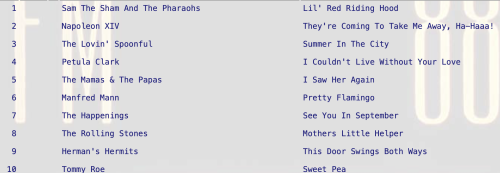
Regina’s Official Radio Record Survey – Top 50 CJME 1300-AM Regina (SK) | August 12, 1966
One of my favorite songs.
Mine too!