
#14: Some Day, One Day by the Seekers
City: St. John’s, NL
Radio Station: VOCM
Peak Month: May 1966
Peak Position in St. John’s ~ #4
Peak Position in Vancouver ~ did not chart
Peak Position on Billboard Hot 100 ~ did not chart
YouTube: “Some Day, One Day”
Lyrics: “Some Day, One Day”
The Seekers were a group from Australia. Formed in Melbourne in 1962, it was founded by Athol Guy. He was born in a small city southwest of Melbourne in 1940. In 1958 he formed a group called the Ramblers. He attended Melbourne Boys High School and became friends with schoolmates Keith Potger and Bruce Woodley. Keith Potter was born in 1941 in Columbo, Ceylon. His family moved to Australia while he was a child. In the late 50s, Potger led a rock ‘n roll group named the Trinamics. Bruce Woodley was born in 1942 in Melbourne. He and Athol Guy formed the Escorts in the early 60s. By 1962, the Escorts morphed into the Seekers. There were several lineup changes before they got the right fit. Athol Guy played double-bass guitar. Keith Potger played twelve-string guitar. Bruce Woodley played guitar. While Judith Durham became the female lead vocalist. Born Judith Mavis Cock in 1943 in suburban Melbourne, she had a knack for music. In her late teens she began to have some professional engagements playing piano. She had classical vocal training as a soprano, and performed blues, gospel and jazz pieces. Starting in 1961, at the age of 18, Judith Cock took her mother’s maiden name, Durham, as a surname for her stage name: Judith Durham.
In 1963 the group released Introducing the Seekers. Their debut single, “Kumbaya”, was not a hit. Their self-titled album, The Seekers, a featured the track, “Waltzing Matilda”, which was a minor hit single in Australia late in 1963. But in late 1964, the group released a non-album single “I’ll Never Find Another You”. It became a smash international hit in 1965, climbing to number-one in Australia and the UK, #2 in Ireland, #3 in Canada, #6 in Norway, and into the Top 20 in both South Africa and Sweden. They were rewarded with a followup hit, “A World Of Our Own”. It topped the pop chart in South Africa and Rhodesia, peaked at #2 in Australia, Ireland, and Singapore, #3 in the UK, #5 in Canada, #9 in Malaysia, and Top 20 in the Netherlands and the USA.
The Seekers won the Best New Group in the New Musical Express Poll Winners Awards and performed on 11 April at the Wembley Empire Pool, on a bill that included the Beatles, the Rolling Stones, Cliff Richard and Dusty Springfield.
The group released “Morningtown Ride” in 1965, which became an international hit. But in Canada and the United States, the single did not crack the pop charts until 1967. Meanwhile, the Seekers had another hit in 1965 titled “The Carnival Is Over”. It topped the pop chart in Australia, Ireland, New Zealand and the UK. It also climbed to #2 in South Africa and #3 in Norway. But it stalled beneath the Billboard Hot 100 at #105.
In 1966, the Seekers released “Someday, One Day”.
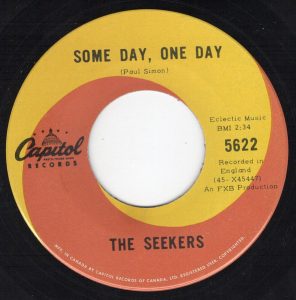
“Some Day, One Day” was written by Paul Simon. The song anticipates a time not so far off when the dreams shared by companions will be realized. Though time seems to move slowly, hold on fast. Look in the mirror and behold all of who you are, as the singer contends “someone to be proud of…”
Paul Simon was born in 1941 in Newark (NJ). He had a solo career before he met Art Garfunkel and the pair became Simon & Garfunkel. They sold over 100 million records. They were nominated for 18 Grammy Awards and won 14. The duo broke up in 1970 and both pursued solo careers. Paul Simon went on to separately received 17 Grammy Award nominations, winning four of these. He has released 15 solo albums.
“Some Day, One Day” reached #4 in St. John’s (NL), #21 in Portland (OR), and #23 in Sacramento (CA). It peaked at #4 in Australia, and #11 in both New Zealand and the UK.
Next, “Walk With Me” jumped to #5 in South Africa and #10 in the UK. A further high mark in the Seekers musical career was the October 1966 release of “Georgy Girl”. It was the theme song for the romantic comedy Georgy Girl, starring Lynn Redgrave and James Mason.
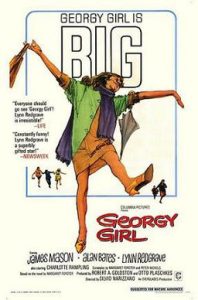
The opening credits show the title character walking through the streets of London and being tempted into a hairdressers where she has her hair set in a far more contemporary style. She immediately changes her mind, and runs through the streets until she reaches a public lavatory. Once there, she submerges her hair in a sink-full of water, happy to return to her previously unkempt hairstyle. Georgina (“Georgy”) Parkin (played by Lynn Redgrave) is a 22-year-old Londoner who has considerable musical talent, is well-educated, and has an engaging, unpretentious character. At the same time, she believes herself to be plain and slightly overweight, she dresses haphazardly, and she is incredibly naïve on the subjects of love and flirtation. She has never had a boyfriend.
“Georgy Girl” was nominated for Best Song at the Academy Awards. The film received four Academy Award nominations, including Best Actress (Lynn Redgrave) and Best Supporting Actor (James Mason). “Georgy Girl” topped the pop charts in Australia, Canada, New Zealand, and the USA (Cashbox), climbed to #3 in the UK, #10 in Ireland and South Africa, and #14 in Sweden. It was a Top Ten hit in many radio markets across Canada in January-February 1967. The album, Come the Day, which featured “Georgy Girl”, was a Top Ten seller on the album charts in Australia, the UK and USA. The album peaked at #2 in Australia, their highest rank ever achieved.
With fresh interest in the sound of the Seekers, radio stations in North America began to play “Morningtown Ride” once “Georgy Girl” fell off the pop charts here.
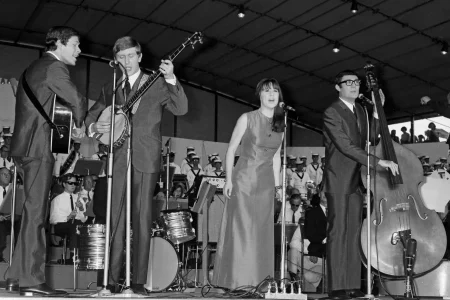
The Seekers performing in Sydney, Australia, in 1967
In May and June 1967, The Seekers appeared three times in concert at the Expo Theatre at Expo ’67 in Montreal.
Later in 1967, “When Will the Good Apples Fall” was a Top Ten hit in Ireland, #11 in the UK and #12 in South Africa. Before Christmas 1967, the Seekers released “Emerald City”, a song set to the tune of “Ode to Joy”. The song was about a visit to the Emerald City in the Frank L. Baum story The Wizard of Oz.
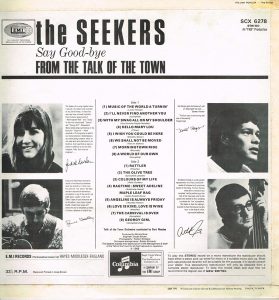
In 1968, Guy and the other members of The Seekers were named jointly Australians of the Year for 1967. In 1968 the Seekers announced they were disbanding. They performed a farewell concert in July 1968 at The Talk of the Town in London, UK, on Charring Cross Road. An album was released titled Live at The Talk Of The Town. On the back of the album a caption read “The Seekers Say Goodbye from The Talk Of The Town.”
Near the end of 1968, Judith Durham released a solo album For Christmas With Love. It was the first of four solo studio albums she released into the mid-70s. In 1969 Keith Potger released a single but it got little attention.
In 1969, Keith Potger found new musicians and vocalists to form the New Seekers. In 1970, their single release “Look What They’ve Done To My Song Ma”, was an international Top Ten hit, topping the charts in New Zealand. It was the debut single from Keith Potger & the New Seekers. The single also charted well in Australia, Belgium, Canada and the USA. As well, the New Seekers covered the Delaney & Bonnie hit “Never Ending Song of Love”. Their version climbed to #1 in Ireland, and #2 in South Africa and the UK. In 1971 they had a successful international hit with “I’d Like to Teach the World to Sing”. It topped the pop charts in Ireland, Japan, New Zealand and the UK. It was also a Top Ten hit in Australia, Canada, South Africa and the USA.
In 1972, another track from the album We’d Like to Teach the World to Sing was “Beg, Borrow or Steal”. It was a British entry for the Eurovision contest in 1972. It climbed to #1 in Norway, #2 in the UK, #3 in Ireland and the Netherlands, #5 in Switzerland and West Germany, #9 in Belgium and #10 in South Africa. Late that year the New Seekers covered a Harry Chapin song titled “Circles”. It became another international best seller, peaking at #3 in Ireland and #4 in the UK. The New Seekers had a Top 20 UK hit with their cover of the Fleetwoods song “Come Softly To Me” in 1973.
The New Seekers also had a Top 20 hit with their cover of The Who medley “Pinball Wizard-See Me, Feel Me”. Late in 1973, the New Seekers had a number-one hit in the UK with “You Won’t Find Another Fool Like Me”. It climbed to #5 in Australia. The New Seekers last notable hit was in 1974 with “I Get a Little Sentimental Over You”. The single reached #5 in the UK, #9 in Ireland, #11 in New Zealand and #12 in Australia. The New Seekers disbanded in 1974.
In 1971, Bruce Woodley released a solo album titled Just Good Friends.
In 1975, the Seekers reformed with Louisa Wisseling, a semi-professional folk singer formerly with Melbourne group the Settlers. They had their last Top Ten hit, “Sparrow Song”, on the Australian pop chart. It was written by Bruce Woodley. He left the reformed Seekers in 1977. By 1978 Keith Potger was the only original Seeker in the group. Meanwhile, in 1976 Judith Durham formed the The Hot Jazz Duo with pianist Ron Edgeworth. In 1979 they released a self-titled album The Hot Jazz Duo.
In 1995, the Seekers received the Medal of the Order of Australia. In 2012, the Seekers were honoured by Australia Post with a special Legends Of Australian Music postage stamp.
In 1997, after several more solo albums, Judith Durham reunited with the original Seekers. They released the album Future Road. It climbed to #4 in the Australian album chart. That year Bruce Woodley’s “I Am An Australian” became a Top 20 hit in Australia. Over the years the Seekers have released 14 compilation albums. Of these, eight have charted into the Top Ten on album charts variously in Australia, New Zealand and the UK. Their most recent, Carry Me (The Seekers 60th Anniversary), peaked at #10 in Australia. A box set, Treasure Chest, climbed to #7 in Australia in 1997. They have released 13 studio albums as the Seekers, the most recent Back to Our Roots in 2019.
Keith Potger has released four solo albums between 2004 and 2020. Athol Guy, Bruce Woodley and Keith Potger have remained active members in what is now called The Original Seekers. In 2003 a memoir about Judith Durham was published titled The Colours of My Life: The Judith Durham Story. In 2022 Judith Durham died at the age of 79, after recording a dozen solo albums.
Worldwide, the Seekers have sold over 50 million records.
April 17, 2026
Ray McGinnis
References:
Jackson Graham, “Judith Durham, lead of The Seekers, dies aged 79,” WA Today, August 6, 2022.
D Kelsen, “The Life and Times of Malvina Reynolds, Long Beach’s Most Legendary (and Hated) Folksinger,” OCWeekly, Orange County, CA, August 31, 2016.
Malvina Reynolds, “Magic Penny“, 1957.
“Songs Written by Malvina Reynolds,” musicvf.com.
“The Seekers: Athol Guy, Judith Durham, Keith Potger, and Bruce Woodley: Chart Topping Singing Group,” Australian of the Year Awards.
Graham Simpson, Colours of My Life: The Judith Durham Story, (Random House, 2003).
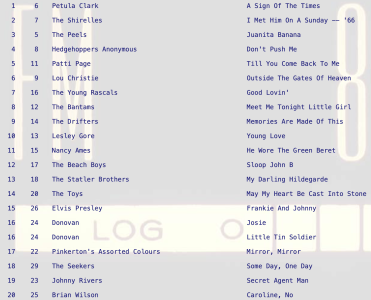
VOCM 590-AM St. John’s (NFLD) | April 15, 1966
Leave a Reply