
#171: The Swingin’ Shepherd Blues by Moe Koffman Quartette
City: Toronto, ON
Radio Station: CHUM
Peak Month: February 1958
Peak Position in Toronto ~ #4
Peak Position in Vancouver ~ #22
Peak Position on Billboard Hot 100 ~ #36
YouTube: “The Swingin’ Shepherd Blues”
Morris “Moe” Koffman was born in Toronto in 1928 to Jewish parents who ran a variety store. Koffman began to study violin at the age of nine. He later attended the Toronto Conservatory of Music. Koffman dropped out of school when he found work performing in dance bands. In 1950, he moved to the United States, where he played with a number of big bands, including with Sonny Dunham and Jimmy Dorsey. In 1955, he returned to Toronto where he formed a quartet and later a quintet.
Other members of the Moe Koffman Quartette were Ed Bickert on guitar, Hugh Currie on bass guitar, and Ron Rully on drums. Ed Bickert was born in Hochfeld, Manitoba, in 1932. His family moved to Vernon, British Columbia during his early childhood. Bickert appeared as a child with his family as a performer at country dances. He learned to play guitar from his brother. In 1952, he moved to Toronto and was in the recording studio as a session musician with Chet Baker and others, where he also met Moe Koffman.
Ron Rully was born in 1935. He was a composer and drummer who was in the ensemble as a drummer with the CBC TV show Wayne and Shuster, from 1957 onwards. He later was on the CBC documentary series Quest in 1963.
Hugh Currie travelled to England for several years in the early fifties and played with bandleaders Jack Parnell and Tony Crombie, and tenor saxophonist Ronnie Scott. By the mid-50s, Currie became the house bass guitar player at the Toronto jazz club Town Tavern at 16 Queen Street E. was part of the Moe Koffman Quartette formed in 1955, and into the late 50s.
The Moe Koffman Quartette released an album in 1957 titled Cool and Hot Sax.
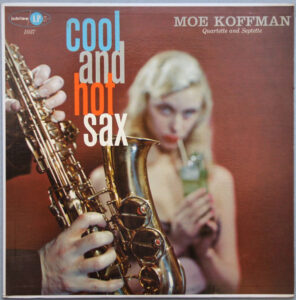
From the album came the single “The Swingin’ Shepherd Blues”, written by Moe Koffman.
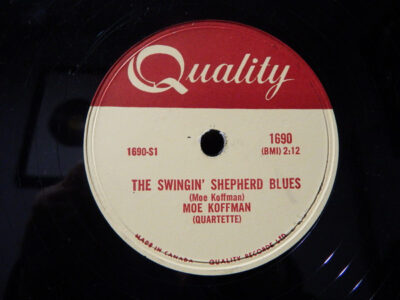
“The Swingin’ Shepherd Blues” features the flute. The word flute first appeared in the English language during the Middle English period, as floute, flowte, or flo(y)te, possibly from Old French flaute and Old Provencal flaüt. The first known use of the word flute was in the 14th century. According to the Oxford English Dictionary, this was in Geoffrey Chaucer’s The House of Fame, c. 1380. However, there was a flute found in the Hohle Fels Cave in Germany in 2009, that is dated as at least 35,000 years old. It is made from a vulture wing bone. A musician who plays any instrument in the flute family can be called a flutist, flautist, or flute player. Flutist dates back to at least 1603, the earliest quotation cited by the Oxford English Dictionary. In jazz, the flute only became common in the 1950s. Moe Koffman’s choice of flute for “The Swingin’ Shepherd Blues” was in tune with the embrace of the instrument in jazz circles during the decade.
“The Swingin’ Shepherd Blues” peaked at #1 in St. Louis, and New Orleans, #2 in Albany (NY), #3 in Washington DC, Smiths Falls (ON), and Rutland (VT), #4 in Toronto, Winnipeg (MB), and Milwaukee, #5 in Oklahoma City, #7 in Kansas City (MO), Springfield (MA), and Buffalo, #8 in New York City, La Crosse (WI), Ottawa, and Burlington (VT), and #9 in Rochester (NY) and #11 in Houston. Internationally, it reached #23 in England, and #36 on the Billboard Hot 100. At the time Canada did not have a national record survey.
On February 3, 1958, “The Swingin’ Shepherd Blues” jumped from #21 to #4 on the CHUM Hit Parade in Toronto. You’d expect the single would climb higher the following week. But, due to sales of “Stood Up” by Ricky Nelson, “You Are My Destiny” by Paul Anka, and “Short Shorts” by the Royal Teens, and “Maybe” by the Chantels, the instrumental dropped to #10. However, the following weeks it remained in the CHUM Top Ten at #7 and #6, before dropping out of the Top Ten on the CHUM chart the first week of March.
Other recording artists went to the studio to record “The Swingin’ Shepherd Blues”. In January 1958, the Johnny Pate Quintet offered a close cover of the Moe Koffman Quartette, and this cover reached #43 on the Billboard wpop chart, and #17 on the R&B chart. In February and March 1958, David Terry and His Orchestra saw their cover reach the Top Ten in Chicago, New Orleans, Pittsburgh, and Schenectady (NY). Concurrently, Kirk Stuart with The Honeydreamers cracked the Top Ten in Boston and Troy (NY). British bandleader David Rose and His Orchestra, reached the Top Ten with his version in Buffalo, Denver, La Crosse (WI), Los Angeles, Lowell (MA), Milwaukee (WI), Pittsburgh, Rochester (NY), and Washington DC. David Rose’s version, with a rock ‘n roll piano background, stalled at #50 on the Billboard pop chart. Ted Heath and His Orchestra took the instrumental to #3 in the UK. In this version, the flute was replaced with main solos provided by soprano saxophone and clarinet. As well, vibraphone is featured in the recording.
As well, in 1958, Ella Fitzgerald And Her Shepherds released a single with vocals. It featured these lyrics:
Along a mountain pass,
There is a patch of grass,
Where the swingin’ shepard plays his tunes.
His sheep never stray,
Dancing all day til they see the pale and yellow moon.
And then he leads his flock,
And they all rock to the tune of the swingin’ sheperd blues.
Fitzgerald’s recording reached #15 in the UK in 1958.
In 1967, Hugh Davie and the Calliope Band had a minor hit with the instrumental. While in 1993 Natalie Cole recorded the song. She sang an additional verse:
This is something really extra special
A ditty we like to do just for you
It’s the onliest swinginest grooviest thingy that we’ve ever done
And if you like it then before we are thru
Then you ought to move along groove and join this song and I don’t have to repeat
It’s swing!
Ah yes!
Now it’s complete
Wooh!
There are over 300 recordings of “The Swingin’ Shepherd Blues”, including by Count Basie, Mantovani, Herbie Mann, Oscar Peterson, Duane Eddy, Floyd Cramer, Woody Herman, Tito Puente, King Curtis, and others.
Moe Kauffman followed up “The Swingin’ Shepherd Blues” with the release of “Little Pixie” in June 1958. The single stalled at #72 on the Billboard Hot 100, but topped the pop chart on CJBC in Toronto in April 1958, and #20 in Vancouver.
In 1962, in the midst of the Twist craze, Moe Koffman released “Swingin’ Shepherd Blues Twist”. It peaked at #24 in Seattle on KJR. The single was a track from the album The Swinging Shepherd Plays For The Teens. Other tracks included “Twist the Hully Gully”, “Pretzel Twist”, “Flute Twist”, “Twistin’ and Bumpin'”, “Shimmy Twist”, “Backbone Twist” and others.
On the album, the liner notes were effusive:
…to the show business firmament comes Moe Koffman, an exciting young man, his flute and a Sound that has reached and captured young listeners all over the world. This is truly music of The Sixties, a sound of youth, and a talented young man and his orchestra performing…. Despite his popularity as a performer, Moe has spent many long hours as a composer, and in this album a number of his original tunes are featured.
Koffman was inspired by Rahsaan Roland Kirk to play multiple instruments at once; and had a modified set of straps to hold a tenor and an alto saxophone so that he could put forward incredible chords and improvise at the same time. One of the more famous session musicians in Toronto, he appeared in countless commercials, background music, and film and TV soundtracks. Most work on bass flute in Canadian soundtracks from 1950 to 1990 in Toronto sessions was done by Koffman on this rare instrument. Koffman was also an exponent of circular breathing techniques for his large volumes of sound, and joined fellow Canadian Maynard Ferguson and new age multi-instrumentalist musician Ron Allen in this talent.
In 1963, a Moe Koffman Quintet single, “Cool Ghoul”, was a charting hit on Long Island, New York, on WGLI in Babylon. In early 1964, Moe Koffman’s “Flootenanny” was a charting single on CKOC in Hamilton.
During the 1970s, Koffman recorded several albums with arrangements of works by classical composers including Bach, Mozart and Vivaldi. The albums were released by GRT Canada and later by Universal. He also was a guest performer with a number of symphony orchestras across Canada.
Moe Koffman performed with trumpeter and bandleader, Dizzy Gillespie, and vibraphonist and composer, Peter Appleyard, during the 1980s. He also continued to front the Moe Koffman Quintet. He often performed with Rob McConnell’s Boss Brass. From 1956 to 1990, Koffman booked performers for George’s Spaghetti House in Toronto, where he performed weekly. His compositions “Curried Soul” and “Koff Drops” have been used as the opening and closing themes respectively for the CBC radio show As It Happens since 1972.
He was appointed to the Order of Canada in 1993 and inducted into the Canadian Music Hall of Fame in 1997. In 2001, Moe Koffman died at the age of 72 after being diagnosed the previous year with non-Hodgkin’s lymphoma.
Through the 1960s and 1970s, fellow Moe Koffman Quarette member Ed Bickert was frequently hired in Toronto. This was as a studio guitarist for traditional pop singers, singer-songwriters, and easy listening albums. In the late 1960s, he joined trombonist Rob McConnell’s Boss Brass big band, and continued to play and record with the group for three decades. Over the years, this group featured several musicians Bickert would work with in his own groups, including bassists Don Thompson and Steve Wallace, and drummers Jerry Fuller and Terry Clarke.
At age 42, Bickert was hired by alto saxophonist Paul Desmond, and he played on Demond’s final studio and live albums. Desmond’s international audience of jazz fans and critics greatly increased Bickert’s exposure and boosted his reputation. Following Desmond’s death in 1977, Bickert continued to record and perform with well-known jazz stars including Milt Jackson, Ruby Braff, Oscar Peterson, Benny Carter, and Rosemary Clooney, Bickert also began recording under his own name starting in 1975, initially releasing albums on Canadian labels, and then signing with Concord Records in 1982. Between 1983 and 1990 Bickert released five albums under his own name on Concord, and appeared as a backing musician on several other Concord releases. Bickert also toured and recorded live albums with The Concord All-Stars, a group that included other Concord recording artists like Scott Hamilton, Warren Vache, Dave McKenna, and Ernestine Anderson. In the 1990s, Bickert recorded as a co-leader in two trios that featured his guitar with a bassist and one horn; the first was a trio with his longtime employer Rob McConnell, while the second was a group organized by saxophonist Mike Murley. Each trio released two albums
Bickert stopped playing guitar in 2000 after his wife died and he fell and broke both his arms. In 2012, Ed Bickert was celebrated on his 80th birthday with a tribute concert in Toronto featuring many of the musicians he played with or influenced. Bickert died in 2019 in Toronto after a battle with cancer. He is a member of the Order of Canada.
Ron Rully went on from his work in the Moe Koffman Quartette to earn a reputation as a prominent Canadian jazz and studio drummer for decades. He performed with artists and ensembles including Oscar Peterson, Anne Murray, Ron Collier, Maynard Ferguson, Phil Nimmons, and others. He was also active in Toronto studio work for television, radio, and recordings. He fronted the Ron Rully Sextet. In 1974, he toured in Japan as part of the Quincy Jones Orchestra. Ron Rully died in 2015 at the age of 79.
Little is written about Hugh Currie since his time with the Moe Koffman Quartette. If anyone knows what became of Hugh Currie, send me a message.
September 25, 2026
Ray McGinnis
References:
Bruce Crowther, “Ed Bickert: Obituary,” Jazz Journal, March 13, 2019.
Moe Koffman, “Swinging Shepherd Blues Twist“, United Artists, 1962.
“Jazz legend Moe Koffman dies,” CBC, March 29, 2001.
Ella Fitzgerald And Her Shepherds, “The Swingin’ Shepherd Blues“, Verve Records, 1958.
Natalie Cole, “The Swingin’ Shepherd Blues“, Elektra Records, 1993.
Ted Health and His Orchestra, “The Swingin’ Shepherd Blues“, Decca Records, 1958.
Pallab Ghosh, “‘Oldest musical instrument’ found,” BBC, June 25, 2009.
Moe Koffman, “Curried Soul“, Revolver Records, 1970.
Moe Koffman, “Koff Drops“, GRT, 1971.
Count Basie, “The Swingin’ Shepherd Blues“, Reprise Records, 1963.
Tito Puente, “The Swingin’ Shepherd Blues (Goes Latin)“, Concord Jazz Picante, 1987.
Floyd Cramer, “The Swingin’ Shepherd Blues“, RCA Victor, 1960.
David Rose and His Orchestra, “Swingin’ Shepherd Blues“, MGM Records, 1958.
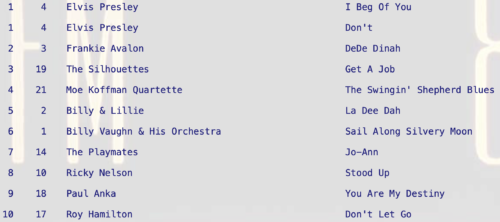
CHUM Hit Parade | CHUM 1050-AM Toronto (ON) | February 3, 1958a
Great post — thanks! I was only nine, but I remember every note.
Thanks Judy!
Another great Toronto creation. Always loved this instrumental.
A classic and I’m glad to review “The Swingin’ Shepherd Blues” for my website archive project.