
#8: When The World Is Running Down, You Make the Best of What’s Still Around by the Police
City: Sherbrooke, PQ
Radio Station: CKTS
Peak Month: May 1981
Peak Position in Sherbrooke ~ #3
Peak Position in Vancouver ~ did not chart
Peak Position on Billboard Hot 100 ~ #81
YouTube: “When The World Is Running Down, You Make the Best of What’s Still Around”
Lyrics: “When The World Is Running Down, You Make the Best of What’s Still Around”
Gordon Matthew Thomas Sumner was born in Wallsend on Tyne, North Tyneside, Northumberland, England, in 1951. His mother was a hairdresser and his father was a milkman and engineer. When he was ten-years-old, young Sumner got introduced to Spanish guitar, when a family friend left it at the Sumner residence. After high school he was variously a bus conductor, building labourer and tax officer. He went to college and from 1974-76 was a public school teacher. Sumner performed jazz in the evening, weekends and during breaks from college and teaching, playing with the Phoenix Jazzmen, Newcastle Big Band, and Last Exit. He gained his nickname, “Sting,” due to his habit of wearing a black and yellow sweater with hooped stripes with the Phoenix Jazzmen. Bandleader Gordon Solomon thought Sumner looked like a bee which prompted the name “Sting.” According to Sting, in an interview with CBS Sunday Morning, “they thought I looked like a wasp, and they’d joke. They called me Sting. They thought it was hilarious…That became my name.”
In January 1977, Sting moved from Newcastle to London. It was in London that he met up with Steward Copeland and Henry Padovani to form the Police. (Padovani was replaced by Andy Summers at the end of August 1977).
Stewart Copeland was born in Alexandria, Virginia, in 1952. His father, Miles Copeland, was a CIA officer who was involved in covert operations to overthrow the governments of Syria (1949) and Iran (1953). In retirement, Stewart’s father told Rolling Stone in 1986 “my complaint has been that the CIA isn’t overthrowing enough anti-American governments or assassinating enough anti-American leaders.” The family moved to Beirut while Stewart was five. He started taking drum lessons at age 12 and was playing drums for school dances within a year.
Andy Summers was born in 1942 in a market town in Lancashire, England. Summers’s professional career began in the mid-1960s in London as guitarist for Zoot Money’s Big Roll Band which morphed into the acid rock band Dantalian’s Chariot. In 1968, Summers was briefly with Eric Burdon and the Animals on the Love Is album. He studied classical guitar for five years, and in the 70s toured as part of the band variously for Joan Armatrading, Neil Sedaka and David Essex. He also was in a band for some concerts with Mike Oldfield. Summers was briefly in a band called Strontium 90, before he was coaxed to join the Police.
In late 1978, the Police released their debut album, Outlandos d’Amour. From the album came “Can’t Stand Losing You”, a Top Ten hit in the UK, Ireland and the Netherlands. A subsequent release was “Roxanne”.
In 1979 the Police won a Grammy Award for Best Rock Instrumental Performance with “Reggatta de Blanc”. In 1980, the Police won the again in the same Grammy category for “Behind My Camel”. In 1979 the Police released the album Reggatta de Blanc. The lead single from the album was “Message In A Bottle”. It was a number-one hit in Ireland, Spain and the UK, and a Top Ten hit in Australia, Belgium, the Netherlands and Canada.
In October 1980, the Police released their third studio album titled Zenyatta Mondatta. The debut single from the album was “Don’t Stand So Close To Me”. The followup single release from Zenyatta Mondatta was “De Do Do Do, De Da Da Da”. The single climbed to #2 in Ireland and Spain, #4 in South Africa, #5 in Canada and the UK, #6 in Australia, #8 in New Zealand, #10 on the Billboard Hot 100, #11 in the Netherlands, #15 in West Germany, and #17 in Italy.
One other track from Zenyatta Mondatta was “When The World Is Running Down, You Make the Best of What’s Still Around.”
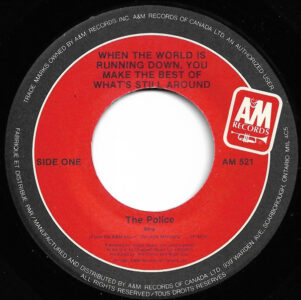
“When the World Is Running Down, You Make the Best of What’s Still Around” was one of Sting’s earliest attempts at a song whose lyrics deal with concerns of the outside world rather than just his own issues. Ultimate Classic Rock critic Mike Duquette describes the theme as “a man going insane in a post-apocalyptic world.” Sting has said it was one of two songs depicting “such vanity as to imagine one’s self as the sole survivor of a holocaust with all one’s favorite things still intact.” “When the World Is Running Down, You Make the Best of What’s Still Around” repeats its three-chord progression over its nearly four-minute length, achieving a hypnotic effect.
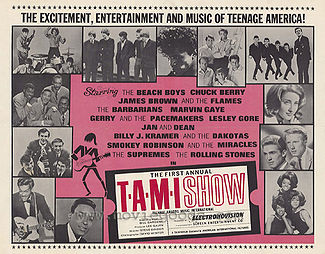
In the lyrics, Sting sings about turning on his VCR to watch James Brown on the T.A.M.I. Show. This was an acronym for Teen Age Music International. The T.A.M.I Show was a film made from Santa Monica Civic Auditorium concerts of the same name on October 28-29, 1964. James Brown was one of a number of performers that included Chuck Berry, the Rolling Stones, the Beach Boys, Lesley Gore, Jan and Dean, Smokey Robinson and the Miracles, Marvin Gaye, the Supremes, Billy J. Kramer and the Dakotas, Gerry and the Pacemakers, and the Barbarians.
Sting sits in his “old car.” It’s the same one he’s had for years, and the “battery’s running down.” When he turns on the radio, the static hurts his ears. He reveals to those listening to the song the following:
1) “I ain’t been out in years.”
2) He “can’t go out in the rain”
3) There’s “no one to talk to me.”
4) “When I feel lonely here, don’t waste my time with tears, I run Deep Throat again.”
(Referencing the adult film Deep Throat, starring Linda Lovelace and Harry Reems from 1972, which he watches by himself).
5) “Don’t like the food I eat, the cans are running out. Same food for years and years.”
Sting also describes how he is going to “plug in my M.C.I.” This means connecting to and powering up his MCI multitrack recorder so he can creatively record music by himself.
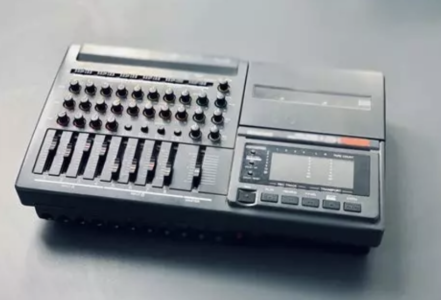
His M.C.I. represents a way to stay mentally active, as he sings, to “exercise my brain,” and productive in an otherwise monotonous, confined existence, where he can “make records on my own.”
Sting is singing about living in a post-apocalyptic world where he happens to be the only one left. He philosophically concludes “When the world is running down, you make the best of what’s still around.”
“When The World Is Running Down, You Make the Best of What’s Still Around” reached #3 in Sherbrooke (PQ), #17 in Ottawa, and #21 in Oklahoma City. It climbed to #3 on the Billboard Dance Music/Club Play Singles chart, #7 on the Dance Club chart in Ireland, and #28 on the UK pop chart.
In 1982, the Police won a second Grammy Award with “Don’t Stand So Close To Me” in the category for Best Rock Performance by a Duo or Group with Vocal.
In 1981 the Police released Ghost in the Machine. The debut single, “Invisible Sun” was a Top Ten hit in Ireland and the UK. But it was the second release, “Every Little Thing She Does Is Magic”, which topped the pop charts in Canada, Ireland, the Netherlands and the UK, and made the Top Ten in a half a dozen other nations. A followup release from the album was “Spirits In The Material World”.
In 1982, Sting released the single “Spread A Little Happiness” which was part of the soundtrack from the film Brimstone and Treacle. It was a Top 20 hit for Sting in Ireland and the UK. It was originally a number from the 1929 West End musical Mr. Cinders popularized by British singer Binnie Hale.
The album Synchronicity featured “Every Breathe You Take”. It climbed to number-one in Canada, Ireland, Israel, South Africa, the UK and USA. It was also a Top Ten hit in Australia, Austria, Belgium, Denmark, Finland, Italy, the Netherlands, New Zealand, Norway, Spain, Sweden, and Switzerland. Another release, “King Of Pain” reached number-one in Canada, #3 in the USA, #7 in Ireland and #8 in Venezuela. A final Top Ten international hit for the Police was “Wrapped Around Your Finger”. It was a number-one hit in Ireland and Poland, #5 in Spain, #6 in France, #7 in the UK, #8 in the USA, #10 in Canada and #13 in Italy.
In 1984, the Police won a Grammy Award for the album Synchronicity in the category for Best Rock Performance by a Duo or Group with Vocal. Synchronicity also won The Police a Juno Award for International Album of the Year. The Police also won a Grammy Award in 1984 for “Every Breath You Take” in the Best Pop Performance by a Duo or Group with Vocals category. The song was also nominated for a Grammy Award in the Record of the Year category, but lost to “Beat It” by Michael Jackson. While Synchronicity lost the Grammy Award for Album of the Year to Thriller by Michael Jackson. Then in 1986 the Police received a Grammy Award nomination for Best Music Video, Long Form for The Police Synchronicity Concert. But they lost to Huey Lewis and the News Huey Lewis & The News: The Heart of Rock ‘n Roll.
According to Sting, appearing in the documentary Last Play at Shea, he decided to leave the Police while onstage during a concert of 18 August 1983 at Shea Stadium in New York City because he felt that playing that venue was “[Mount] Everest.”
In June 1985, Sting released his debut solo album The Dream of the Blue Turtles. His debut single release from the album, “If You Love Somebody Set Them Free”, peaked at #3 on the Billboard Hot 100 in the USA, #7 in Italy, but stalled at #26 in the UK. A second single release, “Love Is The Seventh Wave” cracked the Top 20 on the Billboard Hot 100 in the winter of 1985-86. As well, “Fortress Around Your Heart”, charting to #8 on the Hot 100, and #13 in New Zealand. The fourth single release from The Dream of the Blue Turtles, “Russians”, made the Top Ten in Saskatoon in early 1986. Internationally, it reached #1 in Italy, #2 in France, #4 in West Germany, #7 in Belgium and the Netherlands, #11 in Ireland and Australia, #12 in the UK and #13 in Switzerland.
In the fall of 1987, Sting released his studio album …Nothing Like the Sun. From the album he released “We’ll Be Together”, a Top Ten hit in Canada, Italy and the USA. A second track from the album, “Be Still My Beating Heart”, sprinted to #2 in Montreal. A third single from the album, “Englishman In New York” was an international hit where it peaked at #7 in Italy, #9 in the Netherlands, #11 in Luxembourg, #12 in Ireland, and #16 in Belgium. A subsequent single, “Fragile”, reached #11 in Belgium, #12 in the Netherlands, and #17 in Italy.
In 1991 Sting released his third studio album, The Soul Cages. The lead single, “All This Time”, became a Top Ten hit in Canada, Denmark, Finland, Italy, Norway, Portugal, and the USA.
In 1993 Sting released his album Ten Summoner’s Tales. The debut release from his album was “If I Ever Lose My Faith In You“. The song topped the Canadian RPM Top 100 Singles chart. It also climbed to #2 in Italy, Portugal and the UK, and the Top Ten in Belgium, Denmark, Finland, Iceland, Norway and Spain. Soon after, his single “Fields Of Gold” reached #2 in Canada, and #6 in Iceland.
As well, in the 1990s Sting was heard in movie theaters singing a duet with Eric Clapton in 1992 titled “It’s Probably Me” in Lethal Weapon 3, and with Bryan Adams and Rod Stewart on “All For Love” in the soundtrack for The Three Musketeers. The single became the number-one song of the year in Canada in 1994, and also topped the weekly pop charts in over a dozen other countries in 1993-94. In the mid-90s, Sting released a Fields Of Gold: The Best of Sting.
Sting had a last Top 20 hit in some international markets in 2000 with “Desert Rose” from his Brand New Day album.
Sting has continued to chart his album releases into the Top Ten of album charts internationally. This includes Sacred Love (2003), Songs from the Labyrinth (2006), If on a Winter’s Night… (2009), Symphonicities (2010), The Last Ship (2013), 57th & 9th – in reference to an intersection in New York City near the studio where the album was being recorded (2016) and My Songs (2019)
After the Police disbanded, Stewart Copeland composed soundtracks for numerous films. These include Out of Bounds, Talk Radio, Wall Street, She’s Having a Baby, See No Evil Hear No Evil, Taking Care Of Business, The First Power, Men at Work, Highlander II: The Quickening, and Good Burger. Copeland has also been a session musician on many recordings, including “Red Rain” by Peter Gabriel. In 2009, Copeland’s memoir Strange Things Happen: A Life with The Police, Polo, and Pygmies was released. In May 2013, Stewart Copeland and the Long Beach Opera premiered The Tale Tell Heart, an opera based on the short story by Edgar Allan Poe. On September 5, 2021, the opera Electric Saint about the life of Nikola Tesla by Stewart Copeland with libretto by Jonathan Moore premiered at the National Theater of Weimar. On February 6, 2023, the album Divine Tides brought Copeland his seventh Grammy Award for Best Immersive Audio Album.
In August 2013, Andy Summers announced he had formed the band Circa Zero. Four years later, Summers formed Call the Police, a Police tribute band.
In 2003, the Police were inducted into the Rock and Roll Hall of Fame. In 2007, the French government appointed Stewart Copeland, Andy Summers and Sting, a Chevalier of the Ordre des Arts et des Lettres. This was in recognition of significant contributions to the arts. Also in 2007-2008, the Police put on a 30-year reunion tour across five continents at 151 cities. These included concert dates in Edmonton, Montreal, Ottawa, Toronto and Vancouver.
March 25, 2026
Ray McGinnis
References:
Robert Eringer, “Secret Agent Man: No wonder Miles Copeland’s kids formed the Police,” Rolling Stone, January 16, 1986.
Kristine McKenna, “Sting: The Rolling Stone Interview,” Rolling Stone, September 1, 1983.
Elizabeth Day, “Interview: The Thing About Sting,” Guardian, September 25, 2011.
Anna Puka, “I wish I’d been nicer to Sting: Stewart Copeland talks about life after The Police,” May 27, 2014.
“Andy Summers: ‘One of the things I loved about playing in The Police was that it was all guitar all the time! But it needed someone like me to fill that out,’” Guitar World, March 17, 2022.
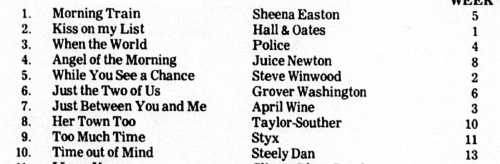
CKTS 900-AM Sherbrooke (PQ) Top Ten | May 8, 1981
Leave a Reply