
#37: Where Is This Love by the Payola$
City: Regina, SK
Radio Station: CJME
Peak Month: March 1984
Peak Position in Regina ~ #6
Peak Position in Vancouver ~ did not chart
Peak Position on Billboard Hot 100 ~ did not chart
YouTube: “Where Is This Love”
Lyrics: “Where Is This Love”
n 1978 a band was formed in Vancouver by Paul Hyde and Bob Rock called the Payola$. Hyde was born in Yorkshire, England, in 1955, and came to Vancouver in his teens. Bob Rock was born in Winnipeg, Manitoba, in 1954, and moved to Victoria, British Columbia, with his family in his later childhood. Rock learned to play guitar. Meeting in the Victoria suburb of Langford, the band settled on a name recalling the American music industry scandal investigated by the US Congress starting in 1959 called Payola. This was an illegal act where record companies paid deejays and radio stations a bribe for playing a single the record company wanted to get promoted. While it was legal for a record company to receive money in exchange for playing it on the radio, such a transaction had to be disclosed and not counted as regular airplay. While the Payola scandal did not spread into the Canadian radio market, as local legendary Vancouver Deejay Red Robinson attests in Robin Brunet’s book Red Robinson: The Last Deejay, Payola still had a bad name in the industry in America into the 80s. Consequently, although the Payola$ sold well in Canada, they met with stiff resistance south of the border.
The term payola fused the word “pay” with the suffix “-ola.” The latter was a common suffix for a variety of product names in the early 20th century. A player piano was invented in 1895 in the USA called the Pianola and was first put on sale in Meriden, Connecticut, by the Aeolian Company in 1898. RCA Victor made a record player in 1906 called the Victrola. Blue Amberol cylinder phonograph records by Thomas Edison Inc. were first introduced to the public in 1908 and called amberolas. The Rock-Ola company made jukeboxes from 1935 onward. While another company connected to the music industry, Motorola, manufactured radio equipment. The practice of payola was satirized by Neil Young in song “Payola Blues” by Neil Young off his 1983 album Everybody’s Rockin’. Young’s lyrics begin: “This one’s for you, Alan Freed…cause the things they’re doing today would make a saint out of you.” Young was hinting that Payola was more extensive in the 1980s than in the ’50s. So the Payola$ were just rubbing salt into a wound that hadn’t healed in the USA since it was still going on.
The Payola$ debut single from 1979 was called “China Boys” recorded at Little Mountain Sound Studios in Vancouver. The band got a contract with A&M records and after an initial EP release in 1980 they went on to record their first album in 1981.
The Payola$ appeared in concert in Vancouver (BC) on May 13, 1982, at the Kerrisdale Arena. The Payola$ second album, No Stranger To Danger resulted in their biggest hit, “Eyes Of A Stranger.”
With the success of “Eyes Of A Stranger”, the Payola$ earned a Juno Award for Best Single of the Year. Junos were also given to Rock and Hyde for their songwriting, and to the band as a whole for Most Promising Group. Bob Rock also won a Juno for Recording Engineer of the Year.
The Payola$ still had the US record market in their sights and their sound shifted to resemble a new wave sound on their third album, Hammer On A Drum released in 1983. The album, like the previous one, was produced by Mick Ronson from England. Ronson had produced nine albums with David Bowie including The Rise and Fall of Ziggy Stardust and the Spiders From Mars and Aladdin Sane. Ronson also produced Lou Reed’s 1972 album, Transformers, and Hard Rain for Bob Dylan in 1976. While the Payola$ had a constantly changing line-up backing Rock and Hyde, on Hammer On A Drum they had Christopher Livingston on keyboards and Chris Taylor on drums. Several singles were released from Hammer On A Drum and the biggest in was a Top Ten hit peaking at #8 on the Canadian RPM singles chart, “Never Said I Loved You”. This was followed with “Where Is This Love”.
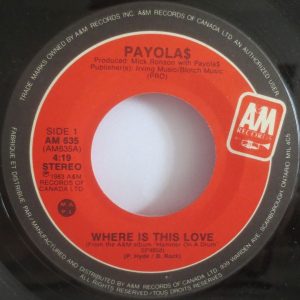
The song depicts a young man who could run like a tiger, walk tall like a Roman emperor, a cockatoo, walk proud like a man in space, or soar like an eagle. This confident space was his to enjoy “away from the lights of home.” However, he has had a troubled home life. The lyrics explain, “In the room with his brothers and sisters, he didn’t sleep at night. (He) kept his ears open for a key in the front door. He’s home again, he’s drunk again. He’s bouncing off the walls again. A fist comes down like a hammer on a drum…” The boy is unable to sleep in the bedroom with his siblings. His father comes home drunk again and is physically violent.
And so the boy who is living in a troubled home like this ends up fighting “like a soldier” with other kids on the street. He was faced with situations where people couldn’t talk things out and resorted to brawling. And at school, “he couldn’t think” and “couldn’t take the pain” (from the cycle of abuse back home). It seems the boy is growing into a man who “keeps on running.” Now he “shivers like a runaway,” suggesting the boy has left home, possibly as a minor. The chorus of the song offers a haunting refrain. The singer repeatedly asks, “Where is this love?” The song asserts that the search for love is universal, and that it “comes from above.” As well, it contends that there is love that “opens doors.” The song holds that longing for love in tension with love that feels elusive and unattainable.
The song was co-written by Paul Hyde and Bob Rock. “Where Is This Love” climbed to #6 in Regina (SK), #10 in Saskatoon (SK), and #17 in Ottawa.
Failing to crack the Billboard Hot 100 with their last song, the Payola$ rebranded themselves as Paul Hyde & the Payola$. This change in the bands’ name did little to dissuade US radio stations from their aversion to play a single by a group with the name Payola$ anywhere in their name.
In 1985 a third album, Here’s The World For Ya was a dud in record sales and the four singles failed to climb into the Canadian RPM Top 30 singles chart.
Nonetheless, 1985 proved to be a great year for Rock and Hyde as songwriters. They teamed up with Bryan Adams, David Foster, Rachel Paiement and Jim Vallance to co-write a song to raise money in Canada in response to the ongoing famine in Ethiopia (1983-85). The song, “Tears Are Not Enough” was a number one single in Canada for the year 1985. It was recorded with cameo appearances from many celebrities of the Canadian pop music scene as Northern Lights. Gordon Lightfoot, Burton Cummings, Anne Murray, Joni Mitchell, Dan Hill, Neil Young and Bryan Adams were among the artists lending cameo solos during the songs’ opening verse. Later in the song Carol Pope and Paul Hyde sang a few lines as a duet.
Although the Payola$ were later rebranded as Rock and Hyde, and had minor hits “Dirty Water” and “I Will”. However, their chart-making days were fading. However, Bob Rock who was already a producer and recording engineer when he joined the Payola$, continued work with recording artists. He has produced recordings by Cher, Loverboy, The Cult, David Lee Roth, Bryan Adams, Bon Jovi, the Tragically Hip, Jann Arden, Michael Bublé, Nelly Furtado, Metallica and Motley Crue. Meanwhile, Paul Hyde released his latest album, Peace Sign, in 2009. He continues to perform.
January 19, 2026
Ray McGinnis
References:
Payola$ biography, Canadian Bands.com
Rough Trade biography, Canadian Bands.com
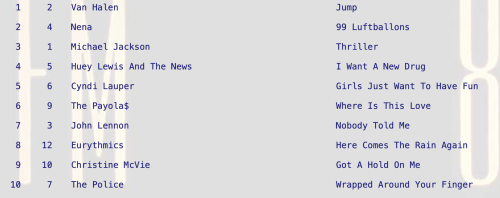
Top 30 CJME 1300-AM Regina (SK) March 16, 1984
Leave a Reply