
#2: Seven Bridges Road by the Eagles
City: Saskatoon, SK
Radio Station: CKOM
Peak Month: March 1981
Peak Position in Saskatoon ~ #2
Peak Position in Vancouver ~ did not chart
Peak Position on Billboard Hot 100 ~ #21
YouTube: “Seven Bridges Road”
Lyrics: “Seven Bridges Road”
The Eagles are an American rock band formed in Los Angeles in 1971. With five number-one singles, six number-one albums, six Grammy Awards. The band was founded by co-lead vocalist and guitarist Glen Frey, co-lead vocalist Don Henley, guitar and banjo player Bernie Leadon, and bass guitarist Randy Meisner. Glenn Frey was born in Detroit in 1948. Frey studied piano at age five, later switched to guitar, and became part of the mid-1960s Detroit rock scene. One of his earliest bands was called the Subterraneans, named after the 1958 Jack Kerouac novel The Subterraneans. In 1968, Frey played acoustic guitar and provided backing vocals on the Bob Seger System’s “Ramblin’ Gamblin’ Man”. The song reached #17 on the Billboard Hot 100, and #1 in Windsor, Ontario. In 1969, Frey teamed up with J.D. Souther to form Longbranch Pennywhistle and the country-rock duo released an album. In 1971, Frey was one of four musicians hired as a backing band to tour with Linda Ronstadt. The other three were Don Henley, Bernie Leadon and Randy Meisner.
Don Henley was born in the small east Texas town of Gilmer in 1947. In the high school band he played the trombone, and then moved to the percussion section. After high school, Henley was part of a band that was called Shiloh. In 1970, the band recorded an album produced by Kenny Rogers. While on tour with Linda Ronstadt in 1971, Henley and Frey decided to form their own band. They invited Randy Meisner and Bernie Leadon to join.
Randall “Randy” Meisner was born in 1946 in Scottsbluff, Nebraska. He grew up on a farm and got a guitar at age ten after he saw Elvis Presley perform on The Ed Sullivan Show. Though he couldn’t read music, playing bass guitar came naturally to Randy. Meisner played bass and sang with a local band named The Dynamics (later The Drivin’ Dynamics) from 1961 to 1965. Their first paying job was performing in the dance hall at Little Moon Lake in Torrington, northeast of Cheyenne, Wyoming, in December 1961. The Drivin’ Dynamics released three singles in the mid-60s. Meisner joined The Poor in 1966, and they released four singles. In 1968, Randy joined Poco. He left Poco due to conflicts within the band. In 1969, he joined Rock Nelson’s Stone Canyon Band. Concurrently, he was a session musician including on James Taylor’s Sweet Baby James, and on Waylon Jennings’ Singer of Sad Songs. Later in 1970, he returned to Nebraska to get work with a John Deere tractor dealership. In mid-1971, Meisner was recruited to join The Eagles.
Bernie Leadon was born in Minneapolis (MN) in 1947. He was in the psychedelic country-folk group Hearts & Flowers in 1967. The following year, he was in the Dillard & Clark band which included ex-Byrds Gene Clark. In 1969 Leadon left that band to join The Corvettes who were the backing band for Linda Ronstadt. Concurrently, Leadon was with the Flying Burrito Brothers from 1969 to 1971. He was the last to join the original lineup of The Eagles.
In 1972, the band released their self-titled Eagles album. From the album came the #12 pop hit “Take It Easy”. This was followed by their first Top Ten hit, “Witchy Woman”, and another Top 30 hit “Peaceful Easy Feeling”. The band’s second album, Desperado, featured the title track that was never released as a single. Nonetheless, “Desperado” is one of Eagles’ most well-known songs, and in 2004 it was ranked #494 on the Rolling Stone‘s list of The 500 Greatest Songs of All Time. The debut single, “Tequila Sunrise”, stalled at #64 on the Billboard Hot 100. Desperado failed to crack the Top 40 on the pop album chart. Though it eventually sold enough to earn double-platinum in sales. In the Netherlands, Desperado reached #5 on the pop album chart.
In 1974, the Eagles released On the Border. The album reached #3 in the Netherlands, and the Top 20 in Canada and the USA. “Already Gone” was the debut single which stalled at #32 on the Billboard Hot 100. However, “Best Of My Love” topped the Hot 100, and also topped the pop charts in Ottawa, Toronto and Windsor (ON).
In 1975, One of These Nights reached the top of the Billboard 200 pop album chart. It climbed to #2 in Canada and the Netherlands, #3 in New Zealand, #5 in Australia, and the Top Ten on album charts in Norway and the UK. It also charted into the Top 30 on pop album charts in Finland and Japan. The album was nominated for a Grammy Award for Album of the Year. It lost out to Paul Simon’s Still Crazy After All These Years. The title track, “One of These Nights”, topped the Billboard Hot 100. However, in Canada it stalled at #13 where its best chart runs were in Montreal and Vancouver where it reached #2. The followup, “Lyin’ Eyes”, was a crossover pop-country hit reaching #8 on the Billboard Hot Country Songs chart. On the Hot 100, “Lyin’ Eyes” peaked at #2, reached #3 in Ireland, #4 in Canada, and #7 in New Zealand. The single earned the band two Grammy Award nominations. The first for Record of the Year, and the second where they won for Best Pop Performance by a Duo or Group with Vocals. The final single release from One of These Nights was “Take It to the Limit” which topped the pop chart in Winnipeg (MB), and peaked at #4 in the USA.
In 1975, Bernie Leadon left the Eagles. After the release of One Of These Nights, tension within the band grew with some sources saying Leadon grew increasingly frustrated by the band’s direction away from his beloved country and bluegrass toward album-oriented stadium rock. He famously quit the band in 1975 by pouring a beer over Glenn Frey’s head. Leadon later cited a need to get healthy and break the vicious cycle of touring, recording and heavy drug use that was rampant within the band.
In 1975, Joe Walsh was invited by Don Henley to join the Eagles. Walsh was with the band when they released the album Hotel California. The hits from the album included “Hotel California”, “Life In the Fast Lane” and “New Kid In Town”. Joe Walsh was born in Wichita, Kansas, in 1947. He got a guitar at age ten in 1957. When he heard the Ventures “Walk Don’t Run” in 1960, he dreamed of a life as a musician. He was part of several groups in the Sixties. One of these, The Measles, were a band of Kent State University students. Two tracks on the Ohio Express’ 1967 Beg Borrow and Steal album, “I Find I Think Of You” and “And It’s True” (both featuring Joe Walsh vocals) were actually recorded by the Measles, led by Walsh. He studied English and music at Kent State College in Ohio. Walsh was present when the Kent State massacre happened in 1970. In 2012, Walsh said “Being at the shootings really affected me profoundly. I decided that maybe I don’t need a degree that bad.” In 1972, Joe Walsh formed a band called Barnstorm, which released a self-titled album. Next, Walsh released a studio album titled The Smoker You Drink, the Player You Get. From the album came a Top 30 single, “Rocky Mountain Way“.
In 1976, the Eagles released Their Greatest Hits (1971-1975). The album sold over 45 million copies worldwide. It topped the pop album charts in Canada and the USA, and reached #2 in New Zealand and the UK, and #3 in Australia. Their next album, Hotel California, sold 42 million copies worldwide. This fifth studio album from The Eagles received another Grammy Award nomination for Album of the Year, but lost out to Fleetwood Mac’s Rumours. The title track, “Hotel California”, topped the pop charts in Canada and the USA, peaked at #2 in France and Switzerland, #3 in Spain, #5 in New Zealand and Norway, and the Top Ten in the Netherland, the UK and West Germany. In Canada, “Hotel California” topped the pop charts in Hamilton (ON), Montreal, Ottawa, Toronto, and Vancouver. The single “New Kid in Town” won the band a Grammy Award for Best Vocal Arrangement for Two or More Voices. It also topped the pop charts in both Canada and the USA, and the record markets in Toronto and Winnipeg (MB). A third single from the album, “Life In the Fast Lane”, was also a solid seller.
Randy Meisner left the Eagles in 1977, citing exhaustion and ulcers from performing on stage during an 11-month Hotel California tour. Timothy B. Schmit from Poco replaced him. Timothy Schmit was born in Oakland, California, in 1947. At age 15 he was in a folk group named Tim, Tom & Ron. That group evolved into a surf band called the Contenders, then changed its name to the New Breed. As the New Breed, they had a major local hit in Sacramento: the Animals-inspired “Green Eye’d Woman,” which was released in 1965 and topped the pop chart in Sacramento on local top-40 outlet KXOA-AM. Schmit joined Poco in 1969 and was one of the personnel in the recording studio on nine of the band’s albums between 1970 and 1977. He sang the lead on “I Can’t Tell You Why” which was a Top Ten hit in both Canada and the USA in 1980. Schmit was a backing vocalist on Don Henley’s “Dirty Laundry”, on Boz Scaggs’ “Look What You’ve Done to Me”, Bob Seger’s “Fire Lake”, Crosby, Stills, & Nash’s “Southern Cross”, “Toto’s “I Won’t Hold You Back”, and played a 12-string acoustic guitar on Toto’s number-one hit “Africa”.
In 1979, the Eagles released the much anticipated The Long Run. It topped the pop charts in Australia, Canada, Japan, Sweden, and the USA. While it climbed to #2 in France and New Zealand, #3 in the Netherlands, #4 in the UK, #5 in Norway, and #9 in Finland. The debut single, “Heartache Tonight”, topped the pop chart in Canada and on the Billboard Hot 100 in the USA. In Canada, the single topped the pop charts in Calgary, Fredericton (NB), London (ON), Montreal, Ottawa, Regina (SK), Sherbrooke (PQ), Smithers (BC), Sydney (NS), Toronto, Vancouver, Victoria (BC), and Winnipeg (MB). The album was also a strong Top Ten seller in Ireland, New Zealand, and Switzerland.
“Seven Bridges Road” is a track from the 1980 Eagles album Eagles Live. It features Glenn Frey, Don Henley, Randy Meisner, Timothy B. Schmit, and Joe Walsh, taking turns as lead vocalists on this and the other thirteen tracks.
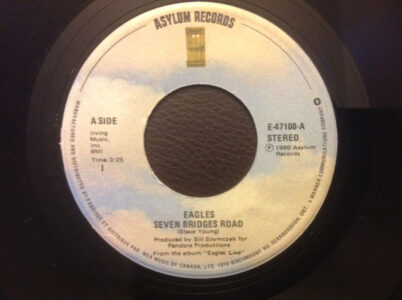
“Seven Bridges Road” was written by Steve Young for his 1969 album Rock, Salt & Nails. Young was born in the small town of Newnan, Georgia, about forty miles southwest of Atlanta. He wrote “Lonesome, On’ry and Mean”, which was covered by Waylon Jennings in 1973. “Seven Bridges Road” is an ode to Woodley Road (County Road 39, Montgomery County, Alabama), a rural two-lane road which runs south off East Fairview Avenue — the southern boundary of the Cloverdale neighborhood of Montgomery, Alabama — at Cloverdale Road, and which features seven bridges: three pairs of bridges, and the seventh approximately one mile south by itself. The song’s composer, Steve Young, stated that he and his friends “used to go out to Woodley Road carousing around”: “I wound up writing this song that I never dreamed anybody would even relate to, or understand, or get. And I still don’t understand why it was so successful, actually.” “I don’t know [exactly] what [the] song means.” “Consciously… I [just] wrote… a song about a girl and a road in south Alabama.” “But I think on another level the song has something kind of cosmic… that registers in the subconscious: the number seven has all of these religious and mystical connotations.”
Living on-and-off in Montgomery in the early 1960s, Young stated that he made “a few close friends there who were very different than the mainstream [locals. These friends told] me about this…Seven Bridges Road…As you went out into the countryside the road became this dirt road, and you crossed seven bridges, and then it was almost like an old Disney scene or something, with these high bank dirt roads and trees hanging down, old cemeteries, and so on. It was very beautiful…and on a moonlit night it was exceedingly beautiful.” Young initially believed that Seven Bridges Road was his friends’ personal byname for Woodley Road, stating, “I found out later that [it] had been called that for a long, long time. A lot of people over the years had been struck by the beauty of the road, and the folk name for it was Seven Bridges Road.” Journalist Wayne Greenhaw in his 2001 book My Heart Is in the Earth: True Stories of Alabama & Mexico, relates how on a Sunday in springtime he accompanied Young and their friend Jimmy Evans on a drive down Woodley Road to Orion for a guitar jam session with bluesman C. P. Austin, and that it was on the return trip up Woodley Road that Young began the composition of Seven Bridges Road.
Between 1968 and 1999, Steve Young released thirteen studio albums, one live album, and several compilation albums. He suffered a head injury in 2015, and died at the age of 73 in 2016.
Before the Eagles covered the song, it had been recorded by Joan Baez, Rita Coolidge, Iain Matthews, Dolly Parton, and Tracy Nelson. The Eagles cover of “Seven Bridges Road” became their third single to crossover and chart on Billboard’s Hot Country Songs chart.
“Seven Bridges Road” peaked at #2 in Saskatoon (SK), #5 in Atlanta, and Corpus Christi (TX), #6 in St. Cloud (MN), and Kansas City (MO), #7 in Bakersfield (CA), Toledo (OH), Seattle, and Minneapolis/St. Paul, #8 in Peoria (IL), Salina (KS), Winnipeg (MB), and Morro Bay (CA), and #10 in Pittsburgh, Tempe (AZ), Denver, and Burbank (CA).
The Eagles broke up in 1981.
Don Henley pursued a solo career. That year his duet with Stevie Nicks, “Leather and Lace”, reached the Top Ten. In 1982, his single “Dirty Laundry” reached #1 in Canada, #2 in South Africa, #3 in the USA, #7 in New Zealand, and #8 in Austria. In 1985, Henley won a Grammy Award for Best Male Rock Vocal Performance for his single “The Boys of Summer”. The song reached the Top Ten in Australia, Ireland, and the USA. It earned Don Henley a Grammy Award for Rock Male Vocalist. Later that year, “All She Wants to Do Is Dance” reached the Top Ten in the USA. In 1989, “The End of Innocence” was a Top Ten hit in Canada and the USA, and earned Henley a Grammy Award for Rock Male Vocalist. The single also received Grammy nominations for Record of the Year and Song of the Year.
In 1992, Henley and Patty Smyth recorded a duet titled “Sometimes Love Just Ain’t Enough”. The Top Ten hit earned them a Grammy Award nomination the following year in the Best Pop Performance by a Duo or Group with Vocals category. In 2001, a track from Don Henley’s Inside Job album titled “Taking You Home” received a Grammy nomination for Male Pop Vocal Performance. While the track, “Workin’ It”, received a separate Grammy nomination in the Rock Male Vocalist category. Inside Job received a Grammy nomination for Album of the Year. While Don Henley and Trisha Yearwood recorded a duet of Bryan Adams’ “Inside Out”. The single earned the duo a Grammy nomination in 2002 for Country Collaboration with Vocals. The following year, Henley received yet another Grammy nomination for his duet with Sheryl Crow on their recording of the Kathryn Crow song “It’s So Easy”. The category for this nomination was Pop Collaboration with Vocals.
In 2007, Don Henley won his third Grammy Award for the MusiCares Person of the Year. That year he was also nominated for a Grammy with Kenny Rogers in their duet “Calling Me” in the Country Collaboration with Vocals category. Henley’s 18th Grammy nomination was in the American Roots Song category in 2016 for his duet on “The Cost of Living” with Stan Lynch. Over the decades Don Henley has released five studio albums.
Glenn Frey also launched a solo career after the Eagles breakup. In 1982, he released his album No Fun Aloud. From the album came “The One You Love” which charted to #2 on the Adult Contemporary charts in both Canada and the USA. While “Partytown” was a #5 hit on the Billboard US Mainstream Rock chart. In 1984, Frey’s recording “The Heat Is On” appeared in the film Beverly Hills Cop. The song topped the pop chart in Panama, climbed to #2 in Australia, Norway and the Billboard Hot 100, #4 in West Germany, #5 in Sweden and Switzerland, #6 in Ireland, #8 in Canada, and was a strong seller in Finland, the Netherlands, and the UK. While “Smuggler’s Blues” was featured in an episode of the TV series Miami Vice. A second song, “You Belong To The City”, was written specifically for Miami Vice, and was a Top Ten hit in Canada and the USA.
In 1986, Frey appeared in the adventure film Let’s Get Harry. Subsequently, he appeared in the 1996 film Jerry Maguire with Tom Cruise, Renée Zellweger, and Cuba Gooding Jr.
In 1988, from Frey’s third solo album Soul Searchin’ came “True Love”. The single reached #2 in Canada and Italy, and #13 on the Billboard Hot 100. In 1991, Glenn Frey released his fourth album titled Strange Weather. The lead single, “Part of Me, Part of You”, stalled at #55 on the Hot 100, but peaked in Canada at #9. In 2012, Frey’s fifth studio album titled After Hours was released.
In 2000, Frey was diagnosed with arthritis. The medication he was prescribed led to both colitis (inflammation of the colon) and pneumonia. He died in January 2016 due to complications from these diseases. Frey’s manager, Irving Azoff, told a reporter “The colitis and pneumonia were side effects from all the meds. He died from complications of ulcer and colitis after being treated with drugs for his rheumatoid arthritis which he had for over 15 years.” Glenn Frey was 67 years of age.
After he left the Eagles, Randy Meisner released several solo albums, and performed with his band Randy Meisner & the Silverados. In 1985, he became part of Black Tie along with Jimmy Griffin of soft rock band Bread, and Billy Swan (best known for his song “I Can Help”). In 2023, Meisner died of chronic obstructive pulmonary disease at the age of 77.
After the Eagles split, Timothy Schmidt toured with Toto in 1982. That year he recorded a cover of the Tymes “So Much In Love” for the film Fast Times at Ridgemount High. He toured with Jimmy Buffett in 1983, 1984, and 1985 as a member of the Coral Reefer Band and coined the term “Parrotheads” to describe Buffett’s fans. In 1991, he sang the pop standard “I Only Have Eyes For You” for the soundtrack on the film Don’t Tell Mom the Babysitter’s Dead. He was a member of Ringo Starr & HIs All-Starr Band in 1992. Between 1984 and 2022 Schmit released seven studio albums. His seventh studio album Day by Day was released in May 2022.
In 1978, Joe Walsh recorded “Life’s Been Good” for the film FM. After the Eagles broke up, Joe Walsh pursued a solo career. He released There Goes the Neighborhood. The debut single was “A Life Of Illusion”. He released a series of albums in the following decades. In 2012, after a 21-year absence in the studio, Joe Walsh released his eleventh studio album titled Analog Man. The album peaked at #12 on the Billboard 200 album chart. The album was co-produced by Jeff Lynne (of the Electric Light Orchestra) and included Ringo Starr as one of the musicians. Over the decades, Joe Walsh has performed in the recording studio with the Ohio Express, B.B. King, America, Rick Derringer, REO Speedwagon, Billy Preston (including in “Nothing From Nothing”), Andy Gibb (including “I Just Want to be Your Everything” and “Love is Thicker Than Water”), Randy Newman, Warren Zevon, Lionel Ritchie (including on “Truly”, “My Love” and “You Are”), Steve Winwood, Wilson Philips, Fleetwood Mac, Michael McDonald, the Foo Fighters and others.
July 15, 2026
Ray McGinnis
References:
Brian McCollum, “Glenn Frey details Detroit days in Free Press interview,” Detroit Free Press, January 19, 2016.
David Browne, “Glenn Frey: An Oral History,” Rolling Stone, January 28, 2016.
Tim Kinneally and Sharon Waxman, “Glenn Frey’s Medication Contributed to His Death, Manager Says (Exclusive),” The Wrap, January 18, 2016.
Cameron Crowe, “Conversations with Don Henley and Glenn Frey,” The Uncool, August 2003.
Walter Tunis, “Don Henley on the Eagles carrying on: “We wanted everybody to be all in.,” Lexington Herald-Leader, July 6, 2020.
Stephen L. Betts, “‘Seven Bridges Road’ Singer Steve Young Dead At 73,” Rolling Stone, March 18, 2016.
Jon Lancaster, “Timothy B. Schmit went from envying the Eagles to becoming one,” Lancaster Online, Lancaster, Pennsylvania. September 12, 2013.
Angie Martoccio, “Randy Meisner, Eagles Co-Founder and ‘Take It To The Limit’ Singer, Dead At 77,” Rolling Stone, July 27, 2023.
Andy Greene, “The Last Word: Joe Walsh on the Future of the Eagles, Trump and Turning 70,” Rolling Stone, July 30, 2017.
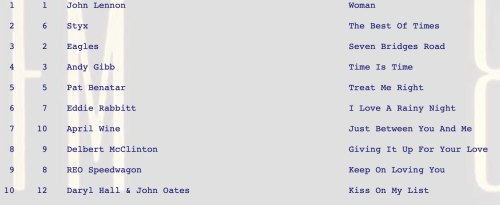
CKOM 1250-AM Saskatoon (SK) Top Ten | March 18, 1981
Leave a Reply