
#76: What Is Life by George Harrison
City: Montreal, PQ
Radio Station: CKVL
Peak Month: April 1971
Peak Position in Montreal ~ #1
Peak position in Vancouver ~ #3
Peak Position on Billboard Hot 100 ~ #10
YouTube: “What Is Life”
Lyrics: “What Is Life”
George Harrison was born in Liverpool in 1943. Harrison remembers cycling past a home in his neighborhood that was playing “Heartbreak Hotel” by Elvis Presley. The encounter with the song got him hooked on rock ‘n roll. He subsequently was influenced by Little Richard and Buddy Holly. Harrison’s father bought him his first guitar in 1956 when Harrison was 13 years old. After Paul McCartney joined John Lennon’s group, the Quarymen, McCartney suggested that his friend, George Harrison, join the group. Harrison became one of the Quarrymen in early 1958, though he was still only 14. They changed their name to the Silver Beatles and then the Beatles in the spring of 1960. They group headed to Hamburg, Germany, on August 17, 1960, for a three-and-a-half month stint. In early 1961 the Beatles returned for more engagements in Germany. On June 22, 1961, Bert Kaempfertproduced “My Bonnie”, “Ain’t She Sweet” and eight other songs. Later in 1961, “My Bonnie” climbed to #4 on the Hamburg pop charts and #32 on the German pop charts.
The Beatles had their first number one hit in the UK with “From Me To You” on May 2, 1963. The song peaked at #14 on the C-FUN-TASTIC FIFTY in July ’63. The Fab Four held down the number one spot on the UK Pop charts for 16 weeks in 1963. The Beatles topped the UK singles charts in the 1960’s for 69 weeks. In the USA they held the number one spot for 59 weeks on the Billboard Hot 100. In Vancouver, between December 1963 and May 1970, the Beatles held the number one spot for a total of 87 weeks.
While the Beatles were known for their Lennon-McCartney songs, George Harrison began to have more of an influence when he began experimenting with the sitar. “Norwegian Wood (This Bird Has Flown)” is an example of Harrison’s influence.
In March 1966, John Lennon had an an interview with Evening Standard reporter Maureen Cleave. Lennon commented, “Christianity will go. It will vanish and shrink … We’re more popular than Jesus now—I don’t know which will go first, rock and roll or Christianity. Jesus was all right but his disciples were thick and ordinary.” The comment was yawned at in Britain, but it caused a furore when it was reported in Datebook’s August edition in America. Suddenly there were protests that involved the burning of Beatles records. The Ku Klux Klan staged protests against the Beatles and nailed their albums to a wooden cross. There were also death threats against Lennon. This development was a catalyst for the band’s decision to cease touring. On August 19th two concerts were scheduled in Memphis, Tennessee. Both were cancelled by the city council who wouldn’t let municipal facilities be used by people who were trying to “ridicule anyone’s religion.”
The band would become the most influential rock ‘n roll band of the 20th Century. They have sold over one billion records. They began recording upbeat love songs like “I Want To Hold Your Hand” and later composed more complex songs, including on their award-winning 1967 album, Sgt. Pepper’s Lonely Hearts Club Band. George Harrison contributed “Within You Without Out” to the album. The Beatles were on the cusp of whatever was new and were often the trend-setting reason for the next new thing. In 1967 they got involved with Transcendental Meditation. When they released “Hey Jude,” they had one of those rare singles that was longer than 7 minutes climb to the top of the charts. At the time, the standard formula for singles was around two to three minutes in length.
In 1968 George Harrison travelled to Rishikesh in northern India with the other Beatles where they studied meditation with Maharishi Mahesh Yogi. Harrison penned the sitar-infused “The Inner Light” which became the B-side to “Lady Madonna”. That year Harrison released a solo album of his music from the film Wonderwall. All tracks were instrumental pieces. Late that year Harrison recorded Electronic Sound on Zapple Records, a subsidiary of Apple Records. It may have been the first album featuring the Moog synthesizer and was comprised of avant-garde rock. In late 1969 Harrison went on tour in Europe with Eric Clapton and Delaney, Bonnie and Friends. During the tour Delaney Bramlett introduced George Harrison to the slide guitar and Harrison subsequently learned the instrument which took his music in a new direction.
George Harrison’s best loved songs written as a Beatle include “While My Guitar Gently Weeps”, “Here Comes The Sun” and “Something”. He also co-wrote “Badge” for Cream in 1969.
The Beatles split in 1970 after the release of the Let It Be album. Paul McCartney told Howard Stern in 2018 that John Lennon walked into a room one day in 1970 and announced that he was leaving the Beatles. All four enjoyed success as solo recording artists. Harrison provided backing vocals for John Lennon’s Plastic Ono Band’s “Instant Karma” in 1970.
George Harrison had a number one hit with “My Sweet Lord”in the winter of 1970-71. And his album, All Things Must Pass topped the album charts internationally. It was nominated for Album of the Year at the March 1972 Grammy Awards, but lost to Carole King’s Tapestry.
After “My Sweet Lord” appeared on the pop charts in 1970 Bright Tunes sued him for copyright infringement of the song “He’s So Fine” by the Chiffons. Harrison told Rolling Stone in 1979 “The guy who actually wrote “He’s So Fine” had died years before, Ronnie Mack. Bright Tunes Music, his publisher, was suing me. So we went through the court case, and in the end the judge said, yes, it is similar, but you’re not guilty of stealing the tune. We do think there’s been a copyright infringement, though, so get your lawyers together and work out some sort of compensation. But Bright Tunes wouldn’t settle for that; they kept trying to bring the case back into court. They even tried to bring it back into court when I did “This Song.” Harrison released “This Song” as a single describing his frustrations with the plagiarism lawsuit.
One of the tracks on All Things Must Pass is “Awaiting On You All”. It charted on AM Top 40 radio in Lethbridge (AB). The B-side to “My Sweet Lord” titled “Isn’t It A Pity” also charted. Another track from All Things Must Pass, “What Is Life”, was released as a single in February 1971.
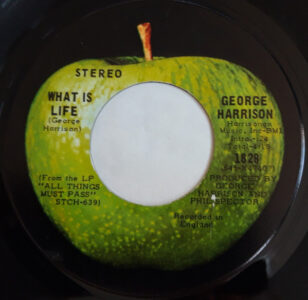
George Harrison wrote “What Is Life”. Originally, Harrison wrote “What Is Life” for Billy Preston with sort of a gospel feel. Preston had been at a number of sessions with the Beatles before the band dissolved in 1970. After “What Is Life” ended up being a fast rocker, Harrison decided it wouldn’t be right for Preston and released it himself. In the song, George Harrison makes a profound statement of devotion:
Tell me, what is my life without your love?
Tell me, who am I without you, by my side?
At the time George Harrison wrote “What Is Life” he was still married to his first wife, Pattie Boyd. When the Harrisons were visiting the Ringo and Maureen Starkeys (Sir Ringo Starkey is billed as Ringo Starr), Harrison confessed how much he loved Maureen, which led to an affair. Ringo threatened to divorce Maureen when George Harrison’s wife Pattie told Ringo that she had found George and Maureen in bed together. Multiple marital infidelities on the part of all parties led to the Starkey’s divorce in 1975, and the Harrison’s divorce in 1977.
In the recording session for “What Is Life”, four of the musicians were bandmates of Badfinger, who had enjoyed Top Ten hits with “Come And Get It” and “No Matter What”. These were Pete Ham (born in Swansea, Wales, in 1947), Tom Evans (born in Liverpool in 1947), Joey Molland (born in Liverpool in 1947), and Mike Gibbons (born in Swansea, Wales, in 1949). Pete Ham and Tom Evans wrote “Without You” which was a hit for Harry Nilsson in 1972. Both Pete Ham and Tom Evans died by their own hand of suicide in the following years. Pete Ham at the age of 27 in 1975 after Badfinger was financially ruined by their fraudulent manager. Tom Evans died of suicide in 1983 at the age of 36, arising from stress from a legal dispute over royalties from “Without You”. Mike Gibbons died of a brain aneurysm at the age of 56 in 2005. Joey Molland died from complications related to diabetes at the age of 77 in 2025.
Another session musician was Carl Radle, who was born in Tulsa, Oklahoma, in 1942. He has been with Gary Lewis & the Playboys. He later joined Delaney, Bonnie & Friends in 1969, and was in the recording studio for “Only You Know And I Know” with Dave Mason. He was later in the recording studio for Dave Mason’s version of the song. Carl Radle was also one of the “friends” on the Delaney and Bonnie hit “Never Ending Song of Love”.
Later that year Radle joined Eric Clapton’s backing band Derek and the Dominoes. Radle was in the recording studio for the album Layla and Other Assorted Love Songs. He was in the recording studio for Clapton’s hits “After Midnight” and “Layla”; And later on Clapton’s number-one hit in 1974 “I Shot The Sheriff”, as well as “Cocaine”, “Lay Down Sally”, and “Wonderful Tonight”.
Radle was in the recording studio for the album All Things Must Pass on bass guitar for “My Sweet Lord” and “Isn’t It A Pity”. In addition, Carl Radle was in the backing band for the August 1, 1971, recording of the live album: The Concert for Bangladesh, and later on Harrison’s 1975 album Extra Texture. Carl Radle also played in the studio on six of Leon Russell’s albums between 1971 and 1975. Five of these were studio albums and one was live. This included Carl Radle playing bass guitar on Leon Russell’s hit singles “Tight Rope” and “Lady Blue”.
Radle was on a brief tour with Joe Cocker in March-April 1970. The live concerts at Filmore East in New York City on March 27-28. Music from these concerts was made into a live album titled Mad Dogs & Englishmen. Three singles were released titled “Cry Me A River” and “The Letter”. It included live performances of other songs Cocker had released on his first two studio albums: “Feeling Alright” and “She Came In Through the Bathroom Window”. He was with Art Garfunkel for his Angel Clare album and the hit single “All I Know”. Radle was additionally in the studio for albums with J.J. Cale, Freddie King, The Staple Singers, Sérgio Mendes, Rita Coolidge, Donovan, and others. Carl Radle died at the age of 37 from a drug overdose.
Jim Gordon was born in Los Angeles in 1945. He passed up a music scholarship to UCLA in order to begin his professional career in 1963, at age 17, backing the Everly Brothers. He went on to become one of the most sought-after recording session drummers in Los Angeles. The protégé of studio drummer Hal Blaine, Gordon performed on many notable recordings in the 1960s. These include Pet Sounds (including “Wouldn’t It Be Nice”, “God Only Knows” and “Sloop John B”) for the Beach Boys, The Spirit of ’67 (including “Good Thing” and “Hungry”) for Paul Revere and the Raiders, Who Knows Where the Time Goes for Judy Collins, “Classical Gas” for Mason Williams, “It Don’t Matter To Me” for Bread, “Wichita Lineman” for Glen Campbell, “Cry Me A River” (Joe Cocker), “Marrakesh Express” and “Suite: Judy Blue Eyes” (Crosby, Stills and Nash), “Different Drum” (Stone Poneys) and “After Midnight” (Eric Clapton). Before he joined Traffic, Jim Gordon was a member of Derrick and the Dominoes and played on the classic rock song “Layla”.
After All Things Must Pass, Gordon continued to work as a session musician. He was in the studio for “On and On” (Stephen Bishop), Diamonds and Rust (Joan Baez), “Here Come Those Tears Again” (Jackson Browne), “Only Yesterday”, “Please Mr. Postman”, “There’s A Kind Of Hush” and “Solitaire” (The Carpenters), “All I Know”, “My Little Town” and “I Only Have Eyes For You” (Art Garfunkel), “Sara Smile” and “Rich Girl” (Hall and Oates), “Power To The People” (John Lennon and Plastic Ono Band), “Sundown”, Carefree Highway”, “Rainy Day People”, and “The Wreck of the Edmund Fitzgerald” (Gordon Lightfoot), “Midnight At the Oasis” (Maria Muldaur), “Summer Breeze” (Seals and Crofts), “Rock And Roll Heaven” (Righteous Brothers), “Rockin’ Pneumonia and the Boogie Woogie Flu”, “Everybody’s Talkin'”, “Without You” and “Coconut” (Nilsson), “Rikki Don’t Loose That Number” (Steely Dan), “The Right Thing To Do”, “You’re So Vain”, “Mockingbird”, “Haven’t Got Time For the Pain”, and “Attitude Dancing” (Carly Simon), “I Never Cry” and “You And Me” (Alice Cooper), “It Never Rains in Southern California” (Albert Hammond), “Stand Tall”, “I’m Scared”, “Break It To Them Gently” and “I Will Play A Rhapsody” (Burton Cummings), and “Rock The Boat” (Hues Corporation), Country Joe McDonald, Emitt Rhodes (of Merry-Go-Round), Frank Zappa, Manhattan Transfer, Cher, Chad & Jeremy, Donovan, B.B. King, Carole King, and others. In 1983, Jim Gordon, in a psychotic episode associated with undiagnosed schizophrenia, murdered his mother. He was sentenced to 16 years to life in prison, remaining incarcerated until his death in 2023.
Other session musicians for “What Is Life” included Eric Clapton, Derek and the Dominoes bandmate Bobby Whitlock, Rolling Stones touring musician Jim Price, and iconic session musician Bobby Keys.
“What Is Life” climbed to #1 in Montreal, Charlottesville (VA), Syracuse (NY), Eugene (OR), Sarasota (FL), Saint Charles (MO), Denver, Erie (PA), St. Louis, and Sudbury (ON), #2 in Cleveland, Reno (NV), West Palm Beach (FL), Marshfield (WI), Rochester (NY), Birmingham (AL), Holland (MI), San Bernardino (CA), Los Angeles, Scranton (PA), Akron (OH), Hartford (CT), Manchester (NH), and Salt Lake City, #3 in Hamilton (ON), Cedar Rapids (IA), Ottawa, Wilkes-Barre (PA), Toronto, Kalamazoo (MI), Colorado Springs (CO), and Vancouver (BC), #4 in Hilo (HI), Eau Claire (WI), Allentown (PA), Quincy (IL), Minneapolis/St. Paul, and Fort Worth (TX), #5 in Pittsburgh, Albany (NY), Flint (MI), Portland (OR), Tulsa (OK), Louisville (KY), Chicago, Wichita (KS), Harrisburg (PA), Orlando, Fort Lauderdale, and Vancouver (WA), #6 in Saskatoon (SK), Lake Charles (LA), La Crosse (WI), Watertown (SD), Indianapolis (IN), Reading (PA), Kansas City (MO), and New Haven (CT), #7 in Barrie (ON), Sioux Falls (SD), Columbus (OH), Waterloo (IA), Oxnard (CA), Newport News (VA), Babylon (NY), and Dallas, #8 in Calgary, Philadelphia, Miami, Grand Rapids (MI), and Dodge City (KS), #9 in Blacksburg (VA), Des Moines (IA), San Antonio (TX), and Pueblo (CO), and #10 in Providence (RI).
The song topped the pop charts in Australia and Switzerland. It also cracked the Top 5 in Austria, Belgium, Canada, the Netherlands, New Zealand, South Africa and West Germany. “What Is Life” also climbed to #7 in Norway, #9 in Italy, and #10 in the USA.
In 1971 Ravi Shankar asked George Harrison if he could organize a charity event for refugees fleeing the Bangladesh Liberation War. What emerged was the Concert for Bangladesh. The concert was held in Madison Square Garden in New York City on August 1, 1971. The event drew over 40,000 people in total attendance for the afternoon and evening shows. The concert began with an introduction from George Harrison and Ravi Shankar. Harrison’s contribution including performing “My Sweet Lord”, “While My Guitar Gently Weeps”, “Here Comes The Sun”, “Something” and “Bangla Desh”. Bob Dylan sang a number of songs in his set including “A Hard Rain’s A-Gonna Fall”, “Blowing In The Wind” and “Mr. Tambourine Man”. Billy Preston sang “That’s The Way God Planned It”. Leon Russell did a medley of the Rolling Stone’s “Jumping Jack Flash” and the Coasters “Young Blood”. Ringo Starr sang “It Don’t Come Easy”. Eric Clapton was very ill, but still managed to play guitar. Among the songs recorded at the concert was “Bangla Desh” by George Harrison.
In December 1971, The Concert for Bangladesh triple album was released. A concert film was released in 1972. The album won the Grammy Award for Album of the Year at the March 1973 Grammy Awards.
In 1973 the single, “Give Me Love”, topped the pop charts. He had a Top 20 hit in 1979 titled “Blow Away”, and in 1981 his tribute to John Lennon, “All Those Years Ago”, climbed into the Top Ten in the USA, Canada, Australia, Ireland, Norway and Switzerland. He had his third and final number one hit in 1987 with “Got My Mind Set On You”. In 1979 Harrison helped finance with Monty Python film Life of Brian. Harrison backed 23 films and in 1987 comedic farce Withnail and I. From 1988-1991 George Harrison teamed up with Roy Orbison, Tom Petty, Bob Dylan and Jeff Lynn to become the Traveling Wilbury’s. The supergroup had a number of minor hits that included “Handle With Care” and “End Of The Line”.
In 1994 Harrison worked with Paul McCartney, Ringo Starr and Jeff Lynne on the Beatles Anthology project. Out of that work emerged two new Beatles songs from demos John Lennon had made in 1977, “Free As A Bird” and “Real Love”. The first song made the Top Ten in the UK and USA in January 1996 and the latter made it to #11 on the Billboard Hot 100 in March ’96.
Harrison was diagnosed with throat cancer in 1997 and began treatment. On December 30, 1999, he and his wife were attacked by an intruder. George Harrison received 40 stab wounds and a punctured lung. After he was successfully treated in hospital the former Beatle released this statement to the press: “”He wasn’t a burglar, and he certainly wasn’t auditioning for the Traveling Wilburys. Adi Shankara, an Indian historical, spiritual and groovy-type person, once said, ‘Life is fragile like a raindrop on a lotus leaf.’ And you’d better believe it.”
George Harrison, who had been a tobacco smoker for 33 years, died of lung cancer in November 2001. His remains were cremated and the ashes were scattered according to Hindu tradition in a private ceremony in the Ganges and Yamuna rivers in India.
July 29, 2026
Ray McGinnis
References:
“The Beatles,” Rolling Stone.
Mick Brown, “A Conversation With George Harrison: The ‘Fab Four’ is Done For, and George Couldn’t be Happier Doing his Own Thing,” Rolling Stone, April 19, 1979.
Dave Laing and Penny Valentine, “George Harrison: The Most Handsome but Underrated Beatle, he Came into his Own as a Solo Artist and Film Producer,” Guardian, December 1, 2001.
Leon Barton, “Badfinger’s Pete Ham at 75 – the most tragic story in rock ‘n’ roll,” April 27, 2022.
Spencer Leigh, “Joey Molland: Obituary,” Guardian, March 19, 2025.
Michael Heatley, “The story of Badfinger: the torment of rock’n’roll and the tragedy that follows,” Classic Rock, April 23, 2023.
“Flashback: ‘Layla’ Co-writer Jim Gordon Murders His Mother,” WDEF 93.2 FM, Chattanooga (TN), June 2, 2022.
Elias Leight, “10 Things We Learned From ‘Eric Clapton: Life in 12 Bars’ Doc,” Rolling Stone, February 9, 2018.
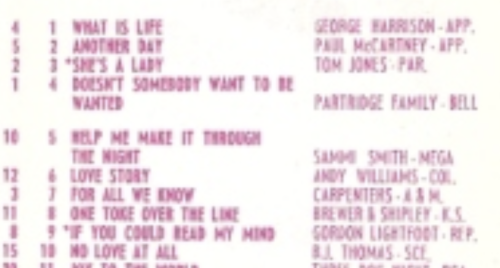
CKVL 850-AM Montreal Top Ten | April 19, 1971
Leave a Reply