
#1: Go Now by the Moody Blues
City: Chatham, ON
Radio Station: CFCO
Peak Month: April 1965
Peak Position in Chatham ~ #1
Peak Position in Vancouver ~ #5
Peak Position on Billboard Hot 100 ~ #10
YouTube.com: “Go Now”
Lyrics: “Go Now”
Born in 1941 in wartime England, Ray Thomas picked up harmonica at the age of nine. He was in the Birmingham Youth Choir and in October 1958 he joined a skiffle group called The Saints and Sinners. The band split up in June 1959. The Saints and Sinners helped Ray discover how well his vocals were received by audiences. Next, he formed El Riot and the Rebels, featuring Ray Thomas as El Riot dressed in a green satin Mexican toreador outfit. The band won a number of competitions in the Birmingham area. It was here that Ray became known for making an entrance onstage by sliding to center stage on his knees. On one occasion Thomas sent a row of potted tulips flying into the audience. El Riot and the Rebels appeared several times on a local variety show called Lunchbox. They made their debut on Lunchbox on November 14, 1962, and played “Guitar Tango” and “I Remember You”. Mike Pinder joined El Riot and the Rebels on keyboards. On April 15, 1963, El Riot and the Rebels performed at The Riverside Dancing Club in Tenbury Wells as the opening act for The Beatles. Pinder went off to serve in the British Army. When he returned, Thomas and Pinder left El Riot and the Rebels and formed a new band called the Krew Kats.
The Krew Kats played in Hamburg, Germany, for four months. They played at the Top Ten Club which The Beatles had made famous. But the Krew Kats didn’t see the money they were expecting. Thomas and Pinder had to walk 417 miles from Hamburg to the English Channel and borrow money for ferry fare back to England.
Once they were back in Birmingham, Thomas and Pinder were searching for other mates to form a new band. Seeing what was unfolding with the British Invasion, they signed up Denny Laine from The Diplomats on vocals and guitar. Clint Warwick, formerly with The Dukes, was on bass. For drums, they chose Graeme Edge, formerly with The Avengers. In addition to being lead singer, Thomas played flute and harmonica. Pinder was on keyboard and mellotron. Initially, they called the new band The Moody Blues Five. But within months they billed themselves as The Moody Blues.
The band recorded a single in November 1964 titled “Go Now”.
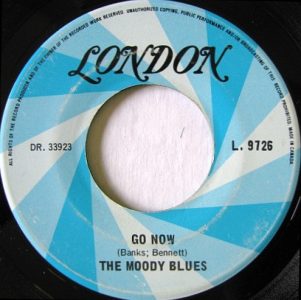
“Go Now” was written by Larry Banks and Bennett. Lawrence “Larry” Banks was born in 1931 in New York City in 1931. He sang in the Dunbar Barbershop Quartet prior to being drafted and fought in the Korean War. On his return in 1953, Banks formed a singing group, The Schemers, with former members of another group, The Four Toppers. This group soon broke up, and in 1954 Banks formed The Four Fellows. They had a hit in 1955 titled “Soldier Boy” which became at Top Ten R&B hit. The Four Fellows appeared with The Moonglows, The Nutmegs and Bo Diddley with Alan Freed as MC. Banks left The Four Fellows in 1957. He wrote a song titled “Go Now” for his spouse Bessie Banks. Though they separated in 1960, she recorded the song in 1963. Though it was not a hit, The Moody Blues heard the song and decided to record it. Larry Banks died in 1992 at the age of 60 and was buried with honors as a military veteran in Calverton National Cemetery. Banks co-writer, Milton Bennett, was a member of The Four Fellows.
“Go Now” was variously printed on record labels with and without an exclamation mark! The song is about a breakup in a relationship. The singer explains, “I don’t want to see you go, but darlin’ you better go now.” He doesn’t want her to hang around and tell him what her plans are going forward. He understands he’s not part of her future and he’s about to cry. This is because he confesses, “I’m still in love with you.”
“Go Now!” reached #1 in Chatham (ON), Harrisburg (PA), Wilmington (DL), New York City, and Port Huron (MI), #2 in Springfield (MA), Long Beach (CA), Detroit, Pittsburgh, Kansas City (MO), Minneapolis/St. Paul, Atlantic City (NJ), Milwaukee (WI), Akron (OH), Battle Creek (MI), and Los Angeles, #3 in Orillia (ON), Louisville (KY), Worcester (MA), Boise (ID), Honolulu, Buffalo, Washington DC, Hartford (CT), Wausau (WI), and Boston, #4 in Chicago, Manchester (NH), Arlington (VA), Rockville (MD), San Bernardino (CA), and San Diego, #5 in Vancouver (BC), New Haven (CT), Cleveland, Butte (MT), Cincinnati (OH), Winnipeg (MB), Providence (CT), and Toronto, #6 in Flint (MI), Philadelphia, Portland (ME), and Knoxville (TN), #7 in El Cajon (CA), #8 in Lansing (MI), Erie (PA), Memphis, and Allentown (PA), #9 in Miami, York (PA), Tulsa (OK), and Reading (PA), and #10 in Kitchener (ON) and Richmond (VA).
The band went on tour as an opening act for The Beatles. Expectations were high for a big followup single. However, the next eight single releases were all flops. In 1966, Denny Laine left the Moody Blues and was replaced by Justin Hayward. Laine would later join Wings, Paul McCartney’s band, from 1971 to 1981. Clint Warwick left to become a carpenter and a steady replacement was eventually found with John Lodge.
Justin Hayward was born in 1946 in Swindon, UK. After playing in school bands, at the age of 15 he bought at Gibson 335 guitar. The instrument would feature in all his studio recordings with the Moody Blues. In 1965, Hayward was in the band with Marty Wilde and The Wild Life. Hayward had auditioned for The Animals. Though he didn’t get hired, Eric Burdon passed on Hayward’s name and demo’s to Mike Pinder of the Moody Blues. While John Lodge, also born in 1946, met Ray Thomas when he was 15 years old. They kept in touch and when Clint Warwick exited the band, Thomas was in touch with Lodge about becoming a new member.
In 1967, nine single releases after “Go Now”, “Nights in White Satin” was released. The song was written in March 1967. It climbed to #1 in the Netherlands, #5 in Austria and #6 in Switzerland and Belgium. However, it stalled at #19 in the UK and fared no better than #103, just beneath the Billboard Hot 100. The song would be reissued five years later in 1972 and become an international Top Ten hit.
The followup to the 1967 release of “Nights In White Satin” was “Tuesday Afternoon”, from the album Days Of Future Passed. Touring with material from the album was a challenge, unless the band lined up an orchestra to accompany them on stage. Next, the band released two singles from the album In Search of The Lost Chord. The second of these was “Ride My See-Saw”.
Their next album, On The Threshold Of A Dream, climbed to #1 on the UK album charts. It went platinum in Canada, however “Never Comes The Day” didn’t make it onto the pop charts. In 1969 the band released To Our Children’s Children. The album climbed to #2 on the UK charts and #14 on the Billboard 200 Album charts. But again, no single release was a commercial success.
A Question Of Balance climbed to #1 in the UK, #3 in the USA and sold platinum in Canada. Building on that success, Every Good Boy Deserves A Favor went to #1 in the UK in 1971, #2 in the USA and was certified platinum in Canada. It also featured the song, “The Story In Your Eyes.”
In 1972, when “Nights In White Satin” became a #2 hit in the USA, Days of Future Passed became a #3 album on the Billboard 200 album chart.
In 1972, The Moody Blues released their eighth studio album, Seventh Sojourn. Again, the album was a best seller and accompanied by the Top 20 hit, “I’m Just A Singer (In a Rock and Roll Band)”. After a world tour with a band called Asia in 1973, the Moody Blues took a break while individual bandmates did some solo work. After a five year hiatus, in 1978 the band reunited to release Octave. Mike Pinder wasn’t happy with the album and opted out of the tour to support it.
In 1981, they released Long Distance Voyager. The album was a chart-topping best seller in the USA and Canada. It went Top Ten in the UK and New Zealand. A single was released titled “Gemini Dream” which climbed to #1 in Vancouver. A followup single was titled “The Voice”.
The third single release from Long Distance Voyager was “Talking Out Of Turn“. In 1983 the Moody Blues released a single titled “Sitting At The Wheel”. In 1986, the band had a Top Ten hit with “Your Wildest Dreams”.
The Moody Blues released their 16th studio album, December, in 2003. Clint Warwick died in 2004.
The Moody Blues have released four live albums, the most recent, Days of Future Passed Live, released in 2018. The live concert took place at the Sony Centre for the Performing Arts in Toronto, Ontario, in 2017.
On April 14, 2018, the Moody Blues were inducted into the Rock ‘N Roll Hall of Fame.
April 11, 2026
Ray McGinnis
References:
“Ray Thomas bio,” Ray Thomas.co.uk.
“Justin Hayward bio,” Justin Hayward.com.
Andy Greene, “Moody Blues’ Justin Hayward on Rock & Roll Hall of Fame Honor: ‘It’s Amazing!’,” Rolling Stone, December 13, 2017.
Scott Mervis, “Denny Laine talks Wings, Moody Blues, ‘Band on the Run’ tour,” Pittsburgh Post-Gazette, May 3, 2017.
Pierre Peronne, “Clint Warwick: Bassist with the original line-up of the Moody Blues on their transatlantic hit ‘Go Now’,” Independent, UK, June 3, 2004.
George W. Harris, John Lodge: Isn’t Life Strange?, Jazz Weekly, January 1, 2018.
“Justin Hayward Interview,” The Ed Bernstein Show, April 13, 2018.
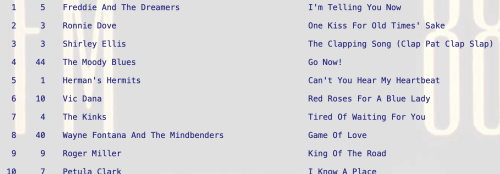
Radio 63 Best Sellers CFCO 630-AM Chatham (ON) | April 7, 1965 | One week before “Go Now” topped the CFCO pop chart.
Definitely in my Top Ten of all time! I remember being devastated when Denny Laine left and still think of Justin Hayward as the “new one”!