
#2: All Strung Out by Nino Tempo and April Stevens
City: Peace River, AB
Radio Station: CKYL
Peak Month: October 1966
Peak Position in Peace River ~ #5
Peak Position in Vancouver ~ #17
Peak Position on Billboard Hot 100 ~ #26
YouTube: “All Strung Out”
Lyrics: “All Strung Out”
Caroline Vincinette LoTempio was born in 1929 in Niagara Falls (NY). She started recording at age fifteen. From the official website of April Stevens & Nino Tempo comes this story: “One day, while standing outside Hollywood’s famous Wallach Music City on Sunset and Vine, she was approached by Tony Sepe, the owner of Laurel Records, who asked her if she could sing. The young teenager thought he was probably flirting, but answered his question in the affirmative. Before long, she changed her name to April Stevens and recorded a few songs for Sepe’s small independent label. An aunt of Carol LoTiempo’s had suggested April as a name, and as she was born in April LoTiempo liked the name. Still in high school, April then moved on to record for Society Records. On her first Society label release, “Don’t Do It”, her sweetly innocent approach to addressing very real concerns for a teenage girl was given a twist at the end. She gives in to the boy’s advances, as long as there’s a commitment. “Don’t Do It” was banned from airplay… “”Stop holding my hand,” April pleaded. But in the second verse, she suggestively purred “I need it, how I need it…ooooh I want it.” Consequently, “Don’t Do It” sold by word of mouth only, from under the counter.”
Stevens most popular solo recording was her RCA Victor recording of Cole Porter’s “I’m in Love Again”. It peaked at #6 on the Billboard pop chart in 1951. Her follow-up, “Gimme Me a Little Kiss, Will Ya, Huh?” made it to #10 that year. In 1952, Stevens recording of “And So to Sleep Again” became her third Top 30 hit, peaking at #27 on the Billboard chart in 1952.
Antonino LoTempio was born in Niagara Falls, New York, in 1935. He recounts, “When I was still in my high chair, whenever the radio was playing, I would not only tap my spoon with the music, but I’d do it in perfect time and would make rhythmic changes as well. That convinced my parents that I had musical talent, so as a child I was given tap dancing and singing lessons.” A child prodigy, Antonio was a talent show winner at four years of age on the Major Bowes Talent Show. At the age of 7, “Nino” appeared on stage with Benny Goodman. He recalls, “Peggy Lee had just finished singing. I walked on the stage, tugged at his coat, and said ‘Mr. Goodman, my grandfather said I could have 10 dollars if I could sing with your band.’ Well, he looked at the audience and said ‘Folks, this is not planned,’ which it wasn’t. So he picked me up and said ‘What are you going to sing?,’ and I said ‘Rosetta in the key of C with a tag at the end,’ and TORE ‘EM UP!” At Benny Goodman’s request, seven-year-old Nino returned to Shea´s Buffalo Theatre in Buffalo, New York for the next six nights to encore his show-stopper.
The LoTempio family moved to LA, and Nino learned to play clarinet, and by age ten the saxophone. He appeared on the Horace Heidt radio show in the late 40s. A child actor, he worked in 1949 in The Red Pony, and in 1953’s The Glenn Miller Story featuring James Stewart. He was a sought-after session musician, recording with Maynard Ferguson on the 1956 album, Live at the Peacock, 1956. Tempo played sporadically in Ferguson’s band for six years. In 1956 Nino Tempo released an album titled Nino Tempo’s Rock ‘N Roll Beach Party. In 1957, at the age of 22, Nino Tempo played “Horn Rock” as the closing credits rolled in the film Bop Goes Calypso.
In 1958, Nino Tempo released a rock tune titled “15 Girl Friends”, which charted in Sydney, Australia. That year Nino Tempo released a western ballad “One Forty-Five”, credited to Black Bart and the Gunslingers. Nino Tempo was the lead vocal, with April Stevens on backing vocals. And in 1959 April Stevens released her album Teach Me Tiger. Stevens title track release, “Teach Me Tiger”, caused a minor uproar for its sexual suggestiveness and consequently did not receive airplay on many radio stations. The song peaked at #86 on the Billboard Hot 100. In 1983, the Challenger Space Shuttle astronauts requested that the wake-up song on their mission be “Teach Me Tiger”. The song was featured in the 2006 film Blind Dating.
In late 1959, Nino Tempo released a rockabilly arrangement for “When You Were Sweet Sixteen”, earning airplay in Philadelphia and San Bernardino (CA). In early 1960, Tempo’s jazz-pop single “Theme From Jack The Ripper” charted in both Ventura and San Bernardino (CA). In the fall of 1960, Nino Tempo released (“I’d Like to Be) Lipstick On Your Lips“, which got some airplay in San Bernardino (CA) and Boston.
In 1960, April Stevens released “In Other Words” (a retitled version of “Fly Me To The Moon”). Late in 1960, April Stevens and Nino Tempo released “High School Sweetheart”. In early 1961, “Big John” was released under the pseudonym Carol and Anthony. The song was a tribute to JFK – “yea, yea, yea, you’re the leader of the USA.” It got some airplay in Miami, Fort Wayne (IN) and Denver. In June 1961, April Stevens released another saucy-sexy single titled “Love Kitten”. It got airplay in Vancouver (BC). She was a “love kitten looking for love,” and did a lot of purring throughout the song.
In 1961, Nino Tempo was a studio musician for Bobby Darin’s Twist with Bobby Darin album. It featured the singles “Multiplication”, “Irresistible You” and “You Must Have Been A Beautiful Baby”. And Nino Tempo was contributing a number of instruments to the recording. Later that year, Nino Tempo made a cameo appearance in the film Breakfast at Tiffany’s. And in 1962, Nino Tempo was back in the recording studio with Bobby Darin for Bobby Darin Sings Ray Charles. In the early 60s, Nino Tempo was also a session musician backing recordings for Frank Sinatra, Steve Lawrence, Eydie Gorme, and Rosemary Clooney.
In the summer of 1962 April Stevens & Nino Tempo charted “True Love (Means More Than Anything)” in Calgary (AB). Earlier in the spring of 1962 April Stevens and Nino Tempo released a cover of the 1933 pop standard “Sweet And Lovely”. It became the debut single for the Deep Purple album. “Deep Purple” was recorded in October 1962. However, it wasn’t released for ten months.
In January 1963, the siblings covered the 1931 pop standard “Paradise” by Nacio Herb Brown from the 1932 film A Woman Commands. The choice to release “Paradise” was because New York producer, Ahmet Ertegun, didn’t like “Deep Purple” and urged it not be released as a single. However, “Paradise” stalled at #126 below the Billboard Hot 100.
Next up, April Stevens and Nino Tempo recorded “Baby Weemus”, a song the duo wrote. It reached #9 in Vancouver (BC).
Next, the duo released “I’ve Been Carrying A Torch For You For So Long That I Burned A Great Big Hole In My Heart”. But it was the B-side, “Deep Purple”, that got listener requests to DJs. Soon “Deep Purple” was pressed as the A-side and the rest is history.
Vancouver (BC) was the first radio market where “Deep Purple” topped the pop chart – September 21, 1963. Over the following month it climbed to #1 in Seattle, Boston, Denver and Miami. The song to reached #1 on the Billboard Hot 100 on November 16, 1963. Ahead of the recording, Nino quickly realized he didn’t have the range to sing “Deep Purple” as originally written. As a lark, he started singing the song in falsetto with April. Personnel at the recording studio overheard the vocal improvisation, told the duo they liked it, and asked to hear more. Encouraged, April and Nino continued to flesh out the arrangement for their “new” version of “Deep Purple”. At one point, Nino decided to sing one chorus alone but he kept forgetting the lyrics so April softly fed him the words. Those listening loved the combination of April’s narration and Nino’s singing but Nino wasn’t sold on the approach. Eventually, April convinced Nino to keep her spoken interlude in the arrangement and the duo made plans to record it with that unique style.
“Deep Purple” received a Grammy Award for Best Rock ‘N Roll Record of 1963. The song beat out “It’s My Party” by Lesley Gore, “Our Day Will Come” by Ruby & The Romantics, and “I Will Follow Him” by Little Peggy March.
April and Nino’s success resulted in TV appearances on Shindig, The Joey Bishop Show, The Smothers Brothers Comedy Hour, as well as a concert tour with the Righteous Brothers, and club dates in Las Vegas, Reno and Lake Tahoe. They also toured in Europe and Australia.
Next, the duo covered the number-one hit in 1920, the Paul Whiteman Orchestra’s “Whispering”. Again April fed the lyrics to Nino. They chose the song while they had just boarded a plane, and April suggested their next song be the tune playing on the aircraft music sound system that moment. The Stevens-Tempo cover peaked #11 on the Billboard Hot 100. In late January 1964, April Stevens & Nino Tempo performed at the Festival della Canzone Italiana di Sanremo, in Sanremo in the northwestern tip of Italy.
Next up, Tempo and Stevens covered “Stardust” popularized by both Hoagy Carmichael and later Bing Crosby; the number-one hit for Marion Harris from 1925: “Tea for Two” (later a Top Ten hit for Tommy Dorsey in 1958), and the Top Ten hit in 1930 – “I’m Confessing That I Love You” – popularized by both Louis Armstrong, Rudy Vallee; and “Bye Bye Blues” – a 1925 jazz standard, later a Top 5 hit for Les Paul and Mary Ford in 1952; “Our Love” – a cover of Frank Sinatra’s debut single in 1939; and “My Old Flame”, sung in Belle of the Nineties by Mae West in 1934. It subsequently was recorded by Duke Ellington featuring vocals by Ivie Anderson. The song was a #7 hit that year for Guy Lombardo.
In the mix of pop standards, April Stevens & Nino Tempo released a cover of the LaVern Baker R&B classic, “Tweedle Dee”. Next up was “I Surrender Dear”, a cover of the 1931 hit by Bing Crosby, which peaked that year at #3 on the American pop charts. They also recorded a cover of the Guy Lombardo tune “Who”, written by Jerome Kern.
In an interview in Song Hits Magazine in August 1964, April stated “I like singing these standards. It isn’t that I don’t like rock ‘n’ roll, but I’m really more of a traditional singer. Nino and I enjoy doing what we do best – bringing a little rhythm to old, slow songs. Making them good all over again.”
Despite their many efforts at covering pop standards, April Stevens & Nino Tempo only had two Billboard Hot 100 Top 30 hits to their credit between 1960 and 1965. Yet, in October 1965, the pair had a #23 hit with a cover of the Paris Sisters’ “I Love How You Love Me”, which included Nino on bagpipes. In 1966, a new record contract with White Whale led to the release of “All Strung Out”.
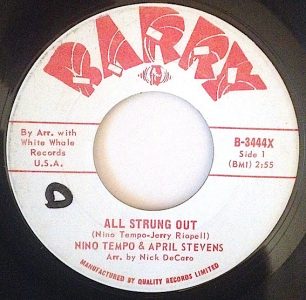
“All Strung Out” was co-written by Nino Tempo and Jerry Riopell. Gerald Henry Riopelle was born in Detroit in 1941, and raised in Tampa, Florida. He moved to Los Angeles after he graduated from high school. And he played drums for the Hollywood Argyles. He became a staff writer for Screen Gems. He was subsequently hired by Phil Spector as both a staff writer and producer. A number of the songs he wrote, and others he produced, made the Billboard Hot 100. These are variously credited to Jerry Riopell and Jerry Riopelle. He wrote songs that were recorded by Herb Alpert, the American Breed, Joan Baez, Brewer & Shipley, Rita Coolidge, Kenny Loggins, Meat Loaf, Leon Russell, Shango, John Travolta and the We Five. Riopelle also composed songs for both film and television. He produced a record titled “Home Of The Brave” for Bonnie & The Treasures, which was covered by Jody Miller.
Riopelle formed a sunshine pop band in 1967 named The Parade. With several of his bandmates he co-wrote a song titled “Sunshine Girl”. The single peaked at #20 on the Billboard Hot 100, and #3 in Vancouver (BC). Between 1971 and 1999 Jerry Riopelle released six studio albums. He lived in Phoenix and developed a solid fan base. In 2005, the mayor of Phoenix, Arizona, Phil Gordon, proclaimed December 31st ‘Jerry Riopelle Day’ in the city. He died of cancer at age 77 in December 2018.
“All Strung Out” is a song about someone who is stressed out, mentally exhausted or extremely nervous about the woman he’s in a relationship with. The relationship seems complicated. On the one hand, the guy begins by saying “I can’t get enough of you baby. There just ain’t enough of you to go around.” One might infer he enjoys being with her. However, it turns out the woman in his life is largely absent: “Just when I’m needing you baby, you ain’t nowhere to be found. Baby, it’s getting me down.” If actions speak louder than words, her focus is not on the boyfriend, as she’s “nowhere to be found.” As a result, he’s “all strung out.”. (A person can also be “strung out” on drugs, but the singer doesn’t describe anything to suggest this is the case). In the chorus, he vows “someday you’ll love me too.” So, he recognizes at this point she doesn’t love him in return.
In the second verse, it becomes clear the relationship is dysfunctional:
It hurts when you needle me baby.
But I’d rather have the pain than lose your love.
I know you’re no good for me baby,
but I’ll keep trippin’ around,
tracking you all over town.
To needle someone is to deliberately annoy someone, especially by criticizing them continuously. Nonetheless, the boyfriend is willing to take it on the chin and endure the pain and be provoked constantly. What is his notion of love? From the lyrics, it’s not clear he’s receiving anything that looks like love, and in the chorus he concedes she doesn’t love him. To be “trippin'” is to be overreacting or acting irrationally. In 1966, if you were trippin’ out about something, you were just shy of being delusional. Your assessment of what was going on is distorted.
And so his time spent trying to track his elusive girlfriend down is questionable.
The bridge in “All Strung Out” goes to a place quite unexpected, given all that’s been described about the relationship:
I love you just the way you are,
like a little falling star.
I’m going to catch you someday,
and you’ll never get away.
What we learn from the lyrics about “the way” she is?
a) When the boyfriend needs her, she’s nowhere to be found.
b) Her absence contributes to her boyfriend being ‘all strung out’
c) She needles her boyfriend (Possibly she just doesn’t like him. Maybe he’s irritating or needy?)
d) Based on his experience, the boyfriend concludes she’s “no good” for him.
Despite the details describing why the boyfriend in the song is “all strung out,” the harmonies and melodies in the song were luscious. The song was produced by Phil Spector. While the bridge in the song is hopeful, sporting the boyfriend’s confidence that things will work out in the end.
“All Strung Out” reached #2 in Dayton (OH), and Greensboro (NC), #3 in Honolulu, #4 in Flint (MI), and Omaha (NE), #5 in Peace River (AB), #6 in Las Vegas, Toledo (OH), Nashville, Little Rock (AR), and Cleveland, #7 in Salt Lake City, Bakersfield (CA), and Kalamazoo (MI), #8 in Fresno (CA), #9 in Springfield (TN), Harrisburg (PA), Louisville (KY), Des Moines (IA), and Erie (PA), #10 in Ann Arbor (MI), and Opelika (AL).
April Stevens & Nino Tempo were one of many American recording acts elbowed down the pop chart ladder in favor of the Beatles, Rolling Stones, Petula Clark, Dave Clark Five, Herman’s Hermits and other British Invasion acts.
In the summer of love, they had a minor hit “I Can’t Go On Living Baby (Without You)”. On September 27, 1967, April Stevens & Nino Tempo appeared on the TV variety show The Groovy Show. This overlapped with the release of her cover of the pop standard “Falling In Love Again”. In November 1967, the duo performed at the Arizona State Fair in Phoenix.
In March 1973, Stevens and Tempo charted “Love Story” to #5 hit in the Netherlands. The Nino Tempo and 5th Ave. Sax. band was formed. “Sister James” reached #53 on the Billboard Hot 100. It’s considered one of the first Disco hits. In 1973, Nino Tempo was in the recording studio with Linda Ronstadt for her album Don’t Cry Now. In 1974 April Stevens cracked the Billboard Hot 100 with “Wake Up And Love Me”, a sultry, breathless, romp. It evoked an emerging sound resembling other hits in the 70s by Thelma Houston, Donna Summer and Barbara Mason (“Give Me Your Love”).
Nino Tempo was in the Wrecking Crew. He was in the recording studio for the Teddy Bears’ “To Know Him Is To Love Him”; Ray Peterson’s “Corrina Corrina”; Ben E. King’s “Spanish Harlem”; The Crystals “He’s A Rebel”, “Da Doo Ron Ron” and “Then He Kissed Me”; Bob B. Soxx and the Blue Jeans’ “Zip-A-Dee Doo Dah”; “I Love How You Love Me” by the Paris Sisters; “Pretty Little Angel Eyes” by Curtis Lee; “Be My Baby”, “Baby I Love You”, “Walking In The Rain” and “Sleigh Ride” for the Ronettes; and “Every Breath I Take” for Gene Pitney; “Black Pearl” for Sonny Charles, “River Deep-Mountain High” for Ike & Tina Turner, “You’ve Lost that Lovin’ Feelin'”, “Unchained Melody”, “Just Once In My Life” and “Ebb Tide” for the Righteous Brothers, as well as for Dion, Cher, Liza Minelli, and others.
During 1975, Tempo played saxophone on John Lennon’s album Rock ‘n’ Roll, and was a featured soloist on The Kenny Rankin Album (1976). In the 1980s Nino Tempo was a voice actor for multiple Garfield TV specials. In the 1990s, Nino released three jazz albums. Meanwhile, in 1991, April Stevens released a cabaret-styled solo album titled Carousel Dreams.
In her 2013 autobiography, Teach Me Tiger, Stevens said she was born in 1929. She’d shaved years off her age early in her career to add to the appeal of being a singing act with her brother Nino. Other recording acts were teen idols. It was suggested her actual age would impede marketing her as “youthful” enough to the teen record buying audience.
April Stevens – Caroline Vincinette LoTiempo – died in April 2023 at the age of 93. Nino Temp – Antonio LoTempio – died in April 2025 at the age of 90.
February 28, 2026
Ray McGinnis
References:
“If You Can’t Beat ‘Em Join ‘Em,” Song Hits Magazine, August 1964.
Tony Gleske, “Nino Tempo,” Hollywood Reporter, January 6, 1995.
Ronnie Allen, “April Stevens & Nino Tempo Interview,” WNJC 1360 AM, Philadelphia, December 13, 2007.
“Nino Tempo and April Stevens Official Website”
April Stevens & Nino Tempo, “Deep Purple,” Atco Records, 1963.
Nino Tempo, “Horn Rock,” Bop Goes Calypso, 1957.
April Stevens, “Don’t Do It“, Society Records, 1950.
April Stevens, “I’m In Love Again,” RCA Victor, 1951.
April Stevens, “Gimme A Little Kiss, Will Ya, Huh?,” RCA Victor, 1951.
April Stevens, “Teach Me Tiger,” Capitol Records, 1959.
April Stevens, “Love Kitten,” Imperial Records, 1961.
Carol and Anthony, “Big John“, Capitol Records, 1961.
“Jerry Riopelle Biography,” Jerry Riopelle.com.
Ed Masley, “‘He was like Phoenix’s Elvis’: Adopted local legend Jerry Riopelle dies of cancer at 77,” Arizona Republic, Phoenix, AZ, December 26, 2018.
“Singer April Stevens dies,” Bang Showbiz, April 28, 2023.
Mark Scheer, “Wrecking Crew member Nino Tempo dies at age 90,” Lockport Union & Sun Journal, Lockport (NY).
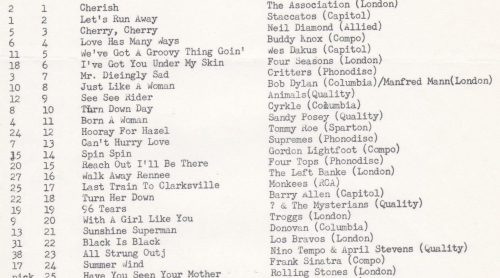
‘Like Young’ Survey CKYL 610-AM Peace River (AB) | October 15, 1966
Leave a Reply