
#142: Big Yellow Taxi by Joni Mitchell
City: Toronto, ON
Radio Station: CHUM
Peak Month: July-August 1970
Peak Position in Toronto ~ #3
Peak Position in Vancouver ~ #19
Peak Position on Billboard Hot 100 ~ #67
YouTube: “Big Yellow Taxi”
Lyrics: “Big Yellow Taxi”
Roberta Joan Anderson was born in 1943, in Fort Macleod, Alberta. Her father was a grocer and her mother a schoolteacher. After the end of World War II, her family moved to North Battleford, Saskatchewan. When she was 9 years old, Joni and her family moved 85 miles southeast to Saskatoon. She took piano lessons as a child. In her teenage years, since she couldn’t afford a guitar, Joni taught herself to play the baritone ukelele which she bought for $36. In her teens Anderson listened to rock-n-roll radio broadcasts out of Texas where the radio signals were especially strong at night. She played at parties and also hung out at a local coffeehouse in Saskatoon called the Louis Riel. She later learned the guitar. In 1964 she began her professional musical career by playing clubs and festivals around Canada. Her repertoire consisted mostly of standard folk songs, many recorded by her idol, Judy Collins, until she began writing her own songs, starting with “Day After Day”, which she wrote while on her way to the Mariposa Folk Festival in 1965.
In 1964 Anderson discovered she was pregnant by her college ex-boyfriend. In February 1965 she gave birth to a baby girl. On her own with a newborn, she was unable to find work. She kept this a secret for three decades ’til in 1994 she told “Vogue” magazine: “I had had a child, and I was broke, literally penniless. And I met Chuck Mitchell, and he said he would take us on. I was kind of railroaded…we were never suitable. I went down the aisle saying ‘I can get out of this.’” A few weeks after the birth, Joni married folk-singer Chuck Mitchell. He promised to help take responsibility for the child but something changed, and a few weeks later Joni gave up her daughter for adoption.
On Toronto Island on August 5th and 7th, 1966, Joni Mitchell played a short set to much acclaim at the Mariposa Folk Festival. On August 17, 1966, Mitchell appeared on TV at the CBC studio in Vancouver. In 1967, her marriage to Chuck Mitchell dissolved. She wrote about her experience in the song “I Had A King” on her debut album, Song to a Seagull. This was followed the next year with Clouds, which won her a Grammy for Best Folk Performance of 1969.
On July 19, 1969, Mitchell appeared on stage at the Newport Folk Festival in Newport, Rhode Island. In early 1970 Joni Mitchell chose to retire from the concert circuit. Taking time off to travel, she was able to reflect on the celebrity that she’d sought and found, but hadn’t enjoyed since the first flickers of fame had approached her with a gasp in their voices. She performed at a few festivals in the summer of 1970, but did not take on a regular concert schedule for most of the year. Simultaneously, her third album, Ladies of the Canyon, went platinum in the USA. Her single from the album was “Big Yellow Taxi”.
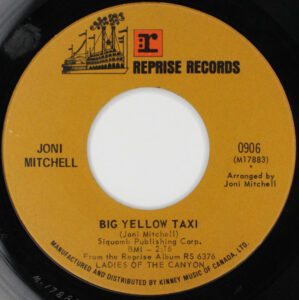
Joni Mitchell said this about writing the song in a 1996 interview:
I wrote ‘Big Yellow Taxi’ on my first trip to Hawaii. I took a taxi to the hotel and when I woke up the next morning, I threw back the curtains and saw these beautiful green mountains in the distance. Then, I looked down and there was a parking lot as far as the eye could see, and it broke my heart […] this blight on paradise. That’s when I sat down and wrote the song.
The song is known for its environmental concern: “They paved paradise to put up a parking lot” and “Hey farmer, farmer, put away that DDT now”. DDT was first synthesized in 1874 by the Austrian chemist Othmar Zeidler. DDT’s insecticidal action was discovered by the Swiss chemist Paul Hermann Müller in 1939. DDT was used in the second half of World War II to limit the spread of the insect-borne diseases malaria and typhus among civilians and troops. Müller was awarded the Nobel Prize in Physiology or Medicine in 1948 “for his discovery of the high efficiency of DDT as a contact poison against several arthropods”. The World Health Organization’s (WHO) anti-malaria campaign of the 1950s and 1960s relied heavily on DDT and the results were promising, though there was a resurgence in developing countries afterwards.
By October 1945, DDT was available for public sale in the United States. Although it was promoted by government and industry for use as an agricultural and household pesticide, there were also concerns about its use from the beginning. Opposition to DDT was focused by the 1962 publication of Rachel Carson’s book Silent Spring. It talked about environmental impacts that correlated with the widespread use of DDT in agriculture in the United States, and it questioned the logic of broadcasting potentially dangerous chemicals into the environment with little prior investigation of their environmental and health effects. The book cited claims that DDT and other pesticides caused cancer and that their agricultural use was a threat to wildlife, particularly birds. Although Carson never directly called for an outright ban on the use of DDT, its publication was a seminal event for the environmental movement and resulted in a large public outcry that eventually led, in 1972, to a ban on DDT’s agricultural use in the United States.
The line “They took all the trees, and put ’em in a tree museum / And charged the people a dollar and a half just to see ’em” refers to Foster Botanical Garden in downtown Honolulu, which is a living museum of tropical plants, some rare and endangered. In the final verse of “Big Yellow Taxi”, the political gives way to the personal. Mitchell recounts the departure of her “old man” in the eponymous “big yellow taxi”, which may refer to the old Metro Toronto Police patrol cars, which until 1986 were painted yellow.
“Big Yellow Taxi” climbed to #3 in Toronto, Hilo (HI), Vancouver (BC), and Honolulu, #5 in Hamilton (ON), and Medicine Hat (AB), #6 in San Jose (CA), #7 in San Bernardino (CA), #9 in Edmonton (AB), #10 in Calgary, #11 in Chilliwack (BC), #12 in Dauphin (MB). On the Billboard Hot 100 “Big Yellow Taxi” stalled at #67. However, in Australia the single reached #6, in the UK #11, in Canada #15, and the Netherlands #19.
Joni Mitchell released a live version of “Big Yellow Taxi” from her Miles of Aisles album in 1974. The live version of her song reached #24 on the Billboard Hot 100 that year. In 1995, Amy Grant covered the song and her version climbed to #4 in Iceland. It also reached the Top 20 in both Scotland and the UK. While in 2003 Counting Crows, featuring Vanessa Carlton, recorded the song which was included in the soundtrack for the film Two Weeks Notice starring Hugh Grant and Sandra Bullock. It reached #3 in Australia, #4 in Latvia and New Zealand, #7 in Hungary and Ireland, #10 in Scotland, #12 in Canada, #16 in the UK, and #19 in the Netherlands.
Perhaps, given the obligation to perform “Big Yellow Taxi” in concert over and over again, Joni Mitchell had this to say in a 1986 interview. ““It’s a nice little ditty, you know? It’s fun to get into. People like it, you know? So it’s one of my arbitrary jukebox tunes”.
In 1970, Mitchell traveled throughout Europe, visiting France, Spain, and Greece. On the ancient isle of Crete she took up the Appalachian dulcimer and rapidly wrote a series of songs dealing with her adventures, including “Carey” and “California”. Both would appear on her fourth studio album, Blue. In 1972, a track from For the Roses titled “You Turn Me On, I’m A Radio” reached #10 on the RPM Top 100 Singles chart in Canada, and #25 on the Billboard Hot 100 in the USA.
In 1975, Mitchell received Grammy Award nominations for Album of the Year and Best Pop Female Vocal Performance for Court and Spark. From the album, the single “Help Me” was nominated for a Grammy in the Record of the Year category. The single would be her only Top ten hit on the Billboard Hot 100, where it reached #7. A second single from Court and Spark, “Free Man in Paris”, reached #16 in Canada and #22 in the USA. She took away a Grammy Award that year for Best Arrangement Accompanying a Vocalist for her track from Court and Spark titled “Down to You”. Subsequently, Joni Mitchell received Grammy nominations for Best Pop Female Vocal Performance for The Hissing of Summer Lawns in 1977, and again for Chalk Mark in a Rain Storm in 1988.
In 1991 the singer had a final single reach a Top Ten chart. This was for “Come in From the Cold” on the Adult Contemporary chart in Canada.
In 1996, Mitchell won two Grammy awards – Album of the Year and Best Record Package – for Turbulent Indigo. In 2001, she was nominated for a Grammy Award in the Best Pop Female Vocal Performance category for “Both Sides Now”. This was a new recording which was featured in the 2003 film Love Actually. She won a Grammy Award in 2001 for Best Traditional Pop Vocal Album for Both Sides Now.
In 2008, Joni Mitchell shared an Album of the Year Grammy Award with Herbie Hancock for his Joni Mitchell tribute album: Joni: The River Letters. On her 18th studio album, Shine, her track “One Week Last Summer” received a Grammy Award for Best Pop Instrumental Performance. In 2016, Mitchell’s box set album Love Has Many Faces: A Quartet, a Ballet, Waiting to Be Danced, received a Grammy Award for Best Album Notes.
In 2020, she released Joni Mitchell Archives – Vol. 1: The Early Years (1963–1967). It received a Grammy Award for Best Historical Album. She received another Grammy Award in the same category in 2026 for her six-disc box set Joni Mitchell Archives – Vol. 4: The Asylum Years (1976–1980). Between these two honors, Mitchell received another Grammy Award in 2024 for Joni Mitchell at Newport. She won in the Best Folk Album category.
Separately, in Canada Joni Mitchell has been nominated for a Juno Award on a dozen occasions. Though, surprisingly it was not until 1980 that Mitchell received a Juno nomination for Female Vocalist of the Year. She has received Juno Awards for a 1981 induction into the Canadian Music Hall of Fame, Best Vocal Jazz Album (2001 – Both Sides Now), Producer of the Year (2008), and in 2026 a Lifetime Achievement Award.
In all, Joni Mitchell has released 19 studio albums and two live albums between 1968 and 2007. She has also released six live albums, and is the subject of the 2007 album A Tribute to Joni Mitchell. The latter includes covers of her catalogue of songs by artists like Prince, k.d. lang, James Taylor, Björk, Emmylou Harris, Annie Lennox, Elvis Costello and Sarah McLachlan.
Joni Mitchell has been inducted into the Rock and Roll Hall of Fame in Cleveland and received the Order of Canada. Over the years she’s won nine Grammy Awards and been nominated for seven others.
October 16, 2026
Ray McGinnis
References:
Joni Mitchell biography, Joni Mitchell.com
The Mermaid Cafe, Kymata/Waves Restaurant, Hersonissos, Crete, Greece.
Renee Montagne, “The Music Midnight Makes: In Conversation With Joni Mitchell,” NPR, December 9, 2014
David Wild, “Morrissey Interviews Joni Mitchell: Melancholy Meets the Infinite Sadness: Two Songwriters Hold Forth on Promiscuity, Chain-smokking, Eating Meat and Suffering for One’s Art,” Rolling Stone, March 6, 1997
Sean O’Hagan, “Joni Mitchell: the Sophistication of her Music Sets her Apart from her Peers – Even Dylan,” Guardian, October 26, 2014
Jack Hamilton, The Unknowable Joni Mitchell: Her Music Inspires a Deep Sense of Intimacy, yet her Fierce Privacy is the Key to her Genius, The Atlantic, November 2017.
Dr. Oliver Tearle, “Joni Mitchell’s Big Yellow Taxi,” Interesting Literature, May 2023.
Elle Palmer, “The legendary song Joni Mitchell dismissed as “arbitrary,” Far Out Magazine, London, UK, December 9, 2025.
“Joni Mitchell: Her Art and Life in 33 Songs,” Pitchfork, May 6, 2019.
Robert Hilburn, “Both Sides Later,” Los Angeles Times, December 8, 1996.

CHUM 30 | CHUM 1050-AM Toronto (ON) | August 1, 1970
Leave a Reply