
#13: Don’t Make Me Over by the Swinging Blue Jeans
City: St. John’s, NL
Radio Station: VOCM
Peak Month: April 1966
Peak Position in St. John’s ~ #2
Peak Position in Vancouver ~ #24
Peak Position on Billboard Hot 100 ~ #116
Peak Position on UK Singles chart ~ #31
Peak Position on Australian Singles chart ~ #35
YouTube: “Don’t Make Me Over”
Lyrics: “Don’t Make Me Over”
The Swinging Blue Jeans had their origins in a band called the Bluegenes, a jazz-influenced skiffle sextet group formed by Bruce McCaskill. From the liner notes on their 1964 album Hippy Hippy Shake, there is a great description about the Swinging Blue Jeans’ origins. “It was in 1959 that Ray Ennis (born in 1942 in Liverpool) and Norman Kuhlke (born in 1942 in Liverpool) met in a dance hall in Garston, a suburb of Liverpool. And it was that meeting that led to the formation of the Swinging Blue Jeans. Ray was a regular singer with the group playing at Garston’s Wilson Hall. Norman used to go in, listen to the band, and request songs for Ray to sing. (“One of my biggest fans,” Ray laughs). Together they formed the SBJ – washboard (which Norman played), tea-chest bass and three guitars (one of which Ray played). They appeared at clubs and dance halls in and around Liverpool for a year, and then, in a talent contest at the Empire Theatre one night, they came up against a group led by Ralph Ellis (born in 1942 in Liverpool).”
“Both groups were in the final – the Swinging Blue Jeans won and the Ralph Ellis Folk Singing Group came second. Ralph Ellis joined the group after the talent contest, and the other newcomer was Les Braid (born in 1937 in Liverpool) who joined the group a month or two in early 1960. The SBJ were without a bass player one night and asked Les, who was playing bass in another group, to sit in. “I’ve been sitting in ever since!” says Les. Lineup at that time was three guitars, bass and drums. The drummer was Norman Kuhlke, who had graduated from washboard.”
Les Braid was an accomplished pianist in his youth, and began an apprenticeship as a cabinet maker before joining the SBJ.
The liner notes provided a snapshot about each of the four bandmates. Ralph Ellis (and the other three bandmates) was born in 1942, “Likes animals, sunbathing, plain girls…jam sandwiches.” Ellis admired the work of Buddy Holly and Peggy Lee. Norman Kuhlke “Likes swimming, driving, practicing the drums and tall, elegant blondes…steak and chips.” Kuhlke also liked Paul Newman and Doris Day. While Les Braid liked “collecting old musical instruments, messing around with old cars, sports, and petite brunettes with lots of personality…ice cream and peanuts…Chuck Berry.” While Ray Ennis liked “theatre, films, fast cars, and girls who are well-dressed and sensible…Marlon Brando and Sammy Davis Jr.”
The liner notes from Hippy Hippy Shake continue: “One important ‘home’ for the boys was the Mardi Gras in Liverpool. After more successful club and dance dates, the boys turned professional in 1961, and they number among their most successful engagements a season at the Star Club in Hamburg. Then in June, 1963, they made their disc debut for EMI with ‘Too Late Now’ which was composed by Ray Ennis.” The debut single climbed to #30 on the UK singles chart in June 1963. A followup single “Do You Know” failed to chart.
However, in December 1963 the Swinging Blue Jeans finally hit their stride with the release of “Hippy Hippy Shake”.
A second single from the album was a cover of Little Richard’s “Good Golly Miss Molly”. It climbed to #11 in the UK, #17 on the C-FUNTASTIC FIFTY in Vancouver in June 1964, and #43 on the Billboard Hot 100. Subsequently, the SBJ had a #3 hit in the UK titled “You’re No Good”, which spent 8 weeks on the C-FUNTASTIC FIFTY in Vancouver but stalled at #36. The Swinging Blue Jeans offered up a memorable cover of a minor R&B hit in 1963. The song was later a number-one hit in February 1975 when Linda Ronstadt covered it. Next, the Swinging Blue Jeans had a Top 50 hit in September 1964 on CKLG’s Silver Dollar Survey with “It’s So Right”. The song was a track from their debut album in the UK, but only released as a single in North America.
Their next album, Blue Jean’s a Swinging, showcased many of the covers the band performed in concert. The tracks included Little Richard‘s “Tutti Frutti” and “Long Tall Sally”, Lloyd Price’s “Lady Miss Clawdy”, and the Drifters’ “Save The Last Dance For Me”.
A third album, Don’t Make Me Over, included a cover of the Burt Bacharach/Hal David song first recorded by Dionne Warwick in 1962, “Chug-A-Lug” by Roger Miller, and “Do You Believe In Magic” by the Lovin’ Spoonful. The title track climbed to #24 on the C-FUNTASTIC FIFTY in April 1966.
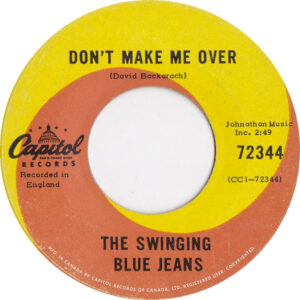
“Don’t Make Me Over” was written by Hal David and Burt Bacharach. The song is a plea for a romantic partner to accept them for who they are. Once you’re formed a relationship, the task is to love the other person, not to change them. “Just love me with all my faults the ay that I love you,” sing the Swinging Blue Jeans. One person in the relationship is focused on an unconditional love. The other is focused on picking “on the things I say, the things I do.” A home where one partner is constantly reminded that they aren’t measuring up to the others’ expectations is a recipe for a rocky future.
Burt Bacharach was born in Kansas City, Missouri, in 1928. He studied at McGill in Montreal, and music schools in New York City and California. In 1948 he was drafted into the United States Army. While in West Germany he met singer Vic Damone, and when he was discharged Burt Bacharach worked with Damone for three years.
Bacharach was in several successful songwriting teams, including with Bob Hillier. They co-wrote “Any Day Now (My Wild Beautiful Bird)” for Chuck Jackson, and “Tower Of Strength” for Gene McDaniels.
Harold “Hal” David was born in 1921 in New York City. In 1949, his song “The Four Winds and The Seven Seas” was a #3 hit for Swing and Sway with Sammy Kaye. In 1959, he cowrote “My Heart Is An Open Book”, a #3 hit for Carl Dobkins Jr. Later that year Sarah Vaughan had a Top Ten hit with “Broken Hearted Melody”. In 1961, David cowrote “Sea Of Heartbreak” for Don Gibson. The following year, his song “Johnny Get Angry” was a Top Ten hit for Joanie Sommers.
Burt Bacharach and Hal David were composers working in the Brill Building starting in the late 50s. They co-wrote “The Story Of My Life” which became a #1 hit for Michael Holliday in 1958 in the UK, and “Magic Moments” for Perry Como another #1 hit in the UK and #4 on the Billboard Hot 100 later that year. In 1961 Bacharach wrote “Tower Of Strength” for Gene McDaniels and “Baby It’s You” for The Shirelles. Bacharach and David had a banner year in 1962 with hits that included “(The Man Who Shot) Liberty Valance” (Gene Pitney), “Make It Easy On Yourself” (Jerry Butler), “Don’t Make Me Over” (Dionne Warwick) and “Only Love Can Break A Heart” (Gene Pitney). In 1963 the songwriting team enjoyed more accolades with “Wishing And Hoping” (Dusty Springfield), “Blue On Blue” (Bobby Vinton), “(They Long To Be) Close To You” (The Carpenters, #1 in 1970) and “Anyone Who Had A Heart” (Dionne Warwick). 1964 continued Buurt Bacharach and Hal David’s winning ways with “Walk On By” (Dionne Warwick) and “There’s Always Something There To Remind Me” (Sandie Shaw, #1 UK).
In 1965, Bacharach and Hal David were nominated for an Academy Award in the Best Song category for “What’s New Pussycat?”. They received nominations again in 1966 for “Alfie” and in 1967 for “The Look of Love”. In 1969, Bacharach and Hal David won Academy Awards for “Raindrops Keep Falling On My Head” (BJ Thomas, #1 US) in the Best Song category, and Best Score for an Original Motion Picture with Butch Cassidy and the Sundance Kid. In 1970, Bacharach and David won a Grammy Award for Best Score from an Original Caste Album for Promises, Promises. In 1981, Burt Bacharach shared an Academy Award for Best Original Song with “Arthur’s Theme (Best That You Can Do)”. Over the years, Burt Bacharach received six Academy Award nominations and won three of these. He also received seven Golden Globe nominations and won two of these.
At the Grammy Awards, Burt Bacharach shared award nominations with Hal David for “Wives and Lovers” (1963), “What the World Needs Now Is Love” (1965), “Casino Royale” (1967). They won a Grammy in 1967 for “Alfie” in the Best Instrumental Arrangement category. The songwriting duo also received Grammy nominations for both “I’ll Never Fall In Love Again” and “Raindrops Keep Falling On My Head” (both losing out to “Games People Play” by Joe South).
In 1981, Bacharach received a Grammy nomination for “Arthur’s Theme”. In 1986 he shared the Grammy Award for Record of the Year in 1986 for “That’s What Friends Are For” with Carol Bayer Sager. In 1995, he shared a Grammy nomination with Elvis Costello in the Best Pop Collaboration with Vocals category for “God Give Me Strength”. Bacharach and Costello won in that category in 1998 for “I Still Have That Other Girl”.
In 2005, Burt Bacharach won a Grammy Award for At This Time in the Best Contemporary Instrumental Album category. In addition, he received a second Grammy nomination for the track “In This Time”.
In 2020, Burt Bacharach received a Grammy nomination in the Best Traditional Pop Vocal Album category for Blue Umbrella. In 2021, Burt Bacharach received a Grammy nomination for Burt Bacharach and Steven Sater’s Some Lovers in the Best Musical Theatre Album category. Over the decades Burt Bacharach received 22 Grammy Award nominations, winning on six occasions.
Over the years Burt Bacharach wrote the soundtracks to eleven movies, and seven theatrical works. He also released eight solo albums, among his many accomplishments. Burt Bacharach died in 2023 at the age of 94. Hal David died in 2012 at the age of 91.
“Don’t Make Me Over” reached #2 in St. John’s (NL), #6 in Montreal, #8 in Midland (TX), #10 in Toledo (OH), #14 in Honolulu, and #17 in Seattle.
Ralph Ellis left the band and in 1967 Norman Kuhlke departed.
In a 2007 obituary for Les Braid, the Guardian wrote “By the end of the 1960s, Braid and singing guitarist Ray Ennis were the only members left from the 1963 line-up. The group continued on the cabaret circuit and on repackaged 1960s tours. They did make further records, and the original Hippy Hippy Shake featured on the soundtrack of the Tom Cruise vehicle Cocktail (1988). After nearly 50 years, Braid quit the Swinging Blue Jeans last spring [2004] after his terminal lung cancer was diagnosed.”
The soundtrack for Cocktail included a cover of “The Hippy Hippy Shake” by the Georgia Satellites, “Tutti Frutti” by Little Richard, “Kokomo” by the Beach Boys, and “Don’t Worry, Be Happy” by Bobby McFerrin. The the Georgia Satellites version spurred more airplay of the Swinging Blue Jeans version on oldies radio stations in the UK and elsewhere. All resulting in more royalty cheques for Ennis, Kuhlke, Ellis and Braid.
Over the years there have been a dozen lineup changes. The longest current member of the band is guitarist Alan Lovell who joined SBJ in 1981. Ray Ennis retired from the Swinging Blue Jeans in 2010. However, Ennis came out of retirement to make occasional appearances with another band under the name “Ray Ennis’s Blue Jeans”. Concurrently, the Swinging Blue Jeans continue as an act with no original members.
May 4, 2026
Ray McGinnis
References:
Bill Harry, “The Swinging Blue Jeans,” Sixtiescity.net.
Alan Clayson, “Les Braid: Founder-member of Merseybeat Group the Swinging Blue Jeans,” Guardian, September 1, 2005.
Swinging Blue Jeans, “You’re No Good“, Capitol Records, Canada, 1964.
Chan Romero, “The Hippy Hippy Shake“, Del-Fi Records, 1959.
Richard Williams, “Hal David Obituary: Lyricist Behind Some of the Greatest Pop Hits of the 20th Century,” Guardian, September 2, 2012.
Richard Barber, “Burt Bacharach at 88: ‘Why Would I Ever Want To Stop?’,” Telegraph, June 10, 2016.
Lauren Huff, “Dionne Warwick says loss of Burt Bacharach is ‘like losing a family member’,” Entertainment Weekly, February 9, 2023.
“Environmental History: Timeline and Historical Insights,” Environmentalhistory.org.
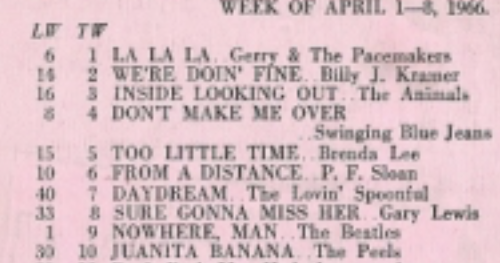
Newfoundland’s Only Official Survey – VOCM 590-AM St. John’s (NFLD) | April 1. 1966
Leave a Reply