
#77: Here Comes Shack by Douglas Rankine & The Secrets
City: Toronto, ON
Radio Station: CHUM
Peak Month: February-March 1966
Peak Position in Toronto ~ #1
Peak Position in Vancouver ~ did not chart
Peak Position on Billboard Hot 100 ~ did not chart
YouTube: “Here Comes Shack”
Lyrics: “Here Comes Shack”
Doug Rankine and the Secrets were one of the sharper beat bands on the mid 1960s Yorkville scene. The original line up featured Doug Rankine on vocals and rhythm guitar, Bob Mark on lead guitar, Henry S. Thaler (later credited as Henry Taylor) on keyboards, Mike Woodroffe on bass, and Rick Felstead on drums. Working first as the Secrets, they held a residency at the Pressmen’s Club and quickly became a popular draw around southern Ontario.
In 1962, 1963, 1964 and 1967 the Toronto Maple Leafs hockey team won the Stanley Cup in the National Hockey League (NHL). One of their star players was Eddie Shack. He joined the Maple Leafs in 1961 as a left-winger. He scored the winning goal in the deciding game for Toronto in 1963 against the Detroit Red Wings. In the seven seasons Shack played for the Maple Leafs, his best was in the 1965-66 season where he scored 26 goals. This inspired a band named Douglas Rankine and the Secrets to record “Clear The Track, Here Comes Shack”. The song was a novelty record about Eddie Shacks playing hockey.
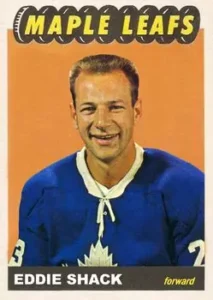
In early 1966 Hockey Night in Canada announcer Brian McFarlane asked the Secrets to record a novelty song he had written for Toronto Maple Leafs fan favourite Eddie Shack. It was initially issued on Canada International as “Clear The Track, Here Comes Shack”.
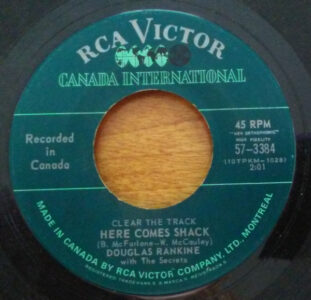
“Here Comes Shack” was cowritten by Brian McFarlane and William McCauley. Brian McFarlane was born in 1931 in New Liskeard, Ontario. He attended St. Lawrence University in Canton, New York. He played hockey for the St. Lawrence Saints, one of three hundred hockey teams in the Eastern College Athletic Conferences. After four years with the Saints, McFarlane has scored 101 goals. When he graduated, Brian McFarlane worked for WRGB in Schenectady, New York. From there he moved to CFRB in Toronto, and then as sports director at CFCF in Montreal. In 1964, Brian McFarlane was hired as a colour commentator with Hockey Night in Canada. Other color commentators McFarlane shared commentary with covering the hockey games include Howie Meeker, Jim Robson, Bobby Orr, Ted Reynolds, Red Storey, Dick Irvin Jr., Bill Good, John Ferguson Sr., and Keith Dancy. McFarlane also became a studio host for Hockey Night in Canada beginning in 1970. In that capacity, he worked alongside Jack Dennett, Dave Hodge, Bill Good Jr., Dick Irvin Jr., Dan Kelly, Dave Reynolds, and Ted Reynolds. In 1980, McFarlane made comments supportive of Toronto Maple Leafs captain Daryl Sittler that were critical of Maple Leafs owner Harold Ballard. He was subsequently banned from the Maple Leaf Gardens press box. For Hockey Night in Canada, he was moved off Toronto games at this point, broadcasting the Montreal Canadiens and Winnipeg Jets, or games in the United States as the on-site host. He also was assigned to provide out-of-town scoreboards and games for Hockey Night in Canada from the NHL Control studios in Toronto when not traveling. His last year with Hockey Night in Canada was 1991, ending a 28-year association with the sports broadcast.
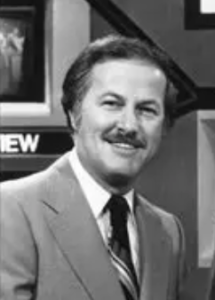
Brian McFarlane, Hockey Night in Canada commentator
McFarlane has published 96 books on hockey, selling over 1.3 million books. His first book, 50 Years of Hockey was published in 1968. McFarlane is an expert on hockey history and has compiled several volumes of NHL lore titled It Happened in Hockey, a 1999 series detailing the colourful history of the Original Six NHL teams – Boston Bruins, Chicago Black Hawks, Detroit Red Wings, Toronto Maple Leafs, Montreal Canadiens, and New York Rangers – and “Proud Past Bright Future,” the history of Women’s Hockey (1994). He has published two memoirs, Brian McFarlane’s World of Hockey (2000), and From The Broadcast Booth (2009). His most recent book is A Helluva Life in Hockey (2021). As of this post, Brian McFarlane is 95 years old and a highly regarded hockey historian.
William McCauley was born in Toefield, Alberta, in 1917. He became a popular composer, conductor and producer. From 1960 until 1987 McCauley served as the Director of Music at the O’Keefe Centre in Toronto. In 1972, he became Director of Music and the conductor for the North York Symphony. He died in 1999 at the age of 82.
“Here Comes Shack” is a song of tribute to Eddie Shack the hockey player. The lyrics tell “He started in the minors, almost gave up the game,” but since he joined the NHL “the leagues haven’t been the same.” The chorus promised that on the ice Shack would “knock you down and he’ll give you a whack.” Shack retired from the National Hockey League at the end of the 1974-75 season at the age of 38. He went on to be the advertising spokesperson for The Pop Shoppe soft drinks, Wendy’s Hamburgers, and Schick razors. Eddie Shack died at the age of 83 in 2020 from throat cancer.
“Here Comes Shack” climbed to #1 in Toronto.
Rock music critic, Ritchie Yorke, wrote “Here Comes Shack” gave Douglas Rankine and the Secrets national exposure. However, it labelled them as a novelty act which impaired their attempts to be taken seriously and evolve into a contemporary pop-rock act in tune with the times. Away from the hockey anthem, the Secrets showed a much deeper side on their Arc Records single “Cryin’ Over Her” backed with “He Treats You Bad”, both written by Bob Mark. Driven by sharp guitar work and Rankine’s urgent vocal, Cryin’ Over Her became a favourite on the local scene and confirmed Mark as the group’s principal songwriter. Even so, the shadow of “Clear The Track, Here Comes Shack” was hard to shake. …by early 1967 the band and their new label Yorkville decided to relaunch the group under a new name, the Quiet Jungle.”
Doug Rankine and the Secrets later became the psychedelic rock band The Quiet Jungle. They charted several minor hits in select Canadian radio markets, including “Ship Of Dreams”. The single cracked the Top 20 in Orillia (ON), and the Top 40 on CHUM 1050-AM in Toronto, and in Belleville (ON). It also charted in Vancouver.
The twilight of the Quiet Jungle came through exposure to other recording acts they shared billing with in concert. By 1968 the group was starting to dissolve. Rankine told Garage Hangover, “There were a few reasons the band broke up. After four years (having the time of my life), I came to the realization that “I personally” was not a good enough singer to hit the big time. While traveling the country, I got to hear bands and singers that were 10 times better than I was and realized that even they would not make it. We were playing the “Red River Exhibition” in Winnipeg one summer when I got to hear a young guy by the name of Burton Cummings sing. As soon as he opened his mouth, I knew I was in the wrong business. There was no mistaking, he had a voice from the Gods and was truly destined for stardom. Bob Mark and Henry Taylor were the true talent of our band. Both were extremely accomplished, Bob on the creative side (writing original material) and Henry as the musical side (arranging). Both Rick and Mike were very solid on drums and bass but it was Bob and Henry who carried the band.”
In his 2007 interview with Chris Bishop at Garagehangover.com, Douglas Rankine said at the time, “Bob retired some years ago and lives somewhere up North. Rick lives in the Durham area. I believe Mike is somewhere in Toronto. Henry is in Toronto and is still active in the music business playing part time with a Doors tribute band.”
November 9, 2026
Ray McGinnis
References:
Brian Parkinson, “The Quiet Jungle“, whatever not.com, May 12, 2019.
Chris Bishop, “The Secrets/The Quiet Jungle,” Garage Hangover.com, December 8, 2007.
Robert Williston, “Douglas Secrets (Douglas Rankine with the Secrets),” Citizen Freak.com.
Jamie Bramburger, “Brian McFarlane remembers his hockey life,” Pembroke Observer, December 28, 2021.
Dave Stubbs, “Shack, four-time Stanley Cup winner with Maple Leafs, dies at 83,” National Hockey League, July 26, 2020.
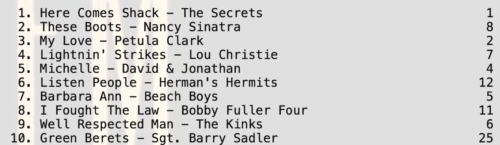
CHUM Hit Parade | CHUM 1050-AM Toronto (ON) | March 7, 1966
Leave a Reply