
#3: Love Me To Pieces by Jill Corey
City: Ottawa, ON
Radio Station: CKOY
Peak Months: July-August and October 1957
Peak Position in Ottawa ~ #1
Peak position in Vancouver ~ #6
Peak Position on Billboard Hot 100 ~ #18
YouTube: “Love Me To Pieces”
Lyrics: “Love Me To Pieces”
Jill Corey (born Norma Jean Speranza) was born in 1935 in Avonmore, Pennsylvania. Her father was a coal miner in this western Pennsylvanian coal mining town. Her mother died when she was four-years-old. She began singing as an imitator of Carmen Miranda at family gatherings, on amateur shows in grade school, and contralto in the local church choir. At the age of 13, she began to develop her own style. She won first prize at a talent contest sponsored by the Lions Club, which entitled her to sing a song on WAVL in Apollo, Pennsylvania. This got her an offer to have her own program. By the age of 14 she was working seven nights a week, earning $5-$6 a night, with a local orchestra led by Johnny Murphy. From 1950 to 1956 she was a regular on the television variety program Robert Q’s Matinee. By the age of 17 she was a local celebrity talent.
At the home of the only owner of a tape recorder in town, with trains going by in the background and no accompaniment, she made a tape recording to demonstrate her singing skills to the outside show business world. The tape came to the attention of Mitch Miller, who headed the artists & repertory section at Columbia Records. He normally received over 100 record demos a week, and this one, with a 17-year-old girl and its train background, would not have been likely to gain his attention. He telephoned her in Avonmore, and the next morning she flew to New York to be heard by Miller in a more normal studio setting. Miller had Life magazine send over reporters and photographers, and had her audition with Arthur Godfrey (host of Arthur Godfrey’s Talent Scouts) and Dave Garroway (anchor of the NBC show Today). The Life photographers reenacted her signing a contract with Columbia, and all this happened in a single day, with her headed back to Avonmore that night. She had just turned 18 years of age.
Both Garroway and Godfrey called her, and it was her choice to pick one. She picked Garroway, who took the name Jill Corey out of a telephone book and let Norma Jean Speranza know that she had a new stage name. In the Life magazine article of November 9, 1953, readers learned that the nickname her father gave her was “Scarpo” which means big shoe, as she wore a size 7 1/2. Life writer Gordon Parks wrote “At high school where Norma graduated last June, the boys, who often called her “Skinny Legs Speranza” thought her real name was better” than Jill Corey. Later in November 1953, she appeared for the first time on The Dave Garroway Show.
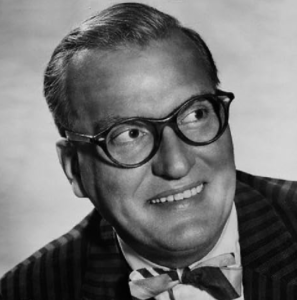
(Above) Dave Garroway
She was on The Dave Garroway Show for 32 episodes during the 1953-54 season.
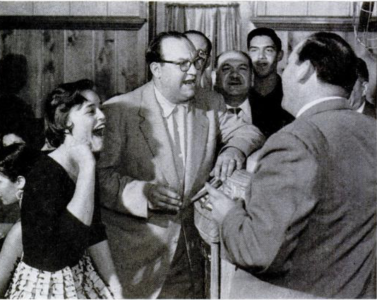
(Above) Farewell song at family’s goodbye party with her bandleader boss,
Johnny Murphy, and bandsmen joining Norma in chorus of “Side By Side”
Within six weeks the Life article, with a cover picture and seven pages, came out. Jill Corey became the youngest star ever at the Copacabana nightclub, where she was hit on by Frank Sinatra, and had numerous hit records.
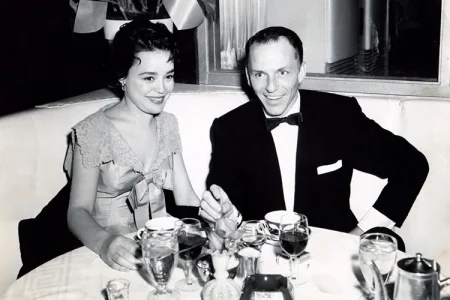
On a date with Frank Sinatra in 1954, after Sinatra and his wife
Ava Gardner had separated in 1953 and Gardner was dating
bullfighter Luis Miguel Dominguín in the public spotlight.
Corey’s dating relationship with Frank Sinatra (while she was 18 and 19) lasted a year. She keeps the details to herself. Pittsburgh Magazine later reported “He did ask me to marry him,” she allows, going no further. She does recall how, when she met Sinatra again years later, he said to her, “Jill, can you tell me why we never got married?” “I don’t know,” Jill remembers saying to him. “I don’t know.”
Jill Corey’s first regional hit was “Robe of Calvary”, which charted into the Top Ten in record markets in Pennsylvania, Michigan, and the New England states. In January 13, 1954 she appeared twice on Coke Time with Eddie Fisher. The show opened with a “Drink Coke” dispenser filling up a glass of Coca-Cola, while an announcer exclaimed “Coke Time is anytime, anywhere. It’s always time for ice cold Coca-Cola.” She also was a guest on the DuMont television network variety show Stars On Parade. That year Jill Corey was one of the celebrities who appeared on the 4th Annual Celebrity Parade for Cerebral Palsy. Hosted by Perry Como, Corey was joined by The Chordettes, Toni Arden, Count Basie, Georgia Gibbs, Eydie Gorme, Eddie Heywood, Steve Lawrence, Patti Page, The Ray Charles Singers, Jerry Vale, Paul Whiteman and others.
In January 1955, her single “Edward” was a Top Ten hit in New York City, Los Angeles, Mobile (AL), and Milwaukee. She released a cover of the LaVern Baker tune “That’s All I Need” which helped Jill Corey crack the Top Ten on the pop charts in New Orleans. Corey had her first appearance on the CBS variety program The Johnny Carson Show on July 21, 1955. Corey returned as a guest twice in Augusta and again in September. Subsequently, she was a weekly guest on eight consecutive episodes between October 13th and December 1st, and again for the final two episodes of the year. Her fifteenth and final appearance on The Johnny Carson Show was on January 5, 1956. She also appeared as a guest on Good Morning! with Will Rogers Jr. A jazz-infused rendition of “Cry Me A River” backed by the Percy Faith Orchestra with a standout trumpeter took her to the Top Ten in a handful of radio markets in the winter of 1955-56. Even so, in May 1956, Billboard described Jill Corey as a performer who “hasn’t made it big” despite the amount of publicity she received.
Columbia Records was certainly releasing quite a few Jill Corey singles. But “The First Christmas”, “Should I Tell”, “Ching-Ching-A-Ling”, “Wait For Tomorrow”, “First Love”, “Summer Night”, and “Let Him Know” got little attention. As did her release of “Egghead” about the failed masculinity of an ‘egghead.’
Corey had her first hit record in December 1956 titled “I Love My Baby (My Baby Loves Me)” which peaked at #21 on the Billboard pop chart and #5 on CHUM in Toronto. She hosted The Jill Corey Show on the National Guard Bureau which consisted of eight 15-minute films. The Jill Corey Sings on radio.
On January 20, 1957, Corey had her first appearance on The Ed Sullivan Show along with Ivory Joe Hunter, Sonny James, The Tarriers, Betty Johnson, and actor and director John Cassavetes. On March 21, 1957 she appeared in an episode of Climax! titled “Let It Be Me” along with Eddie Arnold and Maureen O’Sullivan. In the episode Jill Corey sang the first English translation of the 1955 French hit “Je t’appartiens” made popular in France by Gilbert Bécaud. A single was released after the episode and climbed to #57 on the Billboard pop chart. (The song would later be a hit for the Everly Brothers in 1960, Betty Everett and Jerry Butler in 1964, and Glen Campbell and Bobbie Gentry in 1969). The B-side “Make Like A Bunny Honey” reached #8 in Ottawa and #95 on the Billboard pop chart.
In 1957, she was also a guest on The Arthur Murray Party, three times on The Jonathan Winters Show, and twice on The Steve Allen Plymouth Show along with Sam Cooke, Tommy Leonetti, Xavier Cugat, Sammy Davis Jr., and Orson Wells. Late spring ’57, Columbia Records released Corey’s single “Love Me To Pieces”.
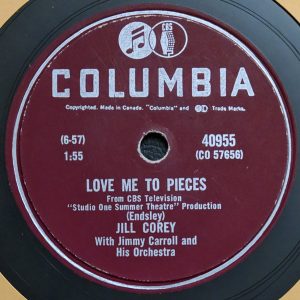
“Love Me To Pieces” was written by Drasco, Arkansas native Melvin Endsley. Born in 1934, when he was three years old, he contracted polio, requiring him to use a wheelchair for the rest of his life. From the age of 11, he spent three years in the Crippled Children’s Hospital in Memphis (TN). While there, he listened to country music on the radio and taught himself to play the guitar. After returning to Drasco, he began to play on radio shows. By the time he was 20 years old, his song, “It Happens Everytime”, caught the attention of Don Gibson and Dorsey Burnette. He was a member of the KWKH Louisiana Hayride. Best known for writing “Singing the blues” which he recorded in 1954 and pitched to the Grande Ole Opry backstage the following year. It was covered in 1956 by Marty Robbins and became a number-one country hit. Guy Mitchell made it a crossover number-one pop hit for nine weeks in the USA (and three weeks in the UK) and #4 on the R&B chart, while Tommy Steele took the song to the top of the British pop chart for three non-consecutive weeks in 1957. Soon after, Guy Mitchell recorded Endsley’s “Knee Deep In The Blues” which reached #3 in the UK and #15 on the Cashbox Best Selling Singles chart in the USA. In May of ’57 Andy Williams recording of Melvin Endsley’s “I Like Your Kind Of Love” reached #8 on the Billboard pop chart. And in early 1958, Frankie Vaughan took “Can’t Get Along Without You”/”We Are Not Alone” to #11 on the UK pop singles chart. In 1998, he was inducted into the Arkansas Entertainers Hall of Fame.
“Love Me To Pieces” reached #1 in Ottawa for 4 non-consecutive weeks, #1 in Pittsburgh, Newport News (VA), and Worcester (MA), #2 in Shreveport (LA), and Albany (NY), #3 in Washington DC, #4 in Smiths Falls (ON), and Edmonton (AB), #5 in New Orleans, #6 in Vancouver (BC), and Saskatoon (SK), #7 in Toronto, Atlanta, and Troy (NY), #8 in Baltimore, and La Crosse (WI), #9 in Salt Lake City, and #10 in Winnipeg (MB).
In September 1957, she returned to The Ed Sullivan Show along with The Andrews Sisters, the R&B group The Dominoes, In October 1957, Corey appeared on the Television talk show Person to Person hosted by Edward R. Murrow. That fall her cover of the West Side Story tune “I Feel Pretty” charted into the Top 30 in Vancouver on CKWX for eleven weeks. It also climbed to #8 in Toronto, but didn’t crack the Billboard pop chart. She had a Top Ten hit in Toronto in January 1958 with a cover of the 1930 Broadway tune from International Revue titled “Exactly Like You”, which was a Top 15 hit for Ruth Etting and also for Harry Richman.
On November 20, 1957 Jill Corey appeared on an episode of Kraft Theatre titled “The Sound of Trouble”. It concerned a traveling family of country music performers, the Singing Canfields, who face a crisis. Papa Canfield’s daughter Marietta (Jill Corey) has fallen for a farm boy and wants to settle down and get married. But her papa will not stand for it. On December 11, 1957, she was a guest on The Big Record along with Patti Page, Count Basie, Gogi Grant, Kate Smith, and others.
In early 1958, she released a treatment of the song “Give It All You Got” from the 1953 Broadway musical Oh Captain. With the continued ‘fad’ of rock n’ roll (or so it seemed to Columbia Records), Jill Corey’s further commercial success was eluded with the releases of “Last Night On The Back Porch” and “Sweet Sugar Lips”. In September 1958, Jill Corey released her last nationally charting single on the Billboard Hot 100 titled “Big Daddy”. The song was from the movie Senior Prom. “Big Daddy” stalled at #96 on the pop chart. In Canada, the single climbed to #7 in Ottawa and #55 in Vancouver. The song’s modest traction in Canada might have stemmed from teen viewers of Jill Corey’s appearance on The Dick Clark Beech Nut Show on September 20, 1958. She also was a return guest in September ’58 on The Ed Sullivan Show along with Georgia Gibbs, Johnnie Ray and Jane Morgan.
On November 30, 1958, Corey was back on The Ed Sullivan Show with Teresa Brewer, and again on the popular variety show the following week. In December 1958, Corey earned top billing in the film Senior Prom, co-starring with jazz singer Keely Smith, and TV show host Ed Sullivan.
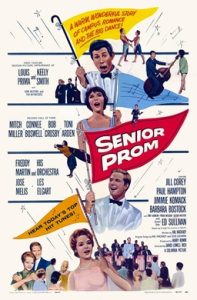
The poster effused “A warm, wonderful story
of campus romance and the bug dance!
From 1958 to 1959, Jill Corey was a regular on the final season of Your Hit Parade. On January 20, 1959 Corey appeared on The Eddie Fisher Show along with Eddie Hodges and The DeCastro Sisters. The following month she was a guest on The George Burns Show, followed by two appearances on The Jack Paar Show alongside Elaine Stritch and She was co-host of Music on Ice, a variety program on NBC in 1960. On January 23, 1961 Corey appeared in an episode of Miami Undercover in an episode titled “The Thrush”. The plot opened with a late night disc jockey being murdered on-air by two thugs. The DJ is murdered because he refused payola to play a record from a gangster-owned label. A police detective pretends to be a New York producer to get an interview with the girl (Lita Irish played by Jill Corey) singing on the record. The killers are tricked when their boss betrays them.
In 1958-59 her singles “Love In Vain”, “Dream Boy”, “My Reverie”, and “Have I Told You Lately That I Love You” and got little action from DJs. Even “Seems Like Old Times”, which had an arrangement similar to many Connie Francis recordings, only charted in a few record markets in Maryland and New York state. A cover of the Bye Bye Birdie tune “One Boy” was a commercial flop, despite a pleasant rendition. Nonetheless, she was back on The Ed Sullivan Show on August 2, 1959 along with comedian Shelley Berman and The Platters. She returned to The Dick Clark Beech Nut Show on January 6, 1960 along with Jim Reeves, Adam Wade, Webb Pierce and Sandy Nelson. In April 1960, she was back on The Ed Sullivan Show sharing the billing with The Ames Brothers, Ed Ames, and The McGuire Sisters. In May 1960 she and traditional pop singer Johnny Desmond were featured in the TV special Music On Ice.
Jill Corey had an eighth and final appearance as a guest on The Ed Sullivan Show on September 4, 1960. Other guests included Della Reese, Teddy Randazzo, Georgia Gibbs and Leon Bibb. Her final minor hit in Canada was “Stick ‘Em Up, Stuck Up” which peaked at #34 on CKWX in Vancouver in October 1960. Despite her effort to sound like Brenda Lee, her traditional pop fans weren’t crossing over with her to snap up pop-rock. Shortly after Columbia Records dropped her from the label.
That year she had been dating a Brazilian diplomat Antonio Tavarez. However, she met Pittsburgh Pirates third baseman Don Hoak during a promotional event at Pittsburgh’s Forbes Field. Hoak swept her off her feet and convinced her to drop her Brazilian envoy. They married 16 months later. Hoak already had a ring, the one he earned at the 1955 World Series while playing for the Brooklyn Dodgers.
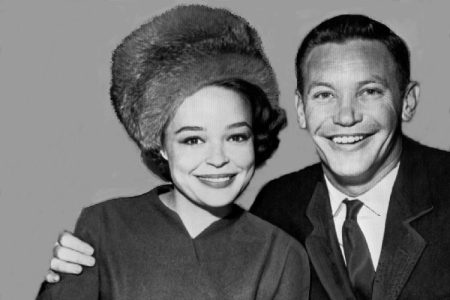
Jill Corey and Don Hoak
In 1961, Jill Corey was on a TV special titled Seasons of Youth along with Paul Anka which was choreographed by director and actor Bob Fosse. Between 1961 and 1963, Jill Corey appeared as a guest on 25 episodes of Sing Along With Mitch with host Mitch Miller.
However, after her December 28, 1961 marriage to Pittsburgh Pirates third baseman Don Hoak, she devoted most of her time to family. In 1963, she appeared on three episodes of The Tonight Show Starring Johnny Carson along with Mitch Miller, bandleader Skitch Henderson, pianist Oscar Peterson, and others. In 1965, she was a guest on both The Merv Griffin Show and The Mike Douglass Show. That year she gave birth to a daughter, Clare.
Corey released one last single in 1968 on the American Music Makers label. In October 1969 her husband, Don Hoak, died of a heart attack. Don had just learned he had not been chosen to be the manager of the Pittsburgh Pirates. He was devastated. Jill Corey recalls, “So he looked out the front door to get a different perspective. He saw my brother-in-law’s car being stolen. Don was impulsive and did whatever he thought was right. He just ran out the door and got in his car.” He suffered a heart attack while chasing the thief and died soon after.
In 1972, she had two appearances on The Bob Braun Show and ABC Late Night in 1975. In an Associated Press article in February 1973 she pointed out the difficulties that she faced in attempting a comeback. “Today I don’t know how to audition, how to get people interested in booking me,” she said. Determined to succeed, she told the reporter, “Somehow, I’m going to find a way to tell people I’m back, and that I want to sing.” The news article detailed how Jill Corey’s nightclub routine included new songs by Elton John, Dory Previn and The Beatles. She also made sure to balance home life and work life. She was always home to cook dinner for her daughter, and then would head off to open her show at 9:30 PM, but wake Clara up when she returned from work after midnight to say “Goodnight. I’m home.”
In the 1970s and 80s, Jill Corey appeared in off-Broadway and regional productions of Promises, Promises, Annie Get Your Gun and Sweet Charity. In 1989, she performed to a sold-out house at Carnegie Hall in Manhattan. In the early 90s, Corey had a one-week engagement at the Cinegrill at the Hollywood Roosevelt Hotel.
A two-CD compilation of her complete singles was released in June 2015 by Jasmin Records. By that time she had retired from performing. Jill Corey died in 2021 at the age of 85 from septic shock while she was at the Shadyside Hospital in Pittsburgh.
December 5, 2025
Ray McGinnis
References:
Gordon Parks, “From Speranza to Corey: Young Singer Feels the Pangs that a New Career Brings,” Life, November 9, 1953.
Jill Corey, “Edward“, Columbia Records, 1954.
Jill Corey, “That’s All I Need“, Columbia Records, 1955.
Jill Corey, “Cry Me A River“, Columbia Records, 1955.
Jill Corey, “Big Daddy“, Columbia Records, 1958.
Jill Corey, “Stick ‘Em Up, Stuck Up“, Columbia Records, 1960.
“Belter Grins Through the Tears: The Tale of Don Hoak and Jill Corey,” NY Press, February 16, 2015.
“Former ‘Hit Parader’ Finds Comeback Not So Grand,” Baytown Sun, Baytown (TX), February 8, 1973.
“A Belter Grins Through the Tears,” New York Times, March 24, 1989.
Joel Samburg, “‘Sometimes I’m Happy’ – The Life of Singer Jill Corey,” Pittsburgh Magazine, September 19, 2018.
Stephi Wild, “Singer Jill Corey Dies at 85: At her peak, she was one of Columbia Records’ top vocalists, releasing more than 60 singles and two albums,” Broadway World, April 17, 2021.
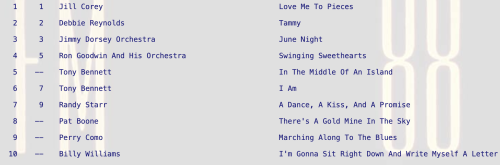
CKOY 1310-AM Ottawa Top Ten | August 3, 1957
This is a great song that I have not heard in years and I will be doing a Moment In Time segment on this within the next two months as I want to tie it in with the opening of the baseball season. I am a big ball fan and I remember her husband Don Hoak who played 3rd base for the Pirates when they won the world series in 1960 in 7 games over the New York Yankees.
I’ll look forward to your Moment In Time piece on “Love Me To Pieces by Jill Corey.