
#39: Rock And Roll Music by the Beatles
City: Hamilton, ON
Radio Station: CKOC
Peak Month: February 1965
Peak Position in Hamilton ~ #1
Peak position in Vancouver ~ did not chart
Peak Position on Billboard Hot 100 ~ did not chart
YouTube: “Rock And Roll Music”
Lyrics: “Rock And Roll Music”
Paul McCartney was born in Liverpool in 1942. He attended the Liverpool Institute High School for Boys and met fellow classmates George Harrison on a school bus. When Paul was 14 his mom died from a blockage in one of her blood vessels. In his early teens McCartney learned to play trumpet, guitar and piano. He was left-handed and restrung the strings to make it work. In 1957, Paul met John Lennon and in October he was invited to join John’s skiffle band, The Quarrymen, which Lennon had founded in 1956. After Paul joined the group his suggested that his friend, George Harrison, join the group. Harrison became one of the Quarrymen in early 1958, though he was still only 14. Other original members of the Quarrymen, Len Garry, Rod Davis, Colin Hanton, Eric Griffiths and Pete Shotton left the band when their set changed from skiffle to rock ‘n roll. John Duff Lowe, a friend of Paul’s from the Liverpool Institute, who had joined the Quarrymen in early 1958 left the band at the end of school. This left Lennon, McCartney and Harrison as remaining trio. On July 15, 1958, John Lennon’s mother died in an automobile accident.
John Winston Lennon was born in Liverpool in 1940. His middle name was after Britain’s current Prime Minister Winston Churchill, during World War II. In 1957, Lennon wrote his first song titled “Hello Little Girl”. It became a Top Ten hit in the UK in 1963 for the Merseybeat band the Fourmost. George Harrison was born in Liverpool in 1943. His father bought him his first guitar in 1956 when Harrison was 13 years old.
Richard Starkey was born in Liverpool in 1940. As a child he was sick with appendicitis, peritonitis and finally tuberculosis. The latter illness had him spend two years in a sanitorium from 1953 to 1955. Out of school for this duration, Starkey remained at home after his return from the sanatorium. He got involved with a skiffle band initially called the Eddie Miles Band which morphed into Eddie Clayton and the Clayton Squares. Starkey next joined Al Caldwell’s Texans which eventually became Rory Storm & The Hurricanes. By the fall of 1959, Starkey changed his professional name to Ringo Starr and his drum solos during their concerts were billed as ‘Starr Time.’ Beginning October 1, 1960, Rory Storm & The Hurricanes began a gig at the Kaiserkeller club in Hamburg, Germany. They alternated sets with The Beatles. On October 18, 1960, with Pete Best on an errand to find drumsticks, Ringo Starr stood in for Best to play a set with McCartney, Lennon and Harrison. This was the first time the Fab Four performed together.
The Quarrymen went through some name changes, including Johnny and the Moondogs. In January 1960, Stuart Sutcliffe joined the band and suggested they name themselves the Beatals as a tribute to Buddy Holly and The Crickets. The name changed to the Silver Beetles in May and in August 1960 they became the Beatles. The name was a cross between the insect cousin of a cricket and a nickname for rock ‘n roll: ‘the beat’. That same month the Beatles hired Pete Best to become the bands drummer. Now a five-piece band, they headed to Hamburg, Germany, on August 17, 1960, for a three-and-a-half month stint. In early 1961 Sutcliffe left the Beatles as they continued to return for more engagements in Germany. On June 22, 1961, Bert Kaempfert produced “My Bonnie”, “Ain’t She Sweet” and eight other songs. Later in 1961, “My Bonnie” climbed to #4 on the Hamburg pop charts and #32 on the German pop charts.
Meanwhile, the Beatles were developing a following back in Liverpool. Between February 9, 1961, and August 3, 1963, the group played at The Cavern Club 292 times. The group got a recording contract with EMI’s Parlophone label in the UK. At the June 6, 1962, studio session, producer George Martin objected to Pete Best remaining with the Beatles due to his poor drumming skills. In August Ringo Starr from Rory & The Hurricanes accepted Paul McCartney and John Lennon’s invitation to became the Beatles new drummer. The first EMI Parlophone single “Love Me Do”/”PS I Love You” climbed to #17 on the UK charts in the fall of 1962. “Please Please Me” climbed to #2 on the UK pop charts in early 1963. And in April 1963 “From Me To You” became the bands first #1 hit on the UK charts staying on top for seven weeks in a row. It became the first Beatles song on the Vancouver pop charts was in June 1963. It charted on C-FUN together with the cover version by Del Shannon. The song stalled at #116 on the Billboard Hot 100, but the Beatles climbed to #14 in Vancouver in July ’63.
In 1963 “She Loves You” topped the UK charts for six weeks and “I Want To Hold Your Hand” wrapped up the year on top for five weeks in the British Isles. Beginning on December 21, 1963, “She Loves You” topped the C-FUN charts in Vancouver for four weeks. It’s first breakout in a Canadian record market. The single sold over 5.4 million copies. “She Loves You” was replaced on the C-FUN survey on January 18 by “Please Mister Postman”. The B-side to “I Want To Hold Your Hand” was “I Saw Her Standing There”. It also became a hit in February 1964. “I Want To Hold Your Hand” eventually sold over 7.1 million copies.
The Beatles appeared three times on The Ed Sullivan Show in February 1964. Beatlemania was the rage and Beatles hits, and even songs about the Beatles got a spin on the radio station. The hits for the Fab Four that year included “Twist And Shout”, “Please Please Me”, “From Me To You”, “All My Loving”, “Can’t Buy Me Love”, “Do You Want To Know A Secret”, “A Hard Day’s Night”, “I Should Have Known Better”, “And I Love Her”/”If I Fell”, and “Slow Down”/”Match Box”. At any week of the year there were numbers of songs by the Beatles either Hit Bound, or soaring up the charts.
Beatlemania continued through the mid-60s, and radio stations were charting some of the overlooked recordings by the group. In Hamilton, in addition to the number-one hit across North America at the start of ’65, “I Feel Fine”, CKOC added the Beatles cover of “Rock And Roll Music”.
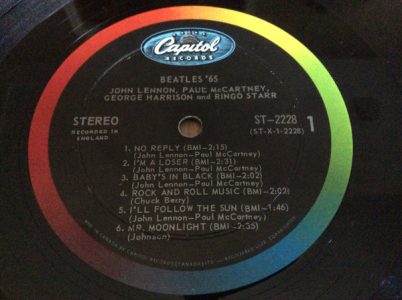
“Rock And Roll Music” was written by Chuck Berry who was born in 1926 in St. Louis, Missouri. He learned to play guitar in high school and performed his first concert at his public school. However, while still a high school student, he was convicted of armed robbery and was sent to a reformatory, where he was held from 1944 to 1947. After his release, Berry settled into married life and worked at an automobile assembly plant. By early 1953, influenced by the guitar riffs and showmanship techniques of the blues musician T-Bone Walker, Berry began performing with the Johnnie Johnson Trio. His break came when he traveled to Chicago in May 1955 and met Muddy Waters, who suggested he contact Leonard Chess, of Chess Records. With Chess, Chuck Berry recorded “Maybellene”—Berry’s adaptation of the country song “Ida Red”—which sold over a million copies, reaching number one on Billboard‘s rhythm and blues chart. It also reached #5 on the Billboard pop chart.
Berry followed up with more R&B hits including “Roll Over Beethoven” in 1956. In 1957, he had more crossover R&B to pop Top Ten hits. These included “School Days”, “Rock and Roll Music”, “Johnny B. Goode”, and “Sweet Little Sixteen”.
By the end of the 1950s, Berry was an established star, with several hit records and film appearances and a lucrative touring career. He had also established his own St. Louis nightclub, Berry’s Club Bandstand. He was sentenced to three years in prison in January 1962 for offenses under the Mann Act—he had transported a 14-year-old girl across state lines for the purpose of having sex. After his release in 1963, Berry had several more successful songs that year and in ’64. These included “No Particular Place to Go”, “Nadine” and “You Never Can Tell”. Chuck Berry had one final hit, “My Ding-A-Ling”, which reached #1 in 1972 on the pop charts in Canada, Ireland, the UK, and USA, and #7 in Norway, and #19 in New Zealand. He continued to perform until 2017 when he died at the age of 90 in March of that year. At the time of his death, Chuck Berry was recording his final and twentieth album, Chuck. It reached the Top Ten on the pop charts in New Zealand, Scotland, and the UK.
“Rock And Roll Music” is an ode to rock and roll. Chuck Berry attests that the backbeat to rock and roll music is a reliable choice “if you want to dance with me.” What are the other options? Berry doesn’t mind modern jazz. However, some arrangements make it sound “just like a symphony.” He recounts, “I took my loved one across the tracks.” At the time, this would have meant across the railroad tracks (or “the wrong side of the tracks”). In many mid-20th-century towns and cities, railroad tracks physically and socially separated neighborhoods by class and race. The side “across the tracks” was typically the poorer or Black side, associated with juke joints, clubs, and the roots of rhythm and blues/rock and roll. In “Rock And Roll Music” across the tracks, Chuck Berry and his loved one go to a joint to hear a “rockin’ band” who with the saxophone player are “blowing like a hurricane.”
At jubilees and jamborees “down South” “country folks” (rural folks) got “All Shook Up” when they started playing that rock and roll music. Chuck Berry purposefully used the phrase “all shook up” in reference to the number-one hit earlier in 1957 by Elvis Presley. Berry declares he prefers rock and roll music to “the mambo, the tango, and the congo.” Tango and mambo are both Latin dances popular at the time, and “congo” in the song means the conga (a Cuban carnival dance that became a big novelty line dance in the US in the 1930s–1950s). People often spelled or pronounced it “congo” in that era. Berry is listing other dance styles and saying he’d rather stick with rock and roll piano instead.
“Rock And Roll Music” peaked at #1 in Hamilton (ON), #2 in Worcester (MA), #3 in Los Angeles, #5 in Medford (OR), and Wilmington (DL). Internationally, “Rock And Roll Music” reached number-one in Norway, #2 in the Netherlands and West Germany, #3 in Belgium, #4 in Austria, and #36 in Italy.
In 1976, the Beach Boys had a Top 5 hit with “Rock And Roll Music” on the Billboard Hot 100. While in 1988, Mental As Anything had a Top 5 hit with the song in Australia.
In 1965 the Beatles had more number-one hits:“Eight Days A Week” (March ’65), “Ticket To Ride” (May), “Help!” (August), and “Yesterday” (October). They ended up with one more number-one hit in December ’65 with “Day Tripper”/”We Can Work It Out”. In early 1966 the Beatles were back in the Top Ten in many radio markets with “Michelle”/”Norwegian Wood”. Their next Top Ten hit was “Nowhere Man”.
In March 1966, John Lennon had an an interview with Evening Standard reporter Maureen Cleave. Lennon commented, “Christianity will go. It will vanish and shrink … We’re more popular than Jesus now—I don’t know which will go first, rock and roll or Christianity. Jesus was all right but his disciples were thick and ordinary.” The comment was yawned at in Britain, but it caused a furore when it was reported in Datebook’s August edition in America. Suddenly there were protests that involved the burning of Beatles records. The Ku Klux Klan staged protests against the Beatles and nailed their albums to a wooden cross. There were also death threats against Lennon. This development was a catalyst for the band’s decision to cease touring. On August 19th two concerts were scheduled in Memphis, Tennessee. Both were cancelled by the city council who wouldn’t let municipal facilities be used by people who were trying to “ridicule anyone’s religion.” Meanwhile, the Fab Four had more hit records including “Paperback Writer”. The B-side to “Paperback Writer” was “Rain“. Later in 1966, the Beatles released “Yellow Submarine”/”Eleanor Rigby”.
In 1967 the band enjoy Top Ten hits with “Penny Lane”/”Strawberry Fields”, “All You Need Is Love” and “Hello, Goodbye”/”I Am The Walrus”. That year the band released Sgt. Pepper’s Lonely Hearts Club Band, which topped the Billboard 200 Album charts for 15 weeks. From the album a number of non-single album charts made a few Top 40 AM radio markets based on listener requests. One of these was “Lovely Rita” which was a hit in Calgary.
In 1968, the Beatles had a hit with “Lady Madonna”, and later with “Hey Jude” – the group’s biggest seller with over 9.5 million physical sales. The following year, the Beatles sold over 5.4 million copies of “Get Back”. Their final big seller was “Let It Be” with over 6 million sales. “Ob-La-Di, Ob-La-Da” was also an international chart-topping hit in 1969 (Australia, Japan, New Zealand, Switzerland, and West Germany) and a Top Ten hit elsewhere. But it wasn’t released in Canada or the USA until 1976, where it became a minor hit. In 1969, “The Ballad of John and Yoko” was a number-one hit in ten nations, and a Top Ten hit in Canada and the USA. It sold 2.5 million copies. In the fall of 1969, “Something”/’Come Together” sold 4.5 million copies.
The Beatles announced their break-up in 1970, and their final single release while they were together, “The Long and Winding Road”, reached number-one. It eventually sold over 2.5 million in physical and digital sales.
Paul McCartney told Howard Stern in 2018 that John Lennon walked into a room one day in 1970 and announced that he was leaving the Beatles.
After the split in 1970 Ringo Starr had a number of Top Ten hits including “Photograph”, “It Don’t Come Easy”, “You’re Sixteen” and the “No No Song”. Since 1970 Ringo has released 19 studio albums and 11 live albums. Beginning with A Hard Day’s Night, Starr has also appeared in 38 films, including several as a voice for animation. He has also authored three books: Postcards From The Boys, featuring reproductions of postcards sent to Starr by Paul McCartney, John Lennon and George Harrison, along with his commentary; Octopus’ Garden which is a children’s book based on the song from the album Abbey Road; And Photograph, a collection of 240 photographs of Starr’s that expresses a visual autobiography together with photo captions.
Paul McCartney had the most successful solo career of the four. His that included “Uncle Albert/Admiral Halsey”, “My Love”, “Band On The Run,” “Live And Let Die”, “With A Little Luck”, “Coming Up” and “Silly Love Songs”. He has topped the charts in duets with Stevie Wonder and with Michael Jackson. His most recent international Top Ten hit was with Kanye West and Rihanna in 2015 titled “FourFiveSeconds”. Between 1971 and 2015 McCartney has had forty-eight of his single releases reach the Top Ten in one or more countries internationally. Over the years Paul McCartney had produced records for other recording artists. This includes “A World Without Love” for Peter and Gordon, “You’ve Got To Hide Your Love Away” for Silkie, “Mellow Yellow” for Donovan, “Those Were The Days” for Mary Hopkin, James Taylor’s self-titled debut album James Taylor, Ringo Starr’s self-titled 1973 album Ringo and George Harrison’s 1981 album Somewhere In England.
George Harrison had hits with “My Sweet Lord” and “Give Me Love”. After “My Sweet Lord” appeared on the pop charts in 1970 Bright Tunes sued him for copyright infringement of the song “He’s So Fine” by the Chiffons. Harrison told Rolling Stone in 1979 “The guy who actually wrote ‘He’s So Fine’ had died years before, Ronnie Mack. Bright Tunes Music, his publisher, was suing me. So we went through the court case, and in the end the judge said, yes, it is similar, but you’re not guilty of stealing the tune. We do think there’s been a copyright infringement, though, so get your lawyers together and work out some sort of compensation. But Bright Tunes wouldn’t settle for that; they kept trying to bring the case back into court. They even tried to bring it back into court when I did “This Song.” Harrison released “This Song” as a single describing his frustrations with the plagiarism lawsuit. In 1979 Harrison helped finance with Monty Python film Life of Brian.
John Lennon recorded a number of hits in the early ’70’s, which included “Instant Karma”, “Power To The People”, “#9 Dream”, “Whatever Gets You Through The Night” and “Imagine”. “Imagine” went on to become an inspirational anthem for decades of pop music aficionados. In 1975 Lennon retreated from the music world to raise his new son, Sean.
In 1980 he returned to the recording studio to release his album Double Fantasy. Hopes for a Beatles reunion were dashed when John Lennon was murdered by Mark David Chapman on December 8, 1980, outside his New York City Dakota apartment near Central Park West and 72nd Street. Two and a half weeks later his single “(Just Like) Starting Over” climbed to #1 on December 26, 1980; And “Woman” peaked at #2 on the Billboard Hot 100 in late March 1981. Both songs peaked at number-one in Vancouver. A third single from Double Fantasy, “Watching The Wheels”, peaked at #3 in Vancouver and #10 on the Billboard Hot 100. And in 1984 “Nobody Told Me” climbed to #3 in Vancouver and #5 on the Billboard Hot 100. Meanwhile, “Imagine”, which had climbed to #1 in the UK in 1971, re-charted in the UK to #6 in 1975 and #3 in 1999.
George Harrison died of lung cancer in 2001. Starr and McCartney have continued to tour.
November 28, 2026
Ray McGinnis
References:
David Fricke, “Paul McCartney Looks Back: The Rolling Stone Interview,” Rolling Stone, August 10, 2016.
Ben Quinn, “Paul McCartney ‘saw God’ After Taking Drugs During Beatles Heyday,” Guardian, September 2, 2018.
Stephen Rodrick, “Being Ringo: A Beatle’s All-Starr Life,” Rolling Stone, April 15, 2015.
“Interview: John Lennon and Ringo Starr in Los Angeles,” Los Angeles Times, August 23, 1964.
Mick Brown, “A Conversation With George Harrison: The ‘Fab Four’ is Done For, and George Couldn’t be Happier Doing his Own Thing,” Rolling Stone, April 19, 1979.
Dave Laing and Penny Valentine, “George Harrison: The Most Handsome but Underrated Beatle, he Came into his Own as a Solo Artist and Film Producer,” Guardian, December 1, 2001.
“John Lennon Died 35 Years Ago Today: Read Original Associated Press Story,” Billboard, December 8, 2015.
Johnathan Cott, “John Lennon: The Last Interview: Three days before he died, John Lennon talked with ‘Rolling Stone’ for nine hours. For the first time, we present this extraordinary interview,” Rolling Stone, December 23, 2010.
“Chuck Berry, Father of Rock ‘n’ Roll, Dies at 90,” NBC, March 18, 2017.
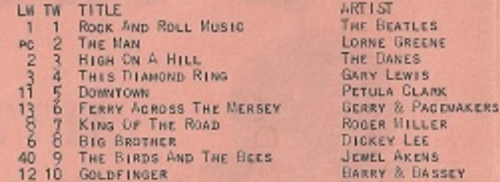
CKOC 1150-AM Hamilton (ON) Top Ten | February 19, 1965
Leave a Reply