
#1: Scarborough Fair by Sergio Mendes & Brasil ’66
City: Swift Current, SK
Radio Station: CKSW
Peak Month: January 1969
Peak Position in Swift Current ~ #1
Peak Position in Vancouver ~ #17
Peak Position on Billboard Hot 100 ~ #16
YouTube: “Scarborough Fair”
Lyrics: “Scarborough Fair”
Sérgio Santos Mendes was born in 1941 in Niterói, a suburb of Rio de Janeiro. He attended the local conservatory intending to become a classical pianist. However, his interest in jazz grew, and he started playing in nightclubs in the late 1950s. This was while bossa nova, a jazz-inflected derivative of samba, was emerging. Mendes played with his mentor, Antônio Carlos Jobim, and with many U.S. jazz musicians who toured Brazil. In 1961, Mendes formed the Sexteto Bossa Rio and recorded the album Dance Modern. In the early Sixties, Mendes toured Europe and the United States. He recorded albums with Cannonball Adderley and Herbie Hancock. Mendes also played at the Carnegie Hall. Mendes moved to the U.S. in 1964 and cut two albums under the group name Sergio Mendes & Brasil ’65. The first, Brasil ’65, is a Portuguese-language album. The second release, The Great Arrival, is an instrumental album. A cover of the Mamas’ and The Papas’ “Monday Monday” later became a minor hit single in 1967. In 1966, it was suggested to Mendes that he add two women who could sing both in English and in Portuguese. The revised lineup was dubbed Brasil ’66.
An album was released in 1966 titled Herb Alpert Presents Sergio Mendes & Brasil ’66. The album climbed to #2 on the Billboard Top Jazz Album chart, but also to #7 on the Billboard (Pop) 200 Album chart. Among the tracks from the album was “Mas Que Nada” (“Just Nothing” in English). In 1966, the song climbed to #47 on the Billboard Hot 100. In 2009, Rolling Stone voted “Mas Que Nada” as the fifth greatest Brazilian song. In 2013, it was inducted into the Latin Grammy Hall of Fame. On the album, they also covered the Beatles’ “Day Tripper” and the Little Anthony and the Imperials’ song “Going Out Of My Head”.
In 1967, Sergio Mendes and Brasil ’66 released the album Equinox. It climbed to #3 on the Top Jazz Album chart, and #24 on the 200 Album chart. From the album came single releases “Constant Rain (Chove Chuba)” and the Cole Porter song “Night And Day”. Both were minor hits in 1967. A third studio album for Sergio Mendes and Brasil ’66 was released in July ’67. Look Around peaked at #2 on the Top Jazz Album chart and #5 on the 200 (Pop) Album chart in the U.S.A. From that album came the single release “The Look Of Love”. The Burt Bacharach and Hal David composition climbed to #4 on the Billboard Hot 100 with Sergio Mendes crafting of the song. A second track, “With A Little Help From My Friends”, was a successful Beatles’ cover on the Adult Contemporary charts.
In 1968, Sergio Mendes and Brasil ’66 released their fourth studio album, The Fool On The Hill. The album climbed to the top of the Top Jazz Album chart, and #3 on the Billboard 200 Album chart. The title track cover of the Beatles’ “The Fool On The Hill”, climbed to #6 on the Billboard Hot 100 in 1968, and topped the Billboard Adult Contemporary chart. A followup release, “Scarborough Fair”, successfully covered Simon & Garfunkel’s tune. The duo had woven an anti-war song titled “Canticle” as a counterpoint to “Scarborough Fair”. However, the recording by Sergio Mendes & Brasil ’66 focused solely on the lyrics to “Scarborough Fair”.

The lyrics of “Scarborough Fair” appear to have something in common with a Scottish ballad titled “The Elfin Knight”, collected by Francis James Child as “Child Ballad #2”, which has been traced as far back as 1670. In this ballad, an elf threatens to abduct a young woman to be his lover unless she can perform an impossible task (“For thou must shape a sark to me / Without any cut or heme, quoth he”); she responds with a list of tasks that he must first perform (“I have an aiker of good ley-land / Which lyeth low by yon sea-strand”).
Dozens of versions existed by the end of the 18th century. A number of older versions refer to locations other than Scarborough Fair, including Wittingham Fair, Cape Ann, “twixt Berwik and Lyne”, etc. Many versions do not mention a place name and are often generically titled (“The Lovers’ Tasks”, “My Father Gave Me an Acre of Land”, etc.).
The lyrics published by Frank Kidson in 1891 represent the most widely recognized version of the song. However, subsequent performers have frequently selected and rearranged verses. Martin Carthy, for example, replaced the final verse with a repetition of the opening stanza, while Simon and Garfunkel recorded a sequence consisting of verses 1, 2, 5, and 7, concluding with a reprise of the first verse. These original verses have a repeating line of “savoury, sage, rosemary and thyme.” By the early 20th-Century, parsley replaced savory in the line. So popular was the replacement of parsley in the lyric that by 1939 John Lomax’s recording of the song was titled “Parsley, Sage, Rosemary and Thyme.”
1891 verses for “Scarborough Fair”:
The male:
O, where are you going? To Scarborough Fair?
Savoury, sage, rosemary and thyme,
Remember me to a lass that lives there,
For she was once a true love of mine.
And tell her to make me a cambric shirt,
Savoury, sage, rosemary and thyme,
Without any seam or needlework,
And then she shall be a true love of mine.
And tell her to wash it in yonder dry well,
Savoury, sage, rosemary and thyme,
Where no water sprung nor a drop of rain fell,
And then she shall be a true love of mine.
And tell her to dry it on yonder thorn,
Savoury, sage, rosemary and thyme,
Which never bore blossom since Adam was born,
And then she shall be a true love of mine.
The female:
O, will you find me an acre of land,
Savoury, sage, rosemary and thyme,
Between the sea foam and the sea sand,
Or never you’ll be a true love of mine.
O, will you plough it with a ram’s horn,
Savoury, sage, rosemary and thyme,
And sow it all over with one peppercorn,
Or else you’ll be a true love of mine.
Or will you reap it with a sickle of leather,
Savoury, sage, rosemary and thyme,
And tie it all up with a peacock’s feather,
Or never you’ll be a true love of mine.
And when you have done and have finished your work,
Savoury, sage, rosemary and thyme,
You can come to me for your cambric shirt,
And then you shall be a true love of mine.
***
Many herbs had symbolic meaning dating back to medieval times. Savory was less symbolic, though it was viewed as an aphrodisiac for love and desire. The following paragraph details how the mention of “parsley, sage, rosemary and thyme” was not just a pretty line of poetry, but infused with symbolic meaning for those familiar with medieval English culture.
In medieval times, parsley was associated with morality and death. People carried sprigs of parsley, scattered it at doors and windows, or used it in barns to ward off demons, witches, malign magic, or protect livestock. It appeared in bridal wreaths and curse-breaking teas. In medieval times sage was strongly tied to wisdom, echoing the word “sage” for a wise person – “sage advice.” It was believed to promote mental clarity, memory, and long life. Medieval traditions included eating sage daily in May for eternal life or using it to strengthen the mind and body. While rosemary symbolized memory and loyalty. Rosemary featured in wedding customs—brides and grooms wore sprigs (sometimes gilded), and it appeared in bouquets as a reminder of vows. It was also used in funerals and mourning to honor the dead and ensure they were not forgotten. Shakespeare later echoed this in Hamlet (“There’s rosemary, that’s for remembrance”). Newlyweds would plant a rosemary bush for a blessed marriage, and it served as a love charm. While sprigs of thyme were given by noble ladies to knights sprigs of thyme, or embroidered it onto scarves, cloaks, or tokens before battles or tournaments. It was believed to impart bravery, vitality, and success in combat. This made thyme an emblem of chivalry and strength. Thyme was thought to ward off evil, nightmares, witchcraft, and plagues. People placed it under pillows for restful sleep, hung it around doors/windows, or used it as incense. Wild thyme was associated with fairies—especially on Midsummer’s Eve—and was said to attract them or grant the ability to see them.
The first recorded version using the best-known melody was performed by Audrey Coppard on the 1956 album English Folk Songs. A decade after collecting the song, Ewan MacColl released his own version, accompanied by Peggy Seeger on guitar, on the 1957 LP Matching Songs of the British Isles and America. Milt Okun and Ellen Stekert recorded the song as “The Cambric Shirt” on their 1957 albumTraditional American Love Songs. In 1965, Martin Carthy sang “Scarborough Fair” on his self-titled album. And Marianne Faithfull recorded the song on her December 1965 album Go Away from My World.
Sergio Mendes and Brasil ’66 sang the lyrics to the version of “Scarborough Fair” credited to Paul Simon and Art Garfunkel. Read about Simon and Garfunkel in my previous post about their song “Fakin’ It“.
The Sergio Mendes and Brasil ’66 1969 cover of the song appeared in the 1973 animated adult film Heavy Traffic.

Scarborough Fair is a six-week trading festival that took place in the North Yorkshire seaside town of Scarborough. It began each year on Assumption Day, August 15th, and ended on Michaelmas Day, September 29th. The original Scarborough Fair was permitted in the royal charter of 1253. The fair continued on a yearly basis for over 500 years between the 13th and 18th centuries. The final Scarborough Fair was held in 1787. It ended due to competition from other fairs, especially the Seamer Fair, and longterm economic pressures including taxation. Yet, for five centuries the Scarborough Fair brought traders from England, Scotland, Wales, Ireland, Denmark, Norway, the Baltic and beyond. The ballad, “Scarborough Fair” commemorated the fair long after it had ended. However, the fair was iconic and spoke to people across the British Isles.
“Scarborough Fair” peaked at #1 in Swift Current (SK), and St. Louis, #2 in Santa Rosa (CA), #3 in Hamilton (ON), New Haven (CT), San Diego, and Denver, #4 in Boston, Minneapolis/St. Paul, Vancouver (WA), and Dayton (OH), #5 in San Francisco, Rochester (NY), Columbus (OH), Indianapolis (IN), and Springfield (OH), #6 in Birmingham (AL), Augusta (GA), Orlando, Memphis, and Fresno (CA), #7 in San Bernardino (CA), Latrobe (PA), Schenectady (NY), and Tucson (AZ), #8 in Winnipeg (MB), #9 in Toronto, Buffalo, New York City, Cincinnati (OH), Lansing (MI), Kansas City (MO), and Sarnia (ON), and #10 in St. Thomas (ON), Holland (MI), and Davenport (IA).
The Sergio Mendes and Brasil ’66 cover of “Scarborough Fair” climbed to #8 in Australia, and #16 on the Billboard Hot 100. Simon & Garfunkel’s earlier recording of “Scarborough Fair” from their Parsley, Sage, Rosemary and Thyme album reached #5 in Canada, and #11 in the USA. The vocal duo’s treatment of the song was featured in the 1968 film The Graduate.
In addition, Sergio Mendes separately released an instrumental album titled Sérgio Mendes’ Favorite Things.
A fifth studio album by Sergio Mendes and Brasil ’66 was released in 1969 titled Crystal Illusions. The album included a cover of the Otis Redding song “(Sittin’ On) the Dock Of The Bay” and “You Stepped Out Of A Dream” from the 1941 film The Ziegfeld Girl. Along with ‘Dock of The Bay,’ a second single released from the album was “Pretty World”.
In 1970, the band released Ye-Me-Le. It featured covers of the Beatles’ “Norwegian Wood”, the Glen Campbell hit “Wichita Lineman”, and the Three Dog Night hit from the musical Hair, “Easy To Be Hard”. In 1983, Sergio Mendes had a #4 hit on the Billboard Hot 100 with “Never Gonna Let You Go”. Vocals were by Joe Pizzulo and Leeza Miller.
In 1993, Sergio Mendes won a Grammy Award for Best World Music Album for Brasileiro. In 2005 Sergio Mendes received a Lifetime Achievement award at the Latin Grammy Awards. In 2012, Mendes received a Grammy nomination for Best Contemporary World Album for Bom tempo. In 2012, Sergio Mendes was nominated for an Oscar at the Academy Awards for Best Original Song in 2012 as co-writer of the song “Real in Rio” from the animated film Rio. And in 2015, Mendes received another Grammy Award nomination for Best World Music Album for Magic. In 2020, Sergio Mendes released his 44th studio album titled In the Key of Joy. Over the decades, Sergio Mendes has charted 13 singles into the Top 20 of Adult Contemporary charts in the USA.
September 4, 2026
Ray McGinnis
References:
Leila Fadel and Peter Breslow, “After 60 Years, Sergio Mendes Is Still Writing Songs ‘In The Key Of Joy’,” NPR, March 1, 2020.
Elisa Wouk Almino, “If you take all the world’s emotions and put them into one sound, it’s Sérgio Mendes,” Los Angeles Times, August 13, 2021.
Paul Guggenheimer, “Trib talks with Brazilian music pioneer Sergio Mendes about new PBS documentary,” Trib Live, June 15, 2021.
John Moore Museum, “A Sprig of Rosemary,” December 15, 2021.
Icy Sedgwick, “Sage Folklore: Boost Your Love and Remembrance Spells,” July 9, 2022.
Siobhan Ball, “Banish demons and slay your enemies… with parsley,” August 18, 2024.
“Thyme,” wikipedia.org.
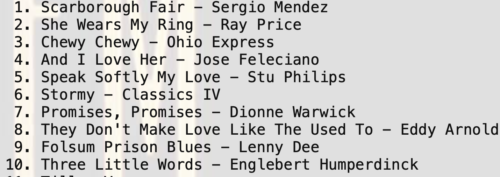
CKSW 1400-AM Shift Current (SK) | January 18, 1969
Leave a Reply